Contents
Get a Personalized Demo
See how Torq harnesses AI in your SOC to investigate, prioritize, and respond to threats faster.

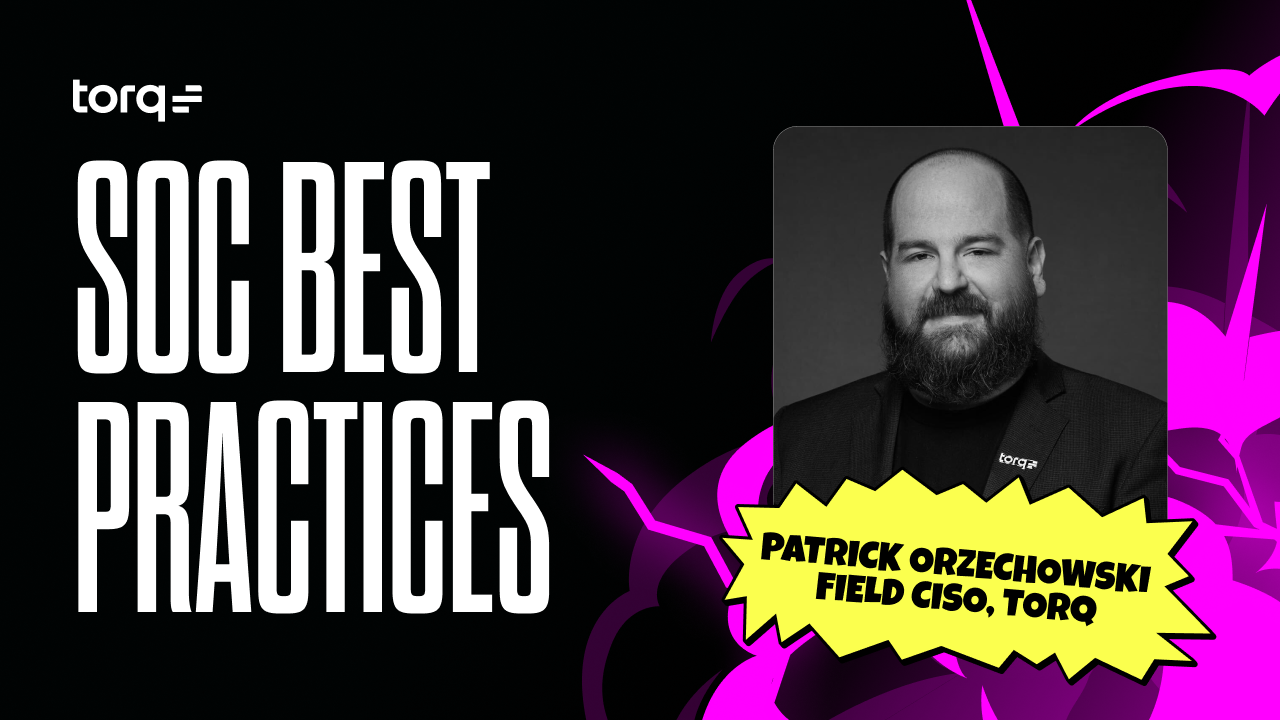
Patrick Orzechowski (also known as “PO”) is Torq’s former Field CISO, bringing his years of experience and expertise as a SOC leader to our customers. PO is a seasoned security veteran with a deep understanding of the modern security landscape. You can find him talking to SOC leaders and CISOs from major brands at cybersecurity events around the world.
Every SOC has an escalation process — but not every SOC has one that is truly effective.
Most still run on an outdated, human-only escalation matrix built for simpler times. A world where analysts could manually sift through a few hundred alerts a day and escalate what “felt” risky.
Now, we’re dealing with tens of thousands of alerts daily, hybrid environments, and adversaries who use AI to move faster than humanly possible. The escalation matrix, once designed to bring order, now struggles under the weight of automation gaps, alert overload, and static processes.
With Torq HyperSOC™, threat escalation moves beyond manual handoffs and playbooks. Teams gain dynamic, automated escalation workflows that adapt in real time, reduce response times, and ensure the right people act the moment an incident occurs.
What Is an Escalation Matrix and Why It Matters
An escalation matrix is a structured framework that defines how incidents, alerts, or service disruptions are escalated to higher authority levels when they aren’t resolved within specific timeframes or exceed impact thresholds.
In traditional SOCs, escalation follows a severity-based model: Critical, High, Medium, Low, and Informational. But modern SOCs are replacing this with context-driven escalation, where business risk, asset criticality, and data sensitivity guide prioritization.
An automated threat escalation matrix enables:
- Faster and more accurate incident routing
- Clear accountability across escalation levels
- Consistent communication and response times across teams outside the SOC
- Reduced noise, false positives, and human fatigue
For security teams, the automated threat escalation matrix dynamically adjusts based on contextual signals — asset importance, user behavior, and ongoing attack patterns.
Manual SOC Threat Escalation: The Old Model
Here’s how escalation still looks in many SOCs:
- Tier-1 analysts triage thousands of alerts by hand.
- Anything that looks “real” gets escalated to Tier 2 for deeper analysis.
- Confirmed incidents go to Tier 3 or the incident response team.
Sounds structured, right? In reality, it’s chaos disguised as process. Alerts bounce from person to person, critical signals get buried under false positives, and by the time something reaches Tier 3, the attacker’s already moved on.
I’ve seen SOCs where 70% of an analyst’s day is spent reclassifying alerts that should’ve been auto-dismissed. It’s not an efficiency problem — it’s a design problem. A lot of vendors do not allow for fundamental reclassification of alert severities.
AI-Powered Threat Escalation for SOCs
Torq HyperSOC brings the Autonomous Threat Escalation Matrix to life — an AI-powered framework that redefines how alerts flow, how context is applied, and how response happens. Instead of human triage being the first filter, AI takes that role — automatically scoring, enriching, and routing alerts based on real business impact.
How it works:
- AI filters out 99% of alert noise and enriches the remaining 1% with full context and risk scores.
- Analysts only see cases — not alerts — prioritized by business impact.
- Human analysts validate AI-generated insights and approve or refine the automated responses (e.g., isolate a host, revoke credentials).
A few examples:
- A malware alert on a retired test server is logged and archived automatically.
- A suspicious login to the CFO’s laptop from two countries apart is escalated immediately with risk context attached.
- A confirmed beacon from a domain controller is triggered with AI for containment before humans even wake up.
How the Autonomous Threat Escalation Matrix Works
Think of the Autonomous Threat Escalation Matrix as an intelligent, risk-based hierarchy — not built on severity labels, but on context. Each alert is scored dynamically using signals like:
- Asset criticality: Is this production or a test?
- User behavior: Does this deviate from baseline patterns?
- Threat intelligence: Is this IOC part of an active campaign?
- Historical context: Has this alert been a false positive before?
The result is a living, automated escalation matrix that determines: what gets handled automatically, what needs a quick human validation, and what demands immediate escalation.
The Autonomous Threat Escalation Matrix operates on a dynamic, context-driven hierarchy that replaces rigid severity scoring with real business risk. Instead of static labels like Critical or Low, each alert is automatically analyzed and scored based on asset importance, user behavior, threat intelligence, and historical reliability. Routine telemetry and low-impact alerts are logged and enriched for trend analysis without human intervention.
Moderate-risk activity — such as suspicious logins or unusual SaaS behavior — triggers automated containment and creates a case for analyst validation. High- and critical-risk incidents, like privileged account compromise or ransomware in production, prompt immediate containment actions and human escalation to senior SOC leadership. This flexible design allows organizations to calibrate AI autonomy to their risk tolerance — fully automated, human-in-the-loop, or hybrid.
This model gives organizations flexibility — tune AI autonomy up or down depending on your risk appetite. Some CISOs want near-total automation; others prefer AI assistance with human checkpoints. Torq HyperSOC™ supports both.
From Framework to Action
In the old SOC model, escalation was linear — an alert passed from Tier 1 to Tier 2 to Tier 3, bleeding time and risking loss of context at every handoff. In the new world, escalation is dynamic — AI does 80% of the heavy lifting, humans focus on the 20% that actually matters.
Here’s what that looks like in a phishing or malicious payload workflow:
Scenario: A user reports a suspicious email with an attachment.
Automated Workflow:
- The email is flagged via user report or spam detection.
- A phishing classifier analyzes the message structure, links, and language patterns.
- Torq runs a user impact analysis, checking who received and clicked the email.
- If the message is determined risky, the system performs auto-quarantine across all affected mailboxes.
- If a VIP or finance team user is impacted, the case is escalated automatically to the incident response team for immediate validation.
Behind the scenes, AI agents handle the enrichment and scoring, while human analysts step in only when risk or ambiguity demands it.
The impact is tangible:
- Faster MTTR: Response times shrink from hours to minutes.
- Lower burnout: Analysts deal only with validated, risk-ranked cases.
- Smarter prioritization: AI understands which systems and identities matter most.
- Governance built in: Human-in-the-loop checkpoints maintain control and compliance.
It’s not about replacing analysts. It’s about giving them time to think, hunt, and innovate — not just click “escalate.”
Why Risk Beats Severity Every Time
Severity-based models like CVSS are still essential, but they tell only part of the story. Two alerts might share a Critical score — yet a compromised test VM and a compromised production database have vastly different business impacts.
AI-powered escalation models fix that by injecting real-world context into every decision. They understand that Critical doesn’t always mean “important” — and that Medium sometimes means “urgent.”
That shift — from static severity to dynamic risk — is what separates modern SOCs from legacy ones.
It’s time to rethink SOC triage. See how the Autonomous Threat Escalation Matrix works.
FAQs
A threat escalation matrix is a structured, hierarchical framework that defines how security threats progress through different response levels based on their severity, impact, and urgency. It outlines clear roles, responsibilities, communication channels, and response timelines to handle every threat with the right priority and accountability.
In practice, a Level 1 threat might be handled by a SOC analyst for initial triage and validation. If the incident shows indicators of compromise or potential data exposure, it escalates to Level 2, where specialized security engineers or threat hunters perform deeper analysis. Level 3 may involve executive or crisis-level coordination when the threat poses a critical risk to operations or compliance.
With Torq Hyperautomation™, organizations can automate their threat escalation matrix, linking detection, triage, and response workflows across platforms like SIEMs, PagerDuty, Slack, and Jira. This ensures that threat alerts escalate automatically, eliminating manual bottlenecks and guaranteeing that the right team addresses every security incident at the right time, with complete visibility and auditability.
Torq’s threat escalation matrix includes four levels of escalation, each representing a different response tier. Level 1 handles initial detection and triage by analysts, Level 2 escalates to security engineers for deeper investigation, Level 3 involves management or cross-functional coordination, and Level 4 activates executive or crisis response. Automating these escalation levels through Torq ensures that incidents move seamlessly through the hierarchy with full traceability and faster resolution.
An escalation matrix is critical in security operations because it prevents delays, confusion, and missed alerts during high-pressure incidents. It defines exactly who acts, when, and how communication flows during an active security threat or incident escalation. By automating the matrix through Torq’s Hyperautomation platform, SOC teams can enforce consistent, real-time escalation workflows that reduce mean time to respond (MTTR) and strengthen their overall security posture.
In a threat escalation matrix, functional escalation occurs when a threat is passed to someone with the required technical expertise — for example, escalating a network anomaly to a forensics specialist. On the other hand, hierarchical escalation moves the incident up the management chain when additional authority or resources are required. Torq Hyperautomation™ supports both models by automatically routing incidents to specialists or leadership based on the escalation criteria defined in your workflow.
Automation enhances the threat escalation by removing manual handoffs and ensuring rapid, reliable response coordination. Using Torq, organizations can automatically trigger escalations when predefined conditions are met, such as time thresholds, severity scores, or detection from integrated tools like PagerDuty or CrowdStrike. This ensures the threat escalation matrix remains consistent, measurable, and scalable — even in complex enterprise environments — while giving SOCs complete visibility into every step of the response chain.