Contents
Get a Personalized Demo
See how Torq harnesses AI in your SOC to investigate, prioritize, and respond to threats faster.
Last Updated December 2025
Security Orchestration, Automation, and Response (SOAR) was once hailed as the answer to a more efficient and automated Security Operations Center (SOC). The idea was compelling: automate repetitive tasks, reduce manual workloads, and speed up response times.
But fast-forward to today, and despite generations of SOAR evolution, SOCs are still battling familiar challenges. Here’s why SOAR is dead — and why AI SOAR alternatives like AI SOC platforms with Hyperautomation have replaced it.
What is SOAR?
SOAR first emerged in the mid-2010s, promising to automate SOC tasks and improve operational efficiency. It aimed to accelerate incident response, reduce manual workloads, and unify siloed tools.
While SOAR platforms were able to automate simple tasks like phishing response and threat intel propagation, they ultimately fell short in addressing the core challenges of modern SecOps: threat detection, investigation, and response (TDIR).
SOAR platforms were designed to orchestrate tools, automate workflows, and respond to alerts more efficiently. Theoretically, they should unify disparate technologies into a cohesive system where incidents can be enriched, triaged, and remediated through pre-built playbooks. So what went wrong?
Why SOAR Failed to Automate the SOC
To understand why SOAR hasn’t met expectations, examining the nature of SOC work is important. Security operations involve a combination of two types of tasks:
- Thinking tasks: Interpreting alerts, determining scope and impact, and creating response plans.
- Doing tasks: Activity-based tasks like taking response actions, updating systems, and notifying stakeholders.
SOAR platforms were pretty good at automating “doing” tasks, but they struggle with the more complex, judgment-driven “thinking” tasks. Here’s why:
- Too complex: Thinking tasks require deep understanding, data synthesis, security expertise, and decision-making. Replicating these traits with static playbooks is nearly impossible.
- Unpredictable: Security operations deal with highly variable inputs, which leads to an ever-expanding set of edge cases that are difficult to account for in playbooks.
- Not customizable: Out-of-the-box playbooks rarely meet an organization’s specific needs, leading to expensive custom coding and high maintenance burdens.
Over 80% of organizations agree SOAR is too complex, costly, and time-consuming — and nearly 90% admit that building even basic automation requires a huge upfront investment in time and resources.
Even GenAI advancements aren’t enough. SOCs need security automation that can adapt and understand the complexities of threat detection and investigation. Automating the “thinking” tasks is the key to achieving true SOC automation.
Instead of solving problems, legacy SOAR platforms created new ones: rigid architectures, limited integrations, disconnected defenses, and overwhelmed analysts drowning in alert noise. Built on monolithic, non-cloud-native infrastructure, SOAR can’t scale, can’t adapt, and definitely can’t keep up with modern threat landscapes.
SOAR isn’t just outdated — it’s holding security teams back. See why SOAR is dead.
Introducing Hyperautomation: The Only AI SOAR Alternative
As organizations reach their breaking point with traditional SOAR’s shortcomings, they’re turning to the only effective AI SOAR alternative, the Torq AI SOC Platform with Hyperautomation. Unlike point solutions that rely on agentic reasoning alone, Torq’s platform is built on a hybrid architecture that combines the flexibility of agentic AI with the machine-speed, deterministic workflow execution of its proprietary Hyperautomation engine. This means routine, high-volume tasks like deduplication, normalization, and escalation routing execute with consistent, auditable precision, while complex, novel threats get the adaptive, human-level reasoning they demand. It’s a combination that pure-inference competitors simply can’t replicate, and one that Gartner named as the defining reason Torq is the Company to Beat in AI SOC Agents for Threat Investigation.
Unlike traditional automation or AI SOAR point solutions, agentic AI-driven Hyperautomation doesn’t just execute tasks — it thinks, learns, and scales. It mimics the analytical reasoning of human analysts, turning high-effort “thinking” functions into fully autonomous, intelligent workflows. From real-time triage to dynamic response, Hyperautomation redefines what’s possible in the modern SOC.
Hyperautomation + AI Agents = A Happy SOC
At the heart of a Hyperautomated SOC are AI agents. While Hyperautomation connects and automates the entire security stack, agentic AI brings the cognitive power — making independent decisions, adapting, and continuously learning from every signal.
This combination transforms traditional automation into something far more powerful: a fully autonomous SOC workflow that mimics human judgment at machine speed. The outcome isn’t replacing human analysts — it’s making their lives in the SOC less stressful and more engaging.
Benefits of AI agents in the SOC include:
- Finding more real threats: Agentic AI can process and correlate every alert at machine speed, allowing SOCs to uncover real threats that might otherwise go unnoticed.
- Reducing MTTR: By eliminating manual bottlenecks in triage and investigation, agentic AI can drastically reduce response times, helping SOC teams resolve incidents in minutes instead of days.
- Boosting analyst productivity: Automating repetitive tasks frees up analysts to focus on higher-value work, such as investigating complex incidents or working on strategic initiatives.
- Increased efficiency: With agentic AI handling the mundane tasks, analysts can shift their focus to more meaningful work, improving job satisfaction and reducing burnout.
Leading Analysts Agree: SOAR is Dead
Leading industry analysts, including Gartner, GigaOm, and IDC agree that legacy SOAR platforms are obsolete. Modern cybersecurity demands flexibility, speed, and intelligence that only Hyperautomation can provide.
In their recent report, IDC confirms what security teams already know: Legacy SOAR promised efficiency but delivered complexity. IDC specifically highlights AI SOAR replacement, Torq Hyperautomation™, as a game-changing platform that goes beyond automation and enters the realm of true autonomous operations — powered by agentic AI, built-in case management, and real-time orchestration across the entire security stack.
“Hyperautomation is the answer to existing SOAR platforms. Torq’s Hyperautomation capabilities can help improve the efficacy of security teams now and in the future. The agentic AI architecture is disruptive.”
– Chris Kissel, Vice President, Security & Trust Products, IDC Research
Real-World Impact: AI SOAR Replacement in Action
Valvoline: Saving 7 Analyst Hours Daily After Legacy SOAR Failed
When Corey Kaemming became Senior Director of InfoSec at Valvoline, his team had just been cut from 24 to 12 analysts during a major divestiture. Their legacy SOAR was a bottleneck — deeply customized, code-heavy, and impossible to maintain. Only a handful of SMEs could build new use cases, and when the SOAR broke, it broke everything. Analysts spent up to 12 hours daily reviewing and triaging phishing emails alone.
Valvoline deployed Torq Hyperautomation and saw operational value within 48 hours. A Rapid7 integration their legacy SOAR couldn’t complete after hundreds of hours was running in under a week. Torq now automatically monitors email activity, correlates data across Microsoft 365, Defender, and CrowdStrike, and escalates only when necessary.
The Results:
- 6–7 analyst hours saved per day on phishing workflows alone
- Automated containment: Malicious link clicks trigger instant password resets, session terminations, and coordinated response
- Operational ROI from day two with continued expansion across teams
- Non-developers building workflows thanks to drag-and-drop logic and in-platform testing
Bloomreach: Scaling Automation Enterprise-Wide After Traditional SOAR Stalled
Bloomreach‘s 24×7 global SOC relied on traditional SOAR, but the platform demanded developer-level expertise for every workflow. Automation was siloed in the hands of just a couple of specialists. Adoption lagged, workflows bottlenecked, and the SOC couldn’t scale its automation culture beyond a few power users. Junior analysts were locked out of the automation process entirely.
Torq AI SOC Platform democratized workflow building across the entire team. Torq Socrates, the AI SOC orchestrator, added intelligence to every step, from triage and enrichment to suggested actions. The platform’s flexibility allowed Bloomreach to extend automation beyond the SOC into Help Desk and Business Intelligence teams.
The Results:
- 5+ analyst hours saved per week from just two workflows — with dozens more in production
- Analysts at every level now build and maintain workflows independently
- Enterprise-wide adoption: Help Desk automates account management; BI automates Salesforce renewal workflows
- Faster learning curve: Team members productive without completing formal training
Why The Torq AI SOC Platform is the Definitive SOAR Replacement
Legacy SOAR platforms promised security automation. The Torq AI SOC Platform delivers it at a scale, speed, and intelligence legacy systems simply can’t match.
Torq’s AI SOC is the industry’s first fully autonomous SOC platform, powered by a Multi-Agent System (MAS) that triages, investigates, and remediates threats. It doesn’t just respond to alerts — it thinks, acts, and learns like a human analyst, but faster and 24/7.
Our cloud-native, AI-powered SOC platform delivers:
- Limitless integrations: Torq connects with virtually any tool in your security ecosystem — EDR, SIEM, IAM, cloud, SaaS, or legacy — with no-code simplicity. You can integrate and automate stack-spanning workflows in minutes, not months.
- Real-time threat response: Powered by agentic AI, Torq doesn’t just wait for alerts — it autonomously triages, investigates, and remediates threats as they emerge.
- Proactive defense: Torq detects patterns, identifies risks before they escalate, and automates preemptive actions to neutralize threats at the source.
- Unmatched scalability: Whether you’re processing 100 or 100,000 alerts daily, Torq’s cloud-native, event-driven architecture handles it without sweat.
This isn’t just an AI SOAR — it’s a whole new category. Torq Hyperautomation isn’t trying to fix legacy problems with band-aid solutions. It’s built from the ground up for the AI era, where speed, intelligence, and adaptability aren’t nice-to-haves — they’re SOC survival essentials.
The Torq Difference: What Sets Us Apart from SOAR Vendors
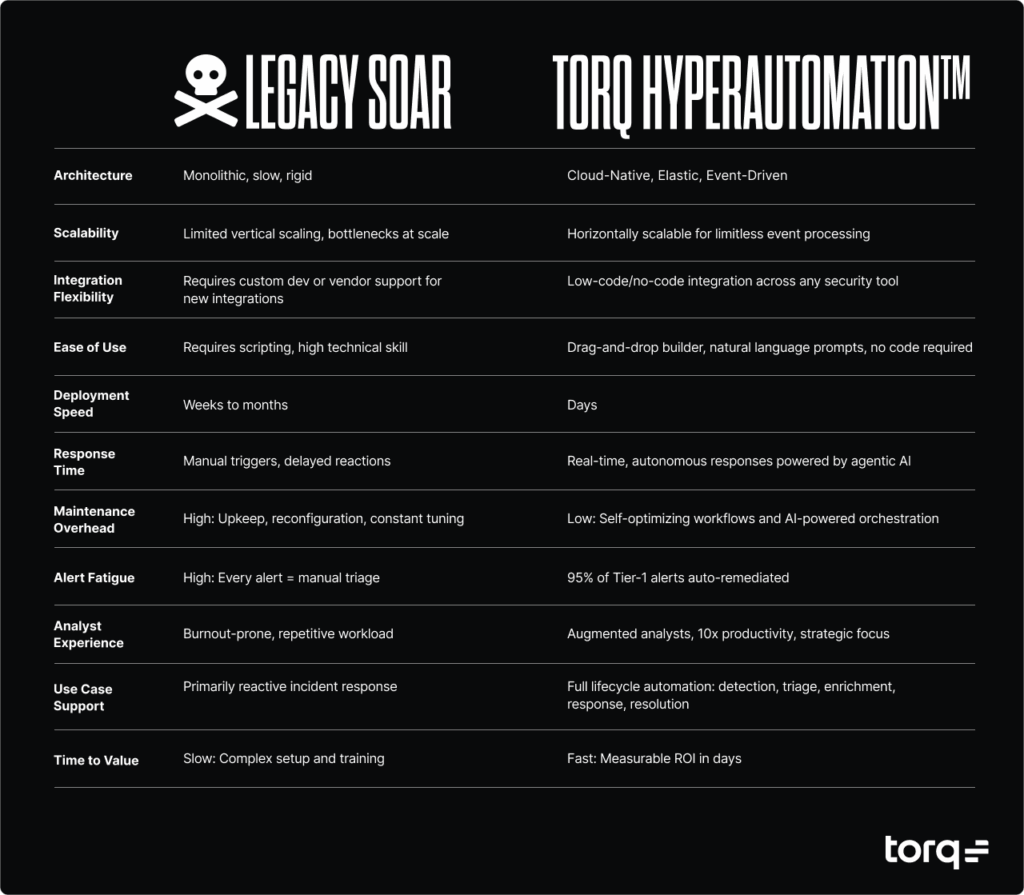
SOAR is Dead: Long Live the AI SOC
The era of legacy SOAR is over. Organizations are increasingly making the switch to the Torq AI SOC Platform powered by Hyperautomation and agentic AI, the true AI SOAR alternative that can meet the modern SOC’s demand for speed, autonomy, and adaptability.
Ready to step into the future of security operations? Our team has helped major enterprises from every industry make the switch, quickly and easily.
FAQs
Your analysts spend more time fixing broken integrations than investigating threats. If every vendor API update triggers a playbook outage, if your team avoids building new workflows because maintenance is already unmanageable, or if your SOAR backlog grows faster than you can clear it — those aren’t operational quirks. They’re structural failures. The clearest sign: your automation platform is creating more work than it eliminates.
Faster than the SOAR implementation took. Valvoline was running production workflows within 48 hours of deployment. Full migrations vary by environment complexity, but the model is consistent: stand up the platform, convert high-priority use cases first, run both systems in parallel during the transition, then decommission SOAR once confidence is established. The migration doesn’t require rebuilding from scratch — existing playbook logic translates, and the AI layer handles the decision-making complexity that used to require nested rules.
The SOAR price tag understates the real cost. The licensing fee is just the entry point — add the professional services fees for every integration repair, the specialist time required to maintain playbooks, and the analyst hours lost to alert fatigue from a system that can’t keep up. Bloomreach recovered 5+ analyst hours per week after switching to the Torq AI SOC Platform. Valvoline recovered 6-7 analyst hours per day. That’s headcount you already have — redirected from maintaining broken automation to doing actual security work.
Visit our in-depth guide on Hyperautomation for detailed insights >
Torq’s AI solutions offer reduced Mean Time to Respond (MTTR), 95% automated triage of Tier-1 alerts, and significant reductions in analyst burnout. By deploying Agentic AI, Torq acts as a force multiplier, allowing lean teams to handle enterprise-scale threat volumes.
Yes. The logic you’ve already built doesn’t disappear — it migrates. Playbook conversion is a core part of the transition process, and most existing workflows translate directly. In many cases, playbooks that required 30+ conditional branches in SOAR simplify significantly when AI handles the contextual decision-making.
The skills your team already has. If your analysts can reason through an investigation and your engineers can build a SOAR playbook, they can operate a Hyperautomation platform. The primary shift is conceptual, not technical: instead of scripting every decision path in advance, you define the outcomes you want and let the AI handle the branching logic. The teams that struggle most with SOAR — because the maintenance burden outpaced their capacity — typically find the transition straightforward. They’re not learning a new skill. They’re getting time back.
Implementing AI SOAR follows a structured approach. Start by auditing your current SOAR pain points — identify which playbooks break most often and which tasks consume the most analyst time. Next, prioritize high-volume, repetitive use cases like phishing triage or endpoint alerts for initial automation. Then, select a platform with no-code integration capabilities to accelerate deployment. Finally, measure baseline metrics (MTTR, alert volume, analyst hours) before implementation to quantify ROI. Torq’s agentless, API-first architecture enables deployment in days, not months.
Any incident that requires correlating context across multiple tools, making judgment calls with incomplete information, or adapting based on asset criticality. Phishing response, identity threat detection, and cloud misconfiguration remediation are high-impact starting points — high volume, well-understood response patterns, and clear ROI when automated correctly. The incidents where SOAR falls short — the ones with too many variables for a static playbook — are exactly where AI-driven platforms deliver the most value.
Start with analyst hours recovered per week. That’s the most immediate, measurable outcome — and it converts directly to dollar value based on your team’s loaded cost. Layer in mean time to respond (MTTR) before and after, the number of automated use cases your team can sustain, and integration maintenance time as a percentage of total automation effort. The leading indicators show up within weeks. Valvoline and Bloomreach both tracked recoverable analyst hours as their primary early metric.