Contents
Get a Personalized Demo
See how Torq harnesses AI in your SOC to investigate, prioritize, and respond to threats faster.

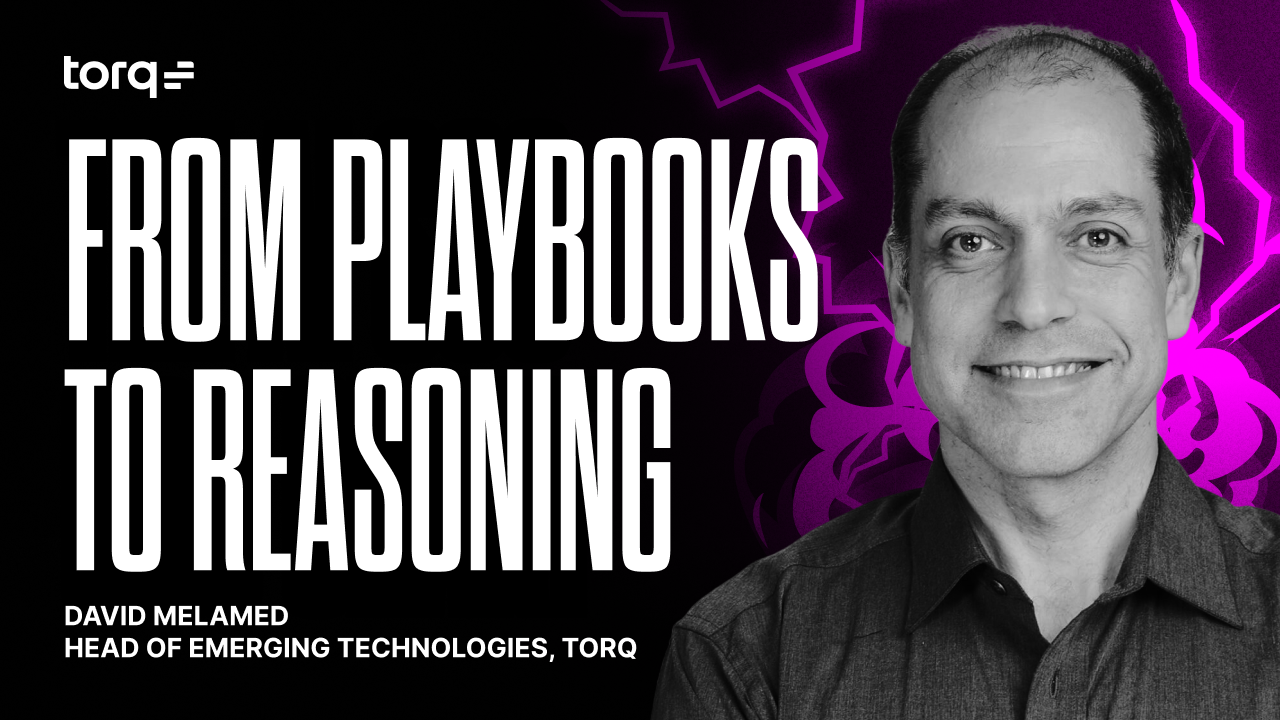
David Melamed is Head of Emerging Technologies at Torq. He joined through Torq’s acquisition of Jit, which he co-founded and has led as CTO since 2020, building agentic security on a production Context Graph. A cloud security veteran with 20+ years of experience, David previously held senior technical roles at Cisco (via the CloudLock acquisition) and MyHeritage.
Before Odysseus can find his way home, Circe tells him that the only guidance for the dangers ahead must come from the spirit of a blind prophet, Tiresias. To consult him, Odysseus must sail to the edge of the world and call up the dead. The prophecy itself takes only a few minutes to hear. Reaching the one who can give it takes an entire voyage.
Difficult security decisions work the same way. Getting a verdict once the context has been properly built is cheap and becomes straightforward. The challenge lies in acquiring that context. Acquiring context has been the focus of security automation for the past decade, but automation has only ever reached part of it.
The Part a Playbook Could Never Reach
The previous post in this series was a blunt autopsy: SOAR platforms promised us to automate the SOC, but as we know, you can’t automate open-ended investigation with flowcharts.
A playbook automates actions you’ve manually laid out. If there is an alert of type X, enrich it with data from source Y, then create a ticket Z. This is all actual valuable work. However, what a Tier 1 analyst really does is look for things that don’t fall into any of the flow branches: Check a user’s recent logins, verify if some file hash was seen anywhere before, evaluate if some specific asset actually matters, or decide if a pattern matches a past incident.
This requires an open-ended, step-by-step investigation, with each step dependent on the outcome of the previous one, making it almost impossible to represent as a flowchart. So this high-value work remained manual, with analysts acting as the human bridge between siloed systems and connecting the dots.
The Unit of Automation Has Shifted From Enrichment to Investigation
That investigative work is what agentic analysis automates, and it is what sets it apart. A playbook makes analysts faster by running a fixed set of paths more quickly. An agent instead acts like a real analyst, determining what to investigate next based on what it has discovered, collecting evidence across the stack, correlating that evidence, and ultimately providing a verdict with a trace of how it got there for full transparency. The unit of automation has shifted from focusing on signal enrichment to investigating the meaning of alerts.
This is what turns “machine-speed investigation” from a slogan into something real, and it is the promise this series has been building toward. As we automate the context collection process, volume becomes less of a factor. It still matters, though: as in an emergency room, where nurses triage patients before doctors run full exams, a fast first pass removes duplicates and known-benign noise so that in-depth investigation goes to the alerts that warrant it.
In many implementations, a team of specialist agents works toward a common goal: one will collect information from various sources, while another collates the timeline. The agents collaborate to provide investigation at machine speed and ensure the alert is processed from the moment it is ingested into the system to a reasoned verdict, without human intervention. This is where the industry is moving, with new terms like ‘agentic AI’ and ‘AI SOC’. And the exact marketing term matters less than the overall underlying mechanism and idea it is based on.
What Burned Analysts Should Care About
If you’ve ever had an AI agent provide a confident, incorrect verdict related to an alert, then you know that the most critical question is not whether it can reason or investigate but rather whether you can verify the reasoning and its grounding, the evidence chain used to get to this conclusion. That verification is not free: According to Torq’s 2026 AI SOC Leadership Report, which surveyed 450 security leaders, analysts already spend an average of 8.6 hours per week overseeing AI outputs. While that oversight time is repaid many times over by the manual work AI takes off analysts’ plates, a platform that makes verification fast is still worth more than one that only speeds up investigation.
This depends on:
- How the context was gathered: The agent decides what to look at next, and that planning is probabilistic by nature. The collection must not be: every piece of evidence should come from a deterministic query against your own tools, returning exact observables like an IP, hash, user, or hostname, with a reference you can follow back to the source. This will make a big difference in alerts where plausible-sounding hallucinations can cause the most damage.
- How and how much transparency is provided: Don’t settle for less than a fully auditable record of the reasoning behind every decision, the evidence it pulled, the sources, and the chain to the verdict. Indeed, while an incorrect verdict coming from a black box is a minefield, one with full transparency is more of a bug that you can find, understand, and fix.
Transparency is the key difference between the tool that burned you and one you can have in production. It’s the most important thing to verify in your pilot: How transparent are the agents? Can they show the full reasoning chain? Different platforms will yield very different outcomes, so make sure you always substantiate claims with real data.
Two cautions apply. A reasoning trace written by a model is not guaranteed to reflect what actually drove its output, so verify the evidence links rather than the narrative. And a trace only shows what the agent looked at, not what it skipped, so ask whether the platform shows which sources it didn’t query and why.
- How deep your integrations are: An agent can only be as good as its foundation. Point it at a shallow, poorly integrated stack, and you will get shallow results: garbage in, garbage out. Context is the fuel, so beyond the quality of the AI model you pick, the depth of your integrations and agentic tools will determine the quality of your results. It also limits what you can verify: an agent can’t cite evidence from a source it can’t reach.
What It Means for the Bar You Set
In the second post of this series, we discussed how maturity is knowing what you are comfortable with when considering automated verdicts vs. manual reviews, and how to be intentional about it. With investigation at machine speed, you can genuinely raise your bar. Alerts that you couldn’t investigate due to fatigue at 2 a.m. can now be investigated with complete traces and full evidence.
This shrinks the share of alerts you have to intentionally let go of, mostly because investigation is now cheap enough to run around the clock. Be clear about what that implies, though: closing an alert because an agent judged it benign is already a decision, and when that verdict is wrong, it fails silently. So the bar now applies as much to verdicts as to investigations.
What This Post Is Not Claiming
There is something I have carefully set aside until now: letting the machine act on its own. Beyond the verdicts discussed above, trusting it to act on the outcome of an investigation, for example, by containing a host in production, is a whole different ball game.
This is the biggest question in this series, and we’ll discuss it in our next and final post. If agentic analysis can automate evidence collection and reasoning over it, and provide full transparency into the reasoning chain, then it has earned its place to investigate and help you save a considerable amount of time. In order to act, they need to earn something harder: your trust that the confidence with which AI agents plan to act is justified.
What This Means for You
Odysseus didn’t let Tiresias steer his ship. He made the journey, heard the prophecy, and kept control. But the prophecy was right: when his crew ignored its warning about the cattle of Helios, it cost them their lives. Keeping control does not mean discarding good evidence. This is how you should feel about agentic investigation. Let the AI agents make the journey, gather the context, suggest a verdict, and provide you with full transparency into how they got there. But you should be the one to decide what to do with it, until they’ve earned more.
Next in this series, we’ll look at how automation earns the right to act and how trust should be determined.