Contents
Get a Personalized Demo
See how Torq harnesses AI in your SOC to investigate, prioritize, and respond to threats faster.
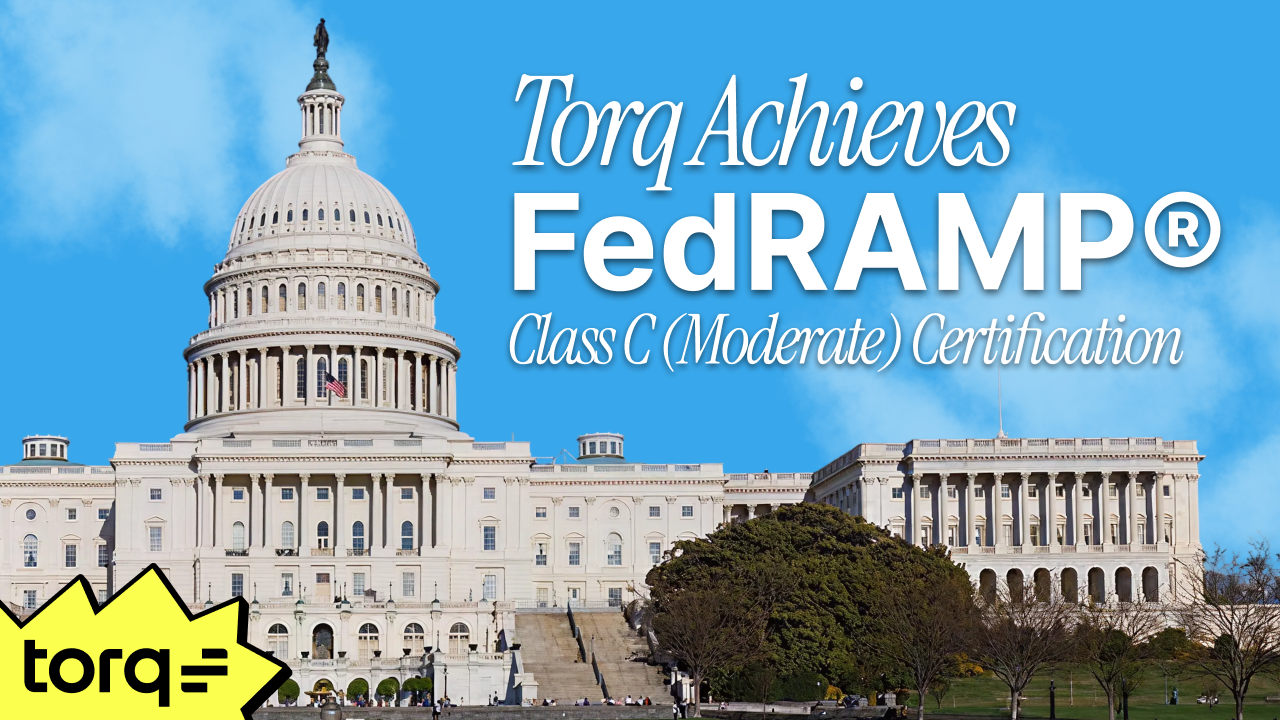
Yesterday, Torq announced FedRAMP Class C certification. This is an incredibly exciting new chapter for the Torq team! Torq’s CEO and Co-Founder, Ofer Smadari, shared his thoughts yesterday in a blog that laid out why it matters, and what agentic defense does for a U.S. federal SOC. As the Head of Public Sector Special Programs at Torq, I thought it would be important to break down the FedRAMP certification process, and what Class C, formerly referred to as FedRAMP Moderate, means in a practical sense:
How did we get here? What can you run on day one? What does the certification mean for your agency? And, most importantly, how can a U.S. federal agency acquire the leading platform in the AI SOC space now that it is available to them?
Built by Torq, Running on CGC, in Partnership with Merlin
Torq is certified through Constellation GovCloud (CGC), the market readiness and compliance automation affiliate of the Merlin Group. CGC is a FedRAMP Class C-certified platform-as-a-service built to host SaaS applications for government agencies, and Torq operates within its certification boundary. The Torq AI SOC Platform itself is built and operated by Torq. It runs in a dedicated federal environment, separate from our commercial platform, on CGC’s platform-as-a-service. Your data stays within that boundary.
We went to market with CGC as our accelerator, following Merlin Ventures’ lead in Torq’s $140 million Series D at a $1.2 billion valuation earlier this year. That partnership is why U.S. federal customers can get Torq now rather than “sometime soon”. Over the past year, Torq and Merlin have worked together to plan, test, and build out the framework, solutions, and some of the most impactful key use cases that federal agencies can benefit from on day one.
“Getting breakthrough technology into government hands takes more than a strong product. It takes validation, compliance rigor, and a clear path to certification. Torq’s FedRAMP Class C certification shows what that looks like in practice. Together with Constellation GovCloud, we’ve helped turn a proven commercial platform into a mission-ready capability that agencies can adopt with confidence.”
– Bob Costello, Chief Digital and Information Officer, Merlin
Seven Use Cases Ready to Run Today
Together, Torq and Merlin have worked closely with some of the top federal agencies to understand where to prioritize the value that agentic SecOps can deliver. It started with Merlin Cyber’s SOC Modernization solution, and the list grew from there. Below are seven ready-to-run use cases that are already making an impact in Torq’s federal and SLED customer environments. These use cases show how quickly an agency can put the platform to work, and each one starts from the same foundation. But this is just the beginning of what agentic security operations can do for the public sector.
1. Agentic AI for Public Sector
U.S. federal teams have waited for agentic AI that they can defend in front of an inspector general. Torq Socrates is the central interface of the Torq AI SOC Platform, operating as the agentic quarterback, calling, delegating, reasoning, and building the Torq HyperAgents® needed to take action across any use case, any function, any time. Torq HyperAgents investigate and respond with agentic reasoning inside the federal boundary, working on agency data that never leaves it. You decide which actions run on their own and which wait for an analyst, and you can change that decision as trust builds.
2. Known Exploited Vulnerabilities (KEV)
When CISA adds a vulnerability to the KEV catalog, Torq identifies the affected assets, ranks them by mission criticality, and kicks off remediation. A critical EDR alert can be matched to a scanner finding on the same endpoint. Then the host is isolated and a ticket is opened, with no analyst in the loop unless you want one.
3. Post-Quantum Cryptography (PQC) Readiness
Torq works with CGC marketplace partner ISG Federal to discover and inventory cryptographic assets, then continuously checks device, user, and cryptographic posture against policy. Agencies get a running view of what needs to migrate as PQC mandates take hold, instead of a spreadsheet that goes stale the day it ships.
4. Tier 1 Triage Across the Stack
Torq Auto Triage is the agentic engine that applies business context, threat intelligence, and historical activity to deliver verdicts and suppress noise. It prioritizes the threats that actually matter before they become incidents. Alerts from your SIEM, EDR, and email security tools get enriched, triaged, and closed in a single case. The verdict is written back to the source platform, so nothing remains open in two places.
5. Multi-Platform Threat Hunting
Socrates not only tasks AI agents with accessing authorized data and context to proactively pinpoint threats before they become incidents, but also functions as a thought partner to your best human threat hunters. Use Socrates to run investigations across hybrid cloud and on-premises environments and execute responses at machine speed. One hunt reaches every environment you run, not just the one with the best tooling.
6. Continuous Compliance and Evidence
Configuration changes get checked against approved baselines, and logs from segmented networks move to enterprise storage with a documented chain of custody. Every case created in Torq Case Management is mapped to the MITRE ATT&CK® framework. Timestamped, auditor-ready evidence builds automatically against NIST 800-53 controls, so audit prep stops being a scramble.
7. Identity Lifecycle and Access
Offboarding revokes live sessions the moment HR flags a departure. Provisioning requests clear automated checks, such as employee type and device encryption status, before they reach an approver. Just-in-time access replaces standing privileges.
These seven are a starting point. Torq’s Hyperautomation foundation connects the security stack you already own, so the next use case is a conversation with your team and Torq Socrates’ Agentic Builder, not a multi-year project.
What FedRAMP Class C, Formerly Moderate, Means for Your Agency
FedRAMP, the Federal Risk and Authorization Management Program, is the government’s standardized approach to security assessment, certification, and continuous monitoring for cloud products and services. A certification means a SaaS service has been assessed against the NIST SP 800-53 control baseline, reviewed by a third-party assessor, and approved for federal use. With one certification, any agency can reuse it instead of running its own security review from scratch.
Class C certification is the baseline that most federal workloads fall under. You may know this as “FedRAMP Moderate Authority to Operate”, which is now considered a legacy naming convention under FedRAMP’s Consolidated Rules for 2026, which become mandatory adoption on January 1, 2027. Class C covers controlled unclassified information (CUI), the sensitive-but-unclassified data that agencies handle every day, and it spans over 300 controls.
For a security leader, that translates into a short list of practical wins. Your authorizing official gets an existing package to review instead of a blank page. Your procurement team gets a vendor that already clears the cloud security bar. And most of all, your SOC gets agentic AI aimed at increasing efficiency and response speed, without a multi-year approval process first. For MSSP and MDR partners that support federal, state, local, and education (SLED) customers, the certification enables you to support customers that adhere to FedRAMP requirements too.
What 300+ NIST Controls Cover
Class C spans more than 300 NIST SP 800-53 controls. These controls align to access control, identification and authentication, audit and accountability, configuration management, incident response, risk assessment, contingency planning, system and communications protection, and more. Together they cover how a service handles data, who can touch it, how every action gets logged, how changes get approved, and how the provider responds when something breaks.
A third-party assessor tested those controls, and the certification keeps them under continuous monitoring after the paperwork clears. This is the baseline where most federal workloads live, and it is the bar most federal, state, local, and education teams already measure their own security programs against. For the majority of public sector organizations, this covers the data you need to protect and then some.
Buying Torq Through the Vehicles Agencies Already Use
Certification clears the security review. Contract vehicles clear the buying process, and Torq will be available through the ones agencies already use.
The most prominent is GSA, the federal government’s primary buying schedule. GSA vets technologies, sets the terms and conditions, and fixes a not-to-exceed pricing structure in advance. Buyers can skip much of the procurement legwork because the contract is already in place.
GSA is one of several contract vehicles public sector buyers trust most. Torq is also available through the multi-state cooperative contract program NASPO ValuePoint, NASA’s Solutions for Enterprise-Wide Procurement (NASA SEWP VI), Texas Department of Information Resources (DIR), California’s Software Licensing Program (SLP), and Omnia Partners, a large cooperative purchasing organization for state, local, and education buyers. More vehicles are coming, and we’ll publish the full list as they go live.
Ready When Your Agency Is
Torq’s FedRAMP Class C certification means U.S. agencies no longer have to pick between moving fast and meeting the bar. The certification, the platform, and the path to purchase are all in place so your SOC doesn’t have to wait on another approval cycle to start.
None of this happens without a lot of people. Thank you to the Merlin Group, and to the Constellation GovCloud team for backing us, building the runway, and turning “sometime soon” into “today.” Thank you to Ofer Smadari and the entire Torq leadership team for betting big on the public sector and giving us the room to go win it. And thank you to the Torq team, who put in the work to get this over the line. Federal, state, and local agencies have waited a long time for an AI SOC they can trust, and now it’s here.
Book a demo with the Torq public sector team today and pick your first use case to run.