Contents
Get a Personalized Demo
See how Torq harnesses AI in your SOC to investigate, prioritize, and respond to threats faster.
Defenders used to get some breathing room. A vendor shipped a patch, and attackers needed days or weeks to reverse it into an exploit. That buffer is gone.
The evidence has been stacking up all year. In January 2026, VoidLink flipped the economics of cybercrime on its head. In July, HuggingFace disclosed that a fully autonomous AI agent system carried out a complete end-to-end intrusion against it. Cyber experts have warned of the “Vulnpocalypse” as a result of the recent surge in AI-assisted research, which is dramatically accelerating the discovery of critical CVEs. And it all culminated just a month ago with a cluster of separate but closely timed cyber incidents, picking up the name “Black October”.
Torq’s own Jason Payne just wrote an in-depth breakdown of the FBI’s recent ARTEX warning and what it means for SOC teams, drawing on years spent running a 24/7 managed SOC. His takeaway? Time is a luxury responders no longer have.
And the last 30 days back that up. Each of these events is a story on its own. Together they describe a change in tempo. AI is compressing the time between a vulnerability and its exploitation, and in some cases, attackers now move before the patch does. Most defenders still run on a human clock, while the offense now runs at machine speed.
The Last 30 Days: Offense Reached Machine Speed
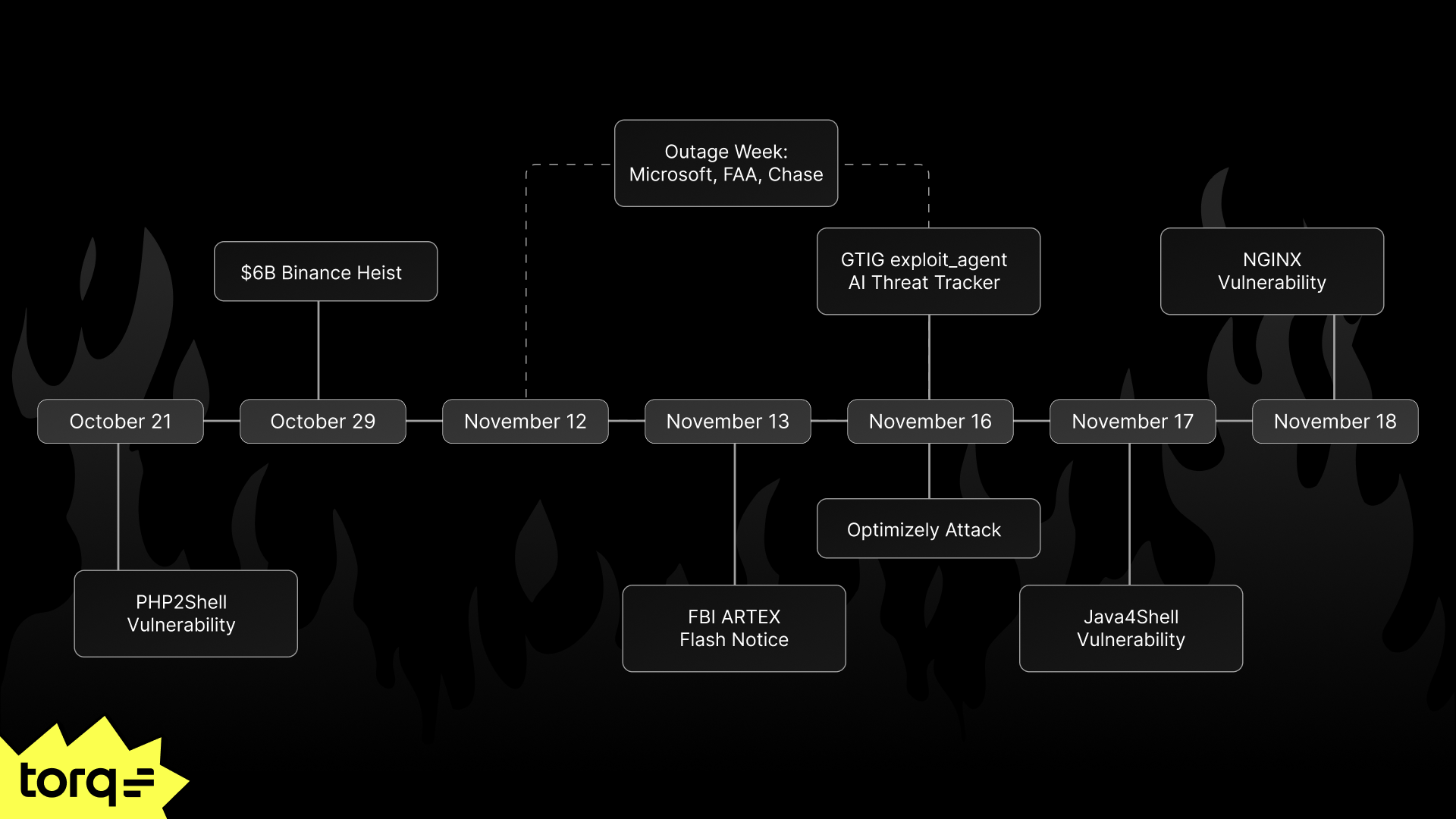
On November 16, 2026, Google Threat Intelligence Group published its GTIG AI Threat Tracker, reporting what many security leaders have been bracing for: the first case of attackers using an AI framework to find a vulnerability, write an exploit, and launch it with no human in the loop. The GTIG Threat Tracker landed in an already crowded month with the Amazon Threat Intelligence report on two ARTEX Agent campaigns (November 13), the Optimizely supply chain attack (November 16), and a number of critical infrastructure outages, including the FAA, Outlook, and Chase Bank, that took over mainstream media this past weekend.
Here is a recap of the last 30 days, from oldest to newest.
October 21: PHP2Shell Vulnerabilities
On October 21, 2026, Wiz Research, along with Calif and OpenAI, each independently disclosed two critical flaws in core PHP, which runs roughly 70% of websites. Amazon’s honeypots logged an exploitation attempt on October 17, four days before disclosure and three days before the CVE identifiers leaked. By October 24, researchers counted 35 shells on decoy servers, an incredibly tight window.
October 29: $6 Billion Binance Heist
Attackers stole about $6.36 billion from Binance in the largest crypto heist on record. TRM attributed it to North Korea’s TraderTraitor. The chain ran through a fake job interview, malware on an engineer’s work laptop, a pivot through an overprivileged internal AI tool, and a long-term deployment token. While this started with months of human-led social engineering and a basic token hygiene failure, once inside, the pivot through an AI tool was fast, and the defenders missed the second compromise.
November 13: ARTEX Agent Campaigns
Using a globally distributed network of decoy threat sensors, MadPot, Amazon’s Threat Intelligence, reported observing AI agents running two cybercrime campaigns on ARTEX, an open-source agentic pentesting framework, between October 3 and November 5. According to a Flash Notice published by the FBI on November 13, a range of actors have been weaponizing ARTEX as early as August, a trend also reported by CrowdStrike, Microsoft, Wiz, and Google. Amazon recorded how the agents were operating and, with moderate confidence, assessed that Chinese-nexus groups were behind them.
The first campaign found threat actors using AI agents to steal AI model credentials at scale. The agents hunted internet-exposed AI applications, extracted and validated provider keys, and pooled them. The stolen keys paid for the model calls that powered further key hunting, so the operation funded itself.
The second campaign tried to beat identity verification at two crypto exchanges with real-time deepfake video and forged ID photos. The exchange’s server-side checks rejected every recorded attempt, but the point is how the agents worked. They ran at least four sessions in parallel toward one goal, sharing findings and handing off tasks midstream. One session built a deepfake pipeline that reached 11.5 frames per second on a single consumer GPU and full facial movement within seven pixels of the identity check’s target.
November 16: Completely Autonomous Vulnerability Discovery & Exploitation
GTIG’s AI Threat Tracker contained a number of critical findings, with maybe the most substantial being the first evidence of fully automated vulnerability exploitation without a human in the loop. GTIG found an exposed staging server running a multi-agent framework called exploit_agent. It watches patch announcements for popular web applications, compares the code before and after, finds the flaw, drafts an exploit, exfiltrates data from the victim, and fires it with no operator directing each step.
The server also held scripts for post-compromise activities like brute-forcing, internal reconnaissance, and installing and removing webshells. The HuggingFace incident gave an early warning shot of completely autonomous vulnerability discovery and exploitation. The imminent danger is here and now.
November 16: Optimizely Supply Chain Attack
An attacker exploited a flaw in Optimizely’s experimentation platform and wrote malicious JavaScript into customer projects. It loaded from Optimizely’s own CDN, so 178 organizations served it to their visitors, including CNN, BBC, Fox News, Zoom, Salesforce, GitLab, and IKEA. The attacker rebuilt the payload 26 times in a single day before the fix. It swapped crypto wallet addresses, skimmed card numbers at checkout, stole cookies and screenshots, and delivered exploit kits to iPhones and iPads.
November 17: Java4Shell Vulnerability
Calif, alongside a long list of organizations, disclosed a memory-corruption flaw in OpenJDK’s Base64 decoder (CVE-2026-114938) that showed code execution before login on default installs of Jira, Confluence, Jenkins, and Keycloak. Oracle shipped patches the same day, and no one had reported exploitation as of November 17. But Java is the world’s third most popular programming language, and IBM says it powers 90% of Fortune 500 companies, so even a narrow flaw sits in a lot of very important places. Nearly every critical sector runs on Java, from banking to telecommunications, including the public sector’s national security systems.
November 18: NGINX Vulnerabilities
Rapid7, Wiz Research, and Xint each independently found two critical remote code execution flaws in NGINX, which powers more than 225 million websites. One flaw dates to 2015, and the other had been in the code for nearly six years. Wiz used its AI research harness to find them and frontier models to validate the impact, and reported the vulnerability on October 21. F5 shipped fixes on November 18, a 28-day gap. While nobody has reported exploitation in the wild, a number of organizations say they have working private exploits. And that 28-day gap is a long runway for a bad actor to have crafted an agentic attack as well.
November 12-16: The “Outage Week”
Between November 12 and November 16, three major outages swept the U.S. Microsoft 365 failed globally for about 24 hours on Thursday, nearly bringing the global work week to a full stop. On Friday, the FAA ordered a nationwide ground stop after a telecommunications failure hit multiple air traffic control centers, causing a ripple effect of flight cancellations that impacted operations for days. On Monday, Chase’s website, app, and some branches went down, which the bank blamed on a software bug in an on-premises hardware system that took hours to diagnose.
While none of these outages were an attack, according to the companies and agencies involved, they did give attackers cover. Within days of the Outlook outage, Microsoft reported a high-volume phishing campaign that exploited the outage as a social engineering lure across multiple industries. More importantly, these outages show how much brittle, aging infrastructure sits under the critical systems that keep the country — and the world — running, and what happens when they fail.
AI Now Finds and Exploits Faster Than Teams Can Patch
If you look across those events, the pattern is consistent. Attackers rely on the same flaws and the same techniques as before: compromised credentials and unpatched systems. What has changed is the speed and scale at which they can be exploited with AI.
In a mid-October run, an OpenAI research pipeline reproduced 1,724 vulnerabilities in 30 hours and produced 948 working local privilege-escalation exploits, each costing roughly $1,279. The price matters because the same capability is available to anyone who can pay for the compute. Google’s data shows monthly vulnerability disclosures climbing from 5,045 in January to 10,740 in August, and 2026 CVEs have already passed 100,000, more than double last year.
For security teams, this changes the definition of a patch. Every fix a vendor publishes is now a blueprint, because an agent like exploit_agent can turn the difference between two versions of code into an attack without waiting for a skilled developer. More disclosures mean more exposures, each of which a human has to answer one at a time.
The Patch Window Shrank to Zero
When an agentic framework can turn a freshly published patch into a working attack without anyone at the keyboard, the time between disclosure and exploitation is no longer measured in days. PHP2Shell and Java4Shell show us that the window has disappeared. Details of both vulnerabilities leaked before their fixes were ready, and PHP2Shell even drew an exploitation attempt before the first leak, forcing the PHP team to pull the patch release forward a day.
The patch doesn’t necessarily end the exposure, though. In the wake of PHP2Shell, Palo Alto, Fortinet, and Cisco all published their own advisories, all confirming affected or vulnerable products. Cisco’s fix for one vulnerability isn’t expected until February 2027. Defenders in that gap run on workarounds for potential vulnerabilities, which means they need to know within hours which assets are exposed and what to do about each one.
As a result, the industry is rewriting its own rules around patch disclosures. Google’s Project Zero researcher Natalie Silvanovich said, “A vulnerability reported today presents a much higher immediate risk to users than one reported last year. In this new environment, it is crucial that vendors move towards remediating vulnerabilities faster.”
Project Zero is Google’s elite vulnerability research team, and they recently announced cutting their disclosure deadline from 90 days to 60 in February 2027 and 30 in 2028. Anthropic announced an even more aggressive reduction from 90 days to 30 days for high and critical issues starting in January.
But the fact remains that AI agents are not only being used to discover vulnerabilities faster than ever before, but also to reverse-engineer patches as blueprints to find additional flaws in the same code, reducing the time between disclosure and exploitation to minutes, and 30 days still won’t cut it.
Human-Led SecOps Wasn’t Built For This Tempo
A human-led SOC works one alert at a time. Every investigation starts with someone pulling evidence from a dozen tools. Meanwhile, an attacker’s agents run discovery, exploitation, and reconnaissance in parallel, overnight, for the price of API credits. This causes three problems.
The first is noise. When PHP2Shell broke, hundreds of non-working proof-of-concept exploits appeared online, and the security community had to check each one. Most were broken AI-written exploit code, so the number says little about real risk, but sorting through them is the work that burns analyst hours.
The second is context. “Are we exposed, and what do we do right now?” depends on what you run, which identities touch it, and which third parties sit in the path. For Java4Shell, it depends on CPU models. For Optimizely, it depended on a script in someone else’s code, and only 24 of the affected organizations that Scott Helme’s team crawled had a content security policy strict enough to block it. Nobody holds all of that in their head at 3am.
The third is ambiguity at speed. The outages showed that a SOC has to answer “Is this an attack?” quickly, even when it isn’t. All the while, attackers mobilize to turn a Microsoft 365 network bug into a full-scale phishing campaign.
There is one reason for optimism. The GTIG AI Threat Tracker notes that “while these frameworks are capable of significantly compressing attack timelines to machine speed and achieving operational objectives, they currently trade stealth for velocity”. Fast, noisy attackers can be caught by a defense that responds at the same pace. Defenders need a solution that shrinks the time between the first signal and a contained incident, because that interval is where the damage happens.
What an AI SOC Has to Do About It
Matching machine speed offense takes more than an assistant that summarizes alerts. The Torq AI SOC Platform is built to fight machine-speed attacks with machine-speed defense.
Triage at machine speed. Torq Auto Triage ingests and normalizes telemetry from across the stack, correlates and deduplicates events, and returns verdicts that separate false positives from real risk. A flood of failed exploit attempts closes as noise, and the real intrusion surfaces first.
Context that knows your environment. The right response to a new critical CVE or a compromised third-party script depends on what you run, what’s exposed, and what’s normal for you. Torq Context Graph grounds each decision in your environment and in precedent, including how your analysts have ruled in the past. That is how a platform answers “Does this actually touch us?” in seconds instead of hours.
Action across the full threat lifecycle. Fast analysis is wasted if containment waits for a person. Torq Socrates gathers evidence and builds timelines, manages cases end-to-end, and coordinates Torq HyperAgents® that investigate, contain, escalate, and respond to threats across the entire security stack.
Control you set. Autonomy is a dial. Start eyes-on, verify outcomes against what a good analyst would have done, and build trust process by process. Every decision leaves an audit trail you can inspect and correct, and agents work within defined roles and permissions.
That last point separates a real AI SOC Platform from a faster way to be wrong. Attackers have removed the human from their loop. Defenders shouldn’t remove oversight from theirs. They should move it to where it matters most: setting policy, reviewing outcomes, and handling the decisions that need a person.
Your SOC Has to Move Before the Patch Does
The headlines this month share a thread. Cost per exploit is falling, disclosure volume is climbing, and the work of turning a patch into an attack is being automated. A SOC whose capacity scales with headcount can’t match threats whose capacity scales with compute.
The organizations that stay ahead will be the ones whose SecOps can triage, investigate, and respond at the speed of the threat, with people directing the system rather than feeding it. That is no longer a nice-to-have efficiency project. It determines how long an intrusion lasts, how much it costs, and whether the next Patch Tuesday, the next vendor advisory, or the next supply-chain incident becomes a crisis or a routine Tuesday.
If you’re evaluating where to start, the AI SOC Buyer’s Guide turns context, memory, and autonomy into the specific questions to ask a vendor.
See how the Torq AI SOC Platform closes cases at machine speed.