Contents
Get a Personalized Demo
See how Torq harnesses AI in your SOC to investigate, prioritize, and respond to threats faster.
When Anthropic unveiled Claude Mythos Preview in April 2026, the security industry felt the ground shift. First, in a controlled research environment, Mythos autonomously discovered thousands of previously unknown vulnerabilities spanning every major operating system and web browser, including flaws that had survived decades of expert human review. And perhaps most impactfully, it then developed working exploits, without human guidance, at a rate no team of human researchers could match.
At first, Anthropic withheld Mythos from public release, channeling it instead through Project Glasswing to focus the model’s capabilities on defense. Since then, on June 9, 2026, Anthropic released a public version as Claude Fable 5. Even though the full Mythos 5 model remains restricted, the implications were already clear to security leaders. The economics of finding and exploiting software flaws have collapsed. This capability, in the hands of attackers, has fundamentally altered defenders’ collective calculus.
Manual SOC processes architected in an era that predates agentic AI now teeter on the precipice of obsolescence. The urgency shifts from detection to containment and remediation. Machine-speed threats demand machine-speed response. And SOC practices must be reborn and embrace agentic AI if they are to respond at the pace this new reality demands.
The Economics Collapsed. You Know This. So Do Attackers.
Claude Mythos is remarkable not only for its detection capability, but also, and especially, what that capability means in the wrong hands. We want to be clear: this is not fear-mongering. It is a call to action.
Historically, sophisticated cyberattacks required sophisticated attackers. Identifying a zero-day vulnerability in a major browser, chaining it with a privilege-escalation flaw, and building a working exploit required years of experience, deep technical knowledge, and significant time. That barrier kept the most dangerous attacks in the hands of nation-state actors and elite criminal groups.
Mythos obliterates that barrier. Detection is now commoditized.
Security analysts have characterized it plainly: tasks that once required specialist skills (ie, writing exploit code, understanding system architecture, using advanced attack tooling) can increasingly be automated using AI. What once separated a script kiddie from an elite threat actor was expertise. Mythos-class AI can supply that expertise on demand.
The AI-augmented low-skill attacker is born. Someone with minimal technical background can now point a capable AI at a target, receive a map of exploitable vulnerabilities, and get working attack code in return. What once took a nation-state months can now take an amateur hours. One security researcher put it starkly: handing a similarly capable model to bad actors would be “like giving script kiddies a nuclear weapon.”
We think that analogy appropriately frames the urgency. The democratization of exploitation capability is unfolding before our eyes in real time. We are asking you to break the glass and give this the attention it deserves. Now.
Manual SOC Practices Are Already Obsolete
The traditional Security Operations Center was built for a different threat landscape. Analysts triaged alerts manually, investigated incidents by hand, and escalated through human decision chains. Even as SIEM and SOAR tools added automation, the core model remained human-paced: see, think, act.
That model cannot survive in a world shaped by Mythos-class adversaries.
When attackers can generate targeted, sophisticated exploits at machine speed, the attack chain evolves faster than any human-centric operation can run. Vulnerabilities are identified, weaponized, and exploited in cycles measured in hours, perhaps even minutes, but certainly not weeks. The attacker’s tempo has permanently outpaced manual response.
The consequences are predictable: alert fatigue intensifies as detection volume spikes, critical signals get buried in noise, and analysts face an impossible triage workload. The attackers overwhelm the defenders. Triage becomes the bottleneck at exactly the moment that speed matters most.
Enterprise defenders have no choice but to adapt. The organizations that recognize this shift and act now to restructure their operations amidst this new normal will be the ones that contain Mythos-era attacks. Those who don’t will find themselves perpetually responding to breaches they could not prevent.
The Bottleneck Has Moved
Detection is no longer the hard part.
Modern threat detection has matured considerably. EDR, NDR, SIEM, and cloud security tools collectively generate enormous signal fidelity. Seeing a threat does not mean automatically neutralizing it. The bottleneck has shifted from detection to response action.
An alert fires. A SOC Analyst pulls context from five different tools, assesses scope and severity, and decides on containment. They document the recommended response action and initiate communication and coordination with the security control owner. All of this, to say nothing about whether they chose the alert that represents the greatest threat to the enterprise. Because let’s face it, the threat needle resides in an alert haystack. Maybe multiple haystacks. Meanwhile, the attacker has pivoted, moving laterally and establishing persistence. More alerts, more noise, more pressure.
Even for experienced analysts, response time falls off the adversary’s pace set by an automated, focused attack moving at machine speed. The detection sensor is not the SOC’s critical constraint; the gap between detection and action most certainly is.
Machine-Speed Threats Demand Machine-Speed Response
If the attacker is operating at machine speed, the defender must too. Easier said than done? Perhaps not as difficult as you imagine. Stay with me.
Machine-speed response does not mean removing humans from the loop entirely. Nor does it mean turning the keys entirely over to AI. It does mean restructuring operations so that humans provide critical oversight, define guardrails, and review high-stakes actions, while AI handles the high-volume, time-sensitive work that comprises a large share of security operations.
Agentic AI makes this new SOC architecture possible. Hence the term, “AI SOC.” Unlike traditional automation, which executes static playbooks, agentic AI reasons through novel situations, plans multi-step response actions, and executes across integrated systems without requiring human intervention at every step. It can triage an alert, enrich it with threat intelligence, correlate it against historical activity, determine the appropriate response, and execute containment — in seconds, at any hour, across unlimited concurrent incidents.
In a post-Mythos world, the most successful SecOps leaders will (1) structure their operations to use agentic AI to augment their human staff, (2) combine agentic AI and automation to slash MTTR, (3) balance agentic and deterministic automation for economic investment horizon optimization, and (4) build trust in agentically augmented systems through strategic scoping and small wins that build momentum.
How Torq Helps: The AI SOC Platform Built for This Moment
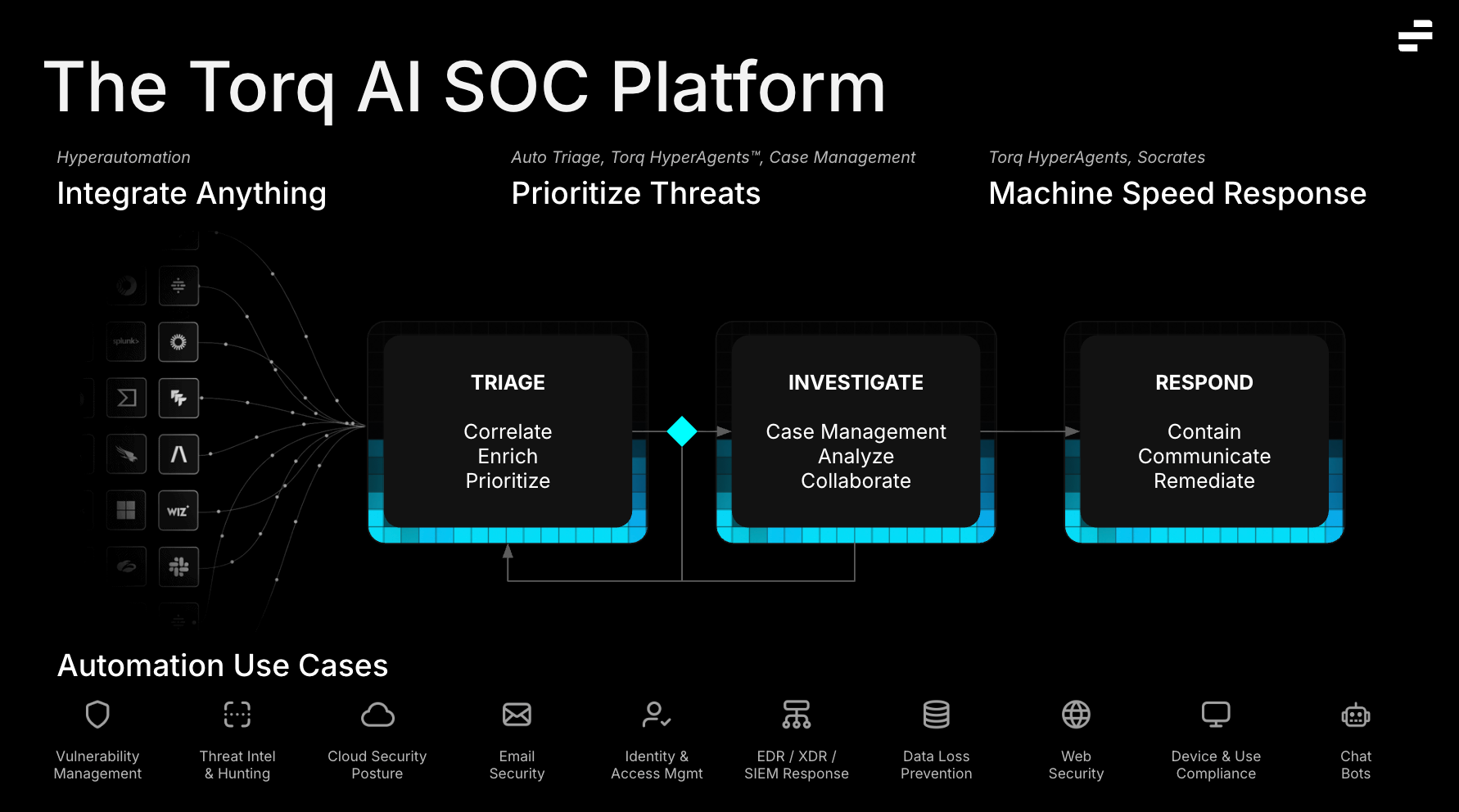
Torq built its AI SOC Platform for exactly the threat environment that Mythos crystallized. Recognized by Gartner® as the Company to Beat in AI SOC Agents for Threat Investigation (May 2026), Torq’s platform is purpose-engineered to close the gap between detection and response at the speed this era demands.
Multi-Agent Architecture
The Torq AI SOC Platform runs a multi-agent system (MAS), with Socrates serving as the agentic orchestrator, overseeing specialized AI agents that work in parallel across triage, investigation, containment, and case management. Each agent accesses only the data you specify and takes only the actions you authorize, within the scope you define. All agentic reasoning and actions are documented, transparent, and auditable.
Autonomous Triage
Torq Auto Triage is the agentic engine that stops noise before it floods your SOC. Auto Triage is fully integrated with the Torq AI SOC Platform and your security stack, to (1) ingest, normalize, and analyze telemetry at machine speed, (2) reveal your biggest risks, and (3) automatically open cases for true positives. Torq has some compelling tech under the hood that learns and adapts to how your SOC operates, so our model becomes your model. Where manual triage took 60 minutes, Auto Triage completes in seconds.
Investigation at Machine Speed.
Cases are automatically opened within Torq Case Management. Agentic insights, timelines, and evidentiary artifacts are automatically added to each case, which serves as the single source of truth for analysts and stakeholders. Socrates leads machine-speed investigation, tasking the specialized Torq HyperAgents™ to offload gruntwork from human analysts and get to the recommended course of action quickly, in minutes, not hours.
Autonomous Response with Guardrails
With Torq, autonomous response is a controlled dial, not a binary decision of human or agent. With recommended containment and remediation plans in hand, you decide what level of automation and under what conditions makes the most sense for your enterprise. Start small, build trust, and expand as you go. We have Fortune 500 enterprises using Torq to autonomously handle 100% of Tier 1 incidents. Mean time to respond (MTTR) is reduced by an average of 94% in our enterprise installed base.
Imagine what a 94% improvement in MTTR would mean for your SOC and your enterprise.
Agentic Builder for Continuous Adaptation
As the threat landscape rapidly evolves post-Mythos, Torq’s Agentic Builder enables security teams to translate human natural-language intent into production-grade AI agents and dynamic business logic. Simply, easily. What once took months is now done literally in minutes.
- A Fortune 500 Retailer transferred four years of legacy SOAR to the Torq AI SOC Platform in days, freeing time to develop new use cases they never had bandwidth to get to before. Fully operational and deployed in under three weeks.
- A Global Hospitality Enterprise ripped out SOAR, upgraded to the Torq AI SOC Platform, and was fully operational and deployed in six weeks.
- A Commercial Real Estate Firm realized instantaneous value on Day 1, and now 60% of phishing cases are handled fully autonomously
New attack patterns demand new responses; Agentic Builder makes that adaptation achievable.
The Mythos moment dramatically reduced the barrier to entry to sophisticated attacks, compressed timelines, and raised the volume of what defenders must handle. The Torq AI SOC Platform was built to absorb that pressure, so your analysts can focus on what AI cannot replicate: human judgment, strategy, and context-aware oversight at the edge of the unknown.
The Clock Is Running
Claude Mythos is a preview of the threat environment that is coming. In some ways, this threat environment is already here. Attackers with AI assistance can already find, weaponize, and deploy exploits at a pace that manual SOC operations never anticipated and simply cannot match. The organizations that respond by building agentic defense capabilities that now work alongside their human experts will be significantly better positioned than those waiting for the next incident to prompt action.
The bottleneck has moved from detection to response. The economics of sophisticated attacks have collapsed. The SOC clock is running. The right time to build a machine-speed defense was before Mythos. The second-best time is now.
To learn more about how Torq’s AI SOC Platform can help your team meet the Mythos moment, get a demo.