Contents
Get a Personalized Demo
See how Torq harnesses AI in your SOC to investigate, prioritize, and respond to threats faster.
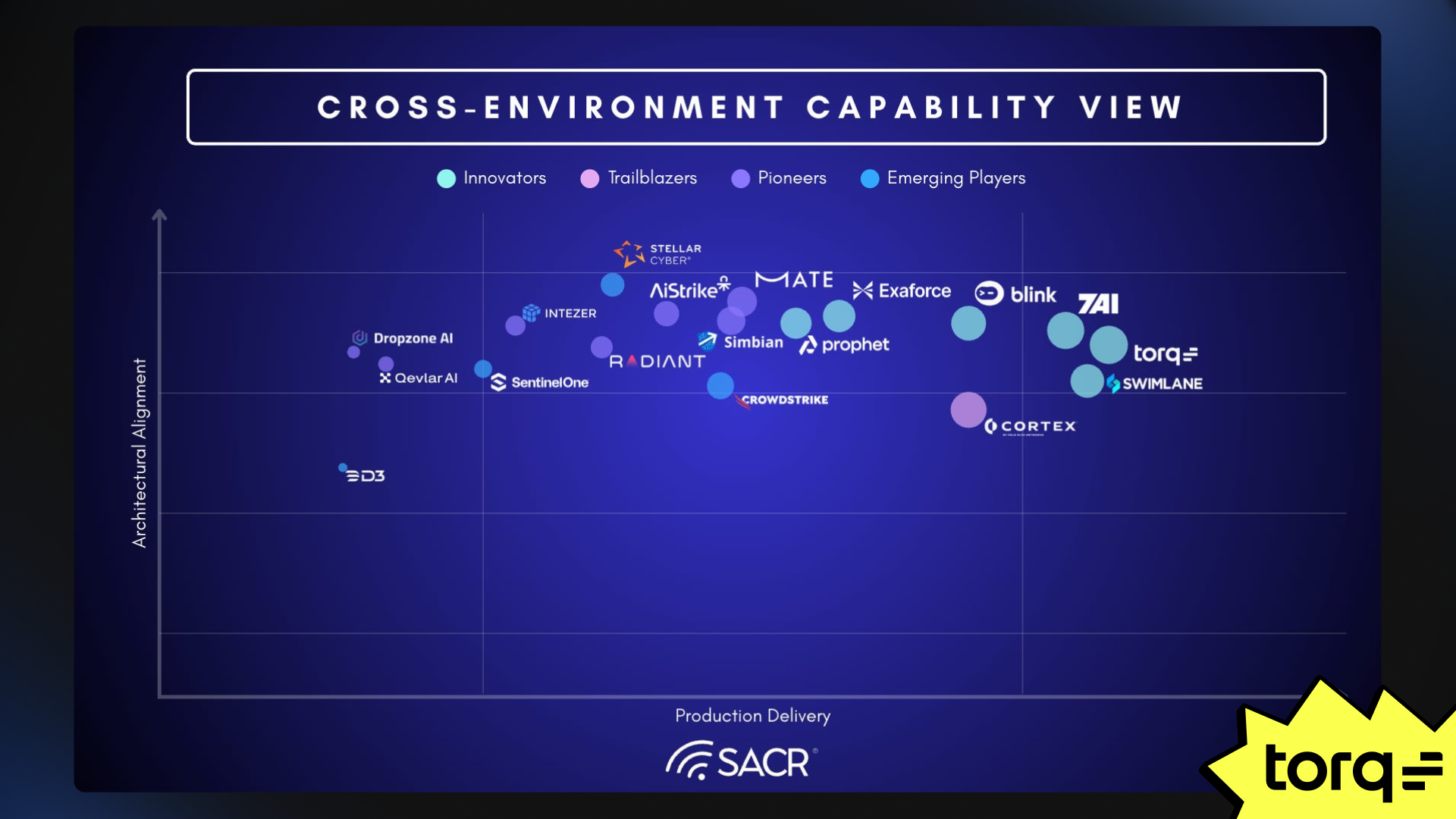
Software Analyst Cyber Research (SACR) just published its 2026 AI SOC Market Report, offering an independent assessment of vendors competing in what has rapidly become the most consequential category in enterprise security. Torq features prominently, and the report’s framing is worth unpacking because it illuminates what makes the AI SOC category hard to evaluate and why Torq’s approach is consequential.
Torq’s AI SOC: From Alert Triage Through Remediation
SACR’s most pointed observation about Torq is definitional. The firm writes:
“Torq is best understood less as a conventional SOAR vendor with AI features and more as an AI SOC operating layer that can ingest alerts, classify triage outcomes, construct cases, assign work to Socrates, and route remediation through deterministic or agentic workflows depending on the use case.”
That distinction matters. Much of what gets marketed as AI SOC today amounts to copilot functionality that surfaces recommendations and draft summaries, and stops at basic triage that simply moves the bottleneck down the SOC line by an increment. SACR cuts through that framing:
“Torq is trying to own high-volume alert triage and response closure, not simply accelerate analyst review.”
Owning closure requires a different architecture than assisting analysts. It requires accurate alert classification at scale, a context layer deep enough to support trustworthy, autonomous verdicts, case management that carries investigations forward, and response automation that can act, not just advise. But let’s circle back and dwell a bit on the first phase: autonomous alert triage.
Auto Triage: Context Is the Differentiator
Torq Auto Triage classifies incoming alerts as false positive, benign, or malicious, enriches them with threat intelligence and business context, and routes them accordingly, all before a human analyst is involved. True positives become cases automatically. False positives are fed back into the per-tenant AI model.
SACR called out the quality of Torq’s context layer directly:
“Torq is not treating alerts as isolated artifacts. It is building a context pipeline around entities, access history, business role, device state, SaaS activity, and related evidence before determining whether an alert should be closed, escalated, or remediated.”
Three underlying capabilities power that context pipeline.
- Torq Reflex is a per-tenant ML model trained continuously on your team’s confirmed verdicts.
- Torq Recall retrieves the most relevant prior cases from your environment’s history and applies an LLM to determine how those precedents apply to the current alert.
- Torq Context Graph provides the unified substrate both depend on: a continuously updated map of identities, assets, networks, policies, and analyst decisions, normalized across your entire security stack.
The results speak volumes. On average, large enterprises achieve a mean time to triage (MTTT) of 1 minute, a 60x improvement over manual triage. A global biotech titan cites a 97% reduction in noise entering the SOC; imagine how much better their security analysts can focus. A well-known financial services enterprise achieved 99% faster threat triage after deploying Torq.
Case Management: The Operating Unit
When Auto Triage surfaces a true positive, it flows directly into Torq Case Management, where analysts inherit the full verdict, enrichment context, and proposed next steps. They do not reconstruct context from scratch.
From within the case interface, analysts collaborate with Torq Socrates™, trigger automated response actions, and track investigation continuity across shift handoffs. Each confirmed verdict and analyst correction flows back into Reflex as a training signal, compounding accuracy over time.
This is the mechanism behind what SACR identifies as Torq’s stronger-than-expected investigation story: the platform captures and encodes analyst judgment, rather than relying on individual expertise to repeat the same reasoning shift after shift. The machine clears the noise. The analysts focus on the highest priority items.
Socrates: Reasoning and Orchestration
Torq Socrates is the agentic reasoning and orchestration layer at the center of the platform. It can be used interactively by analysts, embedded in investigation templates, or assigned cases autonomously. Once on a case, Socrates plans investigations, delegates tasks to specialized Torq HyperAgents®, and coordinates response actions across the security stack.
SACR characterizes Socrates as “the reasoning and planning layer that decides how much work should be agentic, how much should be deterministic, and where the human should approve or intervene.” As SACR notes, “autonomy is a dial, not a binary switch,” and Torq’s model lets security organizations operationalize that dial gradually: starting with triage and recommendation, moving into human-approved action, and eventually automating higher-confidence alert classes.
One Torq customer on PeerSpot describes the cumulative impact: Torq handles a large volume of their alerts autonomously, fundamentally changing the burden placed on their security team.
Hyperautomation: Execution Depth
Torq Hyperautomation is the execution layer that connects AI decisions to real action, supporting both agentic and deterministic workflows across the full security stack. SACR identifies this automation heritage as a structural advantage:
“Compared with AI SOC point solutions, Torq’s advantage is the ability to connect AI decisioning to actual workflow execution.”
That advantage compounds. The same platform that classifies an alert, builds the case, and assigns it to Socrates is the platform that executes containment and remediation at machine speed. Customers have measured a 94% reduction in mean time to respond (MTTR), a metric that requires the full chain, not just faster triage at the front end.
What SACR’s Assessment Means for Buyers
SACR closes its Torq vendor profile with a synthesis that applies beyond Torq specifically:
“Autonomous SOC value will be measured by closed-loop operating capability rather than AI summarization.”
Verdict quality matters. But a verdict quality that does not connect to case construction, investigation, response, and organizational learning is an incomplete story. Torq’s architecture is designed around that full loop.