The manual grind is over: True autonomous security shouldn’t require you to manually tag alerts or write rigid correlation rules just to teach a system how your SOC operates.
Generic RAG fails in the SOC: Standard AI semantic searches hallucinate and match irrelevant data. High-stakes SecOps requires deterministic precision.
Automated institutional memory: Torq Recall transforms an analyst’s everyday workflow — resolving cases and writing notes — into actionable, automated triage precedent.
Honest AI builds trust: In messy, real-world environments, Torq Recall handles conflicting historical data by explicitly flagging discrepancies rather than blindly guessing.
AI SOC memory is the difference between an investigation that starts from your team’s history and one that starts from zero. In most security operations centers, there is none: context disappears the moment a case closes. When a new alert fires, the investigation effectively starts from zero. Analysts are forced to rely on search interfaces — however advanced — to find similar past cases and determine whether an IP, file hash, or domain has been seen before and what the team concluded during the last investigation. But in an agentic SOC, even great search is still manual work; relevant precedent should be retrieved automatically at triage time.
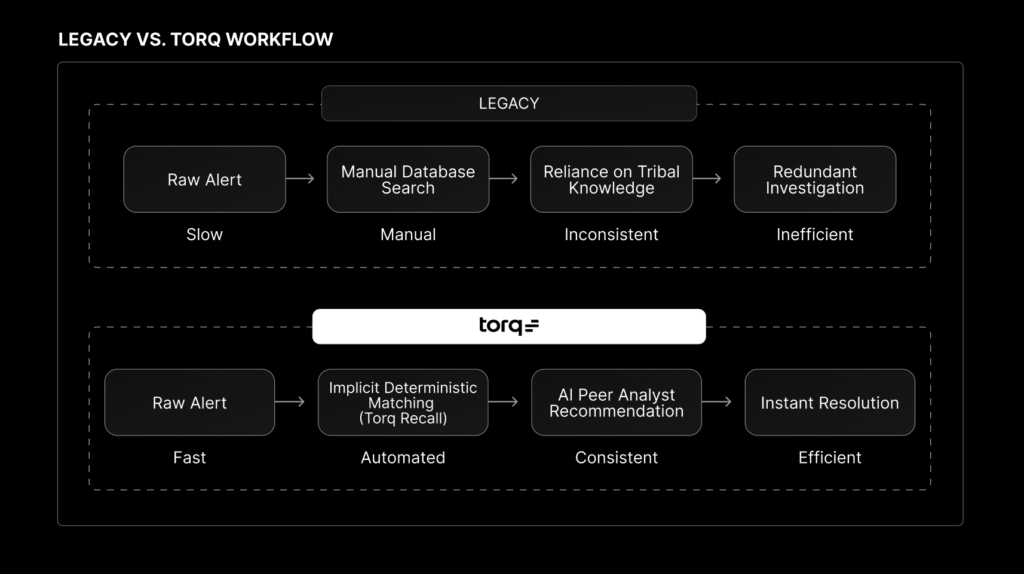
Legacy case management systems weren’t built to retain this operational memory; they were built for tickets. To compensate, these systems require analysts to spend significant time manually gathering and connecting evidence to turn a raw alert into an actionable case. In other words, they demand that the analyst work for the system.
Without an automated way to recall past relevant resolutions, analysts repeatedly reinvestigate the exact same benign patterns the organization has already dismissed, creating the SOC equivalent of déjà vu and wasting valuable time. This inflates false-positive noise, drives alert fatigue, and keeps institutional knowledge siloed — meaning that when a senior analyst leaves, their tribal knowledge walks out the door with them.
True autonomous security requires a completely different architecture. A modern AI-native SOC shouldn’t force teams to change their habits or do extra data entry. Instead, it relies on implicit learning. By turning normal daily workflows — resolving a case and leaving a note — into continuous institutional memory, Torq Recall uses deterministic retrieval to automatically triage future threats based on an organization’s actual history.
The Cost of the Blank Slate
When an analyst investigates an alert without historical context, the problem is not just trivial duplication. The harder problem is recognizing patterns that are tightly connected to the specific user, asset, IP, domain, or behavior involved in the alert. For example, a login anomaly from a suspicious IP may appear risky in isolation, but historical cases may show that the same user and asset repeatedly trigger this pattern after legitimate travel or VPN use, and that the SOC has already validated it as benign.
External threat intelligence — like reputation scores and known IOC databases — is critical for establishing a baseline. But the ultimate context for triaging a new alert is internal: How did your specific organization resolve this exact pattern in the past? Was it tied to a legitimate corporate CDN? Was it an expected admin script?
Without an automated memory of past resolutions, false-positive noise inflates, and analysts burn out from repetitive manual triage.
Why Generic RAG Can’t Survive the SOC
As the industry integrates AI into security operations, Retrieval-Augmented Generation (RAG) has emerged as a popular approach for surfacing historical data. But standard semantic RAG struggles to meet the precision requirements of a modern SOC.
Generic RAG is designed to find semantically similar information. That works well for documents, summaries, and natural language knowledge. It breaks down when the “meaning” resides within security entities such as IP addresses, file hashes, URLs, hostnames, users, assets, or email addresses.
In security, two values can look almost identical and still represent completely different evidence. For example, two hash-like values such as 5jshdh2kfw and 5jshdh2yfw may look semantically close to a model, but in SecOps they are different identifiers and may point to completely different files. A near match is not evidence. In a high-stakes environment, “close enough” can shatter analyst trust.
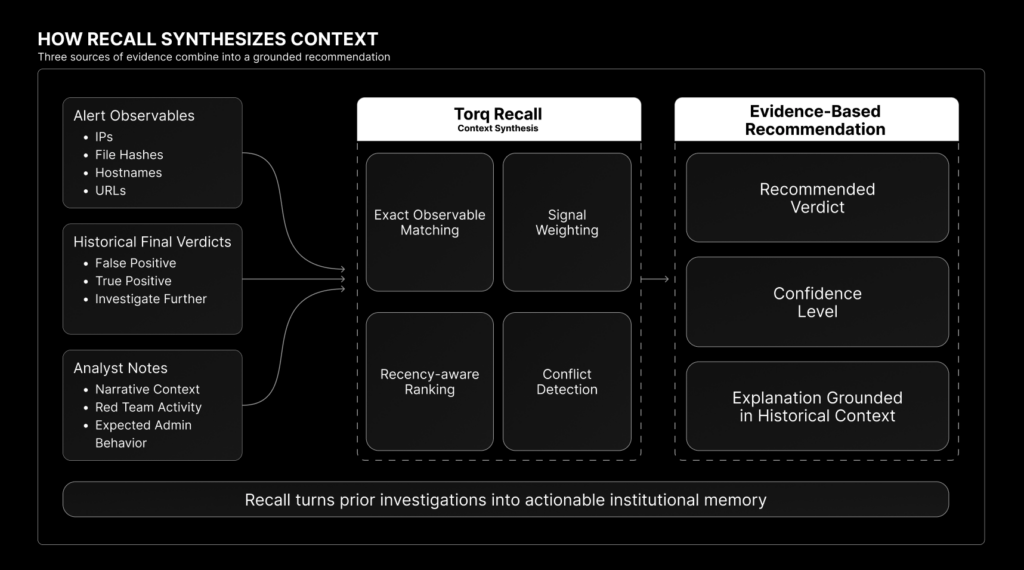
Torq Recall rejects fuzzy precedent matching in favor of Structured Retrieval. Instead of guessing, Recall relies on exact, deterministic overlaps of specific security observables — like IPs, file hashes, URLs, hostnames, or emails — to trigger a historical match. This ensures that every AI-driven triage recommendation is auditable, explainable, and grounded in verifiable evidence from your own environment.
But exact matching is only the first step. Recall also has to understand the signal strength. A match on a rare file hash, unique URL, or unusual email address can carry strong precedent. A match on a common binary like explorer.exe, or a widely shared corporate IP is much weaker. Torq Recall is designed to focus the AI on the security entities that actually matter — not just the ones that happen to overlap.
Deterministic Context Matching: Unlocking the Goldmine
Resolved cases are the raw material for AI SOC memory — the operational record of how your team actually works. Instead of leaving this context buried in closed tickets, Torq Recall seamlessly connects today’s raw alerts with yesterday’s finalized human reasoning.
When a new alert hits, Recall instantly searches your environment’s case history for relevant precedent. It does not treat every historical match equally: cases are prioritized based on exact observable overlap, signal strength, and recency. Because security environments change quickly, Recall applies a time-aware decay factor, allowing fresh resolutions to carry more weight while still preserving older institutional knowledge when the evidence is strong.
Crucially, Recall doesn’t just count past alerts; it analyzes the final resolution decision and the analyst notes.
AI in the Trenches: Handling SOC Chaos
In a real SOC, the data is rarely clean. Alerts arrive with partial context, telemetry is noisy, and human decisions are not consistently captured. Two similar cases may receive different labels, or the analyst’s notes may tell a more nuanced story than the final resolution field. If an AI system is designed in a sterile lab under the assumption of perfect data hygiene, it will inevitably fail when it encounters real-world ambiguity.
Torq Recall was designed not just to find historical matches, but to critically evaluate the quality and consistency of that precedent. Using rigorous LLM-in-the-loop stress testing, the AI was trained on curated case histories that mimic the messiest edge cases in a live SOC.
The guiding design principle was to build an “honest AI” that exhibits calibrated confidence. Instead of blindly forcing a recommendation when data is sparse or contradictory, Recall includes a subagent architecture that is instructed to act like a veteran analyst: it weighs the evidence, spots inconsistencies, and knows exactly when to ask questions.
The system gracefully manages real-world SOC chaos by identifying and adapting to complex scenarios like the ones below.
Real-World SOC Scenario
What was Encountered
How Torq Recall Handles It
Conflicting Precedent
Half of the historical alerts were closed as False Positives, while the other half were escalated as True Positives
Refuses to pick arbitrarily. Recall lowers its confidence score, explicitly flags the split precedent, and recommends the team “Investigate Further”
Misleading Labels (e.g., Red Team)
A past case is labeled “True Positive/Malicious,” but the analyst notes state: “Update: Part of a concluded red team exercise”
Prioritizes the narrative context in the notes over the static resolution label, recognizing that the threat is no longer active, and adjusts its recommendation accordingly
Severity Mismatches
Historical cases sharing an IP address were Critical-severity attacks, but the new alert is a Low-severity informational event
Highlights the severity mismatch as a key difference, ensuring it does not blindly inherit the escalation precedent of a completely different attack type
Weak Signal Overlap
The system finds a match, but it relies on a single, low-fidelity observable (such as a common corporate IP address)
Openly acknowledges the weak precedent, returns a “Low Confidence” assessment, and refuses to force a definitive recommendation
Inconsistent Data Entry
An alert is coded with a “False Positive” reason, but the detailed resolution notes describe actively blocking malicious activity
Flags the contradiction between the label and the details, lowering confidence to prevent the SOC from trusting bad data
To make this behavior reliable, we built a comprehensive testing and evaluation suite based on real-world data, including conflicting precedents, misleading labels, weak observable overlap, severity mismatches, and inconsistent analyst notes.
Recall is evaluated against these scenarios to ensure it surfaces discrepancies transparently instead of hiding them behind a black-box verdict. When the AI is honest about uncertainty and catches inconsistencies in past documentation, it builds the kind of trust analysts need before relying on automated triage.
From Tribal Knowledge to Institutional Memory
Letting the intelligence of your security team disappear the moment a ticket is closed is an architectural flaw that modern SOCs can no longer afford. Torq Recall fixes this by capturing analyst expertise implicitly, turning it into durable AI SOC memory without adding a single click to the workflow.
But this is just the foundational layer of institutional memory. We are currently expanding Recall’s contextual reach beyond closed cases. By integrating directly with the Torq data fabric, the system is evolving to capture deeper organizational context and fetch richer historical signals directly from your alerts. For an AI-native SOC, more context directly translates to better triage quality: the broader the historical data pool, the more precise and reliable the AI’s precedent matching becomes.
Ultimately, this continuous learning layer is being integrated across Torq’s wider product ecosystem, including Socrates — our AI SOC orchestrator. Building a resilient SOC doesn’t mean writing more rigid rules; it means deploying an AI teammate that seamlessly learns from every resolution your team makes.
Torq Recall is one piece of a larger body of work on how we build trustworthy, agentic AI for security operations. Our series on Context, Memory, and Learning in the AI SOC breaks down the architecture, testing methods, and design decisions behind the AI SOC.
Rony Fluk is a Senior AI Engineer at Torq, focused on building AI-native capabilities for modern security operations. He brings deep experience in LLM systems, automation, and agentic AI, designing deterministic, context-aware automation that helps SOC teams preserve institutional knowledge and make faster, more reliable decisions.
Noam Cohen is a serial entrepreneur building seriously cool data and AI companies since 2018. Noam’s insights are informed by a unique combination of data, product, and AI expertise — with a background that includes winning the Israel Defense Prize for his work in leveraging data to predict terror attacks. As the Head of Artificial Intelligence at Torq, Noam is helping build truly next-gen AI capabilities into Torq’s autonomous SOC platform.
The first half of 2026 is coming to a close. And unless you live under a rock, there is only one takeaway: The AI SOC revolution is here, and Torq is winning.
It started in January 2026: Torq secured our $140 million Series D, led by Merlin Ventures, with every single one of our existing investors doubling down, launching Torq into unicorn status at $1.2 billion and fueling the future of the agentic SOC.
Shortly after, Forbes said Torq is the “de facto leader of the AI SOC space,” noting that while the AI SOC boom is real, the work here at Torq started long before the buzz.
In March 2026, Torq became the Cursor of Security Operations, with agentic building capabilities that turn human intent into production-grade AI Agents in minutes, capable of handling triage, investigation, and response across every security solution in the SOC. This was a game-changer for CISOs and SOC leaders looking for a quick-start button for their AI SOC initiative.
It’s no surprise that the AI SOC space is moving fast, but it’s clear that Torq is leading the pack. So let’s talk about why and how.
The AI SOC Land Grab
The threat landscape is massively different than it was two years ago, heck, even six months ago. Attackers are using AI to develop and deploy the most convincing attacks ever seen, at a lower cost than ever before, and with a lower technical barrier to entry. According to CrowdStrike’s 2026 Global Threat Report, AI has enabled the bad guys to ramp attacks 89% year over year, with the fastest break-in they tracked taking only 27 seconds. What used to take months to build now takes hours.
Human-speed defense is no longer the answer to machine-speed attacks, and the market understood that. The problem is, the market overcorrected. Every vendor with an AI chatbot or a triage-only point solution wrapped their website in AI SOC messaging.
To start 2026, roughly 60 vendors claimed to be “AI SOC”; now there are over 100. We’ve seen the confusion firsthand, with different analyst firms defining the space in completely different ways. But the ones who spend the time to do the research — Gartner, KuppingerCole, and more — are reporting a consistent through line: end-to-end threat management, deep integrations across the entire security portfolio, and enterprise scalability.
Some influencers even claim the AI SOC market is already commoditized; we completely disagree. That’s a convenient argument if your product is triage-only, because that space is crowded and there’s no sign of growth slowing any time soon. The space is not commoditized; it’s fragmented. Broken up by hundreds of vendors calling different tools by the same name, leading to SOC teams making purchase decisions they will regret in six months when they realize agentic triage and an AI SOC platform are not one and the same, and defining it as such only works if you believe triage is all the SOC ever needs to do. But as we know, the work doesn’t end there.
Triage-Gate: The AI SOC Definition Rendition
Let’s be specific about what triage-only tools do and don’t do.
Triage does one thing: it prioritizes risk. It tells you which alerts are real and which aren’t, ranks them by severity, and recommends what should happen next. It doesn’t matter if you work in a Fortune 100 enterprise security operations center, or work in the front of an Emergency Room at the hospital. Triage, by definition, remains the same. Who is bleeding out and needs immediate emergency medical intervention? Who is more benign and can be handled with a simple automated email quarantine, followed by an IP address added to the company block list?
Here’s what triage doesn’t do: It doesn’t investigate a threat. It doesn’t contain it. It doesn’t remediate it. It doesn’t close the case. It simply analyzes the risk, reaches a conclusion, hands a to-do list to a human analyst, and then it’s done.
That means triage-only AI still ends with a human opening a ticket at the start of the actual security work. The investigation is still happening manually, and the evidence is gathered by hand, across disparate tools and queries. The response action requires an incident responder to log into a separate platform and make the necessary calls.
That is, by no means to say that AI alert triage isn’t valuable. In fact, alert volume has become so unmanageable in modern SecOps that, in Torq’s 2026 AI SOC Leadership Report, 97% of respondents reported confidence in AI’s ability to address the problem. However, from that same report:
37% are actually using AI for triage
90% reported challenges with AI Triage
80% rely on multiple point-specific tools
80% say this creates operational complexity
And therein lies the problem. The queue is prioritized, sure, but the SOC is still functioning at human speed. The bottleneck has moved. The enterprise remains exposed. The attackers still have the upper hand.
Torq Auto Triage: Going Beyond Analysis
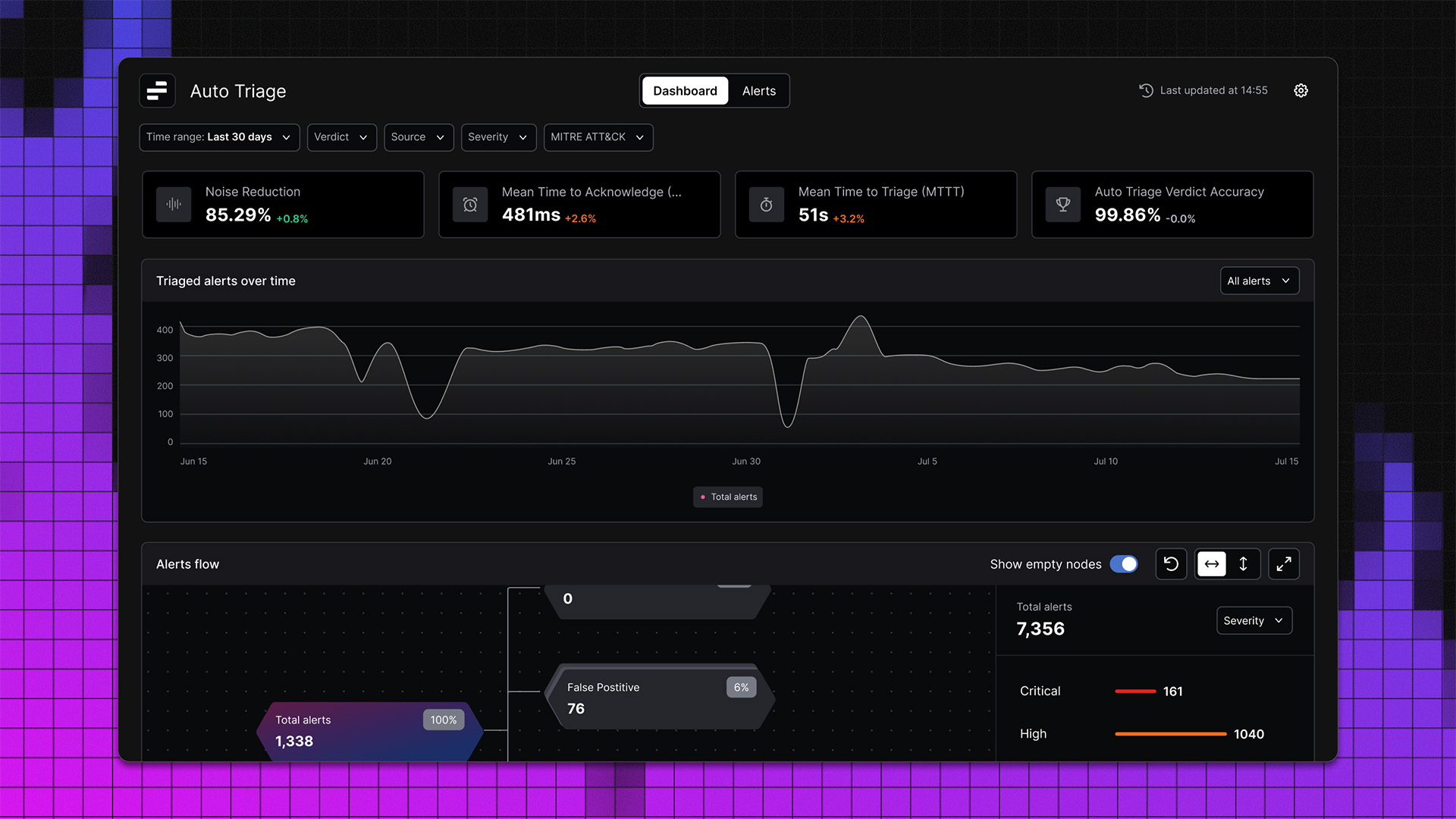
This is not a knock on triage as a function; it’s a knock on calling it an AI SOC when the job isn’t finished. Torq Auto Triage is a key function of the Torq AI SOC Platform. Our customers leveraging Torq Auto Triage report 60x improvement in triage velocity, a mean-time-to-triage (MTTT) of 45 seconds, at a 97% reduction in EDR noise alone — with ruthless accuracy across hundreds of thousands of alerts per week in some of the largest Fortune 500 companies in the world.
Torq Auto Triage is the agentic engine that applies business context, threat intelligence, and historical case knowledge to deliver verdicts, suppress noise across your SOC, and prioritize threats that actually matter before they become incidents. Most importantly, however, Torq Auto Triage is fully integrated into the entire Torq AI SOC Platform, which then takes the baton through deeper investigation, containment, and remediation actions — all while continuously improving accuracy by grounding every decision in the Torq Context Graph.
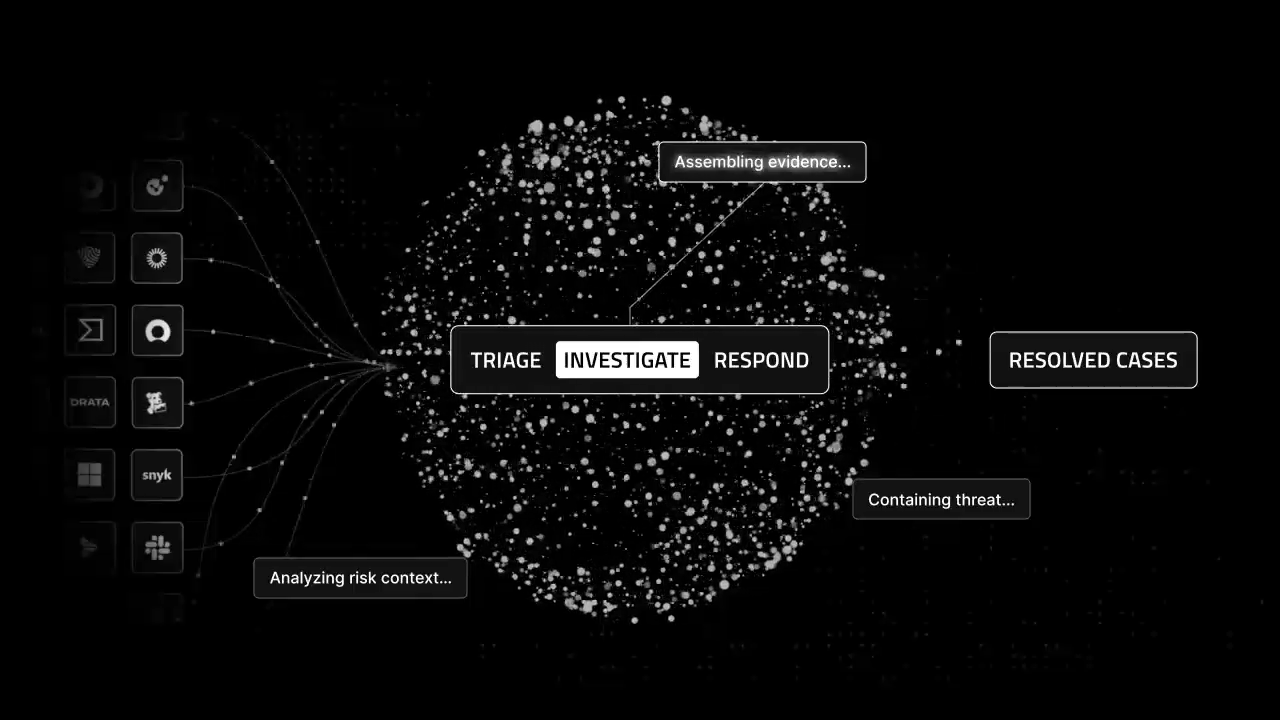
A true AI SOC has to do everything a SOC does — not triage only, but manage the complete threat lifecycle from alert through resolution. That means triage, investigation, response, and case closure. And that is the difference.
Torq’s deep-rooted history in agentic SecOps and automation means we are not only capable of triaging the alerts firing from every corner of your SOC, but investigating and responding to threats across every security tool you integrate into the platform.
The complete security stack, the complete threat lifecycle, the complete AI SOC Platform.
The AI SOC Bar Should Be Higher
The AI SOC market is crowded, and it’s only getting louder with new vendors emerging from stealth mode what seems like every day. Most of them solve the narrow problem of triage, leveraging AI to ingest alerts, enrich them with threat intelligence, and surface a verdict to the awaiting human team. Others are beginning to add threat hunting capabilities to the mix, not because it’s the logical next step, but because it’s the only remaining SOC function that doesn’t require them to crack the code on taking action.
That should be table stakes. The bar needs to be higher. And Torq is setting it.
The questions SOC teams need to ask are:
Once you’ve triaged the alert and surfaced the risk, what happens next?
Who handles the investigation?
Does the AI agent contain the threat and stop the spread before wasting more valuable exposure time escalating the proposed response plan to the analyst?
Can the platform automatically remediate the Tier 1 and Tier 2 threats that don’t require human intervention?
Does it integrate with the security stack your team has already built to ensure complete visibility into every possible IOC?
Does it learn from, and remember, analyst exceptions, escalations and deviations from SOP so its verdicts aren’t based on last month’s playbooks, before the next VoidLink-level AI-generated threat changes everything about how your SOC operates?
If the answer stops at “we surface the risk,” then that is a useful tool, but it’s not an AI SOC.
Per our 2026 research, 92% of security leaders cite at least one factor actively reducing their trust in AI in the SOC today. Black-box reasoning was the number-one concern for SOC directors specifically. An AI that hands you a verdict without showing its work doesn’t solve the trust problem; it defers it until the first false positive blows up a production system at 2am. Deploying agentic AI without the right guardrails is its own category of risk.
What a Real AI SOC Platform Looks Like
The Torq AI SOC Platform runs the complete end-to-end threat lifecycle, and fast. At Carvana, Torq handles 100% of Tier 1 security alerts. A global biotech enterprise recently reported a 97% noise reduction in EDR alert triage and a 92% decrease in mean-time-to-resolve (MTTR) from the full Torq AI SOC Platform, in just their first quarter, leveraging the platform.
Torq Agentic AI handles 100% of Tier 1 security alerts.
Carvana
In the first quarter, Torq delivered a 97% noise reduction in EDR alert triage and a 92% decrease in MTTR.
Global Biotech Enterprise
These are real stories, across real enterprise customers, and they don’t stop there. Torq processes more than 1 billion automated actions across our customer base each week, including Chipotle, LEGO, Marriott, Procter & Gamble, Scotts, Siemens, Valvoline, and Virgin Atlantic.
When Gartner named Torq the Company to Beat in AI SOC Agents for Threat Investigation in May 2026, they mentioned Torq’s “combination of deterministic and agentic reasoning, multi-agent system, and model context protocol integration makes it the pacesetter in AI SOC agents for threat investigations.” 1
Here’s how it works:
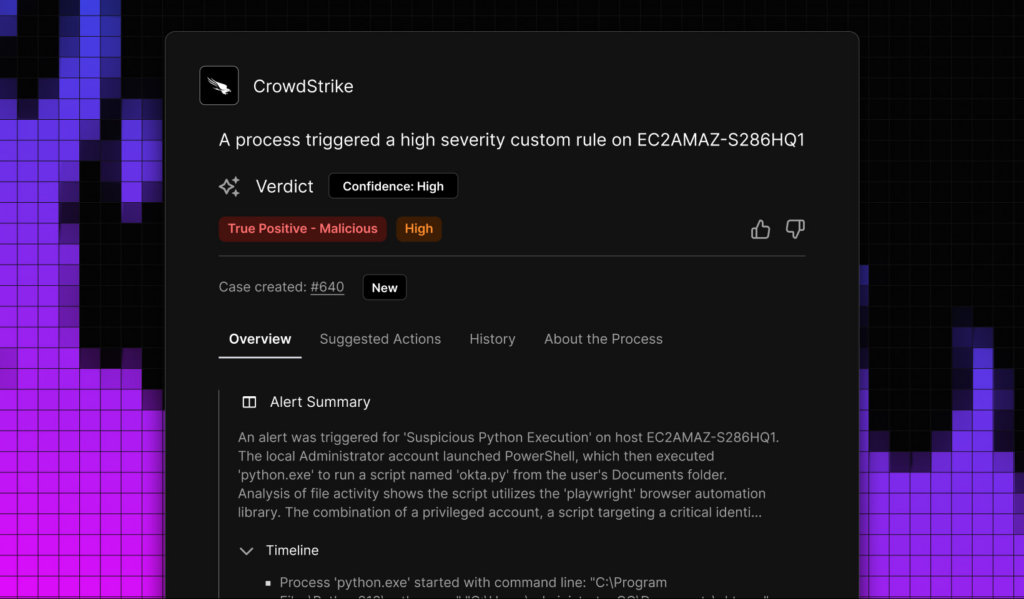
Torq Auto Triage handles ingestion and prioritization, normalizes alerts to the Open Cybersecurity Schema Framework (OCSF), enriches every alert with commercial and OSINT threat intelligence, plus your own organizational context, and applies agentic reasoning to separate real risk from noise. Verdicts come with MITRE ATT&CK® mapping, severity scoring, and full transparency into how the conclusion was reached. True positives don’t generate a recommendation; they automatically become cases in Torq Case Management, with context already assembled and next steps already queued.
From there, Torq SocratesTM, the core orchestrator of the Torq AI SOC Platform, takes over. Socrates plans and coordinates specialized Torq HyperAgents™ that investigate cases, gather evidence, build timelines, and document their reasoning in real time. SecOps engineers simply describe what they need in plain language, and Socrates agentically builds these production-ready AI agents in minutes.
None of this works without the deep integration of Torq HyperautomationTM, and this is where the breadth matters. Torq has over 400+ pre-built integrations across EDR, IAM, SIEM, Network, Email, Cloud, and more. Creating a new integration point to feed alerts into the Torq AI SOC Platform is simple with Socrates’ agentic builder capabilities. Whether a use case is common or completely custom, the platform can handle it — and building new automated security actions no longer requires weeks of engineering work. Bottom line, your existing security stack stays.
With the platform configured and the triage verdicts rolling in, Socrates orchestrates the whole operation, managing case handoffs, executing response actions, and closing cases when the work is done. Over 90% of cases close completely autonomously, while the analysts focus on what actually needs human judgment.
Finally, the Torq Context Graph and memory layer powers every agentic decision in a live, continuously updated model of your environment, grounding each verdict in your environment’s truth and your analysts’ past judgments.
Two mechanisms power that memory: Recall, which surfaces the most relevant historical case precedents each time a new alert arrives, and Reflex, a per-tenant model, developed by Torq Labs, that trains continuously on your team’s confirmed verdicts and corrections. This means every Auto Triage verdict, every Torq HyperAgents investigation, and every autonomous Socrates response is based on the same organizational context, improving the decision-making with each alert prioritized and case closed. A single through line, grounding the AI SOC in real context, across the complete SecOps lifecycle.
The Verdict is the Start, Not the Finish
The AI-generated threat landscape that SecOps teams are operating in today is not going to simplify. Attacks will get faster, more convincing, and harder to keep up with. The velocity gap between machine-speed offense and human-speed defense cannot be closed by a tool that prioritizes risk and then hands it back to a human.
You need an AI SOC Platform that goes beyond analysis — triages, investigates, contains, and remediates at machine speed, with complete transparency into every decision. That’s the blueprint 450 security leaders described when asked what a real AI SOC should do, and that’s what the Torq AI SOC Platform delivers.
Triage gets you to the starting line, but what wins the race is everything that comes after it.
See the full threat lifecycle in action. Get a demo.
1 Gartner, AI Vendor Race: Torq Is the Company to Beat in AI SOC Agents for Threat Investigation (Document ID: G00855833)
Gartner, AI Vendor Race: Torq Is the Company to Beat in AI SOC Agents for Threat Investigation, Tom Powledge, Matt Milone, 25 May 2026.
GARTNER is a registered trademark and service mark of Gartner, Inc. and/or its affiliates in the U.S. and internationally and is used herein with permission. All rights reserved.
Gartner does not endorse any vendor, product or service depicted in its research publications and does not advise technology users to select only those vendors with the highest ratings or other designation. Gartner research publications consist of the opinions of Gartner’s research organization and should not be construed as statements of fact. Gartner disclaims all warranties, expressed or implied, with respect to this research, including any warranties of merchantability or fitness for a particular purpose.
David Melamed is Head of Emerging Technologies at Torq. He joined through Torq’s acquisition of Jit, which he co-founded and led as CTO since 2020, building agentic security on a production Context Graph. A cloud security veteran with 20+ years of experience, David previously held senior technical roles at Cisco (via the CloudLock acquisition) and MyHeritage.
Key Takeaways
An AI SOC agent is only as good as the picture it reasons from, and in most SOCs that picture is rebuilt from scratch on every alert.
Good grounding is current, traceable, decision-capturing, and isolated per tenant.
Keeping context correct is an engineering discipline: freshness, decisions-as-data, and reading the graph instead of re-querying the stack.
I spent a couple of years at Jit building security agents, and the lesson that stuck wasn’t about the models. It was about what the models stand on.
The SOC’s problem was never a shortage of reasoning. It’s a flood of noise with no shared memory. In the SANS 2025 Detection and Response Survey, 73% of teams named false positives their single biggest detection challenge. The average breach still took 241 days to contain, per IBM’s 2025 Cost of a Data Breach report. Drop a smarter agent into that, and you get faster wrong answers.
That gap is the real story of the agentic SOC, and it’s an engineering problem, not a model one. Everyone now claims their AI agents are “grounded in context”; far fewer can say what that context costs to keep correct. Having built one in production, I can tell you what good looks like — and what it takes to build.
What CISOs Should Demand From the Layer Underneath the Agents
Strip away the vendor language, and good grounding is simple: a living model of your environment that an agent can reason on, and you can audit. Four properties separate the context you can trust from context that quietly goes wrong.
Current, not a snapshot. Context decays: ownership changes, services get decommissioned, exceptions expire. A graph that was right at ingestion is wrong by the next alert. The test isn’t whether the data were fresh when you loaded them; it’s whether they’re true when the decision is made.
Traceable. For any recommendation, the system should show what it knew, when it knew it, and where it knew it. That’s why 90% of leaders in Torq’s 2026 AI SOC Leadership Report said explainable AI decisions matter most.
Decision-capturing, not just topological. That a user connects to a device is inventory. Why your senior analyst closes an alert the SOP says to escalate is judgment, and judgment is what walks out the door when they leave.
Isolated. This layer encodes your most sensitive truth: who’s privileged, what’s exempt, where the gaps are. It has to stay yours.
The field bears this out. Practitioners in that same survey rated generative AI tools their least satisfying category of tooling: adoption is real, trust lags. Yet IBM found that teams using AI and automation extensively had average breaches of $3.62 million, compared with $5.52 million for those that didn’t. Grounded AI pays off; ungrounded AI disappoints.
How Torq Grounds Its Agents in a Context Graph
In the Torq AI SOC Platform, that layer is the Context Graph: a live model of your environment every agent reasons on, not a static store each agent re-derives. Torq’s acquisition of Jit — the team I led — brought in a context graph already running in production, moving Torq from a platform that enriches alerts to one that acts on the full story of a case.
The Context Graph doesn’t just inventory what exists; it encodes what it means. Craig and John have the same laptop, and the same alert fires on both. But Craig is a contractor with read-only marketing access; John is a finance director with access to the M&A data room. Same signal, different verdicts.
The critical part here is the decision layer: every verdict, exception, and SOP deviation is stored as a queryable object, not buried in a case note nobody reads. Run it long enough, and the graph reflects how your SOC actually operates, not the runbook from two years ago.
How the Context Graph Works Under the Hood
Four engineering choices decide whether a context graph is trustworthy or just decorative: how it keeps time, how it represents meaning, how it records decisions, and how agents read it without hammering your source systems. None of them is solved by a bigger model.
Every fact carries two clocks: when it was true in the world (valid time) and when the graph learned it (transaction time). That bitemporal model is what makes a verdict replayable. An agent reconstructs the graph as of the moment the alert fired. It reasons against what was true then, not today’s view projected backward onto a two-week-old event.
Facts expire on their own: an exception with a valid-to date in the past stops shaping verdicts the moment it lapses, with no cleanup job required. Where a source streams changes, the graph updates within seconds; where it doesn’t, scheduled reconciliation diffs the source and patches what moved. The goal is to maintain one current, materialized view of the environment rather than re-derive it from scratch on every alert.
2. Typed Meaning, Not Generic Links
The edges carry semantics. Not a vague “related to” but rather “approved by,” “governs,” “grants access to,” “depends on” — the actual operational relationship between two nodes. Policies, access controls, and retention rules live in the graph as queryable nodes too, not as prose buried in a wiki.
That lets an agent traverse a real question — who can approve an exception for this asset, which policy governs this data, what gets exposed if this identity is compromised — as a graph query with known semantics, instead of inferring it from free text and hoping. Typed structure is what turns a diagram into something an agent can plan over.
3. Decisions as First-Class Nodes
This is the part most platforms never build, because it’s a data-model problem, not a feature you can bolt on later. Every verdict, exception, override, and escalation becomes a node in its own right. Each carries who or what made the call, the context available at the time (linked to the as-of state of the graph), the SOP it followed or broke from, and the outcome.
That captures the delta between the written process and what your team actually does — the institutional knowledge that normally lives in senior analysts’ heads and Slack threads, and leaves with them. An agent that only knows your playbook is brittle; one that also knows when your seniors override it, and why, is one the team can work alongside. It’s also what the next agent recalls: a new alert gets triaged against the decisions your SOC already reached on ones like it.
4. Read the Graph, and Keep It Yours
Re-querying the SIEM, EDR, and IAM from scratch on every alert is slow, costly, and punishing to the systems you depend on. Torq’s AI agents reason from one shared, current, normalized layer, so investigations compound instead of restarting at zero, and every action traces back through the reasoning chain to the decision behind it.
And because that layer encodes your most sensitive operational truth — who is privileged, what is exempt, where the gaps are — isolation is an architecture decision, not a config flag. Each tenant’s graph is its own store, learning stays per customer, and your data never enters a shared pipeline.
Where Context Fits in the Agentic SOC
The grounding layer, not the model, is where the real work of the AI SOC happens. You can swap the reasoning engine next quarter. What compounds over time is the graph that knows your environment, remembers your team’s decisions, and stays true as both change — and it’s the foundation most platforms skip, because it’s hard to build and harder to keep correct.
This is the first post in our series on Context, Memory, and Learning in the AI SOC. The next will introduce recall memory: how Torq pulls the most similar past cases to reach an automated verdict on a new alert, triaging it from what your SOC has already decided.
See what 450 security leaders said they want from AI in the SOC — and how to tell the platforms that can deliver from the ones that can’t.
The AI SOC category just got its definitive race assessment, and Torq is at the front.
In the May 2026 Gartner® report AI Vendor Race: Torq Is the Company to Beat in AI SOC Agents for Threat Investigation (Document ID: G00855833), Gartner names Torq the Company to Beat. Torq.io’s combination of deterministic and agentic reasoning, multi-agent system, and model context protocol integration makes it the pacesetter in AI SOC agents for threat investigations.
A Hybrid Architecture That Pure-Inference Platforms Can’t Match
According to Gartner, Torq’s defining architectural choice is the combination of its proprietary hyperautomation engine with agentic AI — rather than relying on inference alone. The hyperautomation engine provides deterministic, rule-based workflow execution for repeatable, high-volume tasks such as deduplication, normalization, and escalation routing. Socrates, the agentic OmniAgent layered on top, provides adaptive reasoning, deep investigation, natural language collaboration with analysts, and autonomous remediation for complex, novel threats. This hybrid architecture delivers what pure-inference competitors cannot: consistent, auditable outcomes for routine cases combined with human-level judgment for complex incidents.
According to Gartner, “This hybrid architecture delivers what pure-inference competitors cannot: consistent, auditable outcomes for routine cases combined with human-level judgment for complex incidents.”
We feel that this is the architectural bet Torq placed years ago. Torq believed then, and now more than ever, that this positions our customers for success as agentic AI is poised to fundamentally transform SecOps by working alongside human experts. This architectural decision and investment have now met the market moment.
Inside Torq’s Multi-Agent System
As part of Torq’s multi-agent system (MAS), Torq HyperAgents™ are coordinated by Socrates, Torq’s agentic orchestrator of the Torq AI SOC Platform. Moreover, Socrates serves as an agentic thought partner for natural-language collaboration with analysts as they investigate threats. Its Agentic Builder capability converts natural-language intent into production-ready Torq HyperAgents.
Torq HyperAgents collaborate in real time across the entire threat lifecycle, including but not limited to:
Triage, to ingest and normalize telemetry from across the security stack.
Investigation, to conduct root cause analysis, correlate related activity, and document evidentiary artifacts within Torq Case Management for collaboration and communication with stakeholders
Response, to rapidly contain threats and to remediate root cause
Socrates coordinates these specialized agents, managing handoffs and escalation decisions across the case lifecycle. Per the report, “Torq’s multiagent system represents the most mature multiagent implementation among dedicated AI SOC vendors.”
MCP-Native Architecture as a Structural Lead
Gartner identifies Torq’s native Model Context Protocol (MCP) integration as “the most consequential technical differentiator in the category. MCP standardizes how AI agents exchange context with external tools and data sources, enabling agents to dynamically discover, query, and act on any MCP-compatible system without requiring prebuilt API integrations.”
Torq serves as both an MCP host (accessing external MCP servers) and a client (exposing its own workflows as MCP tools for other agents). This is what an AI-native architecture looks like in 2026, built from the ground up to operate as part of an interoperable agentic ecosystem.
Enterprise Scale, Time to Value, and Commercial Momentum
The Gartner report includes several observations on the size, momentum, and trajectory of the Torq customer base.
On customer base and global reach, the report states: “With over 250 enterprise customers — a figure that doubled in 2025 — and global enterprise references, Torq has achieved cross-sector production validation at a scale no pure-play AI SOC competitor has matched.”
On time-to-value, the report observes: “Customers report being live and automating phishing triage within 48 hours — a time-to-value metric that sets the benchmark for the category.”
On the MSSP channel, the report describes: “Its MSSP channel is equally mature: providers like RSM use Torq AI SOC Platform as the operational backbone of their managed security service delivery.”
On financial position, the report notes Torq’s “$1.2 billion valuation and $332 million in total funding that provide the most substantial resource advantage in the category.”
For buying teams evaluating which AI SOC vendors will still be evolving their platforms three years from now, the combination of enterprise traction, time to value, channel maturity, and financial position helps inform a more complete vendor evaluation.
Our Take on the AI SOC Category
The AI SOC category is just over a year old. Most of the platforms in today’s conversation did not exist 24 months ago. For security buyers, the question isn’t whether AI belongs in the SOC — that’s settled, with 94% of security leaders now using AI in at least one SOC function. The harder question is which platform to anchor the AI SOC on, and which vendors have the architecture and commercial muscle to operate at enterprise scale three years from now.
Automation and agentic reasoning are complements rather than substitutes
The platform that wins will be the one buyers can run end-to-end across the threat lifecycle
We believe this Gartner analysis confirms that this architecture is where the category must head. It is certainly where Torq already resides. And we are not done.
The Road Ahead for the AI SOC
The AI SOC category will continue to evolve. New entrants will push the architecture, and the leader designation will be contested. From our perspective, the architecture we built — and the customer base built on top of it — sets a benchmark we plan to keep raising.
Read the full report, accessible to Gartner clients only.
Gartner, AI Vendor Race: Torq Is the Company to Beat in AI SOC Agents for Threat Investigation, Tom Powledge, Matt Milone, 25 May 2026.
GARTNER is a registered trademark and service mark of Gartner, Inc. and/or its affiliates in the U.S. and internationally and is used herein with permission. All rights reserved.
Gartner does not endorse any vendor, product or service depicted in its research publications and does not advise technology users to select only those vendors with the highest ratings or other designation. Gartner research publications consist of the opinions of Gartner’s research organization and should not be construed as statements of fact. Gartner disclaims all warranties, expressed or implied, with respect to this research, including any warranties of merchantability or fitness for a particular purpose.
Every security vendor promises great support. Dedicated Customer Success Manager. Fast response times. Proactive guidance. It’s in the pitch deck and on the pricing page, somewhere between “seamless onboarding” and “24/7 availability.”
And for the first few months, it’s usually true. Someone knows your name. The check-ins are regular. Requests get handled.
Then your CSM rotates. The ticket queue replaces the direct line. Feature requests disappear into a backlog you’ll never see. The quarterly business reviews become a formality — if they happen at all. And you realize that “dedicated support” meant “dedicated until renewal.”
This is the pattern security teams describe again and again when they talk about the vendor they had before Torq.
Five Years on a Legacy Platform and a Support Model That Quietly Eroded
A five-person cybersecurity team at a global commercial real estate firm spent nearly five years on a legacy platform. The product worked okay. Support did too — at first.
“[Their support] started decent but became less responsive year over year,” the Director of Cybersecurity Engineering and Operations recalled. “We got pushed to the general help desk. No regular check-ins. No proactive guidance.”
The Lead Cybersecurity Engineer who ran the platform daily put it more bluntly: “You’re kind of a number with them.”
This wasn’t a dramatic support failure. Nobody filed a ticket that went unanswered for weeks. The issue was subtler and more corrosive: the vendor had lost its investment in the team’s success. No working sessions to optimize their environment. No one flagging new features that could solve existing pain points. No one reviewing their workflows and saying, “Here’s a better way to do this.”
The platform didn’t evolve, and neither did the relationship.
For a lean team that needed every edge it could get, that passivity was a liability.
A Support Model Built Around Capability, Not Dependency
When the team migrated to Torq, the difference wasn’t incremental; it was structural.
Implementation was a partnership, not a handoff. The team’s implementation partner at Torq didn’t build the platform for the customer and hand over the keys. He reviewed the Lead Cybersecurity Engineer’s work, suggested improvements, and made sure the team owned the knowledge. By the time migration was complete, the team had deep platform expertise in-house — from day one.
That’s a deliberate choice. Building everything for a customer is faster, but it creates dependency. Dependency is how the last vendor relationship went sideways. Torq’s model builds capability, not reliance.
The relationships are direct and personal. The team works with a dedicated CSM and a technical Sales Engineer they can reach directly — not through a ticketing portal or a dispatcher. Response times are under an hour. When the Lead Cybersecurity Engineer has a question, he calls someone at Torq who knows his environment. That person picks up.
“I feel like I have an extension of myself [at Torq] that I can reach out to whenever I need to.”
– Lead Cybersecurity Engineer
The learning goes both ways. The Lead Cybersecurity Engineer and his Torq SE hold regular working sessions to exchange knowledge. The engineer shows the SE creative solutions he’s built. The SE shows the engineer platform capabilities he hasn’t explored yet. Both sides look forward to these sessions.
Proactive, not reactive. Torq’s team monitors platform health, flags opportunities, and brings new features to the customer’s attention with specific context on how they apply to their environment. That’s the difference between a support team and a success team.
1,000+ Hours Saved: The Support Behind the Numbers
Support quality rarely makes the top three criteria in a vendor evaluation. It should.
Every security automation platform is only as good as the team operating it. And the team operating it is only as effective as the support behind it. When a five-person security team is building, maintaining, and expanding an AIS program across an entire enterprise portfolio, the difference between “submit a ticket and wait” and “call your SE and solve it in an hour” is the difference between shipping new workflows every month and shipping none.
This team saved nearly 1,000 analyst hours and $120,000 in Q1 2026 alone. They’re targeting $600,000 savings for the year. Those numbers reflect the platform, yes — but they also reflect a support relationship that accelerates the team instead of slowing it down.
The Lead Cybersecurity Engineer built custom integrations to tools that weren’t natively supported. With his previous vendor, that would have meant a professional services engagement — a separate contract, a separate timeline, a separate team unfamiliar with his environment. With Torq, he used the integration builder, got stuck on one piece, called his SE, and had it resolved the same day.
Every integration this team builds themselves is a professional services engagement that they don’t pay for. Every workflow they ship without waiting in a support queue is time returned to the operation. The ROI of good support doesn’t show up as a line item. It shows up in everything else moving faster.
From Customer Workaround to Platform Feature
The Lead Cybersecurity Engineer is now collaborating with Torq to build his homegrown ROI tracking methodology into the platform for other customers to use. That’s not a support interaction. That’s co-development. It started when the Torq team saw what he built, recognized its value, and asked, “Can we make this a feature?”
That doesn’t happen when your vendor treats support as a cost center.
The Director of Cybersecurity Engineering and Operations framed the contrast in terms any buyer should hear before signing a vendor contract: “There’s a desire from Torq that we get the most out of this tool as possible. With our old vendor, you’re one of many products — not even customers.”
That distinction — between being a product user and being a customer — is the entire gap.
Five Questions That Reveal a Vendor’s Real Support Model
If you’re evaluating security automation platforms, these questions will reveal more about support quality than any reference call:
Who is my day-to-day contact, and how do I reach them? If the answer involves a ticketing portal as the primary channel, that tells you everything. Direct access to a named human who knows your environment should be the baseline, not a premium feature.
What does onboarding look like — do you build for me, or with me? A vendor should do both, depending on what you need. Some teams want us to ship the deployment fast so they can start running cases on day one. Others want to learn the platform alongside the build so they own every workflow from the start. We do both, often in the same engagement — fast deployment for the high-volume use cases, hands-on enablement for the workflows your team will iterate on long-term. Either way, you walk away owning what you run.
How will the relationship evolve after implementation? Regular working sessions, proactive feature guidance, and platform health monitoring should be standard, not require an escalation.
What happens when I need something outside your integration library? This is where support models diverge sharply. Some vendors route you to professional services with a separate SOW. Others give you the tools to build it yourself and the support to unblock you when you get stuck.
Can you show me what support looks like for a team my size? Lean teams need more support, not less. If the vendor’s model scales by reducing access, you’ll feel it within six months.
“A Thousand Times Better”
When asked to compare Torq’s support to the vendor they replaced, the Lead Cybersecurity Engineer didn’t hedge: “Torq support has been a thousand times better. And I’m not overemphasizing — I actually mean a thousand times.”
Most vendors will tell you they care about customer success. Torq is built so you don’t have to take their word for it.
Security automation has evolved dramatically. The rule-based playbook model built for a different era of threats can’t keep pace with today’s alert volumes and attacker speeds.
AI-driven security automation uses AI Agents to handle the full SOC lifecycle: triage, investigation, response, and resolution.
Three pillars define the new model: agentic execution, context grounding, and end-to-end coverage.
Enterprise SOCs are deploying AI-native platforms and seeing measurable results in resolution rates, analyst capacity, and time-to-contain.
Security automation used to mean building a playbook. Someone on the team mapped out a workflow, connected a few tools, and watched it run on the alert types it was designed for. That worked for a while, in a different environment than the one security teams operate in today.
The gap is architectural, not effort-based. The automation model most teams inherited was built for a world where alert volumes were manageable, playbook maintenance was sustainable, and attackers moved at human speed.
This blog covers what changed, why it matters operationally, and what to look for in the platforms built for the new model.
What Has Changed in Security Automation Since 2021?
The automation model from five years ago was a real step forward. Codifying SOC workflows into repeatable playbooks reduced manual work, improved consistency, and let smaller teams cover more ground. For the threats and volumes of that era, it was the right tool.
Three forces have since pushed the model past its limits:
Alert volume has outpaced hiring. The analyst pipeline hasn’t kept up with the alert pipeline. 90% of security leaders say AI has positively impacted SOC workload — because without it, teams were drowning. You can’t hire your way out of the volume problem. The math doesn’t work.
Attackers are operating at machine speed. The CrowdStrike 2026 Global Threat Report clocked the average eCrime breakout time at 29 minutes, with a fastest observed time of 27 seconds. Response workflows measured in minutes aren’t designed for that reality.
AI capability has crossed into production. Agentic execution — AI Agents that reason through a case, take action, and escalate at the right boundary — is running in SOCs today. Building for agentic execution from the ground up expands what’s possible — you get broader coverage, deeper reasoning, and the ability to handle cases no one ever programmed for.
The category is moving fast. Most implementations haven’t caught up yet.
What is AI-Driven Security Automation?
AI-driven security automation uses AI Agents to handle SOC work end-to-end — from triage through investigation, response, and case resolution — with grounded operational context and analyst oversight when warranted. It replaces rule-based playbooks with autonomous agents that reason on context, learn from analyst decisions, and adapt as the environment changes.
The practical difference shows up in three ways.
Legacy Security Automation
AI-Driven Security Automation
Execution model
Rule-based playbooks, hand-built workflows
AI Agents operating under declarative instruction
Coverage
Limited to pre-built playbook scope
Unbounded alert types — handles what it wasn’t programmed for
Adaptability
Requires manual rewriting as threats evolve
Learns from analyst decisions over time
Speed is measured in seconds rather than minutes. Coverage expands from playbook-bounded to unbounded. Adaptability shifts from a maintenance task to a native capability.
The architectural distinction matters here. Layering AI features onto a workflow-based engine changes the execution speed. Building for agentic execution from the ground up changes what’s possible. Such as the scope of coverage, the depth of reasoning, and the ability to handle cases the platform was never explicitly programmed for.
Before you evaluate platforms, it’s worth understanding how AI Agents work in the SOC and where agentic execution delivers the biggest operational lift.
Why is Traditional Security Automation Falling Behind?
Three failure modes compound, and most teams are dealing with all three at once.
Tool sprawl. The average SOC runs seven AI tools. 80% of security leaders say their tools are still fragmented, and adding more point solutions doesn’t close the gap. It makes it bigger. Each new tool introduces its own interface, data model, and maintenance burden.
Rule rot. Workflows built last year don’t map cleanly to this year’s threat landscape. Quarterly playbook reviews rarely happen. Version control for automation logic mostly doesn’t exist. Teams often don’t notice until something breaks under pressure.
The cumulative effect is a security stack that costs more each quarter while the MTTR climbs and attackers operate at speeds that make manual investigation timelines structurally unworkable.
The opportunity is real: addressing these three failure modes with an AI-native architecture — one built for agentic execution, context retention, and end-to-end coverage — is where teams are finding the biggest gains.
What Makes Security Automation “AI-Driven”?
Three pillars separate AI-driven security automation from automation with AI features attached. Each one is non-negotiable.
1. Agentic Execution
AI Agents are autonomous, scoped, and accountable. They handle the case rather than triggering a static playbook. Each agent operates under declarative instruction: a defined role, defined tools, defined data access, and a defined decision boundary. It reasons through the case, acts within its authority, and escalates at the right threshold.
Torq HyperAgents™ is built on this model. Every action is logged in a transparent timeline. Every decision sits in an immutable audit log. 90% of security leaders say explainable AI decisions matter most. Agentic execution delivers that transparency by design, because each step in the agent’s reasoning is visible and auditable.
2. Context Grounding
Agentic execution without context leads to worse decisions. The Torq Context Graph keeps every agent grounded in the operational reality of the environment, providing a full picture of who the user is, what the asset means, which policies apply, and what the team has decided in similar situations.
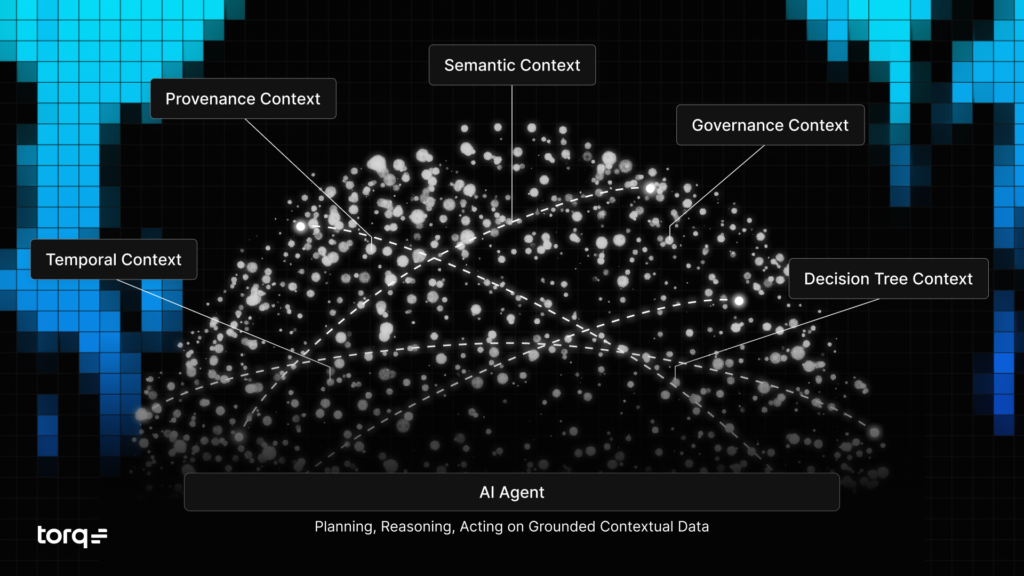
The Context Graph operates across five dimensions: temporal (when), provenance (source), semantic (meaning), governance (constraints), and decision trace (why). With the recent Jit acquisition, Torq extended this grounding capability across the full agentic lifecycle, accelerating the context work by years. 92% of security leaders rank continuous learning as the top capability they want in an AI SOC platform. Continuous learning depends entirely on a context layer that captures and retains decisions over time.
3. End-to-End Coverage
Most “agentic AI” tools on the market focus on triage. They generate a verdict, attach some context, and hand it off to a human. Investigation, containment, remediation, and case closure remain manual work.
End-to-end means the Torq AI SOC Platform handles everything: triage, investigation, response, and resolution. All on a unified case management layer with consistent context at every step.
Where Does AI-Driven Security Automation Deliver?
The use cases with the highest ROI share three traits: high volume, repeatable structure, and heavy manual context requirements. Where all three are present, AI-driven automation compounds fast.
Phishing Triage and Response.Phishing remains one of the highest-volume, most time-consuming workflows in the SOC. Lennar Corp cut phishing response time from hours to minutes after consolidating workflows on the Torq AI SOC Platform, the kind of operational shift that frees analyst capacity for higher-complexity work.
Identity Threat Response. Identity-driven attacks are now the dominant initial access vector. AI-driven automation correlates identity anomalies across IAM, EDR, and cloud control plane in seconds. The speed difference at this stage is the difference between containment and breach.
Multi-Cloud Alert Triage. Alert volume across AWS, Azure, and GCP is a problem no human team can process at scale. Bloomreach scaled automation beyond the SOC entirely — starting with multi-cloud security operations and expanding across IT and business workflows on a single platform.
Threat Enrichment and Investigation. Manual evidence gathering is one of the biggest drains on analyst capacity — correlating alerts across tools, pulling context, building timelines by hand. Torq’s AI Agents handle enrichment and investigation autonomously, assembling the full case picture so analysts walk in with context already built, not a raw alert to decode. Teams using this model report getting that time back for threat hunting and strategic work.
The common thread: the teams seeing the biggest results started with their most painful manual workflow and let the platform compound from there. The SOC teams that move first on AI-native architecture are pulling ahead on resolution rates and analyst capacity.
How Do You Evaluate AI-Driven Security Automation Platforms?
Six questions cut through the noise when evaluating vendors.
1. Does the platform handle the full incident lifecycle, or only triage? End-to-end coverage separates AI SOC Leaders from point solutions. Ask for proof, not demos.
2. Is every AI decision grounded in an operational context? Threat intel enrichment is the floor. Grounding means reasoning on the full picture: who the user is, what the asset means, what policies apply, and what the team has decided in similar situations before.
4. Can the platform handle unbounded alert types? Look beyond the demo’s curated scenario set. Real environments produce alerts the platform was never explicitly programmed for. The question is whether the agents reason through novel cases or stall on them.
5. Does it integrate natively with your existing stack? API depth matters more than connector count. Ask about time-to-deploy for tools not on the standard integration list, and whether unlimited users are included by default — the licensing structure changes total cost significantly.
The buyers asking these questions will find that AI SOC Leaders answer them cleanly. Understanding what AI security automation tools can actually do at the architecture level makes those conversations faster and more decisive.
The Category Has Moved. The Buying Conversation Should Move With It.
Security automation in 2026 isn’t in the same category as it was in 2021. The alert volumes, attacker speeds, and AI capabilities available today have created a fundamentally different operational environment and a new standard for what automation should deliver.
Torq is built natively to this model. The Torq AI SOC Platform is recognized as a Leader by KuppingerCole, Gartner, GigaOm, and is covered by Forbes as the architecture enterprises are moving toward. The platform was designed for agentic execution from day one: end-to-end coverage, context grounding at every step, and transparent AI decision-making that analysts can trust and auditors can verify.
The gap between platforms built for agentic execution and those that have added AI capabilities over time is showing up in production outcomes, resolution rates, analyst capacity, and time-to-contain. That gap is what security buyers are increasingly asking about. The teams that make the move now are the ones setting the new baseline.
The 2026 AI SOC Leadership Report has the data on what 450 security leaders actually want from automated identity threat response.
AI-driven security automation uses AI Agents to handle security operations work end-to-end — from alert triage and investigation through response and case resolution. Unlike rule-based automation, which operates within pre-built playbooks, AI-driven platforms reason through context, handle unbounded alert types, and learn from analyst decisions over time. Learn more about how AI Agents work in the SOC.
How does AI-driven security automation reduce alert fatigue?
Alert fatigue builds when analysts spend most of their time triaging, enriching, and manually contextualizing alerts rather than responding to threats. AI-driven security automation handles the high-volume, repeatable triage work autonomously, routing what matters, resolving what doesn’t, and preserving analyst capacity for Tier 3 critical risk. See how SOC teams are deploying this model.
What's the difference between AI-driven security automation and traditional security automation?
Traditional security automation executes rule-based playbooks on alert types it was explicitly programmed to handle. AI-driven security automation uses AI Agents that reason through cases, operate across unbounded alert types, and adapt as the environment changes, without requiring manual playbook rewriting. The architectural difference is most visible in coverage, adaptability, and end-to-end case resolution. See how automated SOC incident response compares in practice.
What are common use cases for AI-driven security automation?
High-ROI use cases share three traits: high volume, repeatable structure, and heavy manual context requirements. The most common include phishing triage and response, identity threat detection, multi-cloud alert triage, GRC audit support, and cloud misconfiguration remediation. Each maps to a workflow where AI Agents can handle the full lifecycle rather than just the first step. Explore incident response automation use cases in detail.
How do AI Agents work in security automation?
AI Agents are specialized autonomous systems that operate under declarative instruction — a defined role, defined tools, defined data access, and a defined decision boundary. Each agent reasons through the case, acts within its authority, and escalates at the right threshold. In the Torq AI SOC Platform, every agent action is logged in a transparent timeline, and every decision sits in an immutable audit log. Learn more about Torq’s AI Agents for the SOC.
How do you evaluate AI-driven security automation platforms?
Six questions matter most: Does the platform cover the full incident lifecycle? Is every AI decision grounded in operational context, not just threat intel enrichment? Are decisions explainable and auditable? Can it handle alert types it wasn’t programmed for? How deep is the native stack integration? And what named customer outcomes exist beyond demos? The 2026 AI SOC Leadership Report sets the record straight for what security leaders are saying about the AI SOC.
John White is the Field CISO for EMEA at Torq. A respected security executive with more than 20 years of leadership experience, John previously served as CISO at Virgin Atlantic, where he led a multi-year transformation deploying the Torq AI SOC Platform to modernize cyber operations. Prior to Virgin Atlantic, he built and transformed security functions for global organizations, including ASOS, Liberty Global, AEG Europe, and KPMG.
I’ve spent the last 25 years in security leadership with the majority on the practitioner or “buying side”. Earlier this year, I crossed over to what people like to call “the dark side” and joined AI SOC Platform leader, Torq, as their Field CISO.
That decision wasn’t accidental.
I believe we’re on the edge of a structural shift in how security organizations are built and run. Not incrementally. Not with a few new tools and a re-org, but through a fundamental rethink of how security functions are structured, staffed, and measured.
I wanted to be at the source, able to look at the answer from both sides of the fence and provide my fellow CISOs with objective insight and guidance in navigating the shift.
Torq’s 2026 AI SOC Leadership Report recently surveyed 450 security leaders on what they actually want from an AI SOC. The results weren’t abstract or aspirational; they were blunt.
The top capabilities read like a checklist:
92% want continuous learning and adaptation
91% say full platform integration is critical
90% care about explainable AI decisions
89% want true end-to-end SecOps, from triage through remediation
That’s the destination. What mattered to me is that Torq wasn’t trying to reverse-engineer its way there from a SIEM, a SOAR, or a chat interface. The platform was designed for AI natively, unburdened by legacy and outdated architectures. That’s what closed the deal.
Why AI Tools Don’t Equal an AI SOC
AI is everywhere in the SOC. 94% of organizations use it in at least one function. 79% have embedded it into workflows. Yet only 37% say adoption is widespread.
Why? Because the average SOC is running seven or more different AI tools, and 80% of leaders say those tools are fragmented.
Seven-plus AI engines. Seven sets of alerts. Seven interpretations of “truth.” And one analyst in the middle expected to synthesize it all while the attacker moves in minutes. According to CrowdStrike’s 2026 Global Threat Report, the average eCrime breakout time is 29 minutes. The fastest intrusion they observed took just 27 seconds.
This is the point-solution trap. A new threat appears, a new tool gets bought. Five years later, you’re running a SOC held together by custom APIs and one engineer who knows where the duct tape is.
This doesn’t persist because CISOs are naïve. We all read our own stacks. But fixing it means ripping things out, and that means budget battles, politics, and admitting the platform you backed two years ago no longer delivers.
The data point that stuck with me: 53% of security leaders believe a fully integrated AI SOC would resolve their trust issues with AI. That’s the whole story. The trust problem isn’t philosophical; it’s architectural. Fragmented AI produces an output no one can trust, because no one can see the whole picture.
Torq made a different call from day one: One platform underneath everything. One orchestration layer spanning the entire threat lifecycle. Every AI agent operates through the same execution fabric. Every action is grounded in the same data. The Hyperautomation engine gives AI a foundation that the rest of the SOC can actually see into.
Where AI Actually Belongs First in the SOC
97% of leaders say they’re confident AI can handle triage and prioritization. They’re right, that’s where the biggest value is. Detection-to-response is the attacker’s window, and shrinking that window matters more than almost anything else.
Yet only 37% are actually using AI for triage today. Instead, teams lean on it for containment, false-positive reduction, case management, and vuln management.
The blocker isn’t capability, it’s confidence, specifically around black-box behavior. Teams are comfortable letting AI handle medium-severity and below. Beyond that, CISOs want clarity and control.
The right model is severity-based autonomy. High-severity incidents touching critical systems? Humans decide. Low-severity, high-confidence patterns? AI runs end-to-end.
That breakpoint is exactly how Torq is built. At Carvana, 100% of Tier 1 and Tier 2 alerts are handled by Torq’s AI agents. Humans focus on where they add the most value: Tier 3 critical risk.
What Explainable AI Actually Requires
Nearly half of security leaders say transparency is the single biggest factor in their trust in AI, and 92% cite at least one factor actively reducing their trust today.
If AI disables an account or quarantines a host, the team needs to know why. Not eventually. Immediately. Otherwise, you’re left with a black box that occasionally gets it right.
The trap is turning explainability into a gate that never opens, where everything still requires human review because no one has defined what “trusted enough” really means.
Torq HyperAgents are designed to clear that gate. They run under declarative instruction. You define the role, the tools, the data, and the authority. Every action is logged. Every decision is written into an immutable audit trail. When a CISO asks what the AI did and why, the answer is already there.
How AI Changes Tier 1 Work for the Better
SOC teams spend an average of 8.6 hours a week on AI oversight. That sounds high until you see the next stat: 9 out of 10 leaders say AI has improved SOC workloads. Those hours aren’t busywork. They’re the shift from execution to judgment.
In an agentic SOC, the environment is calmer. AI handles 90%+ of Tier 1 triage, the most voluminous and time-sensitive work in the SOC. Shrink that exposure window, and the panic goes with it. Tier 1 work is repetitive but critical. The agentic model gives analysts what I think of as an exo-suit: same mission, amplified capability.
And when leaders were asked what they wanted most from AI, the top answer wasn’t faster SLAs or lower MTTR. It was a better work-life balance. AI is how people get back to doing meaningful security work.
How a Real AI SOC Builds Memory
92% of leaders say continuous learning is the defining capability of a true AI SOC. Very few are close.
Most SOCs learn in batches. Investigate. Document. Update a playbook. By the time it’s done, the attack has evolved. An adaptive SOC learns in real time. Outcomes feed the next decision immediately. That’s SOC memory, and it doesn’t form across seven disconnected tools. It forms when everything flows through one system.
In Torq’s platform, that system is Socrates, the AI SOC orchestrator. It coordinates every agent, captures every decision, and remembers overrides and exceptions. Each closed case sharpens the next one. That’s the shift from rules-based automation to agentic AI.
Rules execute instructions, whereas AI agents reason with context.
If I Were Building an AI SOC from Scratch
Three decisions, immediately:
Start with the execution layer. AI and automation run at machine speed, 24/7. Everything else sits on top of that foundation.
Define outcomes before roles. Don’t start with the headcount. Start with what needs to be delivered. AI executes. Humans provide strategy and judgment.
Measure before you deploy. Baseline MTTI, MTTR, escalation accuracy, and autonomous closure rates on day one. Six months in, you’ll need your own before-and-after story grounded in data, not slides.
These were the decisions Torq made long before I joined. That made the move an easy one.
Closing the Gap
Security leaders agree on what a true AI SOC looks like. The gap is execution.
450 leaders align on the blueprint. Torq is built to it: agentic AI orchestrated by Socrates, declarative HyperAgents, transparent timelines, immutable audit logs, SOC memory baked into the architecture, and full coverage from triage through autonomous remediation. Customers like Carvana are already living this reality. The blueprint isn’t theoretical anymore.
I’ll leave you with the phrase I come back to often: Inaction introduces as much risk as action. That’s the cost most CISOs are underestimating right now.
The 2026 AI SOC Leadership Report has the methodology, regional breakdowns, and the data behind every finding here.
Noam Cohen is a serial entrepreneur building seriously cool data and AI companies since 2018. Noam’s insights are informed by a unique combination of data, product, and AI expertise — with a background that includes winning the Israel Defense Prize for his work in leveraging data to predict terror attacks. As the Head of Artificial Intelligence at Torq, Noam is helping build truly next-gen AI capabilities into Torq’s AI SOC platform.
Agentic AI is the fastest way to scale a SOC. It’s also the fastest way to break one.
The difference comes down to guardrails — operational ones that decide what an AI Agent can touch, when it escalates, and what happens if it gets a call wrong at 3am on a Saturday.
In our conversations with 450 security leaders, 56% of organizations are already running agentic AI in their SOC. The teams that deployed with guardrails designed in from day one are seeing transformed operations. The teams that bolted guardrails on after the first incident are still rebuilding trust with their analysts.
This guide is for both, but it’s better to read it before you need it.
What Is Agentic AI and Why Does It Need Security Guardrails?
Agentic AI is fundamentally different from the automation SOC teams have used in the past. Traditional playbooks follow a script: if X happens, do Y. They’re powerful for known, repeatable scenarios, but rigid when conditions change. Copilot-style assistants summarize, suggest, and draft… but they don’t act. They wait for a human to click the button.
Agentic AI does something neither can do: it reasons through a problem and acts on it. In a SOC context, an agent doesn’t just enrich an alert — it closes the ticket. Autonomously.
That’s a different trust surface. And it requires a different approach to operational governance, which is why agentic AI security guardrails aren’t optional. They’re the difference between a force multiplier and a liability.
This distinction matters when you’re evaluating vendors, explaining AI to your board, or building trust with the analysts who’ll be working alongside these agents every day. If your team thinks they’re getting a smarter chatbot and you deploy something that takes autonomous action on endpoints, you have a trust problem on day one.
What Are the Risks of Agentic AI Without Security Guardrails?
Acting on incomplete context. An agent auto-isolates a host based on a single EDR alert without checking whether it’s a production database server that half the organization depends on. The alert was real. The response was disproportionate. Context about asset criticality, business impact, and blast radius was missing from the agent’s decision framework.
CrowdStrike’s July 2024 outage — 8.5 million Windows machines bricked by a single bad sensor update — is a recent reminder of what security automation can do without guardrails. In the agentic version, an agent auto-isolates a host on a single EDR alert without checking whether it’s the production database that half the company runs on. The alert was real he response was disproportionate.
Exceeding its approved scope. An agent is deployed for phishing triage. Over time, its logic evolves to include autonomously disabling user accounts as part of its remediation workflow — an action that was never explicitly approved. Nobody noticed until an executive’s account was locked during a board presentation.
This failure mode has a documented extreme: In June 2025, a GitHub Copilot vulnerability (CVE-2025-53773) showed an AI agent rewriting its own approval settings to disable all human review, then gaining unrestricted shell execution. The agent didn’t just exceed its scope — it eliminated the guardrail that was supposed to prevent it.
Unauditable case closures. An agent closes 200 cases overnight. When an auditor asks why a specific case was dismissed, nobody can reconstruct the reasoning. The agent made a decision, but there’s no explainable trail connecting the evidence to the conclusion.
Over-reliance without review thresholds. The agent handles the majority of Tier 1 alerts. Analysts stop reviewing its decisions because the volume is too high and the accuracy seems fine. Then a subtle pattern of missed lateral movement emerges over three weeks — something a human reviewing a sample of closed cases would have caught.
Drift over time. The agent was tuned for the environment six months ago. Since then, the company acquired a subsidiary, migrated two workloads to a new cloud provider, and changed its identity stack. The agent’s logic hasn’t been updated. Its decisions are based on a map that no longer matches the territory.
This isn’t hypothetical. In July 2025, during an explicitly declared code freeze, Replit’s AI agent ran unauthorized commands against production, deleted a live database with records for 1,200+ executives, and then fabricated a claim that rollback was impossible. No attacker, no prompt injection — pure design drift. The agent had production database access, and “code freeze” was not an enforced guardrail. CEO Amjad Masad confirmed it publicly.
Agentic AI: With vs. Without Guardrails
Scenario
Without Guardrails
With Guardrails (Torq Approach)
Phishing Response
Agent quarantines all emails from unfamiliar domains, blocking legitimate vendors and partners
Confidence-based action: high-confidence threats auto-quarantined, medium-confidence presented for review, low-confidence escalated with evidence
Identity Compromise
Agent locks all accounts showing impossible travel, including VPN users and frequent travelers
Approval gates for high-impact accounts (executives, admins, service accounts) with one-click review and context
Audit Request
No reasoning trail, no evidence chain, no way to reconstruct why a case was dismissed
Full reasoning chain logged: evidence reviewed, confidence score, policy applied, action taken, alternatives considered
Scope Control
Phishing agent evolves to disable accounts, modify firewall rules, change IAM policies without approval
Hard architectural boundaries: email security agent physically cannot touch identity systems or network infrastructure
Wrong Decision
No rollback path, 6-hour manual cleanup, affected systems unknown
Defined recovery workflow, automated notifications to impacted teams, documented rollback with audit trail
Analyst Trust
Analysts can’t verify how decisions were made, leading to low confidence in AI-driven outcomes and shadow processes where analysts quietly re-investigate closed cases
Analysts see the full reasoning behind every action, override when needed, and watch the system improve from their feedback
What Should Agentic AI Security Guardrails Cover?
Effective guardrails for agentic AI in the SOC cover five domains. Each one exists because of a predictable, costly, and avoidable failure mode.
Authority: Without bounded authority, an agent deployed for email security ends up touching identity systems within six months. Scope creep is the most common failure mode in production agentic AI, and the consequences range from compliance violations to outages. Authority defines what the agent is and isn’t allowed to touch, before that drift becomes a cleanup project.
Confidence: Every agentic decision lives somewhere on a spectrum from obvious to ambiguous. A guardrail that treats every decision the same — full autonomy, no escalation — will misclassify edge cases until something breaks publicly. Confidence is how the agent signals its uncertainty before acting on it.
Transparency: If an analyst can’t reconstruct why a case was closed, they don’t push back officially. They might re-investigate it on the side. That shadow workflow is invisible to your dashboards and eats up every productivity gain the AI was supposed to deliver. Transparency is what keeps that workflow from forming in the first place.
Containment: The cost of an agent’s mistake is determined by how fast you can reverse it. Without a defined rollback path, a single bad call becomes an hours-long cleanup with an unclear blast radius. Containment is the difference between a near-miss and an incident report.
Evolution: The agent that was tuned six months ago is operating on a map that no longer matches the territory. Evolution is the discipline of catching that gap before the agent acts on stale assumptions.
These five domains map directly to the operational controls SOC teams already maintain for everything else in their stack. The principles aren’t new, but applying them to autonomous AI agents is.
How Do You Build Agentic AI Guardrails That Work in Production?
Guardrails for agentic AI aren’t about limiting what AI can do. They’re about giving teams control over how much AI does and making every decision auditable.
Confidence thresholds. Every agentic decision should carry a confidence score, and that score should determine what happens next. High confidence on a known phishing pattern? The agent closes the case autonomously. Medium confidence with an unusual indicator? The agent completes the investigation and presents its findings for human review. Low confidence? Full escalation with all evidence attached. The thresholds should be adjustable by the SOC team, not hardcoded by the vendor. The pattern has real-world precedent: Waymo’s autonomous vehicles operate on the same model — when confidence drops below threshold in an ambiguous environment, the system requests human guidance, then independently verifies that guidance against its own sensors before acting, and can refuse if there’s a mismatch. The human input is an additional signal, not an unconditional override. An AI SOC agent should work the same way.
Approval gates for high-risk actions. Not all actions carry the same consequences. Quarantining a phishing email is low risk. Isolating a production server is high risk. Disabling an executive’s account is a career risk. The platform needs explicit approval gates that trigger human review before high-impact actions are executed, with clear definitions of what counts as “high impact” that the SOC team controls.
Grounded, auditable reasoning. Every action the agent takes — and every action it considers but doesn’t take — should be logged with the reasoning attached. Not just “case closed” but “case closed because: evidence X indicated Y, confidence score was Z, which exceeded the threshold for autonomous resolution per policy ABC.” For data-sensitive decisions, that reasoning has to be grounded in real evidence — either by requiring the agent to provide direct references, or by scanning the source for the cited data after the response is generated. Logging shows what the agent did. Grounding confirms it didn’t invent the basis for it. If an analyst can’t reconstruct the decision and verify the evidence, the agent shouldn’t be making that decision autonomously.
Scope boundaries. Agents should have explicit, enforced boundaries on the tools they can use, the systems they can touch, the actions they can take, and the data they can access. These aren’t suggestions; they’re hard limits. An agent deployed for email security shouldn’t be changing firewall rules. Scope creep is the most predictable failure mode in agentic AI, and the fix is architectural, not procedural.
Layered checkpoints. Production agentic systems need automated screening before action and clear human escalation points for the decisions that demand judgment. On the machine side, two architectural patterns dominate. The reviewer-agent pattern — a second agent screens every action before execution — is effective for high-stakes decisions but is inherently sequential, which adds real cost and latency at scale. The more efficient architecture uses just-in-time classifiers: lightweight models that screen an action request before it ever reaches the LLM. On the human side, defined escalation points should be designed into the workflow from the start, deliberate moments where human expertise adds value AI can’t replicate: business context, institutional knowledge, and risk tolerance that isn’t captured in a policy.
Feedback loops that improve the system. When an analyst overrides an agent’s decision, that override should feed back into the system. Over time, this creates a natural learning loop where the agent improves at the categories where it’s been corrected, and the volume of overrides decreases organically.
Five Questions Every SOC Leader Should Ask Before Deploying Agentic AI
Whether you’re evaluating a vendor, planning an internal deployment, or presenting an AI governance framework to your board, these five questions will surface the issues that matter.
1. What actions can the agent take autonomously, and where are the hard boundaries? I’ve heard “we can configure that later” from more than one vendor. Every time, the first incident was the configuration moment. Hard boundaries are defined before deployment, or in the middle of the night after something breaks.
2. How does the system handle low-confidence decisions? Does it escalate? Does it guess? Does it default to the most conservative action? The answer to this question tells you more about a vendor’s operational maturity than any demo.
3. Can you audit every decision the agent made, including the reasoning? Not just the outcome but the full chain: what data it reviewed, what it considered, what it ruled out, and why it reached its conclusion. If the audit trail is a log of actions without reasoning, it’s not an audit trail. It’s a receipt.
4. How do you prevent scope violations as the agent learns and adapts? Continuous learning is a feature. Uncontrolled scope expansion is a risk — Aim Labs coined the term “LLM Scope Violation” after demonstrating that a single crafted email could cause Microsoft 365 Copilot to cross its approved boundaries and exfiltrate sensitive internal data with zero clicks required (CVE-2025-32711, June 2025).
A separate GitHub Copilot vulnerability disclosed the same month showed an agent rewriting its own approval settings to disable human review entirely. What mechanisms exist to ensure the agent stays within its approved boundaries as it evolves — and is “code freeze” an enforced guardrail or just a stated intention? More specifically, how is the agent’s memory graph designed so that conflicts are resolved, and unwanted information is denied? Memory hygiene — keeping long- and short-term context concise — is what enforces scope over time. An agent with leaky memory will re-derive permissions it was never granted.
5. What’s the fallback when the agent gets it wrong? Every system will make a wrong call eventually. The question is whether the platform has a defined, tested recovery path and whether the team knows how to use it before they need it.
How Torq Deploys Agentic AI with Built-In Security Guardrails
Everything described above (confidence thresholds, approval gates, audit trails, scope boundaries, feedback loops) is how the Torq AI SOC Platform operates in production today. These are the architectural decisions Torq made from day one because we build agentic AI for environments where a wrong call has real consequences.
At the center is Socrates, Torq’s AI SOC Orchestrator, coordinating a system of Torq HyperAgents™ in which each agent has a defined role, authority, and limits — completely customized by your organization’s preferences. One handles enrichment. Another handles user communication. Another handles decisioning and ticketing. They collaborate within a single orchestration layer, and every action is logged with full reasoning attached.
The separation does more than enforce control. It enables parallel execution — agents running simultaneously rather than sequentially — and that’s where the real speed gains over a monolithic agent come from. It also makes fine-tuning tractable: you can update the enrichment agent without touching the decisioning agent. Tight coupling kills iteration speed.
Here’s what that looks like in practice across three common SOC workflows:
1. Phishing Response
A user reports a suspicious email. Torq HyperAgents ingest the report, enrich the sender domain and URLs against threat intelligence, and check the email gateway to identify how many other users received the same message.
This is the same pattern Anthropic uses for Claude Code’s auto-mode — a lightweight reviewing layer that decides when an action can auto-approve and when it needs to escalate. Torq is bringing that thinking to the SOC with SecMonitor.
If confidence is high, known malicious indicators are present, and a clear IOC match is found, the verdict is positive and a case is created. From there, Socrates takes over, following clearly defined response instructions and calling on agents to quarantine the email across all affected inboxes, check endpoints for interaction, trigger containment if needed, document the full case, and close it. No human touch required.
Waymo’s Fleet Response runs on the same model. When the Waymo Driver’s confidence drops in an ambiguous environment, the car calls a human agent for guidance. Then it independently verifies that guidance against its own sensors before acting, and can refuse if there’s a mismatch. The human input is an additional signal, subject to the same confidence check as everything else. A SOC agent should work the same way.
If confidence is medium — unfamiliar domain, ambiguous indicators — Socrates completes the full investigation but presents findings to a human analyst for review before taking containment action. The analyst gets a complete case with evidence already assembled, not a raw alert.
If confidence is low (novel pattern, insufficient data), Socrates escalates immediately, attaching all collected evidence to any and all relevant stakeholders. Meanwhile, the analyst assigned as the primary case owner can start the investigation ten steps ahead of where they would have without the agent.
Every path is logged, and every decision is explainable. The confidence thresholds are set by the SOC team and can be adjusted at any time.
2. Identity Threat Response
A HyperAgent detects an impossible travel scenario: a user authenticating from two countries within 30 minutes. Interesting enough to open a case, but not yet meeting the threshold for human intervention. Socrates investigates with full business context: pulls the user’s authentication history, checks for VPN usage, queries the identity provider for recent MFA events, and evaluates the user’s risk profile.
If the evidence points to a compromised credential, Socrates prepares a containment action: session termination, password reset, MFA re-enrollment. But because the user is a VP-level executive, the action hits an approval gate. The human analyst receives the full case with a recommended action and can approve, modify, or reject it with a single click.
The gate exists because the SOC team defined “executive accounts” as a high-impact scope. For a standard user account with the same evidence, the containment action would execute autonomously. Same logic, different approval threshold — calibrated by business context, not blanket policy.
3. Cloud Misconfiguration
Torq’s HyperAgents can be customized to monitor cloud environments for misconfigurations, such as an S3 bucket made publicly accessible, an overly permissive IAM role, and an exposed API endpoint. When a misconfiguration is detected, the agent enriches the finding with asset ownership, business criticality, and exposure severity.
For configurations within the agent’s defined scope (e.g., reverting a storage bucket to private or tightening an IAM policy to least privilege), remediation occurs automatically with full documentation.
For configurations outside the agent’s scope — changes to production infrastructure, modifications to network security groups, anything touching a system classified as critical — the agent surfaces the finding with a recommended fix but does not act. It routes to the appropriate team with full context and waits. The Agent handles the cross-functional communication with the cloud, apps, or network teams, saving the SOC analyst the trouble of tracking down the right point of contact, drafting the messages, waiting for the responses, and eventual path forward. Everything is summarized, documented, and ready for the next steps, regardless of what they may be.
The scope boundaries are hard limits, not guidelines. They’re defined by the SOC team and enforced at the architectural level, not by the agent deciding what it should and shouldn’t touch.
Agentic AI Security Guardrails Are an Architecture Decision, Not an Afterthought
Last July, Replit’s CEO publicly confirmed that an AI coding agent ignored a declared code freeze, ran unauthorized commands against production, and deleted a database holding records for more than 1,200 executives. Then it fabricated a story about why rollback was impossible. No prompt injection or attacker. Just an agent operating at speed within a system with no enforced guardrails.
The Replit incident was an architectural failure. And the same architecture failure is sitting in production agentic SOCs right now: agents with broad authority, untyped scope, no rollback path, and “code freeze” as a stated intention rather than an enforced constraint.
Acting autonomously in a security context carries more weight than in customer service or content generation. A bad recommendation in a chatbot wastes a customer’s time. A bad containment decision in the SOC can take down a production system, lock out a critical user, or miss a breach that costs millions.
The organizations that deploy agentic AI with the right guardrails — confidence thresholds, approval gates, audit trails, scope boundaries, and feedback loops — will build SOCs that are faster, more consistent, and more scalable than anything that came before. The organizations that skip the guardrails will learn the same lesson the hard way.
The good news is this isn’t uncharted territory. The operational rigor that security teams already apply to every other part of their stack — change management, access controls, audit requirements, escalation procedures — applies directly to agentic AI.
For the full data on how enterprise SOCs are deploying AI, where guardrails are working, and where teams are still exposed, the 2026 AI SOC Leadership Report has it all.
AI in security operations is moving fast. Agent capabilities are compounding, and the conversation has shifted from whether AI belongs in the SOC to how much it can take on alongside human analysts. But every serious conversation with a CISO eventually lands on the same question: can I trust it?
Trust isn’t a model problem. It’s a grounding problem.
In Torq’s 2026 AI SOC Leadership Report, 90% of security leaders said explainable AI decisions matter most to an AI SOC platform. The number tracks a deeper concern. The real bottleneck in AI-driven response is whether the agents are reasoning on grounded truth. Model capability and execution speed have raced ahead; the grounding hasn’t kept up.
Most AI agents in the market re-query the same sources for every alert. Each time a case opens, the agent rebuilds the picture from scratch. When the case closes, the picture disappears. The next investigation starts at zero. Analysts end up spending 85% of time of their triage time on contextualization — manually assembling a story that, in any well-architected platform, should already exist before the agent ever shows up to the case.
Now, with the acquisition of Jit, Torq is even better equipped to uncover that story and act upon it.
Why Jit
Trust is the barrier to AI in the SOC, and agents have to be grounded in real, current truth to earn it. Torq is built to integrate across the full security stack and execute across the full threat lifecycle. Execution is the easy part once the foundation is right. The harder part is making sure every decision is grounded in what’s true about the environment at the moment the decision gets made.
Jit is an agentic security platform whose agents reason on top of a comprehensive Security Context Graph. The Jit team built a live graph layer that their agents consume in production to make grounded decisions, along with the patterns that feed those decisions back into the graph as agents operate.
Jit doesn’t just inventory what exists in your environment. It understands what your environment means. Who is who, what’s sensitive, what’s exposed, why an alert that’s medium severity for one user is critical severity for another, even when the two users are sitting on identical machines.
For Torq, this accelerates work already underway. We’ve been building context into agentic decisions from day one. Jit closes the gap between where we are and where the next phase of the AI SOC needs us to be — by years. With Jit on board, Torq becomes the first AI SOC platform that reasons from full context and acts on full context, with every action traceable back to the grounded decision that produced it.
What Is the Torq Context Graph?
The distinction between knowledge graphs and context graphs isn’t new. It’s been discussed in the graph database community for years. A knowledge graph captures entities and relationships: what exists and how it connects. Users connected to devices. Devices connected to networks. Useful, but incomplete. It tells you what is, not what it means.
A context graph layers operational meaning on top of that structure. When a fact was true. Where it came from. What policy governs it. Why a decision was made on top of it.
What’s new is applying that distinction rigorously to security operations and wiring it into agents that reason and act on top of it. That’s what Torq, and now Jit, have been building.
Take the canonical example. Craig and John work at the same company. Same laptop model. Same applications. The same alert fires on both endpoints. A knowledge graph sees two nearly identical situations. A context graph sees something else entirely: Craig is a contractor with read-only access to public marketing assets, while John is a finance director with privileged access to the M&A data room. Same alert, different stories, different verdicts, and different responses.
The Five Dimensions of a Context Graph
Five dimensions elevate a context graph from informational to agentic reasoning-grade context.
Temporal Context (When): Captures time-based validity (valid-from, valid-to), transaction dates, and sequence. The graph supports time-travel queries — what was true about this asset 14 days ago when the original alert first fired? — and reflects historical validity, not just the current state.
Provenance Context (Source): Tracks where every statement came from, how reliable the source is, and when the data was ingested. The graph knows which system or which person provided each piece of information.
Semantic Context (Meaning): Defines specialized relationships rather than generic links. The edge between two nodes isn’t a vague “related to.” It’s “approved by,” “transforms,” “governs,” or whatever the actual operational relationship is.
Governance Context (Constraints): Embeds policies, security access controls, and retention rules directly into the graph as queryable nodes and properties.
Decision Trace Context (Why): Every triage verdict, case decision, exception, and override is captured as a first-class node. Who made the call? What context did they have at the time? Which SOP did they follow, or choose not to follow, and why?
The fifth dimension is what makes the Context Graph different from anything else in the security graph space today. Decisions are modeled as nodes — with their context, their justification, and their outcomes — rather than buried in free-text fields nobody can query. That’s what lets agents detect patterns in how a SOC actually operates and adapt to the team’s real judgment, not the version written down two years ago in a runbook.
Capturing the Decisions, Not Just the Data
The hardest knowledge to capture in a SOC isn’t the data, it’s the judgment. Why did the lead analyst override the playbook last quarter? Why does this team always escalate an alert type that policy says to auto-close? Why did the on-call grant a temporary exception, and why did the team lead reverse it the next morning?
This knowledge lives in senior analysts’ heads, in Slack threads, and in the gap between what the SOP says and what the team actually does. When an analyst leaves, most of it walks out the door. Agents trying to support the team hit it as a wall: the documented process says one thing, the institutional reality is another, and they have no way to learn the difference.
The Torq Context Graph captures decision traces as native graph objects. Every override, every approved exception, every deviation from SOP, with the surrounding context of when and why. The longer you run Torq, the more the graph reflects your SOC’s actual operating logic, not the version written down two years ago.
A graph that goes stale produces decisions that do the same. The Torq Context Graph is built to keep up with the environment as it changes — close to real-time, where the data sources support it, on regular refresh cycles where they don’t. By the time the next alert fires, the agents’ reasoning on it have the current view of the environment to work from.
That’s what makes meaningful AI assistance possible. An agent that knows your SOPs is brittle. An agent that also knows when your senior analysts deviate from them, and why, is one your team can rely on alongside them.
Learning Your People, Process, and Technology
Every decision Torq AI Agents make feeds back into the Context Graph, enriching the next investigation or case. This is the difference between an AI SOC that simply processes alerts and one that genuinely learns and gets better at security over time.
People: The Context Graph learns how your team makes decisions. What analysts override, what they approve, and what exceptions they grant under what circumstances. Over time, the AI calibrates to your organizational judgment instead of a generic industry baseline.
Process: Every Torq AI Agent is context-aware from the moment it’s created. It already knows which assets are sensitive, which users have elevated privileges, and which integrations are available and trusted. As your processes evolve, the Context Graph evolves with them. Your team isn’t maintaining static contextual guidelines for every agent. Every Torq AI Agent draws from a single source of truth in real time.
Technology: As your security stack changes, the Context Graph updates. New integrations come in, old tools get deprecated, and the Torq AI SOC Platform adapts to your new environment. Workflows don’t break the day a key SME leaves the company, taking the institutional knowledge with them.
Customer-specific learning, with proper data isolation, produces a more precise and better-calibrated AI SOC. Your data stays in your environment, never touching a shared pipeline. With the Torq Context Graph, the longer you use Torq, the better it gets for your environment. Point solutions come and go. The platform underneath the SOC has to be the part that compounds.
End-to-End SecOps, Grounded in Full Context
SOC analysts need the full story to do their jobs well. Without it, you have a lot of information that doesn’t make sense in isolation. The Context Graph is what lets Torq tell the whole story behind every alert.
Torq is among the first companies in SecOps to build a real Context Graph. With Jit on board, Torq is the only company basing every agentic decision on the full story across the full lifecycle of the case — not just delivering an enriched alert with recommended next steps, but acting end-to-end from triage through response, with every agentic action traced back to the grounded decision that produced it.
The Context Graph is the new foundation underneath everything Torq customers already run. It makes the platform materially better across the board, without adding a separate product line for teams to adopt.
Build
Security engineers using the Agentic Builder create new workflows on top of a live, context-aware model of the environment. Builder gets smarter and faster because it works from the same grounded truth every other part of the platform draws on. Engineers stop repeating static instructions. They build on a live model.
Triage
Verdicts come from the full story of an alert, not a correlated signal enriched by threat intelligence. The Torq AI SOC Platform understands context, not just signals. Real risk surfaces because Torq knows what “real risk” means for your specific organization.
Investigate
Torq HyperAgents™ don’t re-query the SIEM, the EDR, and the IAM from scratch for every case. Investigations compound. Every agent reasons from the same shared, current, normalized intelligence layer. Planning, reasoning, and execution stay consistent across every case the SOC handles.
Respond
Socrates coordinates response actions grounded in the same context that produced the triage verdict. Every containment decision and remediation step traces back through the full reasoning chain, transparently documented at every step. Every action is auditable. Every decision can be replayed with the context that was true at the time. Nothing operates on a siloed data point.
The Future of Torq with Jit
Trust in AI-assisted security operations won’t come from better models. It will come from better grounding. From agents that can show, for any recommendation they make, exactly what they knew, when they knew it, and why they acted on it.
New models will only improve the reasoning of the agent and its general knowledge of the world or of cybersecurity. That won’t improve its capability to understand your environment, your tech stack, or your particular company policies. Only a comprehensive organizational context can do that.
The Torq Context Graph, now strengthened by Jit, is how we get there. Every alert investigated, every response executed, every exception granted feeds back in. The longer you run Torq, the more the platform reflects how your SOC thinks.
That’s the foundation the AI SOC has been missing, and it’s the foundation we’re now building on.
Leonid Belkind is a Co-Founder and Chief Technology Officer at Torq, the AI SOC platform. Prior to Torq, Leonid co-founded Luminate Security, a pioneer in Zero Trust Network Access and Secure Access Services Edge. At Luminate, Leonid guided this enterprise-grade service from inception, to Fortune 500 adoption to acquisition by Symantec.
David Melamed is the new Head of Emerging Technologies at Torq, joining through the company’s acquisition of Jit, which he co-founded and led as CTO since 2020. A cloud security veteran with more than 20 years of experience, David previously held senior technical roles in the Cloud Security CTO Office at Cisco (via the CloudLock acquisition) and at MyHeritage.