SOAR vs. AI SOC: The Category That Left SOAR Behind

Contents

Get a Personalized Demo

See how Torq harnesses AI in your SOC to detect, prioritize, and respond to threats faster.

Request a Demo

TL;DR

  • SOAR was security automation’s first draft. But static playbooks, custom scripting, and 12–18 month implementations couldn’t keep pace with a threat landscape that moves at machine speed.
  • The numbers tell the story. Most SOAR deployments cover 30–40% of alerts. 40% of alerts are never investigated. And the engineering hours required to keep playbooks running keep climbing every quarter.
  • AI SOC changes everything. Agentic AI investigates every alert — including scenarios for which no playbook exists. It reasons through problems, adapts to context, and executes a response within guardrails. 
  • Migration isn’t starting over. Your existing workflows run on Torq’s Hyperautomation layer at 10x the speed. The AI SOC layer adds what SOAR never could: autonomous investigation, adaptive triage, full case management, and real remediation actions. RSM migrated 200+ customers in three weeks. Valvoline was live in 48 hours.

If you’ve been in security operations for more than a few years, you’ve lived through the automation hype cycle at least twice. First, it was SIEM that was going to solve everything. Then SOAR was supposed to fix what SIEM couldn’t. Now, AI SOC platforms are delivering what SOAR always promised but never actually could.

Each wave solved real problems. But SOAR’s issues have become bigger than its solutions. Static playbooks that break when APIs change. Custom scripting that only two people on the team understand. Implementations that take 12–18 months before showing ROI. A coverage ceiling that tops out at 30–40% of your alert volume, no matter how many engineering hours you throw at it.

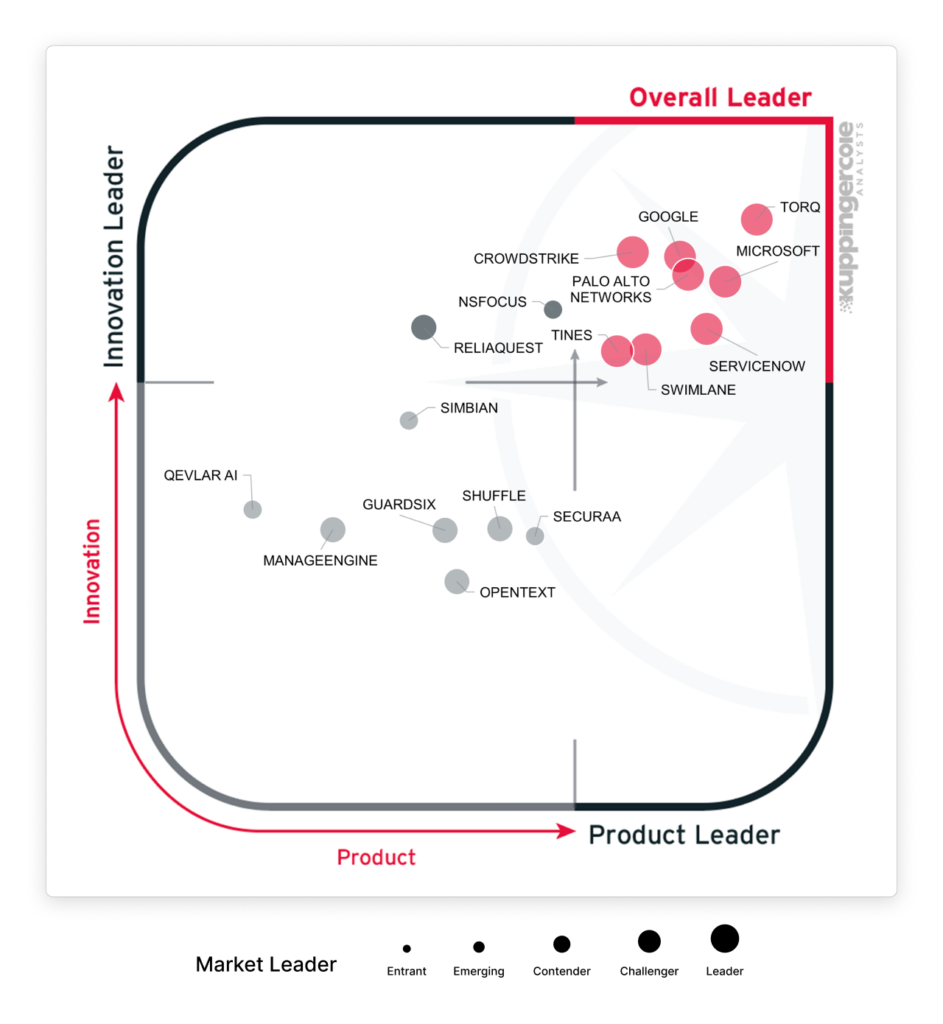
GigaOm recognized this shift when it renamed its SOAR Radar to the SecOps Automation Radar in 2025 — because the category itself has evolved past SOAR. Torq has been named a leader and outperformer in that report for three consecutive years, specifically for Hyperautomation capabilities that legacy SOAR can’t touch.

This piece breaks down what SOAR and AI SOC actually are, where SOAR falls short, and why AI-native Hyperautomation is the clear path forward.

What is SOAR?

SOAR (Security Orchestration, Automation, and Response) emerged around 2015 to solve a specific problem: SOC analysts were drowning in manual, repetitive tasks across disconnected tools. SOAR platforms promised to connect those tools and automate the workflows between them.

At its core, SOAR does three things. It orchestrates actions across your security stack (e.g., fire an API call to your EDR, update a ServiceNow ticket, send an email notification). It automates predefined response playbooks (e.g., if a phishing alert, extract IOCs, check reputation, quarantine the email). And it collects and organizes investigation data.

That model worked when the threat landscape moved slowly enough for playbooks to keep up. It doesn’t anymore.

Every playbook has to be built, tested, and maintained by someone — usually a security engineer with scripting skills your team can’t afford to lose. When vendor APIs change, playbooks break. When a new threat type emerges that doesn’t match an existing workflow, the alert sits in the queue until a human gets to it. SOAR platforms are code-heavy, rigid, and expensive to scale, so most organizations end up automating only a fraction of their workflows and manually handling the rest.

As highlighted in GigaOm’s SecOps Automation Radar, legacy SOAR’s inherent complexity, management overhead, and high costs have made it increasingly unsustainable. The SANS 2024 SOC Survey found that automation itself had become the top barrier to effective SOC operations — ranked higher than staffing — reflecting just how badly the SOAR generation of tools has failed to deliver on its promise.

What is an AI SOC?

A true AI SOC model isn’t just bolted-on “AI in the SOC.” It’s an operating model — a fundamentally different way of structuring how your SOC detects, investigates, and responds to threats. 

An AI SOC must include:

  • Complete threat lifecycle coverage. The Security Operations Center is responsible for every action surrounding a threat to the organization — the work doesn’t end when a threat is detected, and the “this is real!” verdict is made. An AI SOC must accelerate not only mean-time-to-detection or investigation, but also mean-time-to-response.
  • Agentic operations: AI that plans, reasons, and executes end-to-end security tasks like determining real threats from false positives, extracting key attack details across disparate systems, or coordinating case management autonomously. And in successful deployments, AI can fully remediate alerts on its own. 
  • Automation modernization: Teams replace playbook-heavy systems with platforms designed for AI-speed workflow creation, better reuse, and stronger governance. 
  •  More consistent execution: The SOC shifts from “people clicking buttons” to “processes that run consistently,” with humans approving sensitive actions.

Three principles define it:

  1. Agents drive execution. In a legacy SOC, execution depends on whoever is on shift and what they remember to do. In an AI SOC, every alert passes an AI Agent — not a static playbook that breaks when the threat deviates, but an adaptive process in which agentic AI reasons through the situation, selects the right tools to query, gathers evidence, and executes response actions within guardrails. The agent documents an immutable system of record for what happened and why each decision was made. Analysts don’t drive execution manually; they supervise it, intervene on escalations, and refine the logic over time.
  2. Cases centralize accountability. In most SOCs today, accountability is scattered across ticketing systems, Slack threads, email chains, and analyst memory. Nobody can see the full picture of a given incident without manually assembling it from five different tools. In an AI SOC, the case is the single source of truth — automatically created from correlated alerts, enriched with evidence from across the stack, prioritized by business impact, and tracked from detection through resolution. Every automated action, every AI decision, every human intervention is logged in one place. When leadership asks “what happened and how did we respond?” the answer lives in the case, not in someone’s head.
  3. Governance keeps automation from becoming a liability. Automation without governance accelerates risk. An AI SOC builds governance into the operating model itself: approval gates for high-impact actions, immutable audit trails for every decision, scope boundaries that limit what agents can touch, and regular validation cycles where the team reviews AI-closed cases to ensure accuracy. This isn’t a compliance checkbox bolted on after deployment. It’s the architecture that makes autonomy safe enough to trust at scale, and explainable enough to defend to auditors, insurers, and the board.

The shift from SOAR to AI SOC isn’t a tool swap. It’s a fundamental move from “we have some automation” to “AI-driven automation is how we operate” — with the structure, accountability, and controls to make that sustainable.

SOAR vs AI SOC: Key Differences

CapabilityLegacy SOARThe Torq AI SOC Platform
How it worksExecutes predefined playbooks built by engineersAgentic AI reasons through alerts dynamically
Playbook dependencyEvery scenario needs a playbook; no playbook = no automationInvestigates and responds without predefined workflows
Maintenance burdenHigh: Playbooks break when APIs change, or new threats emergeLow: AI adapts to new patterns and learns from feedback
Alert coverageCovers only the scenarios you’ve built playbooks for (typically 30–40%)Investigates every alert, including novel and unknown threat types
Investigation depthEnrichment and triage based on static logicContextual reasoning across the full stack, like an experienced analyst
Integration modelCustom scripting per tool; brittle at scale300+ native integrations, 4,000+ actions, AI-generated connectors
Time-to-value12–18 months for meaningful ROI (typical)Days to weeks (Valvoline achieved ROI within 48 hours)
Human-in-the-loopBinary: Fully automated or fully manual per playbookConfigurable guardrails: Autonomy calibrated by action type and risk
ScalabilityDegrades under volume spikes; serial execution queuesElastic, cloud-native; processes millions of events without bottlenecks
Skill requirementRequires dedicated security engineers for playbook developmentNo-code builder + natural language interface accessible to any analyst

This isn’t a matter of preference or maturity level. Legacy SOAR solutions fall short across every dimension that matters to a modern SOC: coverage, speed, maintenance costs, scalability, and accessibility. The only column where SOAR holds up is deterministic playbook execution for known scenarios… and Hyperautomation does that too, 10x faster.

The Case Against Keeping SOAR

The most common argument for staying on SOAR is sunk cost: “We’ve already invested in playbooks, and they work for what they cover.”

Consider what that actually means. Your team has spent years building automation that covers a third of your alerts. The other two-thirds sit in the queue or remain uninvestigated. SACR’s 2025 AI SOC Market Landscape research, based on a survey of 300+ CISOs, found that 40% of alerts are never investigated — and of those that are, 90% turn out to be false positives. That’s the reality of your SOAR investment.

Meanwhile, the engineering hours required to keep those playbooks functional keep climbing. Every vendor API update is a maintenance cycle. Every new tool in the stack needs custom integration work. Every novel threat type requires a new playbook that takes weeks to build and test. You’re running on a treadmill that speeds up every quarter.

And the talent math makes it worse. The engineers who built your SOAR playbooks are the same engineers every company in your industry is trying to hire. When one leaves, they take the tribal knowledge encoded in your automation with them. Legacy SOAR’s reliance on custom scripting and constant maintenance creates a dependency on scarce, expensive talent that most organizations can’t sustain.

SOAR’s deterministic model made sense when attack patterns were slower and more predictable. That era is over. Attackers use AI. They move at machine speed. They don’t wait for your team to write a new playbook.

Why AI SOC Is the Clear Path Forward

For organizations evaluating automation in 2026, AI SOC solves the problems SOAR created and the problems SOAR was never designed to address.

Coverage, not just speed. SOAR makes workflows faster. AI SOC investigates everything — 100% of alerts that hit your queue, not just the 30–40% with matching playbooks. That’s the difference between automating tasks and automating outcomes.

Adaptability over rigidity. Novel attack techniques, evolving TTPs, and multi-stage campaigns don’t wait for someone to write a playbook. Agentic AI investigates unfamiliar scenarios by reasoning through them — correlating signals, enriching context, making policy-aware decisions — not by pattern-matching against a static ruleset.

Accessible to your whole team, not just your engineers. Torq’s agentic workflow builder and natural language interface mean any analyst can build, modify, and trigger automations. You stop being dependent on two senior engineers who understand the Python scripts holding your playbooks together.

Time-to-value is measured in days. Valvoline was live on top-priority use cases within a week. A stalled Rapid7 integration that had been blocked for months under their legacy SOAR was delivered in days. They were saving 6 to 7 hours of analyst time every day from the start. Legacy SOAR implementations typically take 12–18 months to show meaningful ROI. That gap is 12–18 months of risk.

Scale without degradation. Legacy SOAR platforms queue work serially during volume spikes. When alert volume surges — exactly when you need your automation most — response times slip, pipelines back up, and containment gets delayed. Torq’s cloud-native architecture processes millions of daily security automations without bottlenecks because it was built for elastic scale from the start.

“But What About My Existing Playbooks?”

This is the question that keeps teams on legacy SOAR longer than they should be. It’s also the question Torq was designed to answer. Migrating to Torq Hyperautomation doesn’t mean burning down what you’ve built. It means running it better — and adding capabilities your SOAR platform could never deliver.

Your proven workflows run on Torq’s Hyperautomation layer, executing 10x faster than they did on legacy SOAR. Your integrations stay intact through 300+ native connectors. And on top of that orchestration layer, Torq’s multi-agent system handles the agentic investigation, autonomous triage, and adaptive response that your playbooks never covered.

Deepwatch standardized its entire global security infrastructure on Torq after leaving legacy SOAR, recreating years’ worth of automations in weeks. RSM migrated 200+ managed customers in three weeks. Lennar Corp. replaced XSOAR and cut phishing response from hours to minutes. None of them started from scratch. All of them got more from Torq in weeks than they got from SOAR in years.

The migration path is straightforward. Torq’s team helps you audit your current SOAR workflows, integrations, and pain points — prioritize key use cases, and define measurable success metrics before you start. The JumpStart implementation program gets priority use cases live fast, and Torq Academy, plus 24/7 access to the Knowledge Base, ensures long-term adoption.

Staying on legacy SOAR to protect an existing investment is like keeping a pager because you already paid for the service plan. The cost of staying is higher than the cost of switching.

Decision Framework: How to Know It’s Time to Move

Be honest about where your SOC is today. These five questions will tell you whether your SOAR investment is still working — or whether it’s holding you back.

1. What percentage of your alerts are actually investigated? If the answer is under 80%, you have a coverage gap that playbooks can’t close. AI SOC investigates everything. SOAR only covers what someone built a workflow for.

2. How many full-time engineers maintain your automation? If you need dedicated security engineers just to keep playbooks running, your automation has become a cost center and your talent is being underutilized. Modern platforms reduce engineering dependency; they don’t require it.

3. How long does it take to operationalize a new use case? If the answer is weeks or months, your automation can’t keep pace with your threat landscape. Torq customers operationalize new workflows in minutes using natural language or the no-code builder.

4. What happens when an alert doesn’t match an existing playbook? If it sits in the queue, your automation gap grows every time a new attack technique emerges. Agentic AI investigates novel scenarios without waiting for someone to write the logic.

5. How does your platform perform during alert volume spikes? If response time degrades when you need it most, your architecture has a structural problem that more playbooks won’t fix.

If you answered honestly and two or more of these points to problems, your SOAR isn’t serving you anymore. It’s time to evaluate what replaces it.

SOAR Promised Automation. AI SOC Delivers It.

SOAR was an important step. It proved that security operations could benefit from automation and orchestration. But it also proved that static playbooks, custom scripting, and code-heavy platforms can’t keep pace with a threat landscape that moves at machine speed.

AI SOC — powered by agentic AI and Hyperautomation — delivers what SOAR always promised: every alert investigated, every response executed fast, every action auditable, and your analysts focused on work that actually requires human judgment. Not 30% of alerts. All of them.

The organizations that have already made the switch aren’t looking back. Carvana. Valvoline. Deepwatch. RSM. Kenvue. They didn’t settle for incremental improvements to a broken model. They replaced it.

Your SOAR had its run. See what comes next. 

FAQs

What is the difference between SOAR and AI SOC?

SOAR automates predefined workflows through static playbooks that require engineering resources to build and maintain. AI SOC platforms use agentic AI to investigate, reason through, and respond to alerts autonomously — including threat scenarios no playbook exists. SOAR handles a subset of known, repeatable processes. AI SOC handles the full spectrum at machine speed.

Is AI SOC a replacement for SOAR?

Yes. AI-native Hyperautomation platforms like Torq do everything SOAR does — orchestration, automation, case management — but faster, with less maintenance, and without the playbook ceiling that limits SOAR’s coverage. Torq also adds agentic AI investigation and autonomous response that SOAR architectures can’t deliver. GigaOm has named Torq a leader and outperformer for three consecutive years for exactly this reason.

What is the best SOAR alternative?

Torq is the leading SOAR alternative. It combines the orchestration capabilities of SOAR with agentic AI that reasons, adapts, and responds without rigid playbooks — executing workflows 10x faster than legacy SOAR with 300+ native integrations and a no-code builder accessible to any analyst. Customers such as Valvoline, Carvana, Deepwatch, and RSM have migrated from legacy SOAR solutions and achieved measurable results within days.

How long does it take to migrate from SOAR to an AI SOC platform?

With Torq, migration happens in days or weeks. RSM migrated 200+ managed customers in three weeks. Valvoline replaced its legacy SOAR and was live on priority use cases within one week, achieving ROI in 48 hours. Compare that to the 12–18 months of legacy SOAR that typically require before delivering meaningful value.

What happens to my existing playbooks if I switch from SOAR?

They don’t disappear. Torq’s orchestration layer runs existing workflows 10x faster than legacy SOAR, while the AI SOC layer adds agentic investigation, autonomous triage, and adaptive response on top. Organizations like Deepwatch recreated years’ worth of legacy automations in weeks on Torq — and immediately started building capabilities their SOAR could never deliver.

SEE TORQ IN ACTION

Ready to automate everything?

“Torq takes the vision that’s in your head and actually puts it on paper and into practice.”

Corey Kaemming, Senior Director of InfoSec

“Torq HyperSOC offers unprecedented protection and drives extraordinary efficiency for RSM and our customers.”

Todd Willoughby, Director

Compuquip logo in white

“Torq saves hundreds of hours a month on analysis. Alert fatigue is a thing of the past.”

Phillip Tarrant, SOC Technical Manager

Fiverr logo in black

“The only limit Torq has is people’s imaginations.”

Gai Hanochi, VP Business Technologies

Carvana logo in black

“Torq Agentic AI now handles 100% of Carvana’s Tier-1 security alerts.”

Dina Mathers, CISO

Riskified logo in white

“Torq has transformed efficiency for all five of my security teams and enabled them to focus on much more high-value strategic work.”

Yossi Yeshua, CISO

How IT Automation Tools Transform Security Operations

Contents

Get a Personalized Demo

See how Torq harnesses AI in your SOC to detect, prioritize, and respond to threats faster.

Request a Demo

TL;DR

  • IT automation isn’t about replacing your team — it’s about stopping them from spending their best hours on work that never required human judgment in the first place. Provisioning, access requests, onboarding checklists: these should run themselves.
  • The difference between basic task automation and true IT workflow automation is platform depth. Connecting dozens of systems, enforcing security guardrails, and handling real-world complexity — conditional logic, exception handling, human-in-the-loop approvals — requires more than a point solution.
  • Torq gives IT operations teams enterprise-grade automation infrastructure that powers the world’s most sophisticated security teams — with the integrations, AI-driven decision-making, and governance controls to match.

IT teams aren’t overwhelmed because the work is hard. They’re overwhelmed because the work is endless. Provisioning requests. Access queues. Onboarding checklists duct-taped across a dozen disconnected systems. None of it requires a skilled engineer — it just requires one to be available. And available, at enterprise scale, means buried. That’s not an IT problem. That’s an automation problem.

IT automation changes that equation. When done right, it doesn’t just speed up existing processes — it fundamentally transforms how IT operations run, what your team focuses on, and how securely and efficiently your organization scales.

This is what modern IT process automation looks like, why it matters, and how solutions like Hyperautomation are enabling enterprises to get there faster.

What Are IT Automation Tools?

IT automation tools are software platforms that execute IT processes and workflows with minimal or no human intervention. Instead of a technician manually stepping through a ticket, an automated workflow handles the trigger, the logic, the cross-system actions, and the outcome — consistently, at scale, and at machine speed.

This spans a wide range of IT processes: access provisioning, employee lifecycle management, service desk requests, compliance documentation, software deployment, system configuration, and more. The common thread is that these are high-volume, rule-based processes where manual execution creates bottlenecks, inconsistencies, and risk.

IT automation can be narrow (automating a single repetitive task) or expansive (orchestrating complex, cross-functional workflows across your entire technology stack). The difference between those two ends of the spectrum is the platform you build on.

What IT Automation Tools Are Not

IT automation tools are not meant to replace IT professionals. They’re about redirecting them. When your team isn’t spending half their day provisioning accounts, chasing approval chains, or resetting passwords, they have the bandwidth to tackle the work that actually requires their expertise.

It’s also not a “set it and forget it” proposition — at least not at the enterprise level. Effective IT workflow automation requires thoughtful design, strong governance, and a platform that can handle real-world complexity: conditional logic, exception handling, human-in-the-loop checkpoints, and cross-system integrations that actually hold up in production.

What Are the Benefits of IT Automation Tools?

Efficiency and Time Savings

The most immediate impact of IT automation tools is time — specifically, time reclaimed from repetitive, low-value tasks. Consider what a typical IT team handles on any given day: access requests, onboarding and offboarding workflows, software installations, password resets, compliance checks. These tasks are necessary. They are not, however, a good use of skilled engineers.

Automated IT software executes these workflows in a fraction of the time, without the delays introduced by manual handoffs, approval queues, or business-hour dependencies. Access provisioning that once took three to five days can be completed in minutes. Help desk tickets that piled up in queues get resolved — or never generated in the first place — through self-service automation.

Improved Security Posture

Manual processes are inherently inconsistent. When a human executes a workflow, there’s variance: steps get skipped, exceptions get made informally, and documentation lags. Automation enforces consistency. Every workflow runs the same way, every time, with a full audit trail.

This matters especially for access management. Departing employees who retain system access after their last day represent a real, well-documented security risk. Automated offboarding eliminates that window entirely. Just-in-time (JIT) access workflows ensure that elevated permissions are granted only when needed and revoked automatically when the need expires — reducing your standing attack surface without creating operational friction.

Scalability and Integration

IT operations teams don’t scale linearly with headcount. As organizations grow, there are more employees, more systems, and more complexity — the volume of IT work grows faster than any team can manually absorb. Automation is the only way to scale IT operations without increasing costs in proportion.

The right IT automation platform doesn’t operate in isolation. It connects across your full technology stack: HR systems, identity providers, cloud platforms, SaaS applications, communication tools, and ticketing systems. That integration depth is what separates a narrow automation tool from a true IT automation solution — and it’s what enables the kind of cross-functional, multi-step workflows that drive real operational transformation.

How Do You Build a Roadmap for IT Automation?

Enterprises rarely achieve full IT automation in a single initiative. The organizations that get there do so in stages — building confidence, expanding scope, and deepening integration as they go. Here are some stages of IT automation success. 

Phase 1: Quick Wins

Start with high-volume, low-complexity processes where the ROI is immediate, and the risk of getting it wrong is low. Password resets. Software access requests. Basic onboarding task lists. These are workflows your team executes dozens of times per week, where automation delivers instant time savings and a clear proof of value.

This phase is also about building the organizational muscle for automation: getting stakeholders aligned, establishing governance practices, and proving the concept internally before expanding scope.

Phase 2: Intermediate Automation

Once your team has initial wins under their belt, move into more complex, multi-step workflows that span multiple systems. Employee onboarding and offboarding is a prime example — it touches HR platforms, identity providers, communication tools, cloud applications, and more. Automating it end-to-end requires integration depth and workflow logic, but the payoff is significant: faster time-to-productivity for new hires, fewer access errors, and dramatically reduced IT overhead.

This phase also introduces more sophisticated patterns: conditional branching, approval routing, exception handling, and human-in-the-loop checkpoints for decisions that still warrant human judgment.

Phase 3: Full Orchestration

At the enterprise level, IT automation becomes Hyperautomation — the orchestration of complex, cross-functional workflows across security, IT, DevOps, and HR. This isn’t just automating what humans do today. It’s enabling systems to analyze context, make risk-based decisions, and act autonomously on complex data — so humans can intervene precisely when and where they add the most value.

This phase requires a platform built for enterprise-scale complexity: deep integration capabilities, strong security guardrails, agentic AI that can reason through multi-step decisions, and governance controls that keep automated processes auditable and compliant.

Common IT Automation Use Cases

Employee Onboarding and Offboarding

Manual identity lifecycle management is one of the most consequential inefficiencies in enterprise IT. Fragmented systems, manual coordination, and inconsistent processes — these create security vulnerabilities, compliance gaps, and a bad experience for the employees on both ends of the workflow.

Automated onboarding and offboarding orchestrates the full identity lifecycle: provisioning accounts across every relevant system, enforcing role-based access policies, generating compliance documentation, and — critically — executing offboarding the moment an employee departs, with no delay and no manual steps that could be missed.

Just-in-Time Access

Standing privileges are a persistent security liability. Users accumulate elevated permissions over time — permissions that remain active long after the operational need expires. JIT access automation flips this model: permissions are granted on demand, scoped to what’s actually needed, and automatically revoked when the window closes.

This reduces your attack surface without slowing down operations. Employees get access when they need it, through familiar self-service channels, without waiting for a manual approval chain.

Self-Service Employee Chatbots

Most IT help desk tickets are routine. Access requests, software installations, password resets, and account unlocks — these don’t require a skilled engineer. They require a reliable process. Self-service employee chatbots and automation deliver that process through channels employees already use: Slack, Microsoft Teams, and web forms.

The result is a dramatically lower ticket volume for IT teams and a dramatically better experience for employees who get their requests resolved in minutes instead of days.

How Do You Choose the Right IT Automation Tools?

Not all IT automation platforms are built the same. Evaluating them requires clarity about what you actually need — today, and as your operations scale.

Evaluating Maturity and Needs

Start with an honest assessment of your team’s current state. What processes are consuming the most time? Where are the most common points of failure or inconsistency? What does your integration landscape look like, and how complex are the workflows you want to automate?

Teams early in their automation journey often benefit from starting with a platform that offers both low-code accessibility and the depth to grow with them — so they’re not rearchitecting their automation stack eighteen months in. The right IT automation solution meets you where you are and scales to where you need to go.

Governance and Security Considerations

Automation amplifies whatever governance practices you have in place. If access controls and credential management are weak, automating workflows on top of that foundation makes the problem worse.

The platform you choose needs to take security seriously — not as a feature, but as a foundation. That means strong role-based access controls for the automation platform itself, encrypted credential management, comprehensive audit logging, and human-in-the-loop checkpoints for high-stakes actions. An automated workflow that grants privileged access to sensitive systems cannot be built on a flimsy foundation.

Why Torq Is the IT Automation Platform Enterprises Choose

The Torq AI SOC platform, powered by Hyperautomation™, supports enterprises that need IT automation to operate at the same level of rigor, scale, and security as their most critical business systems.

The platform connects SecOps, IT, DevOps, and HR through 300+ integrations and 4,000+ out-of-the-box actions — eliminating the visibility gaps and manual handoffs that come from siloed operations. It supports the full range of IT automation patterns: simple task automation, complex multi-step workflows, AI-driven decision-making, and human-in-the-loop approvals. And it does all of this without compromising on the security guardrails that enterprise operations demand.

For IT teams, this means automated employee onboarding and offboarding that reduces identity management costs by 60% and cuts access errors by 99%. It means just-in-time access workflows that eliminate standing privileges and provision access 70% faster. And it means self-service chatbots that reduce help desk ticket volume by up to 70% while giving employees a better experience.

IT automation isn’t a future capability. It’s a present-day competitive advantage — and the gap between organizations that have it and those that don’t is widening fast.

See how Agoda automated phishing response, password resets, and cloud security workflows with Torq.

FAQs

What are IT automation tools?

IT automation tools are software platforms that execute IT processes and workflows with minimal or no human intervention. This includes access provisioning, employee onboarding and offboarding, service desk requests, and compliance documentation — high-volume, rule-based processes where manual execution creates bottlenecks, inconsistencies, and security risk.

What is an example of IT automation?

A common example is automated employee onboarding. When a new hire is added to an HR system, an automated workflow provisions their accounts across every relevant platform — email, Slack, cloud applications, identity providers — assigns role-based access, and generates compliance documentation, all without a single manual step from IT.

Why are IT automation tools important?

IT teams are consistently asked to do more with the same or fewer resources. IT automation tools are the only way to scale operations without increasing headcount in proportion. Beyond efficiency, they improve security by enforcing consistent processes, reducing human error, and freeing skilled engineers to focus on work that actually requires their expertise.

What IT processes are best suited for automation?

The best candidates are high-volume, repetitive, rule-based processes — ones that follow a predictable path and don’t require nuanced human judgment on every instance. Employee onboarding and offboarding, access provisioning, just-in-time access requests, password resets, and help desk ticket routing are all strong starting points.

How do IT automation tools improve security?

IT automation tools enforce consistent execution of security-sensitive workflows, eliminating the variability that comes with manual processes. Automated offboarding ensures departing employees lose access immediately with no gaps. Just-in-time access provisioning eliminates standing privileges. Comprehensive audit logging provides the documentation that compliance and security teams require.

SEE TORQ IN ACTION

Ready to automate everything?

“Torq takes the vision that’s in your head and actually puts it on paper and into practice.”

Corey Kaemming, Senior Director of InfoSec

“Torq HyperSOC offers unprecedented protection and drives extraordinary efficiency for RSM and our customers.”

Todd Willoughby, Director

Compuquip logo in white

“Torq saves hundreds of hours a month on analysis. Alert fatigue is a thing of the past.”

Phillip Tarrant, SOC Technical Manager

Fiverr logo in black

“The only limit Torq has is people’s imaginations.”

Gai Hanochi, VP Business Technologies

Carvana logo in black

“Torq Agentic AI now handles 100% of Carvana’s Tier-1 security alerts.”

Dina Mathers, CISO

Riskified logo in white

“Torq has transformed efficiency for all five of my security teams and enabled them to focus on much more high-value strategic work.”

Yossi Yeshua, CISO

How AI Should Actually Work in Your SOC

Contents

Get a Personalized Demo

See how Torq harnesses AI in your SOC to detect, prioritize, and respond to threats faster.

Request a Demo

TL;DR

The problem: Attackers achieve breakout in under 48 minutes. The average alert investigation takes 70 minutes. And 40% of security alerts are never investigated. Most AI in the SOC helps at the margins — summarizing alerts, suggesting actions — but doesn’t close the gap.

What actually works: AI-autonomous security operations, where agentic AI triages, investigates, and remediates end-to-end without human intervention on routine cases. Not AI that advises. AI that acts.

Five questions to ask vendors: Does it act or just advise? Does it integrate across your full stack? Is every decision explainable? Can you configure where autonomy ends, and human judgment begins? Can they show measurable outcomes from real deployments?

Bottom line: The distinction between AI-assisted and AI-autonomous is between incremental improvement and operational transformation. The SOCs that win in 2026 aren’t the ones with the biggest headcount — they’re the ones that let AI handle volume while humans handle strategy.

The math doesn’t work anymore. Attackers now achieve breakout — moving from initial access to lateral movement — in under 48 minutes. Meanwhile, the average alert investigation takes 70 minutes

AI in security operations was supposed to fix this. Instead, most implementations have delivered chatbots bolted onto legacy workflows, alert summarization that still requires human action, and ML-based detections that generate more noise than signal. These implementations help at the margins, but they don’t solve the core problem: volume, speed, and the widening gap between attacker efficiency and defender capacity.

And it gets worse. According to the SACR AI SOC Market Landscape 2025 report, 40% of security alerts are never investigated at all. Another 61% of security teams admitted to ignoring alerts that later proved to be critical incidents. 

The real opportunity isn’t AI-assisted security operations. It’s AI-autonomous security operations. And the difference between those two concepts is where outcomes live.

Why Does Most AI in Security Operations Fall Short?

Let’s be honest about what AI in the SOC has actually delivered over the past few years. Mostly, we’ve seen alert summarization tools that save analysts a few minutes of reading. Chatbot interfaces that answer questions but don’t take action. Machine learning detections promise precision but deliver false positive rates that make analysts want to throw their laptops out the window.

These tools help at the margins. But they don’t fundamentally change the operational reality. Analysts are still drowning. The SANS 2025 SOC Survey confirms that 66% of teams cannot keep pace with incoming alert volumes. Almost 90% of SOCs report being overwhelmed by backlogs and false positives.

Most AI Stops at Analysis — That’s the Problem

Here’s the thing most AI vendors won’t tell you: their solutions only address the first step of the threat lifecycle. Triage? Covered. Investigation? Partially. Response? “That’s on you.”

A true AI SOC must manage the complete threat lifecycle — from triage through investigation to response. The work doesn’t end once you’ve identified a threat. The Agentic SOC takes action and closes cases. Autonomously.

Most “AI in the SOC” products are really just analysis tools with a chat interface. They’ll tell you what’s happening. They might even tell you what to do about it. But they won’t actually do anything. That still requires a human to click buttons, switch tabs, copy data between systems, and execute remediation steps manually.

The AI SOC that actually works looks different:

  • Triage: AI ingests and normalizes telemetry from across your security stack, correlating and deduplicating events to reduce noise. It delivers verdicts that separate false positives from actual risk — before alerts ever reach a human.
  • Investigate: Specialized AI agents gather evidence, assemble timelines, and summarize findings. No more manual enrichment across six browser tabs.
  • Respond: Contain. Coordinate. Remediate. AI executes response actions autonomously and ensures critical threats reach the right people.

What Should AI in Security Operations Actually Do?

The shift that matters isn’t from manual to AI-assisted. It’s from AI-assisted to AI-autonomous. That means AI that doesn’t just summarize alerts, but triages, investigates, enriches, and remediates — end-to-end, without human intervention unless escalation is genuinely required.

This is where agentic AI enters the picture. Unlike traditional automation or generative AI that responds to prompts, agentic AI sets goals, plans actions, and executes. It reasons through problems. It adapts to context. It operates with the autonomy of a skilled analyst, but at machine speed and scale.

Here’s what this looks like in practice:

  •  An alert fires from your EDR. Within seconds, AI enriches the alert with data from your SIEM, correlates related events across IAM and cloud infrastructure, identifies the affected user and endpoint, checks asset criticality, and reviews recent behavior patterns. 
  • If needed, it contacts the user via Slack to verify suspicious activity. 
  • Based on the investigation findings and predefined runbooks, it either remediates autonomously — isolating the endpoint, revoking sessions, updating blocklists —  or escalates to a human analyst with full context and recommended actions.

No human touched that workflow unless escalation was required. The entire process completes in minutes, not hours.

At Torq, this is exactly what our AI SOC delivers. Socrates, our AI SOC Analyst, coordinates a multi-agent system where specialized AI Agents handle triage, investigation, remediation, and case management in parallel. According to IDC, organizations using Torq can automate more than 95% of Tier-1 analyst tasks. That’s operational transformation.

The human role doesn’t disappear; it evolves. Analysts stop clicking through repetitive alerts and start supervising AI operations, handling the truly complex cases, and doing what they actually got into security to do: hunt threats, improve defenses, and outthink adversaries.

What Does AI-Autonomous Security Operations Look Like in Practice?

These are production outcomes from organizations running Torq HyperSOC.

Carvana

Carvana‘s lean security team was buried in Tier-1 alert volume — repetitive investigations that consumed hours but rarely surfaced real threats. Critical work like threat hunting and posture improvement kept getting pushed back. After deploying Torq’s agentic AI, the platform now handles 100% of Tier-1 and Tier-2 security events autonomously. The team operates at the effectiveness of a SOC five times its size, with analysts focused on strategic projects instead of monotonous triage. They took a deliberate “crawl-walk-run” approach — starting with AI-assisted triage before expanding to full autonomous remediation.

Valvoline

A corporate divestiture cut Valvoline‘s security team in half. Their legacy SOAR was brittle and slow to build on. A Rapid7 integration had stalled for months. After replacing their SOAR with Torq, the team was live on phishing response and EDR alert handling within the first week. The stalled integration was delivered in days. Result: six to seven analyst hours saved per day, with ROI measured in 48 hours — not the 12–18 months legacy SOAR typically requires.

Kenvue

Kenvue‘s SOC faced fragmented security data across a highly customized IT environment. Manual data collection ate into investigation time, and the team couldn’t measure its own performance. After building a full lifecycle case management infrastructure in Torq — automating case creation, IOC extraction, enrichment, and response actions — analysts now start investigations with full context already assembled.

What’s Next for AI in Security Operations?

Attackers aren’t waiting for defenders to figure out AI. They’re using it now — to generate convincing phishing campaigns, automate reconnaissance, identify vulnerabilities faster, and scale attacks that would have required teams of humans. According to the Verizon 2025 DBIR, synthetically generated text in malicious emails has doubled over the past two years. Here’s how defenders can win.

Near-term: Agentic AI becomes the standard operating model for high-performing SOCs. Organizations that don’t adopt will fall further behind as attackers increasingly leverage AI to accelerate their own operations. The asymmetry between offense and defense will widen for those relying on human-only workflows.

Multi-agent systems: Rather than a single AI handling everything, specialized agents coordinate complex investigations in parallel — one analyzing network traffic, another examining endpoint behavior, another correlating identity signals. These agents collaborate and cross-reference findings, achieving investigative depth that would require a team of senior analysts working in concert.

5 Key Considerations for Implementing AI in Your SOC

Before you sign another vendor contract, ask these questions:

1. Does it act or just advise? AI that suggests actions still requires human execution. That’s a copilot, not an autopilot. Look for AI that can execute remediation within defined guardrails — isolating hosts, disabling accounts, removing malicious emails — without waiting for human approval on routine cases.

2. How does it integrate? Point-tool AI creates more silos. If your AI solution only works with one data source or one workflow, it can’t deliver cross-environment correlation or end-to-end automation. You need AI that orchestrates across your entire stack — SIEM, EDR, IAM, cloud, ticketing, collaboration tools — simultaneously.

3. Is it explainable? Black-box AI doesn’t fly with auditors, compliance teams, or analysts who need to trust the system. Every decision, every action, every escalation should have a clear audit trail showing exactly what the AI observed, what it concluded, and why it took the action it did.

4. What’s the human-on-the-loop model? Full autonomy isn’t always appropriate. High-severity incidents, sensitive systems, and novel attack patterns may warrant human review. Look for configurable guardrails and escalation paths that let you define where autonomy ends and human judgment begins — and adjust those boundaries as trust develops.

5. Can you measure outcomes? If the vendor can’t show concrete metrics — MTTD reduction, MTTR improvement, alert clearance rates, analyst hours saved — it’s vaporware. Demand proof of impact from real deployments, not theoretical capabilities.

Can You Afford to Stay at Human Speed?

AI in security operations isn’t new. But AI that actually works — AI that operates, not just assists — is.

The difference between AI-assisted and AI-autonomous is the difference between incremental improvement and operational transformation. Between hiring more analysts to handle more alerts and fundamentally changing the economics of security operations. Between drowning in volume and actually getting ahead of threats.

The SOCs that thrive in 2026 and beyond won’t be the ones with the biggest headcount or the most tools. They’ll be the ones that figured out how to let AI handle volume while humans handle strategy. The ones that shifted from human-in-the-loop to human-on-the-loop. The ones that made the leap from AI as a feature to AI as the foundation.

The attackers aren’t slowing down. The alert volumes aren’t decreasing. The talent shortage isn’t resolving itself. The only variable left to change is how you operate.

Ready to see AI in security operations that actually works? Download the Don’t Die, Get Torq Manifesto.

FAQs

What is AI in security operations?

AI in security operations refers to the use of artificial intelligence to automate core SOC functions — including alert triage, threat investigation, case management, and incident response. Traditional implementations focus on AI-assisted workflows, where AI summarizes or recommends actions that still require human execution. More advanced implementations use agentic AI, where specialized AI agents autonomously triage alerts, gather evidence, make containment decisions, and remediate threats end-to-end — escalating to human analysts only when predefined thresholds require it.

What is the difference between AI-assisted and AI-autonomous security operations?

AI-assisted security operations use AI to help analysts work faster — summarizing alerts, suggesting next steps, or surfacing relevant context. The analyst still makes every decision and executes every action. AI-autonomous security operations use agentic AI to handle the full threat lifecycle independently: triaging alerts, investigating cases, executing response actions, and closing cases without human intervention on routine incidents. The human role shifts from executing tasks to supervising AI operations and handling complex escalations.

What is an agentic AI SOC?

An agentic AI SOC is a security operations center where AI agents autonomously manage the majority of alert triage, investigation, and response workflows. Unlike traditional automation that follows static playbooks, agentic AI reasons through problems, plans its own investigation steps, adapts to context, and executes response actions within defined guardrails. Multi-agent systems coordinate specialized AI agents in parallel — one analyzing network traffic, another examining endpoint behavior, another correlating identity signals — to achieve investigative depth at machine speed.

How does AI reduce alert fatigue in the SOC?

AI reduces alert fatigue by automating the triage and investigation steps that consume most analyst time. Rather than requiring humans to manually review, enrich, and prioritize every alert, AI ingests telemetry across the security stack, correlates and deduplicates events, filters false positives, and delivers high-confidence verdicts before alerts ever reach an analyst. According to the SANS 2025 SOC Survey, 66% of SOC teams cannot keep pace with incoming alert volumes. Organizations using AI-autonomous triage can investigate 100% of alerts — including the 40% that would otherwise go uninvestigated — while freeing analysts to focus on genuine threats and strategic work.

What questions should I ask vendors about AI in the SOC?

When evaluating AI for security operations, ask five key questions. First, does the AI act autonomously or just advise — can it execute remediation, or does it still require a human to click buttons? Second, does it integrate across your full stack (SIEM, EDR, IAM, cloud, ticketing), or does it only work with a single data source? Third, is every AI decision explainable with a clear audit trail? Fourth, what is the human-on-the-loop model — can you configure where autonomy ends and human judgment begins? Fifth, can the vendor demonstrate measurable outcomes from real deployments, including reductions in MTTD and improvements in MTTR, as well as analyst hours saved?

SEE TORQ IN ACTION

Ready to automate everything?

“Torq takes the vision that’s in your head and actually puts it on paper and into practice.”

Corey Kaemming, Senior Director of InfoSec

“Torq HyperSOC offers unprecedented protection and drives extraordinary efficiency for RSM and our customers.”

Todd Willoughby, Director

Compuquip logo in white

“Torq saves hundreds of hours a month on analysis. Alert fatigue is a thing of the past.”

Phillip Tarrant, SOC Technical Manager

Fiverr logo in black

“The only limit Torq has is people’s imaginations.”

Gai Hanochi, VP Business Technologies

Carvana logo in black

“Torq Agentic AI now handles 100% of Carvana’s Tier-1 security alerts.”

Dina Mathers, CISO

Riskified logo in white

“Torq has transformed efficiency for all five of my security teams and enabled them to focus on much more high-value strategic work.”

Yossi Yeshua, CISO

AI SOC Platforms for Financial Services: What You Need in 2026

Contents

Get a Personalized Demo

See how Torq harnesses AI in your SOC to detect, prioritize, and respond to threats faster.

Request a Demo

TL;DR

  • Financial institutions face SOC challenges that no generic platform is built for — overlapping regulatory frameworks (SOX, PCI DSS, GLBA), real-time speed requirements, and audit trails that satisfy examiners, not just security teams.
  • Attackers move faster than manual SOCs can respond: phishing breaches succeed in under 60 minutes, while the average SOC investigation takes 70, making AI-driven automation a risk management necessity, not a nice-to-have.
  • Financial institutions running AI SOC platforms are seeing dramatic results in production: MTTR reduced from one day to 14 minutes, MTTI cut from hours to minutes, 90%+ of alerts investigated and remediated automatically, and weeks of manual audit preparation reduced to hours.
  • The financial institutions that win won’t have the largest SOC headcount — they’ll be the ones operating at machine speed while satisfying every auditor and regulator in the room.

The time between compromise and data exfiltration now occurs before most SOCs finish their first triage. Phishing breaches succeed in under 60 minutes. The average SOC investigation takes 70. This is why financial institutions are operating at a structural disadvantage.

Financial services sit at the center of the global economy. A breach triggers regulatory scrutiny, reputational damage, and potential systemic risk. All at once. 

And yet, fewer than 25% of SOCs have fully automated their processes. Most organizations still rely heavily on manual intervention. The average enterprise ingests data from 83 security tools across 29 vendors. In 75% of breaches, the logging existed to catch the threat, but signals were still buried.

The answer isn’t more seats in chairs. It’s AI-driven SOC platforms that operate at machine speed, with the compliance controls and audit trails financial regulators actually demand.

What Makes Financial Services SOC Challenges Different?

Not all SOC challenges are created equal. Financial institutions face tremendous pressures that legacy cybersecurity platforms aren’t built to handle. Here are five reasons why financial institutions’ SOCs are different. 

1. The Compliance Stack is Unlike Any Other Industry

Financial institutions operate under overlapping frameworks simultaneously: SOX, PCI DSS, GLBA, OCC guidance, SEC requirements, and a patchwork of state regulations. Every automated action needs documentation that satisfies multiple auditors, often with different evidentiary standards. A single incident can touch four different compliance frameworks at once.

2. Speed is a Security Requirement

Trading operations, fraud detection, and payment systems demand real-time response. A 70-minute investigation window isn’t just slow, it’s negligent when attackers move in minutes. The window between credential compromise and lateral movement is shrinking every quarter.

3. Regulators Demand the Full Decision Trail

Financial regulators don’t just want to know what happened. They want to see the decision trail. Who authorized it? What data informed it? Why did the system respond the way it did? Black-box AI isn’t an option in this environment. Explainability it’s a requirement.

4. Financial Infrastructure Requires Deep, Specific Integrations

Trading systems, core banking platforms, fraud detection engines, SWIFT, payment rails — financial institutions have integration requirements that go far beyond what a generic SOC platform anticipates. If your AI SOC can’t talk to your financial infrastructure, it’s operating blind on the most critical attack surfaces.

5. The Talent Shortage is More Acute in Financial Services

The cybersecurity talent shortage hits financial services harder because of specialized compliance knowledge requirements. Finding an analyst who understands both EDR and OCC examination requirements? That’s a unicorn. 

4 Features Financial Institutions Need from an AI SOC Platform

When evaluating AI SOC automation platforms for financial services, the requirements go well beyond what a standard enterprise checklist covers. Here’s what actually matters.

1. Explainable AI with Complete Audit Trails

Regulators and auditors need to understand how decisions were made,not just what was decided. Every automated action must be traceable: what triggered it, what data informed it, who (or what) authorized it, and what the outcome was. Immutable logs that satisfy SOX, PCI DSS, and OCC examination requirements aren’t optional. They’re the price of admission.

If a vendor can’t show you exactly how their AI arrived at a containment decision, that’s a problem — not just for security, but for your next regulatory examination.

2. Machine-Speed Detection and Response

Financial institutions need sub-minute responses for credential compromise, fraud indicators, and lateral movement. Autonomous containment for high-confidence threats isn’t about removing humans from the loop — it’s about not letting attackers operate unchallenged while humans catch up.

3. Deep Integration with Financial Systems

Core banking platforms, trading systems, fraud detection, identity systems — these are your highest-risk attack surfaces. Privileged access is a primary attack vector across financial institutions. Your AI SOC needs to see and act across all of it, including your SIEM, EDR, cloud infrastructure, and case management systems.

4. Human-in-the-Loop Controls

Full autonomy may may not be appropriate for every action in your SOC, especially in a financial services firm. Configurable guardrails for high-impact decisions, clear escalation paths that align with internal policies, and unambiguous accountability for automated decisions — these are the mechanisms that keep regulators satisfied and analysts empowered rather than sidelined. The best AI SOC platforms make human oversight a design principle, not an afterthought.

What Happens When Financial Services SOCs Don’t Automate?

There’s a temptation to frame SOC automation as a cost center decision. It isn’t. It’s a risk-management decision — and the math is unforgiving.

The Speed Gap is the Breach Gap

When attackers move in minutes, and your SOC responds in hours, every minute of delay is an attacker’s opportunity. Manual triage, manual enrichment, manual escalation — each step is a window that stays open longer than it should.

Analyst Burnout is a Security Risk 

Financial services SOCs face the same alert fatigue as everyone else, compounded by compliance documentation burden. According to the SANS 2024 SOC Survey, security teams are overwhelmed, understaffed, and stuck in reactive mode despite significant technology investments. When experienced analysts burn out and leave, they take institutional knowledge with them. Tribal knowledge loss — understanding which alerts matter in your specific environment — is expensive and dangerous to rebuild.

Manual Processes Create Audit Exposure

Inconsistency is the enemy of compliance. Manual processes are inconsistent by definition. Inconsistency creates audit findings. Findings create remediation costs and regulatory attention. Automation creates consistency at scale. 

The numbers from organizations already running AI SOC platforms are stark. IDC validated that Torq enables SOC teams to cut investigation time by up to 90% and handle 3–5x more cases without adding headcount. 

The economics of an agentic SOC are straightforward: Hyperautomation absorbs Tier-1 and Tier-2 work so teams handle significantly more alerts with the same headcount, and audit-ready logs eliminate weeks of manual compliance prep every year.

And the alternative — adding that extra analyst you don’t need — runs directly into a global cybersecurity talent shortage of 4.8 million unfilled positions, according to the ISC2 2024 Cybersecurity Workforce Study. You can’t hire your way to machine speed. 

6 Questions to Ask When Evaluating AI SOC Platforms for Financial Services

Use this checklist when you’re in active evaluation. These are the questions that separate platforms built for financial services complexity from those that aren’t.

  1. Does it provide complete, immutable audit trails? Regulators need to see how every automated decision was made. If the vendor can’t demonstrate this in a live environment, walk away.
  2. What are the time savings at each stage of the complete threat lifecycle? Meant time to Assignment, Mean time to Investigation, Mean time to Response? Incremental improvements at each stage make for not only a faster, but much more efficient incident response strategy.
  3. How are human-in-the-loop controls configured? Full autonomy isn’t always appropriate for every action. Understand the guardrail options and who controls them.
  4. What’s the implementation timeline? Months-long implementations create risk. Look for time-to-value measured in weeks.
  5. How does it handle false positives? Financial services can’t afford to block legitimate transactions. Understand the accuracy metrics and how the platform learns from corrections.
  6. Can you speak with financial services references? Ask for peer conversations with institutions of similar size and regulatory complexity.

What Leading Financial Institutions Are Achieving with Torq

Financial institutions are running Torq in production today — with measurable outcomes that satisfy both security teams and regulators.

Top 30 U.S. Bank: Automated Fraud Detection Got Zelle Back Online: Before reinstating Zelle payment service — which had been suspended due to fraud — the bank needed to demonstrate it could detect and contain fraud at scale. Torq automated end-to-end fraud detection alerts to account lockdown, reducing mean time to investigate (MTTI) from hours to minutes. The bank reinstated the service with a fully automated, auditable response capability and unified its security stack with Torq, reducing IAM tasks from a full day to three minutes.

The team achieved 30% time savings with the vast majority of threat alerts automatically identified, analyzed, and remediated — freeing analysts to focus on higher-value security initiatives.

The throughout numbers tell the same story: 100,000+ events processed in seconds. MTTR improvements from days to minutes. Audit preparation reduced from weeks to hours. These are outcomes your team deserves.

Where AI SOC is Headed for Financial Services

The trajectory is clear, and financial institutions that understand it will have a significant advantage.

Cross-functional automation is breaking down the silos that attackers exploit. Security, fraud, compliance, and risk teams operating on shared AI infrastructure — sharing signals, sharing context, sharing response capabilities. Financial institutions that coordinate across these functions detect and contain threats faster than those that keep them separate.

Regulatory evolution will accelerate. Expect regulators to start requiring AI-driven security capabilities as baseline expectations, not differentiators. OCC and SEC guidance are already moving in this direction. Financial institutions that build AI SOC capability now are positioning ahead of mandates, not scrambling to meet them.

Secure AI by design is becoming a SOC responsibility. The threat landscape has shifted. AI is giving adversaries the ability to industrialize attacks — scaling phishing campaigns, compressing dwell times, and probing defenses faster than human analysts can respond. For financial institutions, the strategic imperative is clear: the SOC must evolve to meet the threat. You can’t defend what you don’t understand.

Torq’s multi-agent systems and agentic AI capabilities aren’t roadmap items. They’re in production.

The AI SOC Advantage for Financial Institutions 

The financial institutions that thrive won’t have the largest SOC headcount. They’ll be the ones that figured out how to operate at machine speed while satisfying every auditor and regulator in the room.

Financial services face unique SOC challenges: regulatory complexity, speed requirements, audit intensity, and integration demands that generic AI SOC platforms weren’t built to address. The platforms that serve financial institutions well are explainable, auditable, fast, and built for compliance from the ground up.

The regulatory direction is clear. The talent math is clear. The question isn’t whether financial institutions need AI SOC capabilities. It’s whether they build them before or after the next incident that demands it.

Ready to see how Torq is built for financial services complexity?

FAQs

What is an AI SOC platform, and why do financial institutions need one?

An AI SOC platform is a security operations solution that uses agentic AI and automation to detect, investigate, and respond to threats — replacing slow, manual processes with machine-speed decision-making. Financial institutions need one because they face a unique combination of pressures: overlapping regulatory frameworks like SOX, PCI DSS, and GLBA; real-time speed requirements across trading and payment systems; and audit intensity that demands a complete, explainable decision trail for every automated action. Generic security tools weren’t built for this level of complexity.

How does an AI SOC platform help with financial services compliance?

The right AI SOC platform provides immutable audit trails that document every automated action — what triggered it, what data informed it, and its outcome. This gives regulators and examiners the decision-trail visibility they need — without your team having to assemble it manually.

What should banks look for when evaluating AI SOC platforms?

Financial institutions should prioritize five things: explainable AI with complete, immutable audit trails; machine-speed detection and response measured in seconds, not minutes; deep integrations with financial systems, including core banking platforms, fraud detection, and identity systems; configurable human-in-the-loop controls for high-impact actions; and financial services-specific references. Always request a live demonstration of audit trail capabilities before making a decision.

What results are financial institutions achieving with AI SOC platforms?

Financial institutions running AI SOC platforms in production are seeing measurable outcomes across speed, scale, and compliance. One institution reduced MTTR from one day to 14 minutes. A major regional U.S. bank automated end-to-end fraud alert detection and account lockdown — cutting mean time to investigate (MTTI) from hours to minutes and enabling the reinstatement of Zelle payment services. A global money transfer platform reduced IAM investigation time from a full day to three minutes, with more than 90% of alerts investigated and remediated automatically. Across the board, audit preparation that previously took weeks is now completed in hours.

SEE TORQ IN ACTION

Ready to automate everything?

“Torq takes the vision that’s in your head and actually puts it on paper and into practice.”

Corey Kaemming, Senior Director of InfoSec

“Torq HyperSOC offers unprecedented protection and drives extraordinary efficiency for RSM and our customers.”

Todd Willoughby, Director

Compuquip logo in white

“Torq saves hundreds of hours a month on analysis. Alert fatigue is a thing of the past.”

Phillip Tarrant, SOC Technical Manager

Fiverr logo in black

“The only limit Torq has is people’s imaginations.”

Gai Hanochi, VP Business Technologies

Carvana logo in black

“Torq Agentic AI now handles 100% of Carvana’s Tier-1 security alerts.”

Dina Mathers, CISO

Riskified logo in white

“Torq has transformed efficiency for all five of my security teams and enabled them to focus on much more high-value strategic work.”

Yossi Yeshua, CISO

Can Business Orchestration and Automation Technologies Handle Security Operations? 

Contents

Get a Personalized Demo

See how Torq harnesses AI in your SOC to detect, prioritize, and respond to threats faster.

Request a Demo

TL;DR

  • BOAT (business orchestration and automation technologies) unifies automation tools like RPA, BPA, and iPaaS to coordinate enterprise workflows end-to-end.
  • BOAT has delivered real results across finance, HR, IT, and supply chain. The question is whether that same model works for a SOC operating in adversarial conditions, under time pressure, across dozens of security tools.
  • General-purpose BOAT platforms lack the security-specific integration depth, threat intelligence context, and adversarial-condition adaptability that SOC workflows demand.
  • The Torq AI SOC Platform combines security Hyperautomation and agentic AI to investigate, enrich, and resolve threats autonomously — at machine speed.

Business automation has transformed enterprise operations. Finance teams close books faster. HR teams onboard employees without touching a spreadsheet. Supply chains self-correct in real time. Across the enterprise, automation is delivering on its promise.

So why is the security operations center (SOC) still drowning?

The answer isn’t a lack of automation. Most SOCs have plenty of it. The problem is that automation without orchestration is just a collection of isolated tasks — and isolated tasks don’t stop threats. Business orchestration and automation technologies (BOAT) offer a more generic answer for the enterprise at large, but the SOC isn’t the enterprise at large. It’s a fundamentally different operating environment — adversarial, time-critical, and deeply tool-fragmented.

This article evaluates whether BOAT can handle security operations, where it falls short, and what SOC teams actually need instead.

What Are Business Orchestration and Automation Technologies?

Business orchestration and automation technologies (BOAT) is a Gartner-defined category of consolidated software platforms that deliver enterprise process automation through orchestration of business processes, enterprise connectivity, low-code development, and agentic automation.

BOAT platforms typically bring together several underlying technologies under one roof, including robotic process automation (RPA), business process automation (BPA), integration platform as a service (iPaaS), and workflow management tools. The goal is a single, coherent layer that manages complexity across the enterprise — not just one corner of it.

In a hybrid, multi-cloud enterprise environment, that kind of coordination is no longer optional. Fragmented systems mean fragmented visibility. Manual handoffs mean slower outcomes. BOAT addresses both by creating a connected operational fabric.

For security teams, that framing is instructive. But the SOC stress-tests it in ways the rest of the enterprise doesn’t.

What Is the Difference Between Automation and Orchestration?

The terms “automation” and “orchestration” are often used interchangeably. They shouldn’t be.

Automation is the execution of a specific, repeatable task without human intervention. Blocking an IP address. Sending an alert notification. Pulling a log file. These are valuable actions, but they are inherently narrow. They don’t know what happened before the task or what needs to happen after it.

Orchestration is the coordination of multiple automated tasks and tools into a cohesive, end-to-end workflow. It’s the intelligence layer that decides what runs, when, in what order, and based on what conditions. Orchestration takes inputs from across your environment, routes them through the right tools, and produces outcomes — not just outputs.

In a security context, blocking an IP is automation. Detecting a suspicious login, pulling threat intel, cross-referencing identity data, notifying the analyst, containing the endpoint, and closing the ticket are all part of orchestration. One is a step. The other is a resolved incident.

Security operations live and die by orchestration. The threats are too dynamic and the workflows too complex for task automation alone to carry the load. This is also why IT operations teams in adjacent environments increasingly need the same end-to-end thinking, but the adversarial nature of security makes the requirement more urgent.

Where Does BOAT Work Well — and Where Does It Break Down?

Process automation technologies have delivered real efficiency gains across the enterprise. In finance, automated invoice processing eliminates manual data entry. In legal, contract review workflows auto-route documents based on risk tier. In IT operations, ticketing systems auto-assign and escalate based on SLA thresholds.

These are legitimate wins. But notice what they have in common: they operate in relatively stable, well-defined environments with predictable inputs and outputs.

Security operations are not in that environment.

A phishing campaign can arrive in dozens of variants. A cloud misconfiguration surfaces differently across providers. An insider threat doesn’t follow a playbook. When process automation tools encounter edge cases, novel attack patterns, or logic that wasn’t anticipated at build time, they stall. They require human intervention. And in a SOC, human intervention at scale is exactly what you were trying to avoid.

Process automation is a necessary foundation. But without orchestration layered on top — and without the intelligence to adapt — it can’t carry the full weight of security operations.

Why Can’t General-Purpose BOAT Platforms Handle the SOC?

This is the central question, and the answer comes down to four structural gaps.

Gartner’s evolving BOAT definition now includes agentic automation as a core capability — a recognition that the market is moving toward AI that can reason and act, not just execute scripts. But there’s a critical distinction between agentic automation built for business processes (approving purchase orders, routing support tickets) and agentic AI built for adversarial environments (investigating a credential compromise across your SIEM, EDR, and IAM stack in real time while an attacker moves laterally).

General-purpose BOAT platforms weren’t designed for the second scenario. Here’s where the gaps show up.

Tool silos kill context. Most SOCs rely on dozens of security tools, including SIEMs, EDRs, threat intelligence platforms, identity systems, cloud security tools, ticketing platforms, and more. BOAT automation that operates within individual tools can’t easily pass security-specific context between them. Analysts end up pivoting between consoles, manually connecting dots that a security-native platform would connect automatically.

Alert volume outpaces what BOAT was designed to handle. According to IBM’s 2025 Cost of a Data Breach Report, organizations that do not use AI and automation extensively average $5.52 million per breach — compared to $3.62 million for those that do. SOC alert volumes are measured in thousands per day. BOAT platforms built for invoice processing and HR workflows weren’t architected for that velocity, and when critical signals get buried, response slows, and breach costs climb.

MTTR requires end-to-end security orchestration. Mean time to respond (MTTR) is the KPI that matters most in security operations. Every minute between detection and containment is an attacker spending time in your environment. Task-level automation — even well-orchestrated task-level automation — doesn’t meaningfully compress MTTR, because MTTR isn’t about individual tasks. It’s about the full detection-to-resolution workflow running without friction, and that workflow needs security-specific logic at every step.

Manual intervention creates compliance exposure. When automation gaps require analysts to step in and complete processes by hand, you introduce human variability into workflows that should be deterministic. Two analysts handling the same alert type may triage, escalate, and document differently. In a SOC, that inconsistency is a compliance problem as much as an efficiency problem — and BOAT platforms don’t have the security-specific guardrails to prevent it.

What Does the SOC Actually Need Instead?

General-purpose BOAT platforms can connect systems and automate tasks. What they can’t do is handle the full complexity of a SOC environment — across dozens of tools, thousands of daily alerts, and workflows that must adapt in real time to evolving threat conditions.

Security automation and orchestration in a SOC is different. A modern SOC framework powered by security Hyperautomation doesn’t just pass data between tools. It applies logic, context, and prioritization to every step of the workflow, so the right action happens at the right time with the right level of analyst involvement.

That means fewer manual handoffs. Faster triage. Consistent, auditable response workflows that hold up to compliance scrutiny. And security teams that spend their time on meaningful investigation instead of repetitive tasks.

The integration flexibility matters just as much. A platform built for security connects to your existing tools without requiring you to rip and replace — and it scales as your environment grows without accumulating technical debt. For organizations managing multi-SIEM strategies or navigating complex compliance requirements under established cybersecurity frameworks, that flexibility is critical.

How Does Agentic AI Close the Gap BOAT Leaves Open?

Security Hyperautomation is powerful. Pair it with agentic AI, and the SOC starts operating at a fundamentally different level from anything general-purpose BOAT can deliver.

Agentic AI systems don’t execute predefined playbooks and stop there. They reason through problems, gather context autonomously, evaluate options, and take action within defined guardrails — without requiring an analyst to drive every step. Alerts don’t sit in a queue waiting for a human to start the triage process. They get investigated, enriched, and in many cases resolved before an analyst ever opens a console.

Torq Socrates is the agentic AI SOC Analyst inside the Torq AI SOC Platform. It triages, investigates, and resolves alerts — pulling context from across the security stack, applying threat intelligence, and making disposition decisions that would otherwise require analyst hours. It doesn’t eliminate the analyst. It eliminates the work that shouldn’t require one.

The result is measurable: higher autonomous resolution rates, compressed MTTR, and analysts focused on the cases that genuinely need human judgment. 

This is the gap BOAT can’t close in the SOC. General-purpose agentic automation can route a support ticket. Security-specific agentic AI can investigate a credential compromise, correlate it with lateral movement across your cloud environment, contain the affected endpoint, and document the entire case… autonomously, in minutes.

What Does This Look Like in Practice? Automated Phishing Response

Here’s what an automated phishing response looks like inside the Torq AI SOC Platform, from first signal to full resolution, and why general-purpose BOAT workflows can’t replicate it.

  1. A user reports a suspicious email. The platform ingests the report and immediately begins enrichment — pulling the sender domain, URLs, and attachments into threat intelligence tools.
  2. Simultaneously, the platform queries the email gateway to identify whether the same message was delivered to other users.
  3. URL and file reputation checks run in parallel. If indicators of compromise are confirmed, the platform automatically quarantines the email across all affected inboxes.
  4. The user’s endpoint is checked for any signs of interaction — clicks, downloads, or execution. If the endpoint shows activity, containment actions trigger automatically.
  5. A case is opened, all investigation steps are documented automatically, and the analyst receives a complete summary with recommended next steps — rather than a raw alert that requires them to start from scratch.
  6. If no compromise is found, the case closes automatically. If escalation is warranted, it routes to the right analyst with full context already assembled.

What used to take an analyst 45 minutes of manual investigation runs autonomously in minutes. A general-purpose BOAT platform could automate individual steps in this chain. What it can’t do is orchestrate the security-specific reasoning, threat intelligence enrichment, cross-tool correlation, and autonomous containment decisions that make the workflow actually work.

How Does the Torq AI SOC Platform Go Beyond BOAT?

General-purpose BOAT platforms solve enterprise process problems. The Torq AI SOC Platform solves security operations problems — and the distinction matters.

Torq was purpose-built for the SOC, which means every architectural decision reflects the realities of security Hyperautomation: high-velocity alert environments, adversarial threat conditions, deep tool sprawl, and response timelines measured in minutes, not days.

What that looks like in practice:

No-code workflow customization. Security teams can build, modify, and deploy complex orchestration workflows without writing code. That means faster time to value and no engineering dependency for every new use case.

4,000+ OOTB integrations and actions. The Torq AI SOC Platform connects natively to the tools already in your stack — SIEM, EDR, identity, cloud, ticketing, threat intel, and beyond — giving AI agents the tools they need to act autonomously. Connectivity is out of the box, not a project.

Torq HyperAgents™ and agentic AI. The multi-agent system that powers autonomous investigation, enrichment, and resolution at scale. It goes beyond playbook execution to handle complex, multi-step workflows with reasoning and adaptability — the kind of agentic capability that general-purpose BOAT platforms don’t have the security context to deliver.

Enterprise-ready architecture. Torq is built for the scale and compliance requirements of Fortune 500 environments — with role-based access controls, full audit logging, and the reliability enterprises demand. The Torq Series D funding reflects the confidence the market has placed in that enterprise-grade approach.

Fast time to value. Teams are automating use cases within days, not months. The platform is designed for adoption, not just capability.

For MSSPs looking to move beyond legacy SOAR, and for enterprise SOC teams building for the future, the Torq AI SOC Platform transforms automation investment into measurable security outcomes.

The SOC Needs More Than BOAT 

Business orchestration and automation technologies represent a genuine evolution in how enterprises manage complexity. BOAT platforms are doing important work across finance, HR, IT operations, and supply chain.

But security operations demand more than general-purpose BOAT can offer. The threats are too dynamic, the tool environments too complex, and the stakes too high. General-purpose BOAT can’t close that gap — no matter how much agentic automation Gartner adds to the definition.

Security-specific orchestration — backed by agentic AI and Hyperautomation — is what turns dozens of automation tools into a coordinated defense. It compresses MTTR from hours to minutes, reduces manual analyst workload, and gives security teams the ability to scale without scaling headcount.

The Torq AI SOC Platform was built for exactly this. Get the Don’t Die, Get Torq manifesto to learn more.

FAQs

What are business orchestration and automation technologies?

Business orchestration and automation technologies (BOAT) is a Gartner-defined category of consolidated software platforms that deliver enterprise process automation through orchestration of business processes, enterprise connectivity, low-code development, and agentic automation. BOAT platforms unify tools like RPA, BPA, LCAP, and iPaaS into a single system for managing workflows across departments and data sources, replacing fragmented manual processes with connected, automated operations.

What is the difference between automation and orchestration?

Automation handles individual, repeatable tasks without human intervention — blocking an IP address, sending a notification, or pulling a log file. Orchestration coordinates multiple automated tasks and tools into a complete, end-to-end workflow. In a security context, automation is a single step. Orchestration is a fully resolved incident — from detection through investigation, containment, and closure.

What is BOAT software?

BOAT software refers to platforms in Gartner’s business orchestration and automation technologies category. These tools combine automation capabilities like RPA and BPA with workflow orchestration, low-code development, and integration features, giving enterprises a unified layer for managing complex, multi-system processes. While effective for general enterprise operations, security teams typically require platforms built for adversarial inputs, dynamic threat conditions, and real-time response requirements that general-purpose BOAT tools weren’t designed for.

How does agentic AI improve security automation?

General-purpose BOAT platforms can automate individual steps in security workflows, but they lack the security-specific integration depth, threat intelligence context, and adversarial-condition adaptability that SOC operations demand. SOCs face thousands of daily alerts across dozens of specialized tools, with response timelines measured in minutes and inputs that are actively adversarial. This is why security teams need purpose-built platforms that combine security Hyperautomation with agentic AI — not general-purpose enterprise automation extended into the SOC.

Does Gartner's BOAT category include agentic AI?

Yes. Gartner’s updated BOAT definition includes agentic automation as a core capability. However, agentic automation built for general business processes (routing approvals, managing workflows) operates in fundamentally different conditions from agentic AI built for security operations — where adversarial inputs, real-time threat response, and cross-stack investigation depth are requirements. This distinction is why security teams need purpose-built platforms even as BOAT evolves.

How does agentic AI improve security automation beyond what BOAT offers?

Agentic AI goes beyond executing predefined playbooks or routing business processes. In a SOC environment, it reasons through problems, gathers context autonomously from across SIEM, EDR, IAM, and cloud tools, evaluates options, and takes action within defined guardrails — without requiring an analyst to drive every step. The result is alerts triaged, investigated, and resolved autonomously, with faster response times, higher resolution rates, and analysts focused on work that genuinely requires human judgment. General-purpose BOAT platforms don’t have the security-specific context to deliver this.

SEE TORQ IN ACTION

Ready to automate everything?

“Torq takes the vision that’s in your head and actually puts it on paper and into practice.”

Corey Kaemming, Senior Director of InfoSec

“Torq HyperSOC offers unprecedented protection and drives extraordinary efficiency for RSM and our customers.”

Todd Willoughby, Director

Compuquip logo in white

“Torq saves hundreds of hours a month on analysis. Alert fatigue is a thing of the past.”

Phillip Tarrant, SOC Technical Manager

Fiverr logo in black

“The only limit Torq has is people’s imaginations.”

Gai Hanochi, VP Business Technologies

Carvana logo in black

“Torq Agentic AI now handles 100% of Carvana’s Tier-1 security alerts.”

Dina Mathers, CISO

Riskified logo in white

“Torq has transformed efficiency for all five of my security teams and enabled them to focus on much more high-value strategic work.”

Yossi Yeshua, CISO

What Your Security Automation Workflow Tools Need in 2026

Contents

Get a Personalized Demo

See how Torq harnesses AI in your SOC to detect, prioritize, and respond to threats faster.

Request a Demo

TL;DR

  • Organizations face 960+ daily alerts, 40% go uninvestigated, and the industry is short 4 million security professionals. 
  • Agentic AI is the new standard. Look for tools that reason through novel situations — not just execute pre-defined rules.
  • Multi-agent systems handle the whole lifecycle. The best platforms autonomously triage, investigate, and remediate Tier-1 cases without human intervention.
  • Integrations must be limitless and fast. If connecting a new tool takes weeks instead of minutes, you’ve got the wrong platform.
  • Autonomous case management saves time. AI-generated summaries, intelligent prioritization, and transparent decision-making are non-negotiable.

The average enterprise SOC processes over 11,000 alerts daily. According to IDC research, up to 30% of those alerts are never even investigated — they’re simply ignored because teams can’t keep up. Meanwhile, the cybersecurity industry is short 4.8 million professionals globally, a gap that’s widened 19% year over year, according to the ISC2 2024 Cybersecurity Workforce Study.

Something has to give. In 2026, it finally is.

Today’s high-security automation workflow tools aren’t just incremental improvements over legacy SOAR platforms. They represent a fundamental shift in how security teams operate — from reactive firefighting to proactive, autonomous defense. But not every tool is created equal. Choosing the wrong one means trading one set of problems for another.

This blog breaks down exactly what separates a great high-security automation workflow tool from the rest — so you can cut through vendor noise and make a decision that actually transforms your security operations.

The Current Threat Landscape: Why 2026 Demands Better Tools

According to recent research, 83% of SOC analysts struggle with alert volume, while over half feel actively overwhelmed. Even more concerning: more than half of teams admit to regularly missing alerts they’d classify as critical. When your analysts are processing their 8,000th alert of the day, even genuine threats start to blur into background noise.

Alert fatigue isn’t just an operational inconvenience; it’s a critical vulnerability that attackers actively exploit. The psychological toll mirrors alarm fatigue in healthcare settings: when humans are constantly bombarded with stimuli, our brains naturally filter them as background noise. This adaptive response, while protective against overstimulation, becomes dangerous when applied to security monitoring.

The talent shortage compounds the problem. With 67% of organizations reporting they’re short on cybersecurity staff, you can’t hire your way out of this. Workforce demand is rising faster than talent supply. The gap keeps widening.

Legacy SOAR platforms promised to solve these challenges. They haven’t. Static playbooks, brittle integrations, and endless maintenance have left many security teams worse off than before. If you’re still running legacy SOAR, it might be time to understand why SOAR is dead  and what’s replacing it.

What’s needed isn’t another tool that automates the easy stuff and hands everything else back to overwhelmed analysts. What’s needed is a fundamentally different approach: Hyperautomation.

What High-Security Automation Actually Requires

Security automation is more than just workflow automation. The distinction matters more than any feature comparison.

General-purpose workflow tools are designed for business process automation. They can move data between apps and trigger notifications. What they can’t do is ingest security telemetry at machine speed, correlate events across SIEM, EDR, and IAM simultaneously, execute containment actions in seconds, or maintain the audit trails that compliance and forensics demand.

High-security automation requires deep security integrations across your entire stack — SIEM, EDR, IAM, cloud infrastructure, threat intelligence, and ticketing. It requires sub-second response times because when an attacker achieves breakout in under 48 minutes, a platform that takes 10 minutes to process a workflow is already too slow. It requires immutable audit logs for compliance and forensic investigation. It requires granular access controls (RBAC, least privilege, sensitive data handling) that go far beyond standard enterprise permissions. And it requires adaptive logic that handles edge cases without waiting for someone to rewrite a playbook.

Six Essential Features of High-Security Automation Workflow Tools in 2026

When evaluating automation workflow tools this year, demand answers to these critical questions. The features below separate tools that genuinely transform security operations from those that simply add another dashboard to your stack.

1. Agentic AI and Adaptive Reasoning

Rule-based automation is dead. Traditional tools rely on static logic: if X happens, do Y. But threats don’t follow predictable patterns, and rigid playbooks break the moment attackers deviate from expected behavior.

The 2026 standard is agentic AI: systems that use adaptive reasoning to evaluate alerts in context, making decisions based on learning rather than rigid logic. Look for tools that can:

  • Plan highly customized triage strategies and response runbooks dynamically
  • Investigate with deep research and detailed root cause analysis
  • Respond at machine speed to accelerate time to resolution
  • Manage real-time and historical data through AI-generated case summaries

The difference is profound. Instead of following a script, agentic systems reason through novel situations, adjusting their approach based on what they discover. They handle edge cases that would break traditional playbooks. This is why forward-thinking security leaders are exploring AI Agents for the SOC as the foundation of modern security operations.

2. Multi-Agent Systems for End-to-End Coverage

Legacy tools automated the easiest part — sorting alerts into buckets — then handed everything back to analysts. Modern platforms handle the full lifecycle: detection, triage, investigation, containment, and remediation. Autonomously.

A true multi-agent system deploys specialized AI agents for distinct functions:

  • Enrichment agents aggregate real-time intelligence on every indicator of compromise for instant clarity on what’s truly malicious
  • Communication agents close the gap with end-user engagement via Slack, Teams, Gmail, and more — slashing analyst follow-up time
  • Alert prioritization agents auto-assign case severity, category, and recommended next steps
  • Phishing agents analyze abuse mailbox email headers, senders, recipients, files, and URLs to filter out spam and false positives

These agents work together, coordinated by an orchestration layer that routes tasks to the right specialist. The result: Tier-1 cases get handled autonomously, saving human expertise for the incidents that actually require it. This is the vision behind an autonomous SOC.

3. Limitless, Native Integrations

Modern organizations maintain an average of 76 security tools according to Panaseer research. Each generates its own stream of notifications. Without strong integration and correlation, a single security event can trigger multiple, overlapping alerts from different tools.

Your automation platform needs to integrate with everything in your stack — not through clunky custom API work, but through native, pre-built connectors. The best platforms let you:

  • Connect your entire security stack in record time
  • Use AI to generate integrations in seconds for tools that don’t have native support
  • Maintain granular control with draggable, low-code, or full-code steps

Attacks pivot across email, endpoint, cloud, and identity. Effective automation requires correlating signals across your entire environment simultaneously — something humans can’t do at scale, but properly integrated systems can.

4. Autonomous Case Management

Cases are where the work happens. But in most SOCs, case management is a manual nightmare — analysts copying data between tools, writing summaries by hand, and losing context every time a case gets handed off.

Autonomous case management changes this equation entirely:

  • Automatic case creation from correlated alerts with intelligent deduplication
  • AI-generated case summaries so analysts can get up to speed in seconds, not minutes
  • Intelligent prioritization based on asset criticality, threat context, and organizational risk
  • Full audit trails with transparent reasoning for every automated decision

The goal is simple: when an analyst does need to engage with a case, they should immediately understand what happened, what’s been done, and what needs to happen next. For a deeper dive on modernizing your triage approach, check out The Autonomous Threat Escalation Matrix

5. Enterprise-Grade Security Architecture

Many automation platforms create as many security risks as they solve. They require overly permissive access, store credentials insecurely, or can’t scale to handle real enterprise volumes.

A high-security automation tool in 2026 must feature enterprise-grade security architecture:

  • Cloud-native architecture that scales elastically with alert volumes
  • Authorized access only to necessary tools, following least-privilege principles
  • Immutable execution logs for compliance and forensic purposes
  • SOC 2, ISO 27001, and relevant compliance certifications as baseline requirements

Your automation platform will have access to some of your most sensitive systems. Security can’t be an afterthought.

6. AI Workflow Generation and No-Code Flexibility

Speed matters. When a new threat emerges, you need to build and deploy response workflows in minutes — not wait weeks for professional services engagements.

Look for platforms that let you:

  • Describe workflows in natural language and have AI implement them automatically
  • Use visual, no-code builders for teams that prefer drag-and-drop
  • Drop into full code when you need granular control over complex logic

The best security engineers should be able to turn concepts into working automations in hours, not weeks. If your platform requires specialized consultants to build basic workflows, you’ve created a new bottleneck.

Best Practices for Implementing High-Security Automation

Selecting the right tool is only half the battle. Implementation determines whether you realize the promised value or add another shelfware casualty to your security budget. Organizations that have successfully made the transition offer valuable lessons — you can explore their journeys in our customer stories.

Start with high-volume, well-understood use cases. Phishing triage, alert enrichment, and user verification are ideal starting points. These workflows are repetitive, time-consuming, and have clear success criteria.

Measure what matters. Track mean time to investigate (MTTI), mean time to respond (MTTR), and analyst hours saved. Vanity metrics like “alerts processed” mean nothing if analysts are still burned out.

Trust but verify. Run autonomous workflows in shadow mode initially, comparing automated decisions against what analysts would have done. Build confidence before cutting humans out of the loop.

Plan for continuous improvement. The threat landscape evolves constantly. Your workflows need to evolve with it. Choose a platform that makes iteration easy, not painful. For a practical roadmap, see how to build an autonomous SOC in 90 days

10 Security Questions to Ask Before Choosing an Automation Tool

Use this checklist when evaluating vendors:

  1. Does the platform eliminate — not just reduce — false positives? Look for 90%+ reduction rates.
  2. Can it handle your alert volume today and tomorrow without performance degradation?
  3. How many native integrations are available? What’s the time-to-integrate for custom tools?
  4. Can the system close Tier-1 cases autonomously without human review?
  5. How transparent is the AI’s decision-making? Can analysts understand why actions were taken?
  6. What enterprise security certifications does the platform hold?
  7. Can analysts build workflows without specialized training or professional services?
  8. What’s the deployment model — and can it support your multi-cloud environment?
  9. How does the platform handle edge cases that the AI hasn’t encountered before?
  10. What measurable outcomes have other customers achieved (MTTI/MTTR reduction, analyst time saved)?

The Platform that Checks Every Box

If you’ve read this far, you’re serious about transforming your security operations. You understand that 2026 demands more than incremental improvements; it demands a fundamentally different approach.

Torq HyperSOC™ and Torq Hyperautomation™ deliver exactly what this guide describes: agentic AI that reasons through novel threats, a multi-agent system that handles the full case lifecycle autonomously, limitless integrations that connect your entire stack, and enterprise-grade security architecture trusted by Fortune 500 organizations, including PepsiCo, Procter & Gamble, Siemens, and Telefónica.

The results speak for themselves. 

  • Valvoline cut analyst workload by 7 hours a day. 
  • Carvana automated 100% of Tier-1 alert handling. 
  • Check Point eliminated alert fatigue despite a 30% manpower gap. 

Organizations using Torq are slashing response times from weeks to minutes — and giving analysts their sanity back.

Legacy SOAR is dead. The autonomous SOC is here.

FAQs

What is a high-security automation workflow tool?

A high-security automation workflow tool is a platform designed to automate security operations tasks — from alert triage and threat investigation to incident response and remediation. Unlike basic automation tools, high-security platforms are built with enterprise-grade security architecture, extensive integrations, and increasingly, agentic AI capabilities that can reason through complex scenarios autonomously. These tools help SOC teams handle massive alert volumes without burning out analysts.

How is security Hyperautomation different from traditional SOAR?

Traditional SOAR (Security Orchestration, Automation, and Response) relies on static playbooks and rigid if-then logic. When threats deviate from expected patterns — which they always do — these playbooks break. Security Hyperautomation uses adaptive, AI-driven reasoning to handle the full case lifecycle dynamically. It integrates faster, scales better, and can actually close cases autonomously rather than just routing them to overwhelmed analysts. Think of it as the difference between a script and a thinking system.

What should I look for when evaluating automation tools in 2026?

Focus on five critical capabilities: agentic AI that adapts to novel threats, multi-agent systems that handle end-to-end case management, native integrations with your entire security stack, autonomous case management with transparent decision-making, and enterprise-grade security architecture. Ask vendors pointed questions: Can the system close Tier-1 cases without human review? What happens during alert volume spikes? How long does it take to integrate a new tool? The answers will separate genuine platforms from legacy tech with new marketing.

Can automation tools really replace Tier-1 analysts?

The best platforms don’t replace analysts — they free them from soul-crushing repetitive work. Carvana automated 100% of Tier-1 alert handling with Torq, but their analysts didn’t disappear. They moved to higher-value work: threat hunting, security architecture, and incident response for genuinely complex cases. The goal isn’t fewer analysts — it’s analysts doing work that actually requires human judgment, not clicking through the same false positives for the 8,000th time.

SEE TORQ IN ACTION

Ready to automate everything?

“Torq takes the vision that’s in your head and actually puts it on paper and into practice.”

Corey Kaemming, Senior Director of InfoSec

“Torq HyperSOC offers unprecedented protection and drives extraordinary efficiency for RSM and our customers.”

Todd Willoughby, Director

Compuquip logo in white

“Torq saves hundreds of hours a month on analysis. Alert fatigue is a thing of the past.”

Phillip Tarrant, SOC Technical Manager

Fiverr logo in black

“The only limit Torq has is people’s imaginations.”

Gai Hanochi, VP Business Technologies

Carvana logo in black

“Torq Agentic AI now handles 100% of Carvana’s Tier-1 security alerts.”

Dina Mathers, CISO

Riskified logo in white

“Torq has transformed efficiency for all five of my security teams and enabled them to focus on much more high-value strategic work.”

Yossi Yeshua, CISO

How to Create an Incident Response Plan in Four Steps 

Contents

Get a Personalized Demo

See how Torq harnesses AI in your SOC to detect, prioritize, and respond to threats faster.

Request a Demo

TL;DR

  • What is an incident response plan (IRP)? A documented strategy for detecting, containing, eradicating, and recovering from cybersecurity incidents like ransomware, data breaches, and insider threats.
  • Why it matters: U.S. data breach costs hit $10.22 million in 2025, and most organizations take 100+ days to recover. A static plan won’t cut it; you need a living, automated system.
  • The 4 steps to build an effective IRP: Build your IRP around four core pillars: defining ownership and accountability, establishing detection and triage processes, creating response playbooks, and continuously improving based on real incident data. Each step builds on the last to create a system that actually executes under pressure.

Is your incident response plan a dusty PDF hidden in a drive that nobody’s read since compliance season?

According to IBM’s 2025 Cost of a Data Breach Report, the average cost of a data breach for U.S. companies hit an all-time high of $10.22 million in 2025. And nearly two-thirds of breached organizations are still recovering — with recovery typically extending beyond 100 days.

Outdated procedures aren’t going to cut it. This guide is for Security Architects and Operations Analysts. The ones who get notified at 2am when something goes wrong. Here’s how to build a modern incident response plan that holds up under fire.

What is an Incident Response Plan?

An Incident Response Plan (IRP) is your organization’s documented strategy for detecting, containing, eradicating, and recovering from cybersecurity incidents — ransomware, data breaches, insider threats, and everything in between.

But here’s where most organizations get it wrong: they treat the IRP as a compliance checkbox. A static document that satisfies auditors but crumbles under real-world pressure.

An effective IRP reduces downtime through clear action paths, meets compliance requirements for frameworks like NIST and ISO 27001, and builds organizational resilience through continuous improvement. Your IRP should evolve with every incident, every tabletop exercise, and every new threat vector.

Static plans fail under pressure. Automated, adaptive response systems don’t.

6 Key Components of a Strong Cybersecurity Incident Response Plan

NIST’s April 2025 guidance sets forth six principles aligned with CSF 2.0: Govern, Identify, Protect, Detect, Respond, and Recover.

1. Governance and preparation: Establish your incident response policy, define what constitutes an incident, and secure executive buy-in. NIST now recommends expanding incident response involvement beyond IT to include leadership, legal, PR, and HR.

2. Asset identification: Map your critical systems, data repositories, and crown jewels — the assets that would cause catastrophic damage if compromised.

3. Protection mechanisms: Access management, network segmentation, endpoint protection. These reduce the attack surface and buy your team time.

4. Detection and analysis: According to Software Analysis Cyber Research, enterprises with 20k+ employees are drowning in more than 3k alerts daily, generated by an average of 28 different tools. Detection isn’t just generating alerts — it’s enriching them with context, eliminating false positives, and surfacing signals that actually matter.

5. Containment, eradication, and recovery: When an incident is confirmed, speed is everything. Each phase needs predefined playbooks that execute in seconds, not hours.

6. Post-incident review: Blameless postmortems, updated playbooks, refined detection rules — this is how good SOCs become great ones.

Why These Components Aren’t Enough on Their Own

The six components above give you the framework. But a framework is only as good as its execution — and that’s where most incident response plans quietly fail.

The gap isn’t knowledge. Security teams know what needs to happen. The gap is speed, consistency, and coordination under pressure. When an incident hits, analysts are expected to query multiple tools, correlate data manually, follow runbooks step by step, notify the right stakeholders, and document every action — all while the clock is ticking and the blast radius is expanding.

According to the SANS 2025 SOC Survey, 66% of SOC teams can’t keep pace with incoming alert volumes. Sophos’s 2025 research found that 76% of IT and cybersecurity professionals experienced burnout or fatigue over the past year — and 69% said it’s getting worse.

This is exactly why Hyperautomation has become essential to modern incident response. Hyperautomation doesn’t replace your IRP; it makes it executable. It turns static playbooks into automated workflows, routes tasks to the right people instantly based on your RACI matrix, enriches alerts with context before an analyst ever touches them, and generates audit-ready documentation without manual effort.

The four steps below are designed with this reality in mind. Each one includes guidance on how Hyperautomation transforms that step from a static process into an operational system that holds up at 2am on the worst night of the year.

4 Steps to Create an Effective Incident Response Plan

Step 1: Define Scope, Roles, and Responsibilities

Every incident response failure has a root cause, and “nobody knew who was supposed to do what” is near the top.

Avoid this and start by mapping your systems and assets. What’s in scope? Where does your data live? Document your communication channels and escalation paths.

Then build your RACI matrix for every incident type, define who is Responsible, Accountable, Consulted, and Informed.

ActivitySOC AnalystIncident CommanderLegalCommsExecutive
Initial TriageResponsible AccountableInformedInformedInformed
ContainmentResponsible AccountableConsultedInformedInformed
Evidence CollectionResponsible AccountableConsultedInformed
External CommunicationConsultedAccountableConsultedResponsible Accountable
Recovery DecisionConsultedAccountableConsultedInformedAccountable

However, with Hyperautomation, task routing becomes instant. When an incident hits a severity threshold, the right people are notified automatically — no frantic Slack messages and no dropped handoffs.

Step 2: Develop Detection and Triage Workflows

Your Security Information and Event Management (SIEM) screen is lighting up with every color in the sunset. Your Endpoint Detection and Response (EDR) is going off. Now what?

Start with high-fidelity data sources: EDR, identity providers, network detection, cloud security posture management. Your SIEM should correlate events across these sources — not just aggregate them.

Then build triage criteria. Not every alert deserves human attention. Define what gets auto-closed, what gets investigated, and what triggers immediate escalation.

The problem? Research shows almost 90% of SOCs are overwhelmed by backlogs and false positives, and more than 70% of SOC analysts report burnout from alert fatigue.

Hyperautomation transforms this. Instead of analysts manually enriching every alert — checking VirusTotal, querying Active Directory, pulling user context — automation handles it instantly. Alerts arrive pre-enriched. False positives get auto-resolved. Real threats get fast-tracked with all relevant evidence attached.

The result? According to IBM’s 2025 Cost of a Data Breach Report, organizations using AI and automation extensively saved an average of $1.9 million in breach costs and reduced the breach lifecycle by 80 days.

Step 3: Create Containment and Remediation Procedures

The moment you confirm an incident, the clock is already ticking. Every second an attacker spends in your environment is another second they’re moving laterally, escalating privileges, or staging ransomware.

Build playbooks for your most common incident types:

  • Phishing and credential compromise: Disable accounts, force password resets, revoke sessions, check for mail forwarding rules, scan for lateral movement
  • Malware and ransomware: Isolate endpoints, block C2 communications, identify patient zero, assess spread, preserve evidence
  • Data exfiltration: Identify data accessed, block egress channels, assess notification requirements, preserve logs
  • Insider threat: Revoke access immediately, preserve evidence, coordinate with HR and legal

Each playbook should include specific actions with tool names: “Isolate endpoint X using EDR tool Y. Block IP range Z at the firewall.”

Manual execution is slow and error-prone.With Hyperautomation, these playbooks don’t live in a wiki — they execute automatically. A confirmed phishing incident can trigger account disablement, session revocation, domain blocking, and case creation simultaneously across every tool in your stack. Containment that used to take 30 minutes happens in seconds.

Step 4: Establish Post-Incident Review and Continuous Improvement

Every incident is expensive. Extract value from it.

Within 72 hours of resolution, conduct a blameless postmortem. What did you detect well? What did you miss? Where did handoffs break down?

Track key metrics consistently:

  • MTTD (Mean Time to Detect): Time from compromise to detection
  • MTTA (Mean Time to Acknowledge): Time from alert to analyst assignment
  • MTTR (Mean Time to Respond): Time from detection to containment and resolution

Organizations with mature threat intelligence integration demonstrate 28-35% faster MTTR than those relying solely on internal data.

Feed lessons back into playbooks, detection rules, and training. Update your RACI if roles are unclear. Hyperautomation can generate audit-ready reports automatically and track metrics across incidents to identify trends.

Incident Response Plan Templates: Essential Components

Your IRP template should include:

1. Incident Classification Matrix: Severity levels (Critical, High, Medium, Low) with response time SLAs and escalation triggers

2. Contact and Escalation Directory:Internal teams and external parties (forensics firm, legal counsel, law enforcement, regulators)

3. Playbook Library: Step-by-step procedures for your top ten incident types with tool-specific instructions

4. Communication Templates: Pre-drafted internal updates, customer notifications, regulatory disclosures, and press statements

5. Evidence Collection Checklist: What to collect, how to collect it, and chain of custody requirements

How Torq Hyperautomation Transforms Incident Response Planning

When an incident hits, analysts don’t have time to flip through a 200-page document or manually query six different tools.

This is exactly what Torq Hyperautomation™ solves. Torq turns your incident response plan from a static document into a living, executable system — one that orchestrates your entire security stack, automates repetitive tasks, and empowers analysts to respond at machine speed.

The impact is real: for the first time in five years, global data breach costs declined, driven by faster containment through AI-powered defenses. Organizations experienced breaches on average for 241 days, the lowest in nine years.

Here’s how Torq transforms each phase of incident response:

  • Alert enrichment happens instantly: Torq connects your entire security stack (SIEM, EDR, identity, threat intel) and correlates signals across tools, presenting analysts with unified, context-rich insights in a single pane.
  • Triage decisions are consistent: Multi-layered AI agents handle alert triage automatically, filtering false positives and routing critical incidents to the right response workflows.
  • Containment executes in seconds: One click (or automatic trigger) initiates coordinated response across your entire stack: isolate endpoints, revoke credentials, block IPs — simultaneously, at machine speed.
  • Reporting generates automatically: Immutable activity logs and automated compliance reporting ensure regulatory requirements are met while providing complete visibility into incident response activities.

This isn’t about replacing analysts. It’s about amplifying them. SOC analysts say manual work eats up more than half their time. This is time that could be spent on threat hunting and strategic improvements. Torq gives them that time back.

The results speak for themselves: Valvoline cut analyst workload by 7 hours per day after implementing Torq, and RSM automates 82% of all managed SOC cases — freeing analysts to focus on strategic work instead of repetitive triage.

Ready to transform your incident response plan with Torq? 

FAQs

What are the 6 phases of an incident response plan?

According to NIST’s CSF 2.0 framework, the six phases are: Govern, Identify, Protect, Detect, Respond, and Recover. These phases work together as a continuous cycle — preparation activities (Govern, Identify, Protect) support the active response phases (Detect, Respond, Recover), while lessons learned feed back into continuous improvement. Torq helps organizations operationalize every phase of the incident lifecycle by connecting tools, automating workflows from detection through remediation, and ensuring consistent execution at machine speed.

How can automation improve incident response times?

Automation dramatically reduces Mean Time to Detect (MTTD) and Mean Time to Respond (MTTR) by eliminating manual tasks that slow down response. Instead of analysts manually querying multiple tools, correlating data, and executing containment actions, automation handles alert enrichment, triage, and response actions in seconds.

What roles should be included in an incident response team?

An effective incident response team extends beyond the SOC. NIST recommends including: an Incident Commander (accountable for overall response), SOC analysts (responsible for technical investigation and containment), IT/infrastructure teams (consulted for system access and recovery), legal counsel (consulted for regulatory and liability issues), communications/PR (responsible for external messaging), HR (consulted for insider threat scenarios), and executive leadership (informed and accountable for major decisions). A RACI matrix helps define these roles clearly before an incident occurs.

What's the difference between an incident response plan and a playbook?

An incident response plan is the overarching strategy document that defines your organization’s approach to handling security incidents — including roles, responsibilities, communication protocols, and escalation paths. Playbooks are tactical, step-by-step procedures for responding to specific incident types (like phishing, ransomware, or data exfiltration). Your IRP provides the framework; playbooks provide the execution details. With Torq Hyperautomation, playbooks become automated workflows that execute instantly, ensuring consistent response regardless of who’s on shift.

How often should organizations test and update their incident response plan?

Organizations should review and test their incident response plan at least once a year, typically through tabletop exercises or simulated drills. Beyond that scheduled review, plans should also be updated after any real incident, major organizational or technology changes, or shifts in the threat landscape. A good rule of thumb: if the plan hasn’t been touched in 12 months, it’s overdue.

Are there any industry-specific considerations for building an incident response plan?

Yes. While core IR principles apply universally, industries like healthcare (HIPAA), financial services (PCI DSS, GLBA), and energy/utilities (NERC CIP) have strict regulatory requirements around breach notification timelines and data handling. Critical infrastructure sectors also need to account for OT/ICS systems, where taking a system offline can have physical safety consequences. Always layer your IR plan on top of the specific compliance and operational requirements of your industry.

SEE TORQ IN ACTION

Ready to automate everything?

“Torq takes the vision that’s in your head and actually puts it on paper and into practice.”

Corey Kaemming, Senior Director of InfoSec

“Torq HyperSOC offers unprecedented protection and drives extraordinary efficiency for RSM and our customers.”

Todd Willoughby, Director

Compuquip logo in white

“Torq saves hundreds of hours a month on analysis. Alert fatigue is a thing of the past.”

Phillip Tarrant, SOC Technical Manager

Fiverr logo in black

“The only limit Torq has is people’s imaginations.”

Gai Hanochi, VP Business Technologies

Carvana logo in black

“Torq Agentic AI now handles 100% of Carvana’s Tier-1 security alerts.”

Dina Mathers, CISO

Riskified logo in white

“Torq has transformed efficiency for all five of my security teams and enabled them to focus on much more high-value strategic work.”

Yossi Yeshua, CISO

The AI SOC Org Chart for 2026 and Beyond

Contents

Get a Personalized Demo

See how Torq harnesses AI in your SOC to detect, prioritize, and respond to threats faster.

Request a Demo

John White is the Field CISO for EMEA at Torq. A respected security executive with more than 20 years of leadership experience, John previously served as CISO at Virgin Atlantic, where he led a multi-year transformation deploying the Torq AI SOC Platform to modernize cyber operations. Prior to Virgin Atlantic, he built and transformed security functions for global organizations, including ASOS, Liberty Global, AEG Europe, and KPMG.

AI isn’t a tool you bolt onto your existing SOC. It’s forcing us to fundamentally rethink how security organizations are structured, staffed, and measured. CISOs who treat 2026 as a transition year will fall behind. The ones who redesign their AI SOC org chart now will build teams that operate at machine speed.

I believe there’s a real shift in the landscape that’s going to require organizations to completely rethink and redesign the way they deliver modern security. That’s not hyperbole; it’s why I made the move to Torq as Field CISO.

I’ve spent the better part of 15 years doing security transformation — current state to future state, rinse and repeat. But I’ll be honest: the piece in the middle has fundamentally changed. It’s no longer about shuffling headcount between ops,  GRC, and architecture. It’s about designing an entirely different operating model. And if you’re still thinking about AI as simply “adopting a new tool,” you’re not thinking big enough.

What’s Breaking in the Traditional SOC Model

Let me start with what made me realize incremental change wasn’t going to cut it.

It’s the scale. There’s always been a talent shortage — that’s nothing new. But the attack surface is growing more complex by the day. It’s not just attacks on your organization anymore. You’ve got third parties, cloud sprawl, and AI-powered threats that evolve faster than your team can write detection rules. And no matter how many human resources you throw at the problem, you’re always battling coverage, response time, and the fundamental limitation of human speed.

Here’s the uncomfortable truth: we keep trying to fix machine-speed problems with traditional methods, and the more we do, the further behind we get.

And the promise of “one platform that does everything”? That’s already disappointed most of us. What I’m seeing now is a shift toward thinking about data and automation as the horizontal layers that cut across every vertical, rather than buying another point solution for another discipline.

So if everyone agrees AI adoption is necessary, why hasn’t it happened at scale? It’s not budget. It’s not belief. It’s hesitation.

There’s an accountability gap. Everyone’s looking at each other — IT, data, security — asking, “Who’s going to grasp the nettle?” Who’s going to put a stake in the ground and take a direction on AI adoption? Leaders hesitate because they don’t want to go in a direction that might not work out. It’s not fear exactly. It’s waiting for permission.

From my experience? Whichever function steps forward first will benefit most. The others become customers of that team. And security is uniquely positioned to lead this, because automation and AI cut across everything we do.

The New AI SOC Org Chart: Outcome, Judgment, Execution

If a CISO were building a security organization from scratch today (no legacy structure, no inherited headcount), what would it look like?

I’ll tell you what it wouldn’t look like: the traditional vertical model based on hierarchical structures, siloed roles and responsibilities, and tenure-based progression. That model is dissolving, whether we like it or not.

Today’s forward-thinking CISO is about to embark on a revolutionary step change. It’s time to embrace a purposeful shift to outcome-based teams, working holistically across pools of human and technical resources to achieve innovative and optimized risk reduction.

I see the model moving toward three distinct layers:

  1. Outcome layer: This is where you define strategic objectives: where we are now, where we need to be, and what success looks like. The people here are your architects, strategists, risk practitioners, and transformation leads. They’re no longer managing a vertical. They’re defining the outcomes the entire function needs to deliver.
  2. Judgment layer: This is where specialists provide oversight. They ensure quality and policy compliance. They make decisions on irreversible actions. They lead complex incidents and facilitate post-incident learning. These are your senior practitioners, people with deep expertise who can validate whether the execution layer is delivering the right results.
  3. Execution layer: This is where AI and automation operate, continuously, consistently, at machine speed, within predefined guardrails. This layer never sleeps. It provides 24/7/365 coverage. It’s the foundation everything else is built on.

The transformation model I’ve used throughout my career still exists: current state, future state, and a program to get from one to the other. But the piece in the middle has changed. It’s no longer about “What does the org look like? How many people in ops versus GRC versus architecture?” Those silos and verticals… they’re going to dissipate.

Instead, groups of people will come together and use elements of different technologies to deliver a service or product that achieves an outcome. It’s almost like a dev squad. Agile teams. That’s not something security organizations are used to, but it’s where we’re headed.

Will AI Replace SOC Analysts? Displaced, Not Replaced

Now, the question I get asked most: “If AI handles 90-95% of Tier-1 work, does that mean we’re cutting headcount?” In my humble opinion, that’s completely the wrong way to think about it.

AI isn’t there to replace people. It’s there to increase capacity, coverage, and response speed — continuously and consistently, within predefined guardrails that ensure outcomes.

Ask anyone in a security function, from CISO to Tier-1 analyst, and they’ll tell you they haven’t got anywhere near enough time to cover all the aspects of their role that they should. AI gives that time back.

The way I think about it: analysts won’t be replaced, they’ll be displaced: 

  • Those with architectural and engineering skills, the thought leaders, and innovators keeping up with technological advances, will move into the outcome layer, helping define what the organization needs.
  • Those who are GRC-focused, specialists in their domain, very experienced, and who know what they’re looking for — they’ll move into the judgment layer, building workflows, validating outputs, ensuring the function is delivering the right results.
  • The execution layer becomes AI-native. Fewer and fewer humans working at human speed will be required in roles that demand machine speed. We can’t have that function lagging as it does today.

And here’s the thing: CISOs are desperate for headcount. If I can take people doing fairly mundane, repeatable operational tasks and move them into something that motivates them more, gives them career development, and allows them to use new skills? That’s a good thing.

You can’t replace the face-to-face skills needed to liaise with your business, understand strategy, educate stakeholders, or provide context and judgment on complex situations. That’s very, very hard for AI at the moment. So it’s back into that judgment box. Human skills become more valuable, not less.

What the AI SOC Org Chart Looks Like in Practice

Let me give you a concrete example of how this AI SOC org chart works in practice: a Detection, Response & Containment team in this new model. The outcome: Rapidly detect, contain, and limit business impact.

AI SOC org chart in practice: a Detection, Response & Containment

What traditional teams does this replace? Tier-1 and Tier-2 SOC. The low-judgment, low-automation work that’s been burning analysts out for years.

The future is high judgment plus high automation: AI-orchestrated, outcome-driven teams. Strategy and architecture designing outcomes. Specialists assuring operations through judgment. Automation and AI performing continuous and consistent execution.

The great thing about this model is that it’s just as applicable outside the AI SOC. It will soon start making sense to adjacent functions like Privacy, GRC, and IT Operations. It won’t be long before the wider organization adopts this as a common language.

What’s Stopping CISOs from Redesigning Around AI?

So if this is the only path forward, what’s stopping people from moving? There’s unclear ownership. IT, data, security — they’re all looking at each other, asking, “Which one of us is going to do it?” There’s fear of stepping forward first and getting it wrong. There’s a tendency to view AI as just another tool requiring effort and time that teams don’t have.

Here’s how to break through:

  • Accept that the future is now. Check Point just documented a threat actor using AI to build an entire malware platform. What was planned as a 30-week development cycle was executed in hours. When threats move at that speed, a security org built around 9-to-5 shifts and procurement cycles isn’t just inefficient. It’s indefensible.
  • Start with your current state. Look across your architecture, processes, skills, and resources. But instead of thinking in disciplines, think in outcomes.
  • Design the organization of the future with AI and automation at the heart. Start with machine speed. Start with 24/7/365 coverage that never sleeps and delivers consistent results. That’s the foundation. Everything else is built around the edges.

The CISOs who map this out now will be able to deploy and sustain AI-native operations when they need it most — when they’re being attacked. The organizations that try to bolt it on later, that haven’t done the thinking, are going to throw these tools in and find it doesn’t work. It won’t be sustainable. It’ll put them in a worse position when they’re under pressure.

The Security Orgs That Get AI Right… and What Happens to Those That Don’t

In two to three years, the organizations that started designing their adoption journey now will be the ones able to sustain that change when they potentially need it most.

Those that don’t? They’re going to be the ones held up as examples. The companies that hesitated. The ones still looking for perfection instead of recognizing this is no longer early adoption; it’s a necessity.

The model I keep coming back to is this: humans at the edges, AI working at machine speed in the middle. A continuous improvement loop where outcomes are defined, execution is automated, and judgment provides the feedback that keeps everything aligned.

It’s a revolutionary step change. I appreciate that’s quite a leap. But why take a small step when you need to make a jump? 

The future isn’t about who has the most analysts or the biggest budget. It’s about who figured out how to let AI handle volume while humans handle strategy. The organizations that design that model now will be the ones still standing when the machine-speed attacks arrive.

And they will arrive.

See how Torq can save your team, strategy, and budget. 

SEE TORQ IN ACTION

Ready to automate everything?

“Torq takes the vision that’s in your head and actually puts it on paper and into practice.”

Corey Kaemming, Senior Director of InfoSec

“Torq HyperSOC offers unprecedented protection and drives extraordinary efficiency for RSM and our customers.”

Todd Willoughby, Director

Compuquip logo in white

“Torq saves hundreds of hours a month on analysis. Alert fatigue is a thing of the past.”

Phillip Tarrant, SOC Technical Manager

Fiverr logo in black

“The only limit Torq has is people’s imaginations.”

Gai Hanochi, VP Business Technologies

Carvana logo in black

“Torq Agentic AI now handles 100% of Carvana’s Tier-1 security alerts.”

Dina Mathers, CISO

Riskified logo in white

“Torq has transformed efficiency for all five of my security teams and enabled them to focus on much more high-value strategic work.”

Yossi Yeshua, CISO

API Authentication 101: Methods, Pitfalls, and the Power of Real-Time Monitoring

Contents

Get a Personalized Demo

See how Torq harnesses AI in your SOC to detect, prioritize, and respond to threats faster.

Request a Demo

TL;DR

  • APIs are your workflows’ Achilles’ heel: When authentication breaks, your security automations fail silently.
  • Legacy SOAR can’t keep up: Static playbooks weren’t built for modern API ecosystems where tokens expire, endpoints shift, and permissions change without notice.
  • Not all auth methods are equal: API keys are simple but leak easily. OAuth 2.0 is robust but complex. JWTs scale but can’t be revoked. mTLS is secure but operationally heavy. Choose based on risk, not convenience.
  • The real problem isn’t choosing auth — it’s knowing when it fails: Broken authentication doesn’t announce itself. By the time you notice, you’ve accumulated hours or days of security gaps.
  • Real-time API monitoring is non-negotiable: Solutions like Torq Hyperautomation™ continuously validate integration health, alert before tokens expire, and keep your stack connected even when vendors ship breaking changes.

APIs constantly change. Authentication tokens expire, endpoints break, and new permissions appear out of nowhere. And when your API connections fail, your security automation fails with them… silently, without a single alert.

Legacy SOAR and SIEM tools can’t keep up. They weren’t built for modern API ecosystems, and the result is workflow failures, security blind spots, and broken toolchains that nobody notices until an incident exposes the gap.

This blog breaks down the most common API authentication methods, their tradeoffs in modern security contexts, and why real-time API monitoring is the key to keeping your integrations resilient. Because choosing the right authentication method is only half the battle. The other half is knowing when it breaks.

What is API Authentication and Why Does it Matter in Security Architecture?

API authentication answers one question: “Are you who you claim to be?”

Don’t confuse it with authorization. Authentication verifies identity. Authorization determines what that identity can do. Authentication is the bouncer at your SOC’s door — if the bouncer’s asleep, your VIP list doesn’t matter.

Your SIEM needs authenticated access to pull cloud logs. Your automation platform requires credentials to execute containment actions. Your identity provider uses API authentication to sync user data. When any of these authentication mechanisms fail, critical security workflows flatline, often without a single alert.

The stakes? According to the Gartner Market Guide for API Connection, API breaches leak ten times more sensitive data than regular breaches. And the attack surface keeps expanding as organizations bolt on more integrations and automated workflows they never actually monitor.

The 7 Most Common API Authentication Methods (and When They’ll Fail You)

Not all authentication methods deserve your trust. The right choice depends on your security requirements, performance needs, and how much operational pain you’re willing to endure. Here’s the unvarnished truth about each approach.

1. API Keys

API keys are the “just ship it” approach to authentication. Generate a random string, slap it in your request headers, and you’re in. Dead simple.

When to use it: Internal services and situations where simplicity trumps security. API keys work for internal services but become a liability without rigorous management, per OWASP API Security guidelines.

The good: Minimal friction, zero learning curve, instant integration.

When it fails: API keys don’t expire automatically, don’t distinguish between users, and when they leak — over 39 million secrets were exposed last year — you’re exposed until someone manually rotates them.

2. Basic Authentication

Basic auth sends your username and password (Base64 encoded, not encrypted) with every request. It’s the authentication equivalent of writing your password on a sticky note.

When to use it: Never in production.

The good: It works everywhere and requires nothing fancy.

When it fails: Your credentials are one network sniffer away from compromise without TLS. No token expiration. No granular permissions. A relic that persists only because legacy systems refuse to die.

3. OAuth 2.0

OAuth 2.0 lets applications access resources without sharing passwords, using tokens that can be scoped, expired, and revoked.

When to use it: Third-party integrations and any modern API that takes security seriously. The OAuth 2.0 specification is the industry standard for good reason.

The good: Tokens expire. You can revoke access instantly. Scopes grant precisely the permissions needed. When implemented correctly, OAuth 2.0 is genuinely robust.

When it fails: “Implemented correctly” is doing heavy lifting. OAuth defines multiple grant types — authorization code, client credentials, implicit — and choosing wrong creates security holes. Misconfigurations are rampant.

4. JWT (JSON Web Tokens)

JWTs are self-contained tokens that carry everything needed to authenticate a request — the header, payload, and signature — without database lookups.

When to use it: Microservices and distributed systems needing stateless authentication that scales.

The good: Speed and scalability. Services verify the signature and trust the claims without round-trips to an auth server.

When it fails: Expiration. Need to revoke access immediately? Too bad — that token keeps working. Revocation requires workarounds that undermine the stateless benefits you chose JWTs for.

5. Mutual TLS (mTLS)

Mutual TLS is authentication for the paranoid — and sometimes paranoia is warranted. Both client and server present certificates and verify each other. Two-way trust, cryptographically enforced.

When to use it: Zero-trust architectures, financial transactions, and regulated industries. Per NCSC guidance, mTLS defends against credential stuffing, spoofing, and man-in-the-middle attacks.

The good: Rock-solid security with both parties authenticating. Since TLS operates at the network layer, your application code stays clean.

When it fails: Certificate management is operational overhead that compounds at scale. The handshake adds latency. Middleboxes like API gateways must terminate connections, complicating security guarantees.

6. HMAC (Hash-based Message Authentication Code)

HMAC proves both identity and message integrity. Both parties share a secret key used to generate and verify a signature over the request. Match? Authentic and untampered. Mismatch? Rejected.

When to use it: Webhooks and financial APIs where message integrity matters as much as identity. HMAC is the authentication method of choice for 65% of webhook implementations.

The good: Blazing fast — millions of verifications per second. If an attacker modifies a single byte, the signature breaks.

When it fails: Key management complexity scales with your organization. Both parties need the secret, making distribution and rotation operational challenges. And HMAC authenticates but doesn’t encrypt — message content remains visible.

7. OpenID Connect

OpenID Connect layers identity verification on top of OAuth 2.0. Where OAuth answers “what can this application access?”, OIDC adds “who is this user?” It’s the backbone of enterprise SSO, used by Google, Microsoft, and Amazon per the OpenID Foundation.

When to use it: Enterprise applications and SSO implementations requiring standardized identity verification alongside authorization.

The good: Industry-standard identity verification with OAuth’s authorization capabilities baked in.

When it fails: Inherits all of OAuth’s complexity, plus adds its own. Token validation, secure storage, scope management — get any wrong, and you’ve created vulnerabilities.

The Hidden Risk: What Happens When API Authentication Fails

Here’s what keeps security architects up at night: authentication failures don’t announce themselves. They don’t trigger alarms or page the on-call team. They just stop working. Quietly. While your dashboards show green.

Your EDR integration’s OAuth token expires. The refresh mechanism silently fails because someone changed a permission scope three weeks ago. Your containment workflows continue to trigger, but execute nothing. Threats slip through because your “automated response” is a corpse nobody’s noticed.

A cloud provider updates their API endpoint. Your SIEM integration breaks. Dashboards still display data — stale data getting older by the hour. You have zero visibility into a critical segment of your environment until an analyst manually discovers the gap during incident response.

These scenarios play out constantly in SOCs running legacy automation. Traditional tools assume integrations work until proven otherwise. They weren’t designed to monitor API health proactively or handle a world where APIs change constantly.

The fallout extends beyond missed detections: broken alerting, incomplete investigations, manual workarounds devouring analyst time. When automation becomes unreliable, your team stops trusting it. Untrusted automation is worse than none because it creates false confidence while delivering nothing.

Why Real-Time API Monitoring is Critical for Resilient Security Workflows

Modern SOCs don’t run on a handful of integrations. They run on dozens. Hundreds. Each one a potential failure point. Each one depends on authentication that can break without warning.

Real-time API monitoring flips the script. Instead of discovering failures during incident response — the worst possible time — proactive monitoring catches issues before impact. Token expiring in 48 hours? You know now, not when your containment workflow fails during an active breach.

Track expiration schedules across your entire integration portfolio. Receive alerts before credentials need rotation. Maintain visibility into which integrations are healthy versus dead. Identify patterns that predict failures before they occur.

Legacy SOAR platforms lack this by design. They execute playbooks but don’t monitor the health of integrations that those playbooks depend on. That architectural gap creates silent failures everywhere.

Building a Secure, Self-Healing Integration Strategy with Torq

Torq Hyperautomation™ was built for the world that actually exists, the one you’re living in right now. One where APIs change constantly, authentication is complex, and “set it and forget it” integrations are a fantasy.

The platform monitors integration health continuously, alerts on authentication issues proactively, and keeps your security stack connected even when vendors make breaking changes. Real-time API monitoring ensures uninterrupted automations 24/7/365.

Every authentication method we’ve covered? Torq handles it. OAuth 2.0 with multiple grant types, API keys, JWT, mTLS, and custom schemes — the Integration Builder enables rapid connection to any system. Configure bearer tokens for API access. Build custom integrations with whatever authentication your tools demand.

For teams building beyond pre-built integrations, Torq eliminates the complexity. No wrestling with JSON formatting. No becoming an unwilling expert in every vendor’s API quirks. Custom steps get saved to your workspace library and shared across your team. See how Torq solves the integration problem at scale.

When vendors update their APIs, Torq handles the adaptation. Your team focuses on security, not integration babysitting. Check out the Torq Knowledge Base to see API key management in practice.

Dead Integrations Don’t Send Alerts

API authentication is foundational to modern security operations. Every automated workflow, every cross-tool integration, every detection-to-response pipeline depends on it working correctly and continuously. But selecting the right method is only half the battle. The other half — the half legacy tools ignore — is ensuring integrations stay healthy as APIs evolve, tokens expire, and vendors ship breaking changes.

Real-time API monitoring changes the game. Proactively validating integration health and surfacing authentication issues before they impact operations delivers the resilience security teams actually need.

Your automation should work as hard as your team does. It’s time to demand tools that keep up.

Ready to see how Torq keeps your security stack connected — even when APIs change?

FAQs

What are the 3 most common methods of API authentication?

API keys, OAuth 2.0, and JWT. API keys win on simplicity. OAuth 2.0 dominates third-party integrations with token-based delegated access. JWTs rule microservices where stateless authentication matters. Choose based on security requirements, not what’s easiest. Torq’s Integration Builder supports all three — plus mTLS and custom schemes — so you’re never locked into a single approach.

How do I authenticate API requests?

Depends on the API. For API keys, include the key in headers. For OAuth 2.0, obtain an access token and include it as a bearer token. For JWT, generate a signed token and pass it in the authorization header. Non-negotiable: always use HTTPS. Torq handles the complexity of token management and refresh automatically, so your integrations stay authenticated without manual intervention.

Why do we need authentication in API?

Unauthenticated APIs are open invitations for attackers. Authentication ensures only legitimate users and applications access your resources — and prevents unauthorized access to critical systems. In security contexts, broken authentication is how threats bypass your tools and execute actions your workflows were supposed to prevent. That’s why real-time monitoring of authentication health matters as much as choosing the right method.

How to test REST API with authentication?

Obtain valid credentials for your test environment. Use Postman or cURL to construct requests with proper headers. Validate authenticated requests succeed and unauthenticated requests get rejected. Test edge cases: malformed tokens, expired credentials, revoked access. In Torq, you can test each workflow step in real time — getting instant feedback before deploying to production.

SEE TORQ IN ACTION

Ready to automate everything?

“Torq takes the vision that’s in your head and actually puts it on paper and into practice.”

Corey Kaemming, Senior Director of InfoSec

“Torq HyperSOC offers unprecedented protection and drives extraordinary efficiency for RSM and our customers.”

Todd Willoughby, Director

Compuquip logo in white

“Torq saves hundreds of hours a month on analysis. Alert fatigue is a thing of the past.”

Phillip Tarrant, SOC Technical Manager

Fiverr logo in black

“The only limit Torq has is people’s imaginations.”

Gai Hanochi, VP Business Technologies

Carvana logo in black

“Torq Agentic AI now handles 100% of Carvana’s Tier-1 security alerts.”

Dina Mathers, CISO

Riskified logo in white

“Torq has transformed efficiency for all five of my security teams and enabled them to focus on much more high-value strategic work.”

Yossi Yeshua, CISO

The Economics of an Agentic SOC: How AI Reduces Security Operations Costs

Contents

Get a Personalized Demo

See how Torq harnesses AI in your SOC to detect, prioritize, and respond to threats faster.

Request a Demo

This article was originally published on Security Info Watch

Running a SOC has never been cheap — but in 2026, it’s become unsustainable. The combination of surging alert volumes, rising labor costs, sprawling tool stacks, and skyrocketing breach expenses has pushed the traditional model to the breaking point.

For years, SOC leaders tried to solve the problem the same way: Throw more people and tools at it. But with burnout at an all-time high, analyst hiring pipelines empty, and budgets shrinking, that strategy has hit a wall.

The only path forward is automation — and more specifically, an agentic SOC powered by AI Agents, Hyperautomation, and enterprise-grade architecture.

The True Cost of Running a SOC

Even the most mature SOCs are weighed down by cost drivers that compound year after year:

People Costs

  • High salaries, high turnover: The average SOC analyst salary tops $100K, but with burnout rampant, many leave within 18–24 months. Each departure triggers recruiting, onboarding, and retraining costs that can easily exceed six figures.
  • Lost productivity: Every time an analyst exits, tribal knowledge leaves with them. Teams spend months rebuilding expertise.
  • Overtime and coverage gaps: When teams are short-staffed, the cost isn’t just money — it’s missed alerts and rising risk.

Tooling Costs

  • Tool sprawl: Enterprises now average 80+ security tools. Each comes with licensing fees, integration complexity, and maintenance overhead.
  • Overlapping functionality: Multiple tools often perform similar functions but don’t integrate well, forcing analysts to swivel-chair between dashboards.
  • Integration debt: Legacy SOAR requires brittle scripts and manual upkeep just to keep tools connected — draining engineering hours and budgets.

Breach Costs

  • Rising price tags: The average cost of a breach is $4.88M. Costs multiply across legal, compliance, brand reputation, and customer trust.
  • Machine-speed adversaries: The SACR 2025 AI SOC Market Landscape reports that phishing breaches succeed in under 60 minutes, while average SOC investigations still take 70 minutes. 
  • Downtime and recovery: Beyond fines and settlements, businesses lose millions in downtime, incident response contracts, and recovery operations.

Hidden Costs

  • Training and onboarding: Legacy platforms demand deep coding knowledge. Getting analysts proficient can take months.
  • Compliance prep: Without automation, audit readiness takes weeks of manual evidence gathering.
  • Cloud bloat: Unmanaged accounts, unused service credentials, and unchecked data storage silently drive up cloud bills.

Outsourcing Costs

  • Costs rise quickly: MSSPs and MDRs play an important role in helping organizations extend security coverage, but contracts can run into hundreds of thousands of dollars annually, with fees tied to log volume, endpoint count, or premium services. As the business scales, so do the costs.
  • Shared responsibility: Outsourcers monitor and notify, but the business remains ultimately accountable for a breach. This makes in-house visibility and control essential.
  • Context gaps: Providers manage many customers at once, so they may not always have the deep, continuous familiarity with your environment that your own team develops.

From AI-Enabled to Agentic Autonomy: The Next Leap in SOC Economics

AI already helps analysts sift through noise, but layering GenAI features on top of a legacy SOC isn’t enough. A chatbot that summarizes alerts or a point tool that uses machine learning for detections doesn’t solve the real problem: scale.

The leap from an AI-enabled SOC to a truly autonomous SOC comes when AI isn’t just analyzing data — it’s made up of AI agents orchestrating, investigating, and remediating at machine speed, with humans only stepping in when judgment and strategy are required. These AI agents become an extension of your SOC team, collaborating alongside human analysts, while autonomously taking action across your security stack based on logic and reasoning. 

That’s the difference between an AI-enabled SOC and an agentic SOC. And that’s exactly what Torq delivers:

  • Agentic AI to act like a full Tier-1 analyst team
  • Event-driven Hyperautomation to connect the entire security stack
  • Enterprise-grade AI architecture to scale with business growth

The Three Pillars of an Autonomous SOC

1. Hyperautomation

An autonomous SOC just isn’t possible without automation. When legacy SOAR platforms couldn’t deliver on their promise of security automation, Security Hyperautomation emerged.

Unlike SOAR, Hyperautomation offers unlimited integrations, cloud-native scalability, automated case management, and the ability to create impactful workflow automations in minutes — all of which combine to Hyperautomate 90% of Tier 1 and Tier 2 SOC operations.

2. AI Agents

SOC teams are overloaded with false positives and nonstop alerts from growing security stacks. Agentic AI can handle the majority of everyday alerts autonomously, triaging the majority of daily alerts, reducing burnout, and speeding response.

With LLMs powering AI agents, incidents are enriched, correlated, and resolved end-to-end — much like a human team, only faster and at scale. These agents learn from every case, getting smarter over time. As a result, SOCs can automatically clear out up to 95% of Tier-1 and Tier-2 tickets, while analysts focus on critical threats with richer context and faster decision support.

3. Enterprise-Grade AI Architecture

An autonomous SOC needs a flexible, extensible architecture that integrates seamlessly with the entire security stack and handles data in any format.

At scale, this pipeline can generate tens of thousands — even millions — of alerts, events, and requests. To keep pace, it must have elastic scalability, automatically adjusting resources as demand spikes. This ensures concurrent processing across diverse data types, with priority-based speeds that guarantee critical alerts are always addressed first — even at peak load.

Don’t pay for shelfware. Invest in a system that actually reduces MTTR and consolidates costs.

“Architecture is changing. Automation tools like Torq are being plugged directly into FDR and identity systems — not after the SIEM, but before it.”

Francis Odum, Software Analyst Cyber Research

What an Agentic SOC Fixes

An agentic SOC doesn’t mean replacing people. It means using automation and AI to handle the volume, so human expertise is focused on the threats that truly matter. This shift delivers tangible economic benefits:

  • Staffing efficiency: Automation absorbs Tier-1 and Tier-2 work, enabling teams to handle 4× more alerts with the same headcount.
  • Tool consolidation: A single Hyperautomation layer connects 300+ integrations, replacing overlapping point automations and cutting down on maintenance costs.
  • Reduced breach impact: Faster MTTR shrinks attacker dwell time, stopping lateral movement before it causes multimillion-dollar damage.
  • Lower training costs: AI-guided workflows accelerate onboarding, letting new analysts contribute in weeks.
  • Improved retention: By eliminating repetitive toil, analysts stay engaged and productive longer — lowering turnover costs.
  • Compliance efficiency: Audit-ready logs and AI-generated case reports save weeks of manual prep per year.

“[With Torq], we have materially improved our operations. We’ve dramatically reduced the cost of operating a security operations center to the point where we can reallocate those funds to different technologies that we need.”

– Dina Mathers, Carvana CISO

The Future of SOC Economics

The old SOC model of more people and more tools has broken SOC economics. With Hyperautomation slashing MTTR, consolidating tools, and reducing manual workloads, organizations can run world-class security operations at a fraction of today’s cost. 

If your SOC is drowning in alerts, shrinking margins, or ballooning headcount costs, it’s time to rethink the model.

Go autonomous in less than 90 days with Torq.

SEE TORQ IN ACTION

Ready to automate everything?

“Torq takes the vision that’s in your head and actually puts it on paper and into practice.”

Corey Kaemming, Senior Director of InfoSec

“Torq HyperSOC offers unprecedented protection and drives extraordinary efficiency for RSM and our customers.”

Todd Willoughby, Director

Compuquip logo in white

“Torq saves hundreds of hours a month on analysis. Alert fatigue is a thing of the past.”

Phillip Tarrant, SOC Technical Manager

Fiverr logo in black

“The only limit Torq has is people’s imaginations.”

Gai Hanochi, VP Business Technologies

Carvana logo in black

“Torq Agentic AI now handles 100% of Carvana’s Tier-1 security alerts.”

Dina Mathers, CISO

Riskified logo in white

“Torq has transformed efficiency for all five of my security teams and enabled them to focus on much more high-value strategic work.”

Yossi Yeshua, CISO