Contents
Get a Personalized Demo
See how Torq harnesses AI in your SOC to investigate, prioritize, and respond to threats faster.
A year ago, a small group of vendors called themselves an “AI SOC.” Today, more than 100 do. That’s a category getting crowded fast.
For months, we’ve watched security teams try to buy their way out of alert overload, only to be handed more dashboards, more “agentic” branding, and more work. So we put our argument on paper.
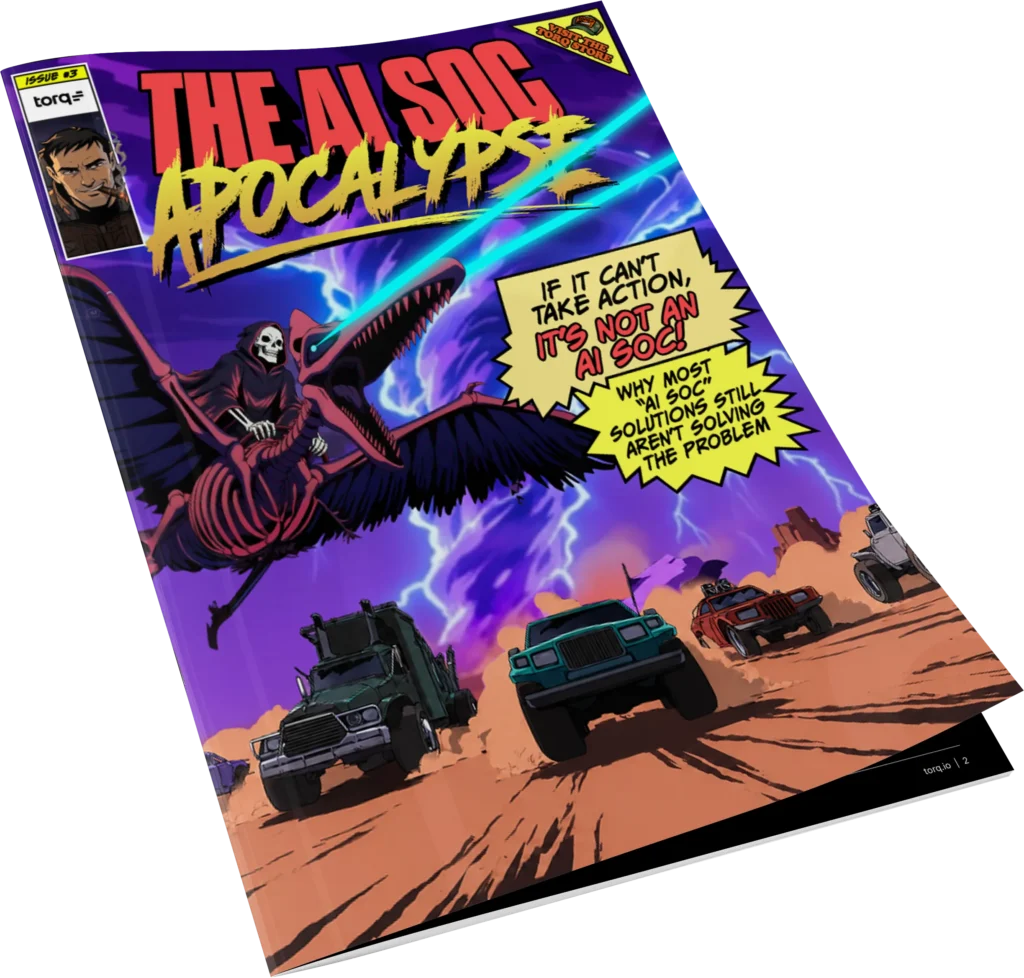
Today, we’re releasing the AI SOC Apocalypse Manifesto, our guide to what an AI SOC actually has to do and how to tell the real platforms from the ones that can’t deliver. Here’s the short version.
Two AI Fronts are Hitting the SOC at Once
The first is a technical storm. AI has democratized cyber attacks, collapsing the time, skill, and cost of running a serious intrusion. When Anthropic previewed Claude Mythos, it autonomously discovered thousands of previously unknown vulnerabilities and built working exploits without human guidance, turning what once took a nation-state months into something an amateur can do in hours. CrowdStrike research also clocked the fastest intrusions in seconds, not hours. Defenders, meanwhile, still wait for a human to wake up, read the alert, and work the playbook by hand.
The second is a commercial stampede. Every booth, ad, and cold email is pitching “agentic” something. According to Torq’s 2026 AI SOC Leadership Report, 94% of security leaders already use AI somewhere in the SOC, the average team runs seven AI tools, and 80% are still stitching together point solutions. The payoff was supposed to be relief. What most teams got was sprawl. It’s why 85% of leaders say they want a fundamentally different approach.

The AI SOC Has Lost Its Meaning
“AI SOC” now means whatever the person selling it needs it to mean. In the manifesto, we sort the market into four familiar disguises:
- Tools that handle triage and leave the actual response to you.
- Legacy products with a chatbot stapled to the front.
- Systems that hand down verdicts you can’t question, tune, or trust.
- Demo-ready newcomers that buckle the moment real enterprise volume or complexity shows up.
Different costumes, same flaw. They can tell you what’s happening, but they can’t do anything about it. Our litmus test fits in one line: a platform that can’t take action (and justify its response with deep contextual grounding) isn’t an AI SOC. It’s one more thing for your team to babysit.
What “Real” Looks Like
An AI SOC worth the name is a unified agentic execution layer that carries an alert through to resolution — triage, investigation, response, and closure — with reasoning your analysts can audit and controls they can govern. People stay on the loop for the judgment calls. The platform handles the grind.

That’s what we’ve been building and running in production for enterprises. Torq brings agentic AI, orchestration, and case management into one system, guided by Torq Socrates™, our AI SOC orchestrator, with specialized Torq HyperAgents™ handling investigation and response. Every decision is grounded in your environment and fully auditable, so your team can trust what it does, and it learns from your team’s decisions, sharpening over time.
And we didn’t show up yesterday. KuppingerCole Analysts named Torq a Leader in all four categories of their 2026 Leadership Compass for the emerging AI SOC. Forbes called Torq “more or less the de facto leader of the AI SOC space.” Gartner® named Torq the company to beat in AI SOC agents for threat investigation.’
The manifesto goes deeper on each of the four types of vendors you’ll come across, the questions worth asking before you sign anything, and what end-to-end execution actually demands. If you’re evaluating anything wearing an “AI SOC” label right now, start there. It will save you a few bad demos.
Survive the AI SOC Apocalypse. Read the blog series.