Contents
Get a Personalized Demo
See how Torq harnesses AI in your SOC to investigate, prioritize, and respond to threats faster.
Dima Kogan is Director of Product Design at Torq, where he leads the design team building Torq’s AI-powered cybersecurity products. Over 15 years in product design, including design leadership at monday.com, he’s spent his career making complex systems feel simpler to use. He writes regularly about product design, leadership, and designing in the age of AI.
Most enterprise cybersecurity products focus on functionality. That’s fine. It’s the job. But enterprise security teams spend hours inside their core products — real humans, doing really important work, seeing the same thing day after day after day.
As our platform grew, we started asking ourselves a simple question: why should powerful software have to look so…generic? We’d spent years making The Torq AI SOC Platform smarter, faster, and more capable. But visually, it still felt like it could belong to almost anyone.
Torq is known for being bold and fun — and that distinctiveness carries weight. Wear a Torq hat at a security conference, and people stop you to talk. But inside The Torq AI SOC Platform, that personality wasn’t there. We’d poured everything into functionality, and at first, the interface wasn’t really us.
Why So Serious?
Consumer software figured this out a long time ago: how a product feels is a big part of whether people stick with it. Enterprise software has been slower to catch on, and security software slowest of all.
The assumption in security has always been that personality is frivolous, or worse, unprofessional. The work is high-stakes, so the tools are built to be serious and nothing else. The result is a whole category of products that look interchangeable and feel clinical.
Our design mission made the goal clear: build products that are powerful, category leaders, and unmistakably Torq. The harder part was execution. How do you bring skeletons, lasers, and monster trucks into the leading AI SOC platform without getting in the way of the work?
Introducing Torq Mode
We started with the people who use Torq: security analysts working under real pressure, and engineers building complex workflows. The work is serious, which is exactly why the experience matters. As one engineer at AppsFlyer put it, “SecOps is a tedious, tiring job. It’s important to have some fun.”
So we got specific about how we wanted them to feel: in control, eager to build, and confident in the system, with a real sense of mastery in what they’d built. One rule anchored everything: Torq is where analysts handle critical incidents all day, so anything we added had to reinforce the experience without interrupting the work.
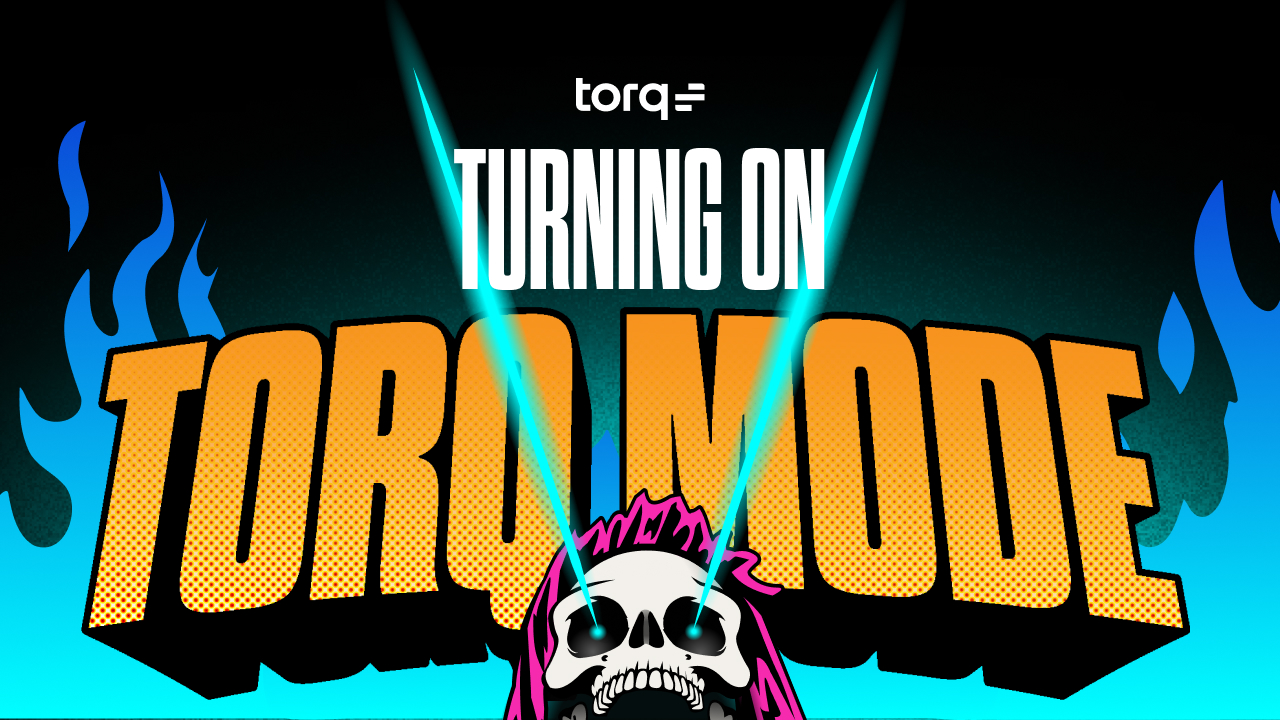
Thus, a third mode was born alongside Light and Dark modes. Users can choose the standard experience in Light or Dark, or the fully brand-connected one: Torq Mode.
We chose specific flows and interactions where a moment could land: places to encourage someone, mark a win, or draw attention to what matters. A few of them:
- Switch to Torq Mode, and a pterodactyl flies across the screen to welcome you in.
- Create your first workflow, and a skeleton fires a laser to draw it into being.
- Close a case, and a monster truck rolls across the screen, pulling a “DONE AND DUSTED!” flag.
- Flag a case as urgent, and the label catches fire on hover.
The Outcome
Two months of thinking, two weeks of building, and then we launched. The results surprised us: 81% of users who turned on Torq Mode kept it on, month after month.
Customers started bringing it up in demos. One wrote: “The animations bring a lot of energy to the interface and make the experience feel more alive… a strong personality that’s instantly recognizable and memorable.” An engineer even spent his own time extending Torq Mode into more of the product, and a customer asked us to add sound effects. When people ask for more personality, not less, you’ve built something they connect with.
Beyond Functionality
Enterprise products already look alike, and the AI era will only push them closer together. AI will build faster than ever, but it won’t decide how people should feel. That part is still on us. Solving the user’s problem is the baseline; building an experience they remember is the craft.
Torq Mode: on.