Contents
Get a Personalized Demo
See how Torq harnesses AI in your SOC to investigate, prioritize, and respond to threats faster.
TL;DR
- Security case management is the process of turning alerts and signals into prioritized, investigated, and tracked cases, and it sits at the center of incident response.
- The Torq AI SOC Platform uses AI agents to enrich context, order cases by severity, priority, and ownership, and carry cases through to remediation.
- Agentic case management reduces noise and manual investigations by up to 70%, so analysts handle judgment calls instead of ticket upkeep.
- Unified cases let SOC analysts hand off work cleanly and let IT, legal, and other teams collaborate in their own tools, such as Jira, ServiceNow, and GitHub.
- AI-generated summaries, like a two-sentence VirusTotal verdict, turn verbose tool output into decisions in seconds.
What Is Security Case Management and Why Does It Matter?
Security case management is the process of collecting security alerts and signals into cases, prioritizing them by risk, investigating them, and tracking every decision through resolution. It sits at the center of incident response, because it connects alert triage, threat prioritization, and remediation across the tools and teams in a SOC. When SOC automation handles case management, analysts spend their time on judgment calls instead of ticket upkeep.
For years, efficient case management has been one of the most challenging tasks for security operations professionals. It means ensuring all threats are proactively identified and prioritized by risk criticality, then rapidly investigated and appropriately escalated across all organizational cybersecurity platforms and tools. Done well, it builds a near-bulletproof incident response posture that makes the most of an organization’s cybersecurity ecosystem.
Legacy security automation gave teams a starting point for case management, and the pace, volume, and variety of evolving threats now call for more. SecOps teams need the flexibility to pivot quickly through records and accurately assess whether they face a targeted campaign, a new and novel threat, or an ongoing, pervasive threat that could stop business in its tracks.
The Torq AI SOC Platform was purpose-built to deliver the comprehensive case management capabilities SecOps teams have demanded for years. AI agents drive efficiency even further, assisting analysts with cutting-edge technology so they make the right choices and catch every detail.
How Does the Torq AI SOC Platform Contextualize and Resolve Security Cases?
The Torq AI SOC Platform rapidly and accurately collects large numbers of unprocessed events and signals and organizes them into contextually enriched cases, ordered by severity, priority, and ownership. Torq Socrates™, Torq’s agentic SOC orchestrator, coordinates specialized AI agents that analyze and remediate cases across multiple organizational functions, and every security decision lands in a single, auditable record.
The benefits of this approach to case management are significant. By using agentic automation for signal detection, the platform reduces noise and manual investigations by up to 70%. Its flexible framework also streamlines decision-making and enriches data automatically, which cuts through the noise and separates minor, easily remedied incidents from significant, existential organizational threats.
Here are some of the key benefits and how they work to streamline your case management processes.
What Is Agentic Security Case Management and How Does It Work?
Agentic security case management uses AI agents to create, update, and manage cases in response to security alerts, so teams prioritize and respond quickly. Torq runs common use cases as repeatable, customizable processes that launch every necessary step, with decision points that bring in human intervention for scenarios such as escalation or case handoff.
Torq Hyperautomation™, the engine behind the Torq AI SOC Platform, executes those repeatable steps, and Torq HyperAgents® add agentic reasoning that adapts to each case. SOC analysts can analyze and build the processes that handle a case or issue, and AI agents take on the routine work.
Security teams streamline their processes and focus on high-priority threats, because Torq creates, updates, and manages cases in response to alerts without manual effort. Analysts move past mundane tasks and concentrate on higher-level security activities.
How Does Torq Automatically Enrich Security Case Context?
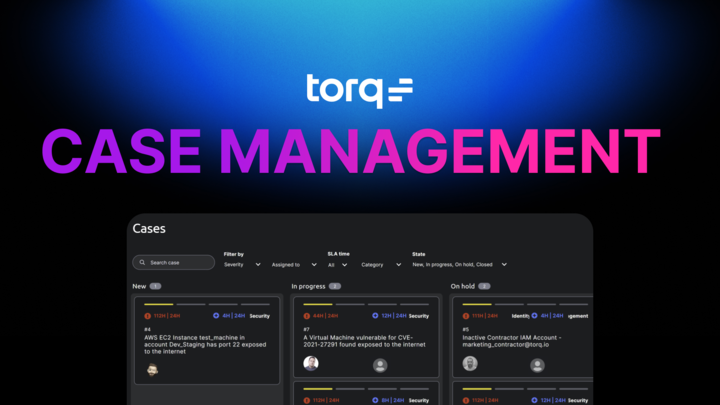
Torq’s Case Management transforms large numbers of events and signals into contextually enriched cases. It orders every case by severity, priority, and ownership, and it uses intelligent correlation of signals to open, update, enrich, or close cases, with human interaction optional.
Contextual enrichment adds threat intelligence, asset details, ownership, and history to a case so analysts see the full picture at a glance. Torq Auto Triage prioritizes alerts first, so the enriched cases that reach analysts reflect real risk.
How Does AI Accelerate Threat Discovery and Remediation in Security Operations?
AI agents in the Torq AI SOC Platform enrich the context of security alerts automatically, so analysts get involved only when a judgment call is required. When an alert fires, the platform evaluates severity, correlates it with historical signals, and determines the next action through event-driven agentic automation connected to your existing security tools. That cuts mean time to detect (MTTD) and mean time to respond (MTTR) and lets teams contain threats before they escalate.
Example: A VirusTotal MD5 Hash Lookup
In this example, a suspicious file is detected on an endpoint, and the IT analyst wants to know whether VirusTotal already lists the threat as suspicious or malicious. The analyst runs an MD5 hash lookup that kicks off an AI agent without leaving the case ticketing system.
A security analyst runs an MD5 hash lookup that kicks off an AI agent without leaving the case ticketing system.
ChatGPT condenses the findings into two sentences stating that 56 of 71 AV engines detected the threat as malicious, in place of the verbose output VirusTotal typically returns. That saves significant time and summarizes the incident in a human-readable format.
A summary of the AI agent’s output, logged automatically to the open ticket.
Torq can then run automatic remediation to scan the environment for persistence anywhere on the network, clean the endpoint, or quarantine it for further analysis by a SOC analyst.
Utilizing the power of ChatGPT, the findings are condensed to two sentences that state that 56 of 71 AV engines detected the threat as malicious. Contrast that with the overly-verbose output that you would typically receive on VirusTotal. This saves tremendous time and summarizes the incident in a readily consumable human-readable format.
Torq can then execute automatic remediation workflows to run a scan of the environment for persistence anywhere on the network, automatically clean the endpoint, or quarantine it for further analysis by a SOC Analyst.
What Does Unified Security Case Management Look Like in Practice?
Unified security case management gives SOC analysts one view of each case, with the essential processes for handling and resolving it. Handoffs between analysts happen seamlessly with all relevant case details at hand, and external teams collaborate inside the platform using the tools they already know.
Intelligent case management lets analysts take action confidently and reduces the risk of human error. AI-generated case summaries capture every step of an investigation, which keeps handoffs clean. Collaboration outside the SOC is easy to do within the platform, and it helps most with complex incidents that need multiple subject matter experts. Each external team resolves security issues efficiently with its tools of choice, including Atlassian Jira, ServiceNow, GitHub, and more.
Cross-team collaboration with various subject matter experts engaged in a high-priority investigation.
How Does Case Management Deliver Accurate, Actionable Outcomes?
Torq Case Management curates accurate, actionable data to identify service and security issues as they develop. Real-time analytics and long-term analysis reveal service trends and show where SOC analysts or other teams could gain efficiency through agentic investigation and containment. Reporting helps teams monitor progress and track performance, which helps analysts resolve cases more efficiently and reach better outcomes.
Want to see how the Torq AI SOC Platform can dramatically enhance your security operations so you can stay ahead of emerging threats?
FAQs
Automated case management shortens MTTD and MTTR by enriching alerts on arrival, routing cases to the right owner instantly, and removing escalation delays and handoff gaps. Torq customers commonly achieve a 90%+ reduction in MTTR. Because every action and decision lands in the case, analysts pick up where the last person stopped. See how SOC incident response works with AI agents.
Effective case management connects to the tools where alerts originate and where work gets done: SIEM platforms, endpoint detection tools, threat intelligence sources such as VirusTotal, and ticketing and collaboration tools such as Jira, ServiceNow, and GitHub. Each integration removes a manual handoff, because data and actions flow between tools without copy-and-paste. The Torq AI SOC Platform offers 300+ native integrations that cover these categories.
AI ranks alerts by severity, correlates them with historical signals, summarizes findings, and recommends next steps. In the VirusTotal example above, ChatGPT condensed verbose output into a two-sentence verdict that 56 of 71 AV engines flagged the file as malicious. Torq Auto Triage applies the same approach at scale and averages 42 seconds per triage with 94% accuracy out of the box (as of May 2026). Analysts then review only the cases that need judgment.
Legacy security automation runs predefined playbooks that engineers configure and maintain, which works well for known scenarios and takes ongoing effort as tools and threats change. An AI SOC adds AI-assisted triage, flexible event-driven automation, and real-time contextual enrichment that adapts to new threat types. That shortens the time to deploy new processes and scales with the volume and variety of modern threats. Many teams keep their existing automations and add AI agents on top. Compare options with the AI SOC Buyer’s Guide.
Security case management automation is the use of AI agents and software platforms to collect, correlate, prioritize, and resolve security alerts and incidents without requiring manual analyst intervention at every step. It replaces manual triage, spreadsheet tracking, and rigid playbook-based security automation with AI-driven processes that enrich alert context, assign severity scores, and trigger remediation. The result is faster incident response, less analyst burnout, and fewer threats that go undetected because of alert fatigue. Learn more in What Is an Agentic SOC?
Automated case management reduces analyst workload by correlating related signals into single cases, filtering out noise, and enriching each case before an analyst opens it. Torq reduces noise and manual investigations by up to 70%. Auto-enrichment means analysts no longer pivot across tools to gather context, and routine cases close or remediate without human touch. Read how to measure AI SOC ROI beyond hours saved for a framework to quantify the savings.
Contextual enrichment is the process of transforming raw signals into enriched cases with threat context, ownership, severity scores, and remediation history. AI agents query threat intelligence, asset inventories, identity data, and past cases, then attach the results so analysts see the full picture. Enriched cases support faster, more confident decisions and cut the time spent gathering context. Explore threat intelligence enrichment for a closer look.
Yes, security case management automation supports cross-team collaboration. External teams such as IT, legal, and compliance can engage through familiar tools like Jira, ServiceNow, and GitHub, while the SOC maintains a unified view of the case. Everyone works from the same enriched record, which reduces back-and-forth and speeds resolution of complex incidents. See how SOC teams work in the Torq AI SOC Platform.
AI reduces alert fatigue by filtering false positives, grouping related alerts into single cases, and resolving routine cases autonomously, so analysts see far fewer low-value notifications. Case summaries and enrichment remove the repetitive context gathering that wears teams down. Analysts then spend their time on investigations that need human judgment. Learn more about cybersecurity alert fatigue.