The AI SOC Analyst That Offloads 90%+ of Tier-1 Cases — Meet Socrates

Contents

Get a Personalized Demo

See how Torq harnesses AI in your SOC to detect, prioritize, and respond to threats faster.

Request a Demo

Security Operations Centers (SOCs) continue to struggle in 2025. The perfect storm of growing alert volume, consistent talent shortage, and the well-documented limitations of legacy SOAR solutions have brought many SOC teams to a breaking point. At the same time, bad actors continue to innovate, and cybercriminals have become more sophisticated in their tactics and techniques, including using AI to launch attacks at scale.

Fortunately,  AI in the SOC has begun to revolutionize the security operations field, specifically in the area of Tier-1 security analysis. According to Gartner, “By 2026, AI will increase SOC efficiency by 40% compared with 2024 efficiency, beginning a shift in SOC expertise toward AI development, maintenance and protection.” 

Why the SOC Needs an AI Analyst

As alert complexity rises, so does burnout and alert fatigue. SOC analysts today spend too much time sifting through noise and manually triaging alerts, rather than taking action to proactively secure the environment. According to the 2024 SANS Detection and Response Survey, more than half of security teams say false positives are a huge problem, and 62.5% are overwhelmed by sheer data volume. 

A major reason for this frustration is that security teams are fighting with their own tools. In a recent State of Security 2025 report, Cisco’s Splunk surveyed over 2,000 security professionals in their community to find:

  • 59% spend too much time and/or effort maintaining tools and associated workflows
  • 51% admit their tools do not integrate well with one another
  • 47% face alerting issues
  • 32% of teams do not have the requisite skills to be efficient in the SOC

Tier-1 alert triage is overwhelming. Analysts face tens of thousands of Tier-1 alerts per day, and on average, security analysts are only getting to half of the alerts they’re supposed to review. Combined with these SOC inefficiencies, the volume becomes too high for human-only triage. As a result, detection and response times suffer. Gartner says, “AI agents are emerging as a critical solution to enhance efficiency, reduce burnout, and enable teams to focus on strategic initiatives.” 

Enter Torq Socrates — the agentic AI SOC Analyst designed to dramatically offload Tier-1 workloads and lead organizations toward an autonomous SOC. 

What Is Torq Socrates?

Socrates is Torq’s agentic AI SOC Analyst — a self-deterministic, autonomous AI Agent that plans, reasons, and acts the way a human SOC analyst would. Unlike SOAR solutions or common Generative AI chatbots, Socrates does not require human instruction or guidance. Socrates understands the SOC objectives and executes complex actions with minimal oversight.

Legacy SOAR and generic workflow automation solutions offer AI chatbots that run on static, rule-based playbooks — controlled by human input. And, while GenAI augments case triage by generating context to help reduce detection and response times, it is still largely reactive and reliant on human analysts to instruct, guide, and manually trigger remediation actions. Agentic AI, on the other hand, represents the next leap towards a more autonomous SOC.

According to IDC’s latest report, agentic AI has enormous potential in cybersecurity as it can process and solve problems the way a human being would. Socrates isn’t reactive — it’s adaptive. To continuously improve and evolve with new threats, Socrates uses: 

  • Semantic memory to understand prompts and take explicit action
  • Episodic memory to learn from past incidents to develop new strategies
  • Procedural memory to make decisions on which tools to use and which data to gather

The Anatomy of Socrates: Torq’s OmniAgent

Socrates is more than just a single AI Agent. Socrates sits at the helm of Torq’s Multi-Agent System (MAS), acting as an OmniAgent in charge of coordinating multiple specialized AI Agents. Each of these agents is trained to perform a specific task, and is capable of using sophisticated iterative planning and reasoning to solve complex, multi-step problems autonomously. Torq’s AI Agents include: 

  • Runbook Agent: Autonomously plans and adapts incident response runbooks with a deep knowledge and understanding of the environment.
  • Investigation Agent: Performs deep-dive investigations in seconds, uncovering hidden patterns across disparate data sources and tools to pinpoint root causes and assess threat impact.
  • Remediation Agent: Executes remediation actions, closing the loop with verifiable outcomes, either by autonomously following the associated runbook or through human-in-the-loop response.
  • Case Management Agent: Gathers real-time and historical data, organizes case timelines, highlights key indicators, and reprioritizes incidents based on evolving information.

This agentic AI architecture is supported by first in class Retrieval-Augemented Generation (RAG) and Model-Context Protocol (MCP) technology that helps the Torq MAS dynamically accelerate SecOps outcomes by improving detection and triage accuracy, while reducing MTTD and MTTR. 

How an AI SOC Analyst Performs Tier-1 Tasks

So, how does Socrates leverage Torq’s MAS to perform Tier-1 security tasks? Let’s look at this Command and Control attack detected by Crowdstrike and see how tasks previously handled by human analysts are now handled with unprecedented efficiency by Torq’s AI SOC Analyst, Socrates. 
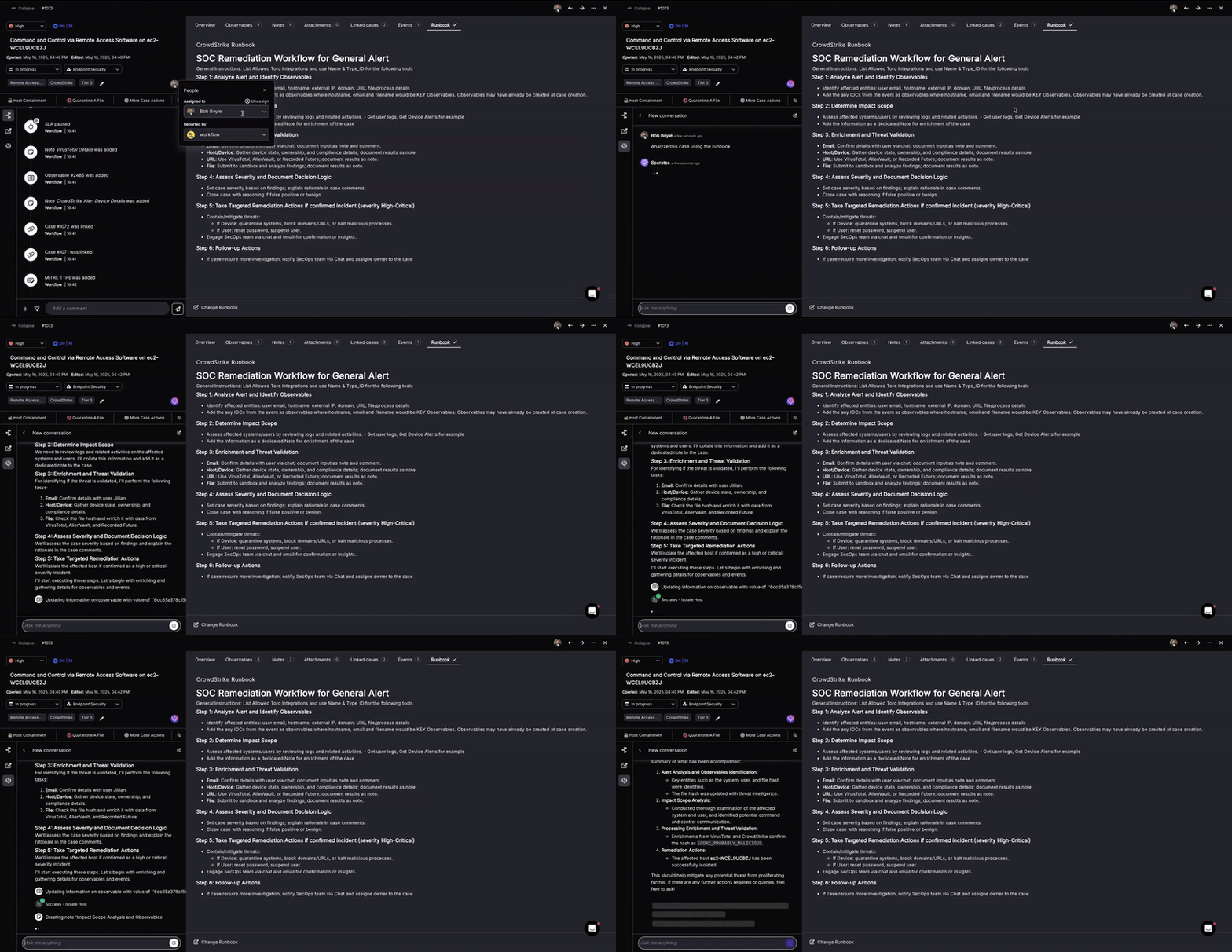
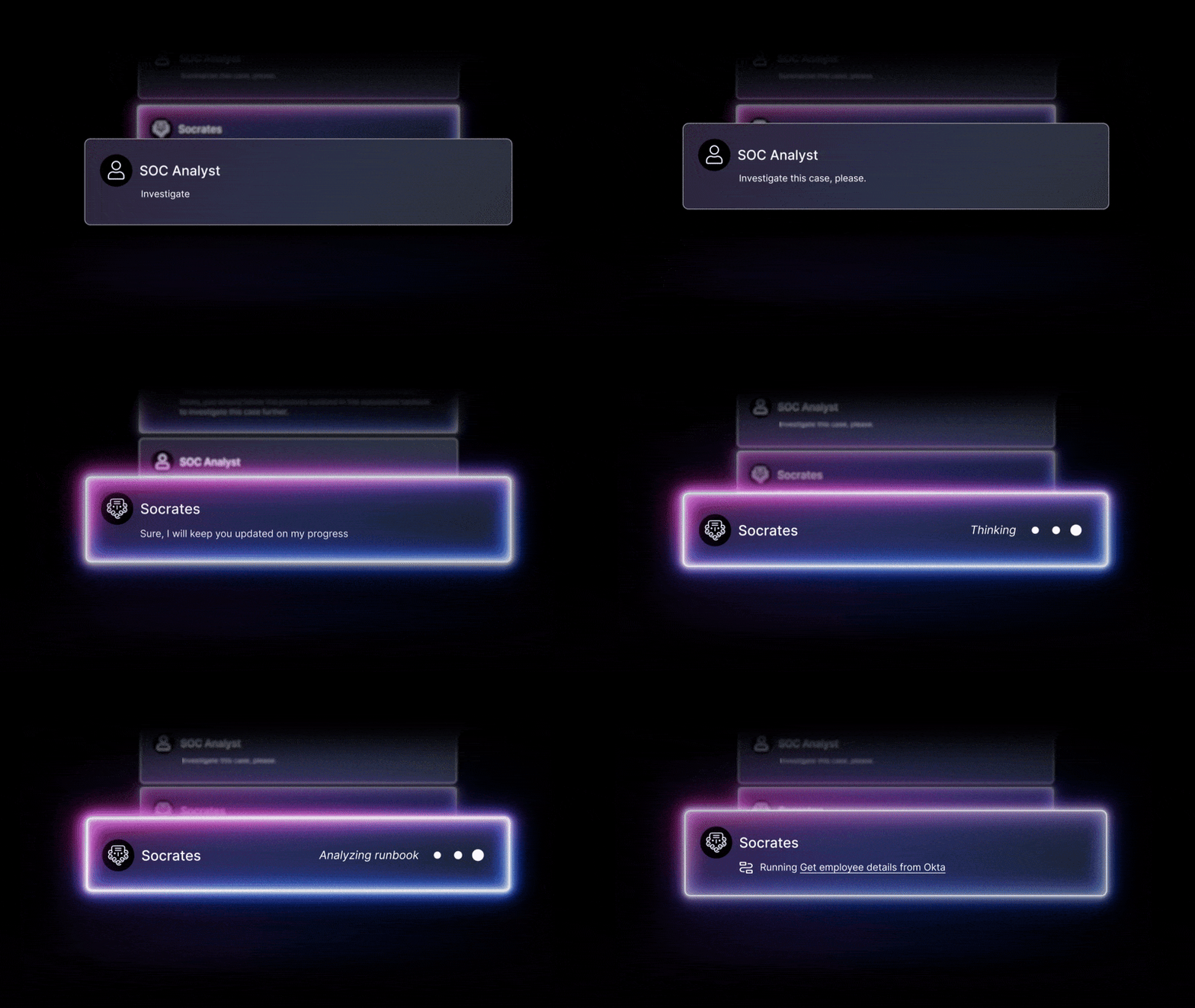
Watch Socrates, Torq’s AI SOC Analyst, following the guidelines in a SOC runbook to triage a case automatically.

1. Automatic Runbook Analysis

When a security event arises, an analyst traditionally consults a “runbook” – a guide specifying the response to that specific type of event. Today, these “runbooks” exist in all modern SOCs and are prepared by senior architects to benefit Tier-1 and Tier-2 analysts.

Torq Socrates looks at outcomes of historical cases and associates the appropriate runbook based on the observables of the new case. Socrates automatically analyzes runbooks written in natural language, typically containing step-by-step procedures for handling various security incidents. By analyzing the semantic meaning of the natural language instructions, the AI SOC Analyst derives action flow from the recommended response strategies for different security events.
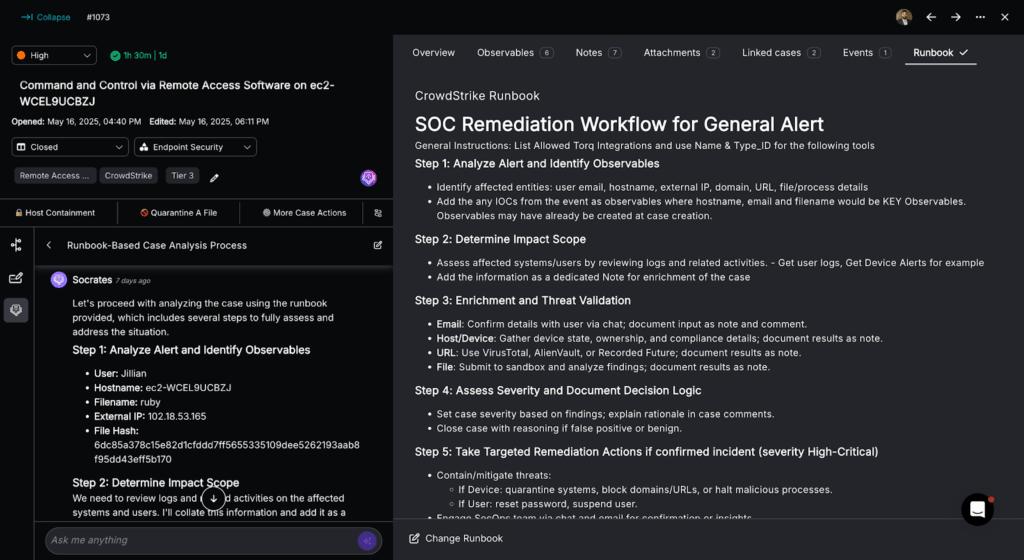
The associated case remediation runbook is written in natural language that Socrates analyzes, “understands,” and can follow.

2. Deep Research Incident Investigations

The many security tools available in the arsenal of Tier-1 SOC analysts can return a large amount of detailed information. The analyst’s goal is to synthesize this information into a decision about which next steps to take, according to the runbook’s guidance. 

Just as human analysts rely on insights from the runbook, Socrates can assist in automating investigation or even incident response tasks. This includes executing tasks such as alert triage, data enrichment, containment, and remediation actions, which speeds up response times and reduces the manual effort required from human analysts.

An agentic AI SOC Analyst like Socrates excels at processing both structured and unstructured security tool data. This enables it to analyze complex information and create dynamic decision trees based on runbook analysis. These decision trees adapt to the specific context of each incident, allowing for more efficient and accurate incident handling. For example, Socrates can determine: Is the file malicious? Is the user a very important person (VIP)? Is the activity frequent or infrequent during a specific time period indicating anomalous behavior?
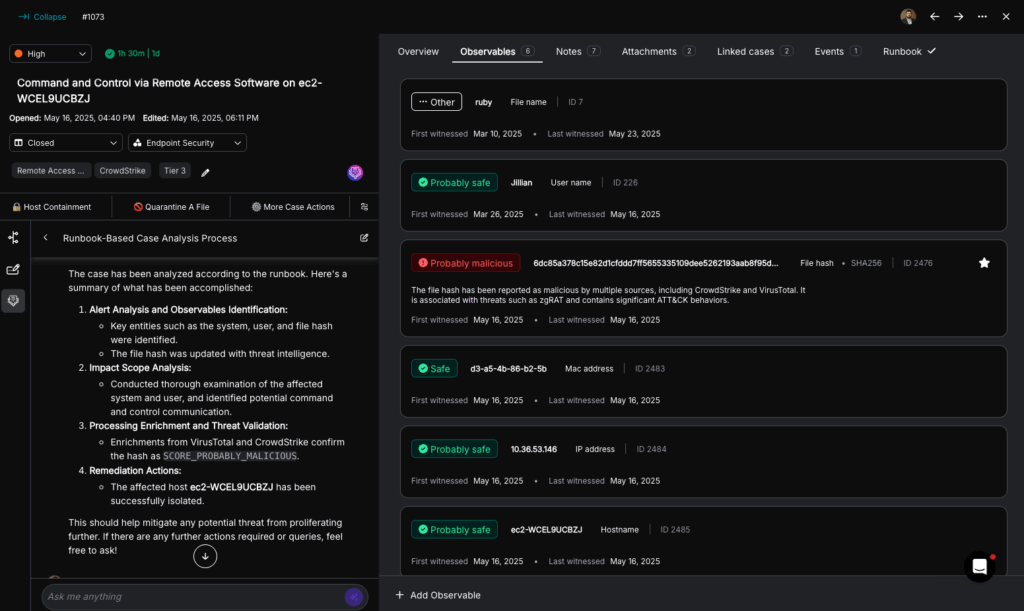
Socrates utilizing Crowdstrike, VirusTotal, and a deep understanding of the organization’s environment to query observables and distill the relevant information.

3. Knowledge of Security Frameworks for Context

More experienced alert triage specialists bring their own contextual knowledge and understanding of networking, endpoint architecture, and attack techniques into the mix.

AI Agents are trained on an immense body of natural language documents containing information about the above and more. This allows the semantic analysis of an AI Agent to match the observed outcome of a security tool and the technique described in a documented framework, such as the MITRE ATT&CK framework.

Using the above technique, Torq’s agentic AI SOC Analyst, Socrates, leverages the information available in numerous documents describing attack frameworks, such as the MITRE ATT&CK framework, and maps its tactics and techniques to the outcomes observed in the analyzed security event.
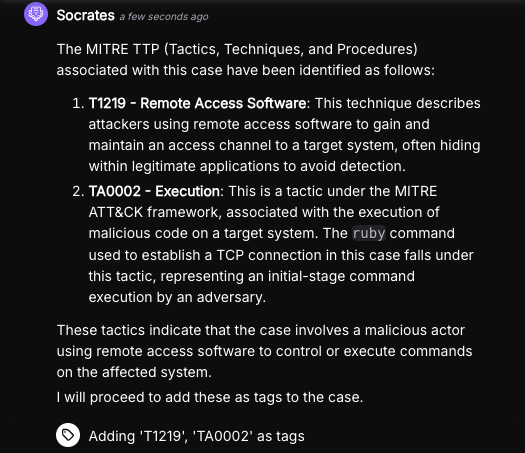
Intelligent modeling with Torq’s AI SOC Analyst Socrates enables it to mimic a human-like thinking process, correlating information efficiently and mapping the appropriate outcomes to common frameworks like the MITRE ATT&CK framework, NIST, and more.

4. Leveraging Hyperautomation to Perform Designated Remediation Actions

The next step for a human analyst is to carry out the remediation actions outlined in the runbooks, choosing the proper tool and executing the instructions.

Based on the content of the runbook, the AI SOC Analyst utilizes its semantic analysis capabilities to suggest and trigger suitable Hyperautomated workflows and security tools from the list of ones explicitly made available within the Torq platform. These workflows align with the specific steps outlined in the document conveyed in natural language.
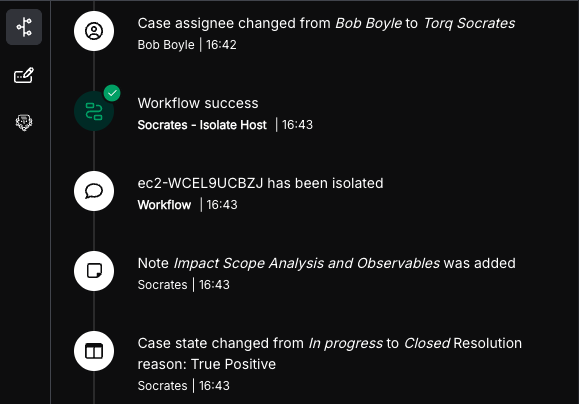
Torq Socrates performing the initial actions within the runbook.

5. Intelligent Case Management and Documentation

An important pillar of any operational practice is the meticulous documentation of all actions taken, decisions, and achieved outcomes. 

AI Agents have proven to be efficient at summarizing large amounts of natural language text. Torq Socrates leverages this capability to summarize the “conclusions” and desired next steps, and document them in the “case timeline”. Socrates then reaches back into its toolbox and ability to take action autonomously, marking the case as “closed” and moving the case forward without any human intervention.

Torq Socrates summarizing the findings and actions taken of the security event and automatically adding them to Torq’s built-in ticket management system timeline.

How Security Teams Use Socrates Today

Gartner forecasts that by 2028, multi-agent AI in threat detection and incident response will rise from 5% to 70%. For Torq customers leveraging Socrates, this is already their reality.

“I believe the successful use of Torq Agentic AI in SOC operations shows up in practical outcomes. With Torq Agentic AI, the answer is yes to questions such as: Are analysts happier? Are they sticking around? Do they have time to focus on more interesting and complex investigations? Are MTTM and MTTR lower? Torq Agentic AI extends and enhances our team so it can make better decisions more quickly — resulting in stronger security all around.”

Mick Leach, Field CISO, Abnormal Security

Socrates isn’t just another tool — it’s another teammate. And it’s changing the way security gets done. With Socrates, security decisions are made with context, fully automated incident response becomes the default, and agentic AI becomes the connective tissue across previously siloed security solutions that enable SOC teams to move from human-in-the-loop to human-on-the-loop. 

According to IDC, Torq HyperSOC, powered by Socrates, helps:

  • Eliminate over 95% of Tier-1 analyst workload
  • Reduce time-to-remediation by 90%
  • Increase case handling capacity 3-5x with zero added headcount

Torq Socrates is designed to handle Tier-1 triage actions by mapping the tasks and activities of human Tier-1 analysts to use cases leveraging agentic AI. With Torq Socrates as their AI SOC Analyst, human security analysts remain in charge of processes and outcomes while introducing dramatic new efficiencies and incident response accuracy, alleviating security analysts’ most critical challenges.

Want to meet Socrates? Request a demo. And get the AI or Die Manifesto to learn strategic considerations and CISO advice for deploying AI in your SOC. 
SEE TORQ IN ACTION

Ready to automate everything?

“Torq takes the vision that’s in your head and actually puts it on paper and into practice.”

Corey Kaemming, Senior Director of InfoSec

“Torq HyperSOC offers unprecedented protection and drives extraordinary efficiency for RSM and our customers.”

Todd Willoughby, Director

Compuquip logo in white

“Torq saves hundreds of hours a month on analysis. Alert fatigue is a thing of the past.”

Phillip Tarrant, SOC Technical Manager

Fiverr logo in black

“The only limit Torq has is people’s imaginations.”

Gai Hanochi, VP Business Technologies

Carvana logo in black

“Torq Agentic AI now handles 100% of Carvana’s Tier-1 security alerts.”

Dina Mathers, CISO

Riskified logo in white

“Torq has transformed efficiency for all five of my security teams and enabled them to focus on much more high-value strategic work.”

Yossi Yeshua, CISO

Cybersecurity Best Practices Every Organization Should Follow

Contents

Get a Personalized Demo

See how Torq harnesses AI in your SOC to detect, prioritize, and respond to threats faster.

Request a Demo

Cybersecurity is foundational to the survival and success of modern businesses. As digital operations expand, the risk of attacks, data breaches, and operational disruption increases dramatically, making cybersecurity not just important, but absolutely essential.

With digital transformation accelerating, remote and hybrid workplaces becoming the norm, and cyber threats evolving rapidly, organizations must adopt proactive cybersecurity strategies. 

Traditional security measures alone no longer suffice — the speed and sophistication of modern threats demand cutting-edge solutions like Hyperautomation and agentic AI. Organizations today need automated and scalable cybersecurity technology.

Learn the latest cybersecurity best practices, how to implement them, and how Hyperautomation platforms like Torq ensure your defenses scale effortlessly.

What are Best Practices in Cybersecurity?

Cybersecurity best practices are proactive measures, policies, and technologies designed to minimize your organization’s cyber risk. Adhering to these practices helps businesses stay secure by preventing breaches, ensuring compliance, protecting sensitive data, preventing data breaches, and maintaining business continuity.

Many cybersecurity frameworks emphasize the “5 C’s of cybersecurity”:

  1. Change: Regularly updating security measures.
  2. Compliance: Adhering to industry standards and regulations.
  3. Cost: Balancing security spending and effectiveness.
  4. Continuity: Ensuring ongoing business operations after incidents.
  5. Coverage: Comprehensive protection across all digital assets.

To improve cybersecurity, companies must combine extensive policies, employee education, strong access controls, and real-time threat response, ideally powered by scalable Hyperautomation platforms. 

10 Essential Cybersecurity Best Practices (and How Torq Hyperautomates Them)

Cyber threats move fast, and your defenses need to move faster. These ten best practices are non-negotiable for modern SOC teams. But implementing them manually? That’s where most organizations fall behind.

Torq Hyperautomation™ eliminates the friction by turning best practices into fully automated, always-on workflows. Whether enforcing access controls, responding to phishing attempts, or monitoring endpoints, Torq ensures each control is executed precisely and at scale.

Here’s what to put in place now — and how Torq helps you do it effortlessly.

1. Use Strong, Unique Passwords and a Password Manager

Passwords are often the first — and weakest — line of defense against cyber intrusions. Weak or reused passwords significantly increase the risk of account compromise, especially in credential stuffing and brute-force cyber attacks. Organizations should enforce strong password policies that mandate the use of long, complex, and unique passwords for every account.

To ease the burden on employees, deploy enterprise-grade password managers that generate, store, and autofill passwords securely. These tools reduce password fatigue and help prevent risky practices like writing down credentials or reusing them across platforms. Periodic password audits can also be automated with Torq, which can trigger alerts when passwords aren’t updated or don’t meet compliance standards.

2. Enable Multi-Factor Authentication (MFA) Everywhere

MFA is one of the simplest and most effective ways to prevent unauthorized access. It ensures that even if credentials are compromised, hackers can’t easily access sensitive systems without a second form of verification, such as biometrics, hardware tokens, or authenticator apps.

Torq enhances MFA implementation with Role-Based Access Control (RBAC) automation workflows. Security teams can use Torq to enforce MFA across platforms, audit authentication events, and automatically revoke access for users who haven’t completed MFA setup, minimizing friction and oversight.

3. Keep All Software and OS Up to Date

Outdated systems often harbor unpatched vulnerabilities that threat actors exploit. From zero-day vulnerabilities in operating systems to neglected third-party apps, every unpatched asset is a liability.

Implement an automated patch management strategy. With Torq, security teams can set up workflows that monitor software versions across endpoints, flag outdated components, and trigger notifications or remediation actions when updates are overdue. Coupling this with scheduled audits ensures continuous hygiene and reduces attack surfaces.

4. Install Antivirus and Anti-Malware on Every Device

Endpoint protection remains critical in defending against a broad range of cyber threats including ransomware, malware, and trojans. Organizations should deploy endpoint detection and response (EDR) solutions that use real-time behavioral analysis, not just signature-based detection.

To ensure these tools stay effective, Torq can integrate with antivirus platforms to monitor endpoint health, validate update statuses, and automate quarantine or isolation actions in response to detected threats, speeding up remediation and reducing exposure windows.

5. Secure Networks with Firewalls and VPNs

Firewalls and VPNs help shield organizational networks from unauthorized access and malicious traffic. Firewalls block suspicious inbound/outbound traffic, while VPNs provide encrypted tunnels for secure remote access, especially critical in hybrid work environments.

Torq can enhance these protections by automating firewall rule updates, triggering alerts when unexpected changes occur, and monitoring VPN usage for anomalous patterns such as logins from unusual geolocations or times. This automation ensures your network security posture stays strong without requiring constant manual oversight.

6. Regularly Back Up Data to the Cloud and Offline

Cyberattacks like ransomware and accidental deletions can lead to devastating data loss. Regular backups are your safety net. Organizations should adopt a 3-2-1 backup strategy: three copies of data, two on different media, and one offsite.

Torq helps ensure backup best practices are followed by automating backup verification, alerting if a backup fails, and orchestrating regular backup operations. Teams can also use Torq to conduct post-backup security posture checks to ensure backups aren’t infected or misconfigured, ensuring they’re both usable and secure.

7. Educate and Train Employees on Phishing and Social Engineering

The human element remains the weakest link in cybersecurity. Regular security awareness training, including simulated phishing campaigns, is essential to prepare employees for common social engineering tactics.

Torq supports these efforts with automated phishing response workflows. When phishing attacks are reported or detected, Socrates, our AI SOC Analyst, rapidly investigates, auto-remediates the message, and updates the reporting employee, reducing response time and enabling analysts to focus on complex threats. Combined with training, this creates a layered defense against email-based attacks.

8. Use Encryption for Sensitive Data at Rest and in Transit

Encryption ensures that even if data is intercepted or accessed without authorization, it remains unreadable. All sensitive data — customer records, financial information, proprietary code — should be encrypted both at rest (on storage systems) and in transit (during transmission over networks).

Organizations should enforce the use of industry-standard protocols such as AES-256 and TLS 1.3, and regularly audit encryption configurations. Torq can automate policy enforcement and integrate with encryption management systems to verify encryption coverage and trigger alerts for unprotected data assets.

9. Limit User Access with RBAC and Least Privilege

The principle of least privilege (PoLP) limits access rights for users to the bare minimum necessary. Overprivileged accounts are a goldmine for cybercriminals and a major source of internal risk.

Torq’s RBAC capabilities automate access provisioning, ensure only necessary permissions are granted, and continuously audit user roles. If access privileges drift over time due to role changes or misconfigurations, Torq can automatically flag or correct them, helping prevent lateral movement in case of compromise.

10. Monitor for Suspicious Behavior and Automate Alerts

Traditional alerting often leads to analyst burnout due to high volumes of low-fidelity alerts. Modern threats demand intelligent monitoring that can identify anomalies and respond in real time.

Torq’s multi-agent system continuously monitors systems for signs of compromise and suspicious behavior. When an anomaly is detected, it automatically triages the event, enriches it with context, and initiates workflows to investigate or contain the threat, without requiring human intervention. This reduces MTTD and MTTR, keeping your defenses agile and proactive.

Common Cyber Threats Every Organization Faces 

To understand why these security best practices matter, consider some of today’s most pressing cyber threats:

  • Ransomware: Ransomware attacks encrypt critical data, demanding payment for restoration. Organizations must maintain backups, enforce patch management, and automate threat detection to prevent such attacks.
  • Phishing: Attackers trick employees into revealing credentials or downloading malware. Continuous security awareness training and automated phishing remediation significantly reduce phishing-related breaches.
  • Insider Threats: Whether intentional or accidental, insider threats pose significant risk. Implement strong RBAC policies and continuous user activity monitoring to quickly detect suspicious behavior.
  • DDoS (Distributed Denial of Service): Attackers overwhelm your network or services with traffic, disrupting operations. Deploy firewall protections, traffic monitoring, and automated mitigation responses to maintain availability.

Hyperautomate Your Cybersecurity Best Practices with Torq Hyperautomation

Even the most extensive cybersecurity best practices can fall short without consistency, speed, and scalability. That’s where Torq Hyperautomation steps in. 

Torq automates every layer of your security operations — from detection to remediation — without writing a single line of code. Whether you’re enforcing MFA, orchestrating real-time phishing response, or managing RBAC policies across hybrid environments, Torq executes it all with precision and speed.

Torq’s Hyperautomation platform empowers organizations to convert cybersecurity best practices into always-on, fully orchestrated workflows. Our agentic AI capabilities, including our multi-agent system led by Socrates, detect, triage, and respond to alerts instantly, without flooding your team with noise. 

This means your security analysts spend less time on repetitive triage and more time focused on high-impact, strategic initiatives. And with a vast library of integrations and workflow templates, you can implement sophisticated security controls faster than ever.

Build a Stronger, Smarter Security Posture

Cybersecurity threats are growing rapidly, but so are the solutions to fight them. Adopting these cybersecurity best practices will strengthen your organization’s defenses against modern threats. However, manually managing every aspect of security is unsustainable. 

Torq Hyperautomation gives your organization an edge by transforming security best practices into streamlined, automated operations. From employee training and endpoint protection to real-time threat response and compliance reporting, Torq ensures that your security posture isn’t just strong; it’s intelligent, adaptable, and future-ready.

Ready to strengthen your cybersecurity posture with Torq? 

SEE TORQ IN ACTION

Ready to automate everything?

“Torq takes the vision that’s in your head and actually puts it on paper and into practice.”

Corey Kaemming, Senior Director of InfoSec

“Torq HyperSOC offers unprecedented protection and drives extraordinary efficiency for RSM and our customers.”

Todd Willoughby, Director

Compuquip logo in white

“Torq saves hundreds of hours a month on analysis. Alert fatigue is a thing of the past.”

Phillip Tarrant, SOC Technical Manager

Fiverr logo in black

“The only limit Torq has is people’s imaginations.”

Gai Hanochi, VP Business Technologies

Carvana logo in black

“Torq Agentic AI now handles 100% of Carvana’s Tier-1 security alerts.”

Dina Mathers, CISO

Riskified logo in white

“Torq has transformed efficiency for all five of my security teams and enabled them to focus on much more high-value strategic work.”

Yossi Yeshua, CISO

The Multi-Agent System: A New Era for SecOps

Contents

Get a Personalized Demo

See how Torq harnesses AI in your SOC to detect, prioritize, and respond to threats faster.

Request a Demo

Security teams face mounting pressure to defend against sophisticated cyber threats. Traditional automation strategies are often rigid, reactive, and lack the ability to scale effectively. Many SOCs already have access to generative AI to assist with simple tasks and now Torq has brought agentic AI into the mix — which thinks, acts, and learns autonomously to handle security risks. What’s next? 

A multi-agent system (MAS) represents the next era for SecOps: specialized AI agents that work together to solve problems. Each AI agent has a specific role that it is responsible for executing, and together, this system of agents collaborates to achieve a common goal.

Let’s explore what a multi-agent system is, why it’s essential for SecOps, and how Torq leverages multi-agent AI to redefine security operations.

What Is a Multi-Agent System?

A multi-agent system is a network of artificially intelligent software agents working collaboratively to achieve complex, multi-step goals, often orchestrated by an OmniAgent, or “Super Agent”. Unlike monolithic automation tools, each agent within the system operates autonomously, specializing in specific tasks and communicating seamlessly to coordinate actions.

Multi-agent systems comprise three key components: the individual AI agents themselves, a communication framework, and a control structure that governs how agents interact. These smaller, focused agents that perform specific tasks break down complex security operations into manageable pieces.

Why Multi-Agent AI Outperforms Single AI Agents

Scalable: A MAS enables multiple agents to work simultaneously across tasks — unlike traditional automation that handles events sequentially. This parallel approach dramatically increases operational speed and resilience.

Specialization: Rather than relying on broad workflows, multi-agent AI deploys specialized agents that are experts in their roles. This ensures every security incident receives expert-level attention explicitly tailored to its context.

Collaborative Learning: Multi-agent systems leverage AI reasoning to improve continuously. They learn from incidents, adapt to changing threats, and refine their workflows automatically, enabling ongoing evolution and enhanced security posture.

Cost Savings: By breaking down responsibilities into smaller specialized tasks, the workload and resource consumption of the AI system is more efficiently distributed, resulting in a less costly AI implementation. Rather than a single general-purpose AI chatbot working step by step through a problem, the parallel execution of bite-sized tasks helps save the SOC money in the long run. 

How Do Multi-Agent AI Systems Work in the SOC?

In a MAS, each agent operates independently, making its own decisions based on its specific role, environment inputs, and communication with other agents.

Here’s how a typical multi-agent system operates:

  • Autonomy: Each agent can act independently without needing centralized control.
  • Specialization: Agents are assigned specific functions (e.g. triage, investigation, remediation, etc.) based on their unique capabilities and expertise.
  • Communication and coordination: Agents share information, either directly or through a central, orchestrating OmniAgent, to align activities, correlate relevant data, and avoid conflicts.
  • Parallel execution: Multiple agents work simultaneously, dramatically accelerating task completion compared to linear automation models.
  • Adaptability: Agents dynamically adjust their behavior in response to real-time inputs, changes in the threat landscape, or evolving priorities.
  • Emergent behavior: Through collaboration, the system can achieve more sophisticated outcomes than any single agent.

Multi-Agent System Use Cases In the SOC

Alert Triage at Scale

With a Multi-Agent System, autonomous agents can instantly evaluate thousands of incoming alerts, enrich them with context, and determine severity using internal telemetry and threat intel sources. Instead of drowning analysts in false positives, MAS filters out noise and flags what actually matters. This dramatically reduces Mean Time to Remediate (MTTR) and frees up security teams to focus on high-value investigations.

Runbook Orchestration

Building and maintaining runbooks shouldn’t require a dev team. Multi-agent systems enable no-code orchestration of complex workflows that span cloud platforms, identity providers, SIEMs, EDRs, and more. Security teams can define desired outcomes in natural language, and AI agents translate those into structured, executable playbooks. This accelerates time-to-value, eliminates human error, and ensures consistent, repeatable outcomes without code dependencies.

Incident Response

A Multi-Agent System coordinates the investigation, containment, remediation, and closure of a case as a single, seamless operation. Each agent specializes in a specific role for triage, root cause analysis, identity verification, and remediation, working in parallel under the direction of an OmniAgent. Threats are resolved faster, response is consistent, and your SOC operates like a finely-tuned machine.

Threat Hunting

Proactive threat-hunting agents continuously monitor activity across your environment, looking for behavioral anomalies, pattern deviations, or signals buried in noise. These agents correlate telemetry from endpoints, cloud assets, and user behavior to surface suspicious activity. They initiate investigations automatically, escalating only when human insight is required.

The World’s First Multi-Agent System for The SOC

Torq is the first cybersecurity platform to launch a true Multi-Agent System (MAS) purpose-built for the SOC. Torq HyperSOC™’s MAS architecture deploys a team of specialized, autonomous AI Agents, coordinated by Socrates, our OmniAgent, to execute complex SecOps workflows in parallel, at scale, and without human intervention. Meet Torq’s AI Agents. 

Socrates, the AI SOC Analyst 

Socrates is the OmniAgent mastermind that serves as the command center for all other agents. It interprets high-level goals and directives and then orchestrates the appropriate sequence of AI Agents to execute the task with precision. Socrates understands natural language, so human SOC analysts can kick off complex investigations or remediation plans with simple prompts. It turns strategic intent into scalable, autonomous action.

Runbook Agent

The Runbook Agent is the architect of execution. It takes strategic objectives, like responding to phishing, escalating ransomware alerts, or handling IAM requests, and maps them to dynamic, modular workflows. This agent builds the execution plan, delegates tasks to specialized agents, and ensures every step adheres to security policy and best practices. It enables your SOC to execute with precision, speed, and zero guesswork.

Investigation Agent

When context is critical, the Investigation Agent takes over. It digs deep into alert data, pulling from internal logs, threat intelligence platforms, CMDBs, and identity systems to uncover the root cause of a threat. It correlates signals, identifies attack paths, and enriches cases with detailed findings. This agent handles the heavy lifting, allowing human analysts to focus on informed decision-making.

Remediation Agent

Once a threat is validated, the Remediationgent initiates the full response lifecycle, from isolating endpoints and revoking credentials to updating firewall rules and notifying affected users. It acts decisively and autonomously to contain incidents and restore normal operations without waiting for human intervention. 

Case Management Agent

The Case Management Agent automatically compiles case summaries, prioritizes incidents based on business impact and severity, and routes alerts to the right stakeholders. It also captures analyst actions and decisions to maintain clean audit trails and feed the system’s memory for more intelligent responses over time. This agent transforms raw alerts into structured, actionable intelligence.

In Torq HyperSOC™,, each AI Agent specializes in a core security function — and together, they operate as an intelligent, coordinated, tireless SOC workforce. This collaborative multi-agent AI architecture eliminates bottlenecks, accelerates response, and drives precision at scale, transforming reactive SOCs into proactive, autonomous security operations.

The Future of SecOps: The Autonomous SOC Powered by Multi-Agent AI

The security industry has outgrown one-size-fits-all automation. Torq’s Multi-Agent System offers a new path forward: agentic AI that works in tandem, orchestrated by Socrates, to transform your SOC from reactive to autonomous. But Torq’s latest advancements truly push our MAS into next-gen territory.

Retrieval-augmented generation (RAG) enhances Torq’s MAS by giving our AI Agents access to private and external knowledge bases. That means every decision is made with the most current, relevant intelligence. RAG enhances everything from case enrichment and threat correlation to report generation, enabling smarter, faster response without sacrificing accuracy.

Model-Context Protocol (MCP) is another Torq game-changer. Torq is the first autonomous SOC platform to natively support MCP, which guarantees AI decisions are grounded in the exact context of your environment. This ensures precise, verifiable actions based on your organization’s specific infrastructure, data, and threat landscape.

Together, these advancements bring Torq’s vision to life: a truly autonomous SOC where AI handles the heavy lifting and humans stay in control as strategic decision-makers. 

See the world’s first true Multi-Agent System for the SOC in action.


Quiz: Which Torq AI SOC Agent Has Your Back?

Still chasing alerts manually? That’s what a multi-agent system is for.

Take this quiz to discover which AI agent in Torq HyperSOC™ is taking the tactical weight off your plate — so you can focus on what really matters.

  1. A zero-day exploit just triggered an alert. What’s your move?
  2. Your SOC team relies on you to...
  3. When faced with numerous alerts, you:
  4. Pick the quote that best sums up how you feel:
Drumroll, please! Your results are in:

SEE TORQ IN ACTION

Ready to automate everything?

“Torq takes the vision that’s in your head and actually puts it on paper and into practice.”

Corey Kaemming, Senior Director of InfoSec

“Torq HyperSOC offers unprecedented protection and drives extraordinary efficiency for RSM and our customers.”

Todd Willoughby, Director

Compuquip logo in white

“Torq saves hundreds of hours a month on analysis. Alert fatigue is a thing of the past.”

Phillip Tarrant, SOC Technical Manager

Fiverr logo in black

“The only limit Torq has is people’s imaginations.”

Gai Hanochi, VP Business Technologies

Carvana logo in black

“Torq Agentic AI now handles 100% of Carvana’s Tier-1 security alerts.”

Dina Mathers, CISO

Riskified logo in white

“Torq has transformed efficiency for all five of my security teams and enabled them to focus on much more high-value strategic work.”

Yossi Yeshua, CISO

3 Ways Torq HyperSOC Reduces MTTR with AI and Automation

Contents

Get a Personalized Demo

See how Torq harnesses AI in your SOC to detect, prioritize, and respond to threats faster.

Request a Demo

Your SOC exists for one core reason: to rapidly reduce the mean time to detect, investigate, and respond to threats. The more efficiently your team operates, the faster you reduce essential KPIs like MTTR, MTTD, MTTI, and what we call ‘MTTx’ (mean time to anything).

Ask our former Field CISO, Patrick Orzechowski (PO), and he’ll tell you straight: If your SOC isn’t relentlessly focused on reducing risk through speed, you’re falling behind.

Talking about efficiency is easy. Actually achieving it, especially when your SOC is drowning in alerts and your analysts are burning out, is another story entirely.

The solution lies in combining Hyperautomation, agentic AI, and intelligent case management. Below, we break down three use cases where Torq HyperSOC™ and Socrates, the AI SOC Analyst, reduce MTTR to just minutes.

The SOC Efficiency Challenge

Reducing MTTR is a top priority for SOCs, yet many struggle to make meaningful progress. The root of the problem lies in legacy SOC environments’ outdated, manual, and disconnected nature.

If you’ve spent time in a SOC, these pain points are familiar:

  • Manual investigations slow everything down: Over half of security teams struggle with false positives and data overload. Analysts spend valuable time pivoting between tools, manually gathering context from logs, threat intel feeds, and asset databases. This “swivel-chair” approach introduces friction at every stage of the investigation.
  • Siloed tools don’t talk to each other: Most SOCs operate across dozens of disconnected platforms — EDR, SIEM, IAM, CMDB, ticketing, and more — without unified visibility or shared context. This makes correlating events and making informed decisions harder and slower.
  • High alert volume leads to fatigue: Teams receive thousands of alerts daily, many of which are false positives. Sifting through the noise to find true threats overwhelms even the most seasoned analysts, increasing the time it takes to detect and resolve incidents.
  • Disjointed shift handoffs cause delays: Without standardized processes or automated case management, investigations are often paused or reset between analyst shifts. Critical details get lost, increasing downtime and dragging out resolution timelines.
  • Inconsistent processes and tribal knowledge: The lack of documented workflows and reliance on individual expertise mean response varies from one analyst to the next. This inconsistency increases mean time to detect (MTTD), mean time to investigate (MTTI), and ultimately mean time to resolve (MTTR).
  • Delayed escalation and decision-making: Analysts often wait for senior approval before containing threats, primarily when procedures aren’t codified. This slows the response and allows attackers to move laterally or escalate privileges.

These pain points slow your team’s reaction times and increase risk. But these barriers disappear when Hyperautomation, AI, and smart case management are unified.

Why Reducing MTTR Is the Key to SOC Efficiency

Related metrics include:

  • MTTD (Mean Time to Detect): How long it takes to identify that an incident has occurred.
  • MTTI (Mean Time to Investigate): The time required to assess and understand the scope and severity of an incident.
  • MTTR (Mean Time to Resolution): The full incident lifecycle — detection through response and resolution.
  • MTTx: A flexible term for any “mean time to X” metric, such as mean time to contain, recover, or respond.

High MTTR leads to longer dwell times, greater risk exposure, and higher operational costs. Reducing MTTR means:

  • Stopping attackers before lateral movement or data exfiltration
  • Limiting downtime and business disruption
  • Giving analysts time back to focus on proactive defense

Reducing MTTR is a direct path to stronger security, happier analysts, and a more efficient SOC.

How AI, Hyperautomation, and Case Management Can Reduce MTTR

Torq HyperSOC is an autonomous, cloud-native security operations platform designed to reduce MTTR by eliminating manual bottlenecks across the incident lifecycle. Built on the Torq Hyperautomation platform, HyperSOC combines:

  • Agentic AI (Socrates) to autonomously triage, investigate, and resolve threats
  • No-code/low-code orchestration for rapid integration with existing tools across SIEM, EDR, IAM, and SaaS environments
  • Natural language processing (NLP)-powered automation for dynamic workflows, smart case management, and intuitive analyst interaction

How Automation Speeds Detection, Investigation, and Response

Every minute matters in security. HyperSOC uses automation to minimize time spent on repetitive and manual tasks, which directly reduces MTTR.

Automated threat detection eliminates wait time for analyst triage.

Instant data correlation reduces downtime spent stitching logs, alerts, and asset context.

Hands-free auto-remediation triggers the correct response playbooks based on the threat type.Audit-ready documentation is generated in real time, ensuring compliance and traceability.

Use Case #1: Neutralize a Reverse Shell Command & Control (C2) Attack 

This example shows how Torq HyperSOC reduced MTTR from hours to under two minutes by automating detection, investigation, and containment, without human intervention.

Threat detection and autonomous response: When a Ruby-powered reverse shell (courtesy of njRAT) targeted an EC2 Linux instance, Socrates got to work. As Torq’s AI SOC Analyst, Socrates detected anomalous process behaviors and network connections, flagging the reverse shell command within seconds.

Real-time enrichment: Without waiting for analyst input, Socrates quarantined the EC2 host. The platform harvested file hashes, process trees, and destination IPs, then enriched them via threat intel feeds and internal CMDB lookups.

AI-generated reporting: Through a deep understanding of the environment and analysis of the remediation runbook associated with the detected use case, Socrates autonomously killed the malicious process in its tracks before the bad actor was able to spread laterally, exfiltrate sensitive data, or cause any further damage. In under two minutes, the HyperSOC dashboard included an AI-generated incident report with prioritized next steps and detailed documentation of every AI-driven action taken. 

Result: The threat was detected and neutralized without manual intervention, reducing MTTR and allowing analysts to move on to higher-priority tasks.

The threat was detected and neutralized without manual intervention, allowing analysts to move swiftly to higher-priority tasks.
Torq HyperSOC™ detected and neutralized a Ruby-based njRAT attack on an EC2 Linux instance in under two minutes.

Use Case #2: Reduce MTTR with Automated MITRE ATT&CK Tagging

Manually identifying and tagging MITRE ATT&CK tactics, techniques, and procedures is time-consuming.

Automatic TTP mapping:  Socrates can streamline this process by automatically linking and tagging threats with relevant MITRE ATT&CK tactics, techniques, and procedures (TTPs). 

Runbook recommendations: The AI Agent parses case data, file hashes, process names, network connections, and behavior patterns, and distills them into discrete observables. Socrates cross-references each observable against the latest MITRE ATT&CK framework — pinpointing the primary tactic and related sub-techniques and procedures. For each matched TTP, Socrates auto-tags the case, links to relevant playbooks,  and correlates with past incidents that used the same methods.

Automated scoring: Finally, the AI generates a concise report section that shows:

  • Tactic: TA0011 – Command and Control
  • Technique: T1219 – Remote Access Software
  • Procedure: njRAT reverse shell delivered via Ruby script on EC2 instance.
  • Confidence: 92%
  • Potential Impact: Successful execution of these TTPs can lead to unauthorized access and control of critical systems, leading to data breaches or disruptions.
  • Next Steps: Trigger the containment playbook, notify the Tier-2 SOC analyst team, and run a full asset sweep.

Result: Analysts no longer spend time manually tagging or correlating cases, which helps reduce MTTR and increase consistency across investigations.

Analysts no longer spend time manually tagging or correlating cases, which helps reduce MTTR and increase consistency across investigations.
Socrates auto-tagged MITRE ATT&CK TTPs for a reverse shell incident, cutting MTTR and surfacing next steps in seconds.

Use Case #3: Investigate and Close an Impossible Travel Alert in Minutes 

Use Case #3: Investigate and Close an Impossible Travel Alert in Minutes 

This case shows how Socrates cut MTTR from 20+ minutes to under three, replacing a manual investigation across multiple tools with a fully automated workflow.

Cross-platform checks: Okta flagged suspicious logins from Austria, Singapore, and Brazil for a single user within a 30-minute window, an impossible travel scenario indicating potential compromise. 

Anomaly resolution: Socrates autonomously checked the user’s leave status in Workday and calendar systems. Next, Socrates messaged the employee on Slack, capturing their response directly into the case notes. Simultaneously, it enriched each login IP against external threat intelligence feeds, scoring them for risk and historical malicious activity. 

Automated case closure: Socrates then compared the session details against the user’s normal behavior baseline to spot anomalies. Finally, because the user had confirmed the unusual travel and all IP reputations returned legitimate, Socrates marked the alert as a benign true positive, documented the reasoning, and closed the case. 

Result: MTTR was reduced to three minutes, false positives were resolved autonomously, and analysts stayed focused on real threats.

This workflow took under three minutes, reducing MTTR and giving analysts hours back by eliminating manual checks and unnecessary escalations.
Socrates investigated suspicious Okta logins, cross-checked HR systems, messaged the user, and closed the alert autonomously.

What These Results Mean for Your SOC

The use cases above aren’t isolated wins — they represent a repeatable, scalable model for transforming your security operations. When you reduce MTTR through AI, Hyperautomation, and intelligent case management, your SOC becomes faster, more resilient, and dramatically more cost-effective.

Proving the ROI of MTTR Reduction

Reducing mean time to resolution doesn’t just make your SOC more efficient — it delivers measurable business value:

  • Faster resolution = less dwell time and downtime: The longer a threat lingers, the more damage it can do. By shortening the incident lifecycle, your team minimizes business disruption, data loss, and risk exposure.
  • Fewer escalations = less analyst fatigue: Automating repetitive tasks and low-risk decisions reduces the volume of escalations sent to senior analysts. That frees them up to focus on high-value investigations — and helps reduce burnout.
  • Higher accuracy = better threat outcomes: With real-time enrichment, contextual tagging, and autonomous decision-making, your SOC can respond more precisely, even under pressure. This leads to faster containment, fewer false positives, and stronger compliance reporting.

Operational resilience = higher ROI: SOCs that reduce MTTR gain more value from their existing tools and staff. You’re not just solving problems faster — you’re using fewer resources.

How to Start Automating Your SOC the Right Way

To reduce MTTR, you don’t need to rip and replace your entire tech stack. The best approach is incremental and targeted, focusing first on areas with high volume, low complexity, and high analyst fatigue.

Start by automating:

  • High-volume alert triage: Automatically enrich, correlate, and suppress low-risk alerts based on historical context and threat intelligence.
  • Repetitive enrichment tasks: Automated gathering of user context, asset data, geolocation, IP reputation, and vulnerability information can be done in seconds, not hours.
  • Access investigations and policy violations: Build workflows that verify unusual access events across IAM, HR, calendar, and communication platforms, then take action based on policy.

These aren’t theoretical benefits; they’re proof points from the frontlines of modern AI-powered SOCs. When the powers of Hyperautomation, AI, and intelligent case management are combined in Torq HyperSOC, your team moves smarter and faster.

Instead of being bogged down, analysts are empowered to lead, strategize, and scale across complex environments. That’s how you reduce risk, retain talent, and prove real value.

Want to see HyperSOC in action? Book a demo now — and don’t miss our Field CISO’s guide full of practical advice for building a more efficient SOC.

SEE TORQ IN ACTION

Ready to automate everything?

“Torq takes the vision that’s in your head and actually puts it on paper and into practice.”

Corey Kaemming, Senior Director of InfoSec

“Torq HyperSOC offers unprecedented protection and drives extraordinary efficiency for RSM and our customers.”

Todd Willoughby, Director

Compuquip logo in white

“Torq saves hundreds of hours a month on analysis. Alert fatigue is a thing of the past.”

Phillip Tarrant, SOC Technical Manager

Fiverr logo in black

“The only limit Torq has is people’s imaginations.”

Gai Hanochi, VP Business Technologies

Carvana logo in black

“Torq Agentic AI now handles 100% of Carvana’s Tier-1 security alerts.”

Dina Mathers, CISO

Riskified logo in white

“Torq has transformed efficiency for all five of my security teams and enabled them to focus on much more high-value strategic work.”

Yossi Yeshua, CISO

The Best Threat Intelligence Tools & How to Automate Alert Enrichment with Torq

Contents

Get a Personalized Demo

See how Torq harnesses AI in your SOC to detect, prioritize, and respond to threats faster.

Request a Demo

Threat intelligence is the cornerstone of proactive security. By collecting and analyzing indicators of compromise (IOCs), tactics, techniques, and procedures (TTPs), and adversary infrastructure, threat intelligence tools help cybersecurity teams spot attacks before they escalate.

But here’s the catch: Most tools stop at surfacing raw intel. They hand you the data but don’t help you operationalize it. This results in analysts drowning in noise, alert fatigue, and slow incident response times.

Explore the top categories of threat intelligence tools and see how Torq Hyperautomation bridges the gap between intel and action, delivering real-time enrichment and autonomous response at scale.

What Threat Intelligence Tools Do

Collect data: Ingests signals from OSINT, dark web sources, malware sandboxes, DNS/WHOIS, product telemetry, ISACs, and commercial vendor feeds to build a comprehensive threat picture.

Normalize and enrich: Standardizes formats, deduplicates indicators, and adds context — actor, campaign, TTPs, confidence, and sightings — so data is usable and trustworthy.

Correlate and score: Links indicators to behaviors using frameworks like MITRE ATT&CK and assign risk and confidence to drive prioritization.

Distribute intel: Pushes curated intelligence to SIEM, EDR, or SOAR via APIs and STIX/TAXII, often triggering automated playbooks.

Search and investigate: Lets analysts pivot across IPs, domains, and hashes, build campaign timelines, and track adversary infrastructure.

Report and measure: Provides dashboards, alerts, and takedown and mitigation guidance while tracking coverage and efficacy.

Threat Intelligence Tooling Categories

  • Feeds (Raw indicators): Continuous streams of IPs, domains, hashes, phishing kits, and C2 infrastructure.
  • Threat Intelligence Platforms (TIPs): Central hubs that aggregate sources, dedupe and score indicators, enable sharing, and orchestrate automation.
  • Vertical/Community intel: ISAC/ISAO groups that facilitate trusted, sector-specific sharing of timely threats and mitigations.
  • Managed TI services: Provider-run offerings where human analysts deliver curated, finished intelligence and advisory support.

4 Types of Threat Intelligence

    1. Strategic (Board/CISO): High-level trends, risks, and business impact to inform investment and policy.
    2. Operational (SOC/IR): Campaign-level insights — adversaries, infrastructure, and TTPs — translated into detections and response actions.
    3. Tactical (Detections): Short-lived IOCs with confidence and expiry to feed blocklists and detection rules.
    4. Technical (Artifacts): Low-level signatures and artifacts — YARA/Sigma rules, decoders, and malware I/O — used to research and codify detections.

    While threat intelligence is vital for shifting from reactive to proactive security, most tools stop short of execution. They provide intel but don’t automate triage or incident response, leaving a critical gap in the security kill chain.

    Why Threat Intelligence Alone Isn’t Enough

    Threat intelligence — while abundant — is frequently underutilized due to inconsistent application and a lack of objective analysis, keeping teams stuck in reactive mode.”

    SANS 2025 SOC Survey

    High-quality threat intelligence is essential for modern security operations, but even the best intel feeds can only take you so far. Many SOC teams still struggle to operationalize that intelligence effectively, facing challenges such as:

    • Siloed data sources: Threat intel often lives in separate tools and feeds, requiring analysts to manually pivot between consoles to correlate indicators with events in their environment. This not only slows investigations but also risks missing connections entirely.
    • Alert fatigue from unverified IOCs: Raw intelligence feeds can produce an overwhelming volume of indicators of compromise (IOCs). Without automated context and verification, analysts are forced to triage a flood of alerts, many of which turn out to be irrelevant or false positives.
    • Slow MTTR due to manual processes: Even when malicious activity is identified, enrichment, prioritization, and incident response often rely on a series of manual steps. This delays containment, gives adversaries more time to act, and increases the likelihood of impact.

    The missing link is security Hyperautomation: The ability to take incoming threat intelligence and enrich it in real time, validate it against your environment, prioritize based on risk, and execute the right response automatically.

    With Hyperautomation in place, security teams can:

    • Instantly correlate threat intel with live telemetry from SIEM, EDR, IAM, and cloud security tools.
    • Automatically filter out low-confidence or irrelevant IOCs before they reach analysts.
    • Trigger pre-approved auto-remediation workflows such as blocking a domain, isolating an endpoint, or disabling a compromised account in seconds.

    Threat intelligence is powerful, but it becomes truly operational when paired with automation. That’s how teams turn static data into actionable, measurable defense at machine speed.

    The Power of Automated Alert Enrichment

    Threat intelligence enrichment is the critical bridge between raw threat data and meaningful, actionable threat intelligence. It transforms a bare IOC or alert into a fully contextualized security event, giving analysts the information they need to make faster, more confident decisions.

    Without enrichment, a malicious IP alert is just a red flag without a story. You know something might be wrong, but you don’t know:

    • Who controls the IP
    • When it was first reported as malicious
    • Whether it has been active in other attacks
    • If it’s currently interacting with your environment

    With threat enrichment, those questions are answered instantly. You can see ownership, reputation scores, historical abuse records, and whether the threat currently targets your assets. This drastically reduces false positives, helps prioritize real threats, and accelerates triage, especially in high-volume SOC environments.

    Real-Time Enrichment with Torq

    Torq automates this process end-to-end, ingesting IOCs from virtually any source:

    • Open-source feeds like AbuseIPDB or AlienVault OTX
    • Commercial CTI platforms such as Recorded Future or CrowdStrike Falcon Intelligence
    • Internal telemetry from SIEM, EDR, IAM, and CSPM systems

    Once ingested, Torq automatically enriches each IOC or alert with:

    • Threat intelligence lookups for risk scoring and category classification
    • WHOIS data to identify domain or IP ownership
    • GeoIP mapping for geographic attribution
    • Historical incident correlation to see if this IOC has appeared in past investigations

    All of this happens without writing a single line of code, using Torq’s no-code/low-code visual builder.

    Connecting Enrichment to Automated Response

    Enrichment is all about enabling faster, more precise action. With Torq, once an alert is enriched, it can immediately trigger targeted, pre-approved response runbooks, such as:

    • Block malicious IPs or domains at the firewall or secure web gateway
    • Disable compromised accounts in IAM systems like Okta or Azure AD
    • Quarantine infected endpoints via EDR tools like CrowdStrike or SentinelOne
    • Notify analysts in Slack or Microsoft Teams with full, structured context for review

    Because enrichment and incident response are linked in the same Hyperautomation workflow, there’s no waiting for an analyst to manually look up data before taking action — vulnerabilities are validated, prioritized, and remediated in near real time.

    Real-World Use Cases: How Torq Elevates Your Threat Intelligence Stack

    IOC-Triggered Triage

    Scenario: A new malicious IP is published by Abuse.ch’s SSL Blacklist feed.

    How Torq Handles It:

    1. The IOC enters Torq through a scheduled or webhook-based integration with Abuse.ch.
    2. Torq automatically enriches it with:
      • Recorded Future for risk scoring and threat actor attribution.
      • VirusTotal for file and domain associations.
      • WHOIS and GeoIP for ownership and location details.
    3. The enriched IOC is compared against SIEM and EDR telemetry to see if it’s active in your environment.
    4. Based on the risk score and internal matches, Torq either:
      • Auto-blocks the IP in your firewall and secure web gateway.
      • Escalates the IOC to a case in Torq for analyst review.

    Result: Threats are validated and acted on within seconds, without manual lookups or context switching.

    Autonomous Response to High-Risk Alerts

    Scenario: Correlated threat intel and internal detections reveal an active phishing campaign targeting corporate users.

    How Torq Handles It:

    1. The IOC feed from a commercial CTI provider flags multiple domains tied to a phishing kit.
    2. Torq cross-references internal email gateway logs to confirm delivery attempts to specific users.
    3. Upon confirmation, Torq executes automated actions:
      • Revokes credentials in Okta or Azure AD for targeted accounts.
      • Sends a Slack or Teams alert to affected users with security guidance.
      • Updates the SIEM with an incident record for correlation and compliance.

    Result: Compromised accounts are secured, and users are alerted before threat actors can exploit access.

    Threat Intel + Phishing Detection

    Scenario: A user reports a suspicious email via the company’s phishing reporting button.

    How Torq Handles It:

    1. The reported email is sent to Torq via Microsoft 365 Security or Proofpoint TAP integration.
    2. Torq extracts sender domains, IPs, and embedded URLs.
    3. Those indicators are checked against:
      • External threat intel feeds like AlienVault OTX and Abuse.ch.
      • Internal blocklists and historical case data in Torq.
    4. If confirmed malicious, Torq:
      • Quarantines the email for all recipients at the email gateway.
      • Blocks the domain in the web proxy.
      • Notifies the reporting user with a “verified malicious” confirmation.

    Result: A single user report becomes a fully automated, organization-wide protection action.

    Scalable Enrichment Without Developer Overhead

    Scenario: The SOC wants to enrich all IOC feeds with cross-platform intelligence but lacks developer bandwidth.

    How Torq Handles It:

    1. An analyst drags and drops connectors for Recorded Future, VirusTotal, AbuseIPDB, and MISP into the workflow canvas.
    2. Using Torq’s no-code visual editor, the analyst chains enrichment steps, scoring logic, and conditional response rules.
    3. New threat intel feeds can be added in minutes, and workflows update automatically without engineering intervention.

    Result: The SOC scales enrichment capabilities rapidly, integrating multiple TI sources and incident response actions without waiting on dev cycles.

    Threat Intelligence Is Only as Good as the Action It Enables

    Threat intelligence is the spark that ignites detection, but it’s the action you take with that intelligence that determines whether it prevents an attack or becomes just another line in a report. Without automation, even the most curated and timely feeds leave SOC teams drowning in manual triage, correlation, and remediation steps.

    The challenge is operationalizing threat intelligence at machine speed, ingesting, validating, enriching, and acting on it in seconds, not hours. That requires an automation platform that connects intelligence sources directly to your detection, investigation, and response layers.

    What to Look for in an Automated Threat Intelligence Stack

    To fully realize the value of your threat intel, your automation stack should deliver:

    • Interoperability: Native integrations with SIEM, SOAR, EDR, firewall, email security, and CTI feeds so threat data flows seamlessly across tools.
    • Real-time enrichment: The ability to instantly enhance IOCs with reputation scores, geo-location, WHOIS data, historical activity, and related incidents, and feed that context back into detection and response systems.
    • Scalability: Capacity to process thousands (or millions) of IOCs per day without slowing down, whether from burst attack campaigns or ongoing intelligence streams.
    • No-code flexibility: The option for analysts to adapt, expand, or fine-tune workflows without relying on developer resources, so you can pivot quickly to new threats.

    Why Torq Is Built for Modern Threat Detection

    Torq’s Hyperautomation Platform turns raw threat intel into orchestrated action across your SOC. It’s designed to:

    • Automate at scale with autonomous runbooks that can process and act on high IOC volumes without analyst intervention.
    • Integrate instantly using agentless, native connectors to 1,000+ tools — from threat intel platforms like Recorded Future, VirusTotal, and MISP to your SIEM, EDR, and firewall stack.
    • Enable SOC agility through a visual no-code/low-code editor and AI workflow building, so analysts can build or modify enrichment and incident response workflows in minutes.
    • Drive immediate outcomes — blocking malicious IPs, quarantining emails, disabling compromised accounts, or alerting security analysts— all triggered by enriched intel in real time.

    With Torq, threat intelligence isn’t just data; it’s a live signal that moves seamlessly from detection to decision to remediation, without manual processing delays.

    Categories of Threat Intelligence Tools Cybersecurity Teams Rely On

    CategoryWorkflow StagePurposeWhere Torq FitsExample Tools
    Threat Data Aggregators & FeedsCollect → NormalizeCentralize raw intel from OSINT, dark web, vendor feedsIngests IOCs, auto-dedupes, normalizes to STIX/TAXII, applies TTL, routes to SIEM/EDR with guardrailsAlienVault OTX, Abuse.ch, Recorded Future
    Threat Analysis & CorrelationEnrich → Analyze → HuntLink IOCs to malware families, campaigns, actorsAutomates enrichment and correlation, captures analyst pivots as runbooks, pushes TTPs back to detectionThreatConnect, Anomali, VirusTotal
    Alert Prioritization & Risk ScoringTriage → PrioritizeRank alerts by risk and asset criticalityAuto-escalates high-risk alerts, auto-suppresses noise, learns from analyst feedbackSplunk ES, Cisco SecureX, Exabeam
    Threat Intelligence Sharing & CollaborationShare → Collaborate → GovernDistribute intel across teams & communitiesAuto-ingests shared intel, validates, enriches, deploys, feeds outcomes back to communityMISP, OpenCTI, ISAC Portals

    Operationalize Threat Intelligence Tools with Torq

    Great threat intelligence tools surface what’s out there; Torq turns that signal into outcomes. By ingesting feeds and TIPs, normalizing to common schemas, enriching with WHOIS/GeoIP/reputation, and correlating against your SIEM/EDR/IAM telemetry, Torq’s no-code Hyperautomation moves from detect to resolve in seconds — automatically. 

    Pre-approved playbooks block domains and IPs, isolate endpoints, revoke access, and notify stakeholders in chat, all with full audit trails and role-based control. The result: lower MTTR, less downtime, fewer manual escalations, a stronger security posture, and a calmer on-call.

    If you’re investing in threat intelligence tools but still triaging by hand, you’re leaving value on the table. Pair your intel with automation that’s interoperable, explainable, and scalable so every high-confidence indicator translates into immediate, governed action.

    Ready to turn intel into impact? See how Torq can help make your SOC more efficient. 

    FAQs

    What are examples of threat intelligence?

    Examples of threat intelligence include malicious IP addresses, suspicious domain names, file hashes associated with malware, phishing email indicators, and known threat actor infrastructure. More advanced threat intelligence also includes TTPs (tactics, techniques, and procedures) tied to specific threat actors.

    What are the four types of threat intelligence?
    1. Strategic: High-level trends and risks for executive decision-making.
    2. Tactical: Information on adversary TTPs for defensive planning.
    3. Operational: Intel on active campaigns and imminent threats.
    4. Technical: Raw indicators like IOCs for detection and blocking.
    What are six major sources of cyber threat intelligence?
    1. Open-source threat feeds (e.g., AlienVault OTX, Abuse.ch)
    2. Commercial CTI platforms (e.g., Recorded Future, Mandiant Advantage)
    3. Security product telemetry (SIEM, EDR, XDR)
    4. Dark web monitoring
    5. Industry sharing groups (ISACs/ISAOs)
    6. Government or law enforcement alerts (e.g., CISA, FBI)
    What are the best free cyber threat intelligence feeds?

    Popular free feeds include AlienVault OTX, Abuse.ch, MalwareBazaar, URLhaus, and various ISAC community feeds. While valuable, they should be supplemented with commercial feeds and automated enrichment for best results.

    What does threat intel do?

    Threat intelligence helps security teams understand, anticipate, and respond to cyber threats by providing context, patterns, and IOCs that inform detection and incident response workflows.

    What are feeds in cybersecurity?

    A threat feed is a continuously updated stream of IOCs and threat data that can be ingested into cybersecurity tools like SIEMs and SOAR platforms to enhance detection.

    What are examples of threat feeds?

    Examples of threat feeds include IP blocklists, malicious domain lists, malware hash databases, and phishing URL repositories.

    What is threat feed vs threat intelligence?

    Threat feed: A raw data stream containing IOCs.

    Threat intelligence: Enriched, analyzed, and contextualized data derived from one or more feeds, ready to be used in decision-making and automated workflows.

    SEE TORQ IN ACTION

    Ready to automate everything?

    “Torq takes the vision that’s in your head and actually puts it on paper and into practice.”

    Corey Kaemming, Senior Director of InfoSec

    “Torq HyperSOC offers unprecedented protection and drives extraordinary efficiency for RSM and our customers.”

    Todd Willoughby, Director

    Compuquip logo in white

    “Torq saves hundreds of hours a month on analysis. Alert fatigue is a thing of the past.”

    Phillip Tarrant, SOC Technical Manager

    Fiverr logo in black

    “The only limit Torq has is people’s imaginations.”

    Gai Hanochi, VP Business Technologies

    Carvana logo in black

    “Torq Agentic AI now handles 100% of Carvana’s Tier-1 security alerts.”

    Dina Mathers, CISO

    Riskified logo in white

    “Torq has transformed efficiency for all five of my security teams and enabled them to focus on much more high-value strategic work.”

    Yossi Yeshua, CISO

    CISOs’ Unconventional Criteria for Evaluating AI SOC Analysts

    Contents

    Get a Personalized Demo

    See how Torq harnesses AI in your SOC to detect, prioritize, and respond to threats faster.

    Request a Demo

    Noam Cohen, Director of AI at Torq

    Noam Cohen is a serial entrepreneur building seriously cool data and AI companies since 2018. Noam’s insights are informed by a unique combination of data, product, and AI expertise — with a background that includes winning the Israel Defense Prize for his work in leveraging data to predict terror attacks. As the Head of Artificial Intelligence at Torq, Noam is helping build truly next-gen AI capabilities into Torq’s autonomous SOC platform.

    Still obsessing over compliance certifications and data volumes when choosing your AI SOC analyst? You might as well be that guy at the dealership kicking tires and demanding V8 specs while ignoring the self-driving capabilities. 

    Today’s CISO battlefield isn’t won with yesterday’s metrics. While AI security vendors sell you on training corpus size and customization options, you should be demanding zero-day detection without signatures and unified threat visibility. 

    Let’s be brutally honest: the blistering pace of AI innovation means your current AI SOC evaluation checklist is obsolete. GenAI marked an inflection point; now, agentic AI is completely disrupting SecOps. This means the real competitive edge lies in capabilities your procurement team isn’t even asking about.

    So, what should CISOs look for in an AI SOC analyst? Below, we break down 8 key capabilities that you might not have considered but are crucial to ensure AI trust and effectiveness in your SOC.
    What to Look for in an AI SOC Analyst Evaluation

    1. AI That Simplifies and Communicates Context

    Look for: Next-gen AI for the SOC that shows sophistication beyond query-response models, demonstrating a nuanced understanding and delightful communication of organizational context, ongoing security incidents, and specific scenarios. 

    Rather than summarizing in a generic “TL;DR” format, the AI should communicate about logs, case artifacts, and indicators of compromise (IOCs) through a cybersecurity-oriented UI that highlights key information for the specific security context. 

    Ask:

    • Can the AI maintain contextual continuity across analyst shifts and SOC handoffs?
    • How does the chat UI maintain context for the user when referencing information-heavy items like logs and cases?
    • Does the AI have different user views for summarizing actions, IOCs, and alerts?
    • Where can I embed our knowledge and policies to guide the AI’s interactions?

    General example: 

    AI SOC Evaluation example: Example: simplified context communication
    General example showing how a smart reference summarization popup from Arc (The Browser Company) helps users quickly understand selected text or an entire webpage without leaving their current browser.

    2. AI for the Entire Team

    Look for: Practical AI capabilities mapped explicitly to real-world SOC workflows and use cases.

    The AI SOC analyst should do the actual, gritty tasks your SOC team performs daily — from initial triage to investigating alerts, hunting for threats, and remediating problems. This isn’t about general intelligence; it’s about directly supporting actual analyst workflows from end to end. If you use a multi-agent system (MAS), the AI SOC analyst should act as an OmniAgent to coordinate and collaborate with multiple specialized AI agents to accomplish these complex security goals.

    Ask:

    • What analyst-level jobs does the AI accelerate (e.g. query writing, unstructured enrichment, and response recommendations)?
    • How does the AI SOC agent accelerate threat hunting and detection engineering through intelligent hypothesis generation?
    • Is the system capable of auto-healing errors in security workflows the way a good security engineer can?

    General example:

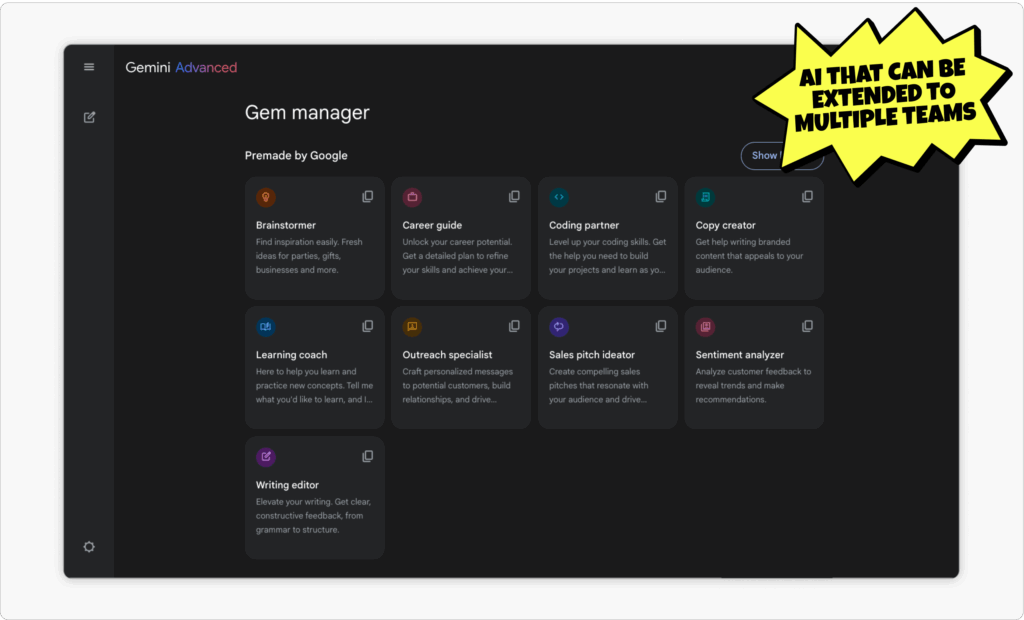
    Example of AI for cross-functional teams
    General example showing how Gemini’s Gem store features different chatbots for Marketing, Sales, and Developers.

    3. AI That Explains What It’s Doing

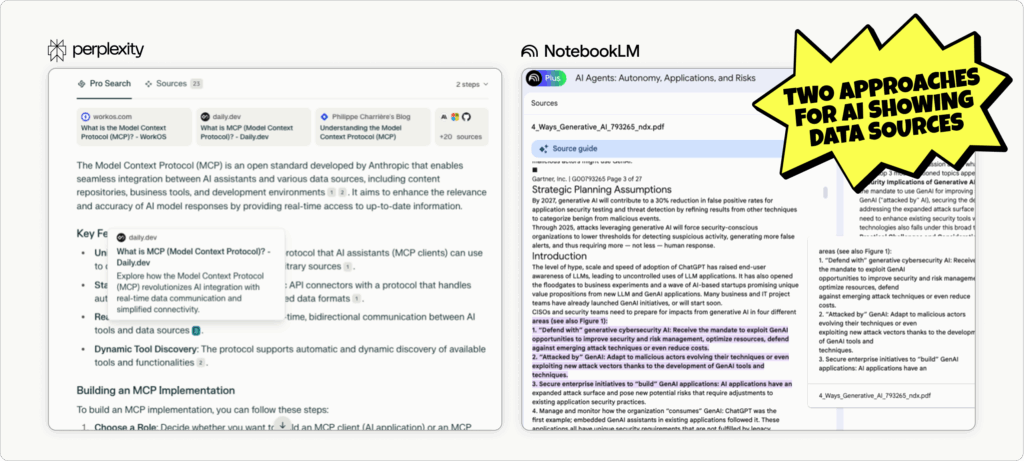
    Look for: AI that grounds its findings and recommendations in clear, structured explanations showing its sources.

    CISOs increasingly prioritize “explainability” in AI decisions as a pragmatic imperative for achieving cognitive alignment between the AI SOC analyst and the human security team. To foster trust, adoption, and effective action, your security team must have a line of sight into the AI’s reasoning, not just its conclusions.

    Ask:

    • Does the AI SOC analyst clearly explain why particular security events are flagged or escalated?
    • How easily can human analysts validate or challenge the AI’s recommendations? For instance, can they request source links, exact quotes, or highlighting?
    • Do we have visibility into the AI agent’s self-critique step?
    • What validation guardrails does the AI implement?

    General examples:

    Example of AI that explains what it's doing
    General examples showing how two AI models show the data it relies on. Perplexity shows a snippet of the source while NotebookLM highlights the exact sentence it used from the source.

    4. AI That’s Easy to Interact With — Without Training

    Look for: A SOC-specific user interface that is genuinely intuitive, innovative, and frictionless and that directly enhances analyst productivity, retention, and job satisfaction.

    Even the most powerful AI can be hampered by a clunky or difficult interface, undermining your team’s effectiveness and morale and discouraging AI adoption. A truly innovative interface should feel natural to use and streamline workflows, not add complexity or friction to processes. An intuitive design enables analysts of any level to quickly access insights and take action without specialized skills or knowledge.

    Ask:

    • How much do our human analysts need to be familiar with AI hacks and general prompt engineering, such as knowing when to use deep search options, ask for a specific data format, or open a new conversation thread?
    • Does the AI SOC analyst support conversational SIEM queries and natural-language threat exploration?
    • How does the AI communicate its planning and thinking process?
    • In autopiloting, can I interrupt the investigation before the AI is done?

    General example:

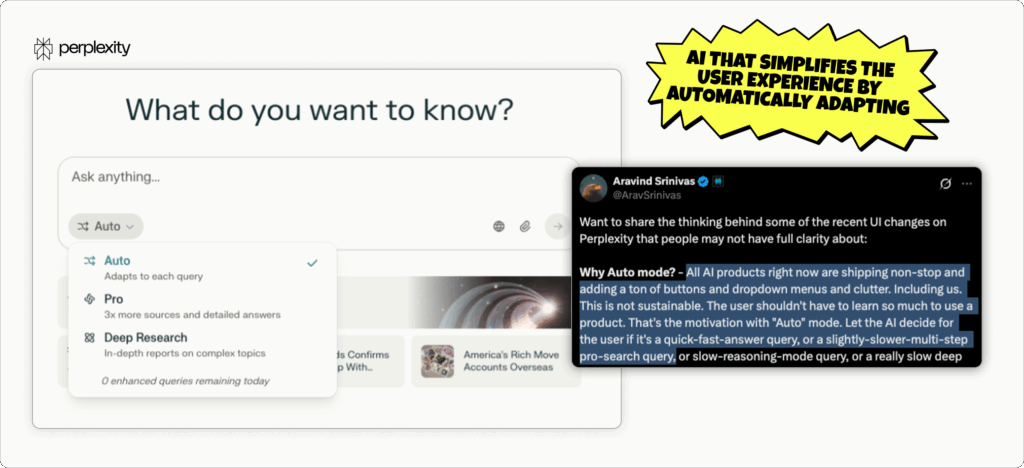
    AI SOC Evaluation: example of AI that is intuitive to use
    General example showing how Perplexity creates a simpler user experience by auto-choosing the model according to its research, rather than making the user choose a model by task/prompt. 

    5. AI That Helps You Get Ahead

    Look for: An AI SOC analyst that doesn’t only react to known threats but proactively guides SOC teams towards improving security posture and operational effectiveness. 

    Think of your top analysts — the ones who are always one step ahead, anticipating your team’s needs and suggesting improvements without being asked. Agentic AI that performs at this advanced level can act as a virtual extension of your team, identifying weaknesses and suggesting optimizations to elevate your security operations.

    Ask:

    • Can the AI SOC analyst proactively detect and suggest SOC operational improvements, such as recommending repetitive manual processes that are ripe for automation?
    • Can it automatically correlate cases with incident history and recommend improvements?
    • Has your AI ever caught a missing step in its instructions and fixed it (or asked about it) before executing?
    • Can the AI automatically tag and store important information from your interactions that can help in future cases?
    • Will the AI suggest changes to the detection rules, workflows, or playbooks? How often does your AI flag inefficiencies in workflows?

    General example: 

    Example of AI that proactively recommends optimizations
    General example of ChatGPT maintaining context after you’ve told it that you are an AI product manager in San Francisco. When asking it to brainstorm messaging for a social post celebrating an achievement, ChatGPT already knows where to start. 

    6. AI That Understands What You Really Want (and Can Figure Out How to Do It)

    Look for: Deterministic, agentic AI that understands how to break a user intent into multiple tasks, which may require different execution plans

    Good AI gets a task and starts working. Great AI first looks for communication gaps, understands the goal, and asks for more instructions when needed. Ideally, the user shouldn’t have to think like the AI to ensure the AI grasps their intent — the AI should understand how the user thinks and ask clarifying questions when needed.

    A structured execution scheme reduces ambiguity and improves the accuracy of the AI’s planning and orchestration, eliminating the likelihood of the AI agent skipping steps, going out of order, selecting incorrect tools, or misinterpreting instructions.

    Ask:

    • When I give the AI a vague or complex instruction, does it ask clarifying questions — or just charge ahead?
    • How does it use screens, user information, and past sessions to better understand the user’s specific intent?
    • Can your AI break down a high-level goal (‘Investigate this alert’) into a sequence of logically ordered tasks — and tell you why?
    • Can your AI explain its execution plan in plain language before it starts and adjust if you push back?

    General example:

    AI SOC Evaluation: Example of AI that asks clarification questions
    General example showing how ChatGPT asks clarification questions before building a report in Deep Research.

    7. An AI Assistant That You Don’t Need to Babysit

    Look for:  Agentic AI capable of autonomously chaining together multiple actions without constant human prompts. 

    Your human analysts don’t want to click through 10 steps every time they need the AI to take action. While human oversight of critical decisions is important, to efficiently investigate an alert end-to-end and even initiate containment, an AI SOC analyst must be capable of independently stringing together a sequence of relevant subtasks — like log collection, enrichment, reverse engineering, and containment suggestions — in pursuit of a high-level goal.

    Ask:

    • Can the AI SOC analyst complete a multi-step investigation with one high-level instruction?
    • Can the AI write and execute deterministic workflows when needed?
    • Does it pause and check with human analysts before executing sensitive tasks (e.g., blocking users or IPs)?
    • When given a high-level goal or non-playbook scenario, does the AI independently decide which steps to take and in what order?
    • How does the AI identify when not to act — and escalate to a human when it hits a confidence or authority threshold?

    General example:

    AI SOC Evaluation: Example of AI that defines when it needs to loop humans in
    General example of how Intercom’s Fin interface defines the moments where a human needs to be looped into the convo.

    8. AI That Gets More Helpful Through Human Feedback

    Look for: An AI SOC analyst that continuously learns and improves by observing and incorporating feedback from human analyst behavior.

    The best AI SOC analysts learn from human analyst behavior to become more effective and accurate over time. Think of it as shaping the ideal analyst that shadows your team, watches how they triage alerts, write queries, and handle false positives — and gets smarter with every interaction.

    Human analysts should be able to fine-tune and correct AI as threats evolve rather than treating it as a black box. In practice, features like thumbs-up/down ratings, interactive retraining, or the ability to override AI decisions make the human–AI loop tighter and more effective.

    Ask:

    • How does the AI SOC analyst adapt based on human analysts’ corrections or preferences over time?
    • Can I adjust the AI’s prioritization or response style via feedback?
    • How can the user flag a successful conversation with the AI to make future sessions easier and more effective?
    • Can you review and audit what the AI has learned from your team? 

    General example: 

    AI SOC Evaluation: Example of AI that continuously improves
    General example showing how Cursor’s Coding Rules feature helps developers continuously improve and adapt their preferences using natural language. 

    Next-Gen AI for the SOC is Here — Are You Ready?

    Don’t be the security leader who marvels at a shiny paint job while ignoring the revolutionary engine. When evaluating AI SOC analysts, focus on explainable intelligence, seamless integration into your team’s workflow, and deterministic AI that can independently plan and orchestrate all of the actions required to complete a high-level goal from end to end.

    Finding an AI SOC analyst that truly understands context, empowers your analysts, and acts with proactive autonomy will ensure you’re not just keeping up with the latest tech but investing in a force multiplier for your security team.

    Get the AI or Die Manifesto to learn strategic considerations, get insights from a CISO, and learn red flags and more questions to ask for an AI SOC evaluation.

    SEE TORQ IN ACTION

    Ready to automate everything?

    “Torq takes the vision that’s in your head and actually puts it on paper and into practice.”

    Corey Kaemming, Senior Director of InfoSec

    “Torq HyperSOC offers unprecedented protection and drives extraordinary efficiency for RSM and our customers.”

    Todd Willoughby, Director

    Compuquip logo in white

    “Torq saves hundreds of hours a month on analysis. Alert fatigue is a thing of the past.”

    Phillip Tarrant, SOC Technical Manager

    Fiverr logo in black

    “The only limit Torq has is people’s imaginations.”

    Gai Hanochi, VP Business Technologies

    Carvana logo in black

    “Torq Agentic AI now handles 100% of Carvana’s Tier-1 security alerts.”

    Dina Mathers, CISO

    Riskified logo in white

    “Torq has transformed efficiency for all five of my security teams and enabled them to focus on much more high-value strategic work.”

    Yossi Yeshua, CISO

    Phishing Analysis That Runs Itself — Powered by Torq

    Contents

    Get a Personalized Demo

    See how Torq harnesses AI in your SOC to detect, prioritize, and respond to threats faster.

    Request a Demo

    Phishing has evolved from a nuisance into a full-blown crisis for SOC teams. Once easy to spot, today’s phishing emails are polished, personalized, and powered by generative AI — enabling attackers to launch thousands of realistic campaigns in minutes. 

    SOCs are drowning in suspicious email reports, with analysts forced to inspect headers, attachments, and URLs at scale manually. Even worse, over a majority of end-user reports turn out to be false positives, meaning hours of wasted effort chasing noise instead of responding to real threats.

    Why Phishing Analysis Overwhelms SOC Teams

    Phishing isn’t just the most common cyberattack; it’s also one of the most draining for security teams. Attacks have increased 49% since 2021, with each successful breach costing organizations nearly $5M on average. GenAI has fueled a 4,151% increase in phishing campaigns since 2022, so the volume and realism of phishing attempts are outpacing traditional defenses.

    Phishing analysis is the process of examining suspicious emails to identify and mitigate phishing attacks. This involves scrutinizing various aspects of the email, including sender details, content, and attachments, to detect signs of malicious intent. It’s a critical component of cybersecurity, helping organizations protect themselves from data breaches and other cyber threats.

    For SOC analysts, every reported phishing email can become a time sink. Investigations require painstaking review of headers, attachments, URLs, and sender reputation checks — often across multiple tools. A Microsoft study found 90% of user-reported phishing emails turn out to be false positives, yet each still consumes valuable analyst time. At scale, that means thousands of hours spent chasing noise while real threats risk slipping through the cracks.

    This perfect storm of higher alert volume, more sophisticated lures, and limited staff creates an unsustainable workload. Instead of focusing on strategic tasks like threat hunting or incident response, analysts get buried in repetitive phishing checks. The result: Burnout, alert fatigue, and delayed response times that adversaries exploit to their advantage.

    With the help of automation taking over the repetitive triage and enrichment tasks that bog analysts down, platforms like Torq HyperSOC™ slash analysis times from hours to minutes, eliminate the majority of false positives, and free security teams to focus on threats that actually matter.

    How to Automate Outlook Mailbox Monitoring with Torq

    Torq HyperSOC™ includes ready-to-run templates that transform your phishing inbox into an always-on, case-driven automation pipeline. Here’s how it works end-to-end, plus the setup details, best practices, and guardrails that make it safe at scale.

    1. Turn Your Mailbox into an Always-On Detection Pipeline

    Instead of relying on analysts to check a shared phishing inbox, Torq connects directly to Microsoft Outlook using Microsoft Graph API. A dedicated mailbox (for example, [email protected]) becomes an automated trigger point, and every new report instantly kicks off an enrichment and triage workflow. This integration is secure by design, using least-privilege permissions and admin-controlled access policies to keep everything locked down.

    2. Automate the Analysis

    Once a message lands, Torq automatically extracts and analyzes the essential data: headers, links, attachments, sender reputation, and user context. Behind the scenes, AI and security Hyperautomation handle all the enrichment tasks that typically burn analyst time — checking SPF/DKIM, scanning URLs and attachments, detonating files in sandboxes, and cross-referencing with threat intel. This leaves analysts with a fully scored, context-rich case that tells you whether it’s safe, suspicious, or malicious, all before a human ever touches it.

    3. Respond at Machine Speed 

    When Torq confirms a threat, response happens automatically but safely. The platform can:

    • Quarantine malicious emails organization-wide
    • Block domains or senders
    • Isolate infected endpoints or reset credentials through integrated EDR and IAM tools
    • Notify users with templated guidance (e.g., “Did you click…?”) for added validation
    • Log every action, approval, and artifact in a complete, auditable case file

    Everything runs according to your organization’s policies; automation never overrides human approval for sensitive actions.

    4. Get Case Management That Writes Itself

    Each investigation is automatically converted into a structured case, complete with enriched data, screenshots, indicators, and an easy-to-read AI-generated summary. Analysts can quickly review, bulk-close false positives, or pivot into related cases for campaign hunting — all from a single workspace.

    What once took hours now happens in seconds, freeing your team to focus on strategy and proactive threat hunting instead of inbox cleanup.

    5. Enforce AI Guardrails

    Automation at scale only works if it’s safe, and Torq was built with that in mind. Every workflow runs with built-in AI governance, compliance, and resiliency features designed for enterprise SOCs and MSSPs.

    • Least-privilege access: Microsoft Graph permissions are scoped to a single mailbox or folder, minimizing exposure.
    • Role-based access controls (RBAC) and approvals: Sensitive actions like global purges or account disables always require the right role or human confirmation.
    • Self-healing subscriptions: Torq automatically monitors Microsoft Graph subscriptions, renews them before expiration, and alerts if something drifts.
    • Resilient error handling: Smart retries and throttling logic keep automations stable under API load or transient faults.
    • MSSP-ready tenant isolation: Shared automations can be cloned per customer, ensuring strict data separation with zero cross-tenant risk.

    6. Experience What “Good” Looks Like

    A well-built phishing response automation doesn’t just run — it delivers measurable impact. Here are the key KPIs that show it’s working:

    • Faster MTTD / MTTR: Phishing cases identified and contained in minutes, not hours
    • Broader automation coverage: A growing percentage of Tier-1 triage handled end-to-end with zero human touch
    • Reduced false positives: Fewer manual reviews and cleaner queues for analysts
    • Better purge performance: Malicious messages removed across mailboxes more quickly and completely.
    • Higher user engagement: High confirmation rates and faster user responses to “Did you click?” checks
    • Improved analyst efficiency: Hours reclaimed per case — often hundreds of hours per quarter — that can be reinvested into proactive security work

    When these numbers start trending up and manual reviews drop off, that’s when you know your automation is transforming the SOC.

    Faster, Smarter, and Scalable Phishing Analysis

    Torq cuts phishing triage from hours to minutes. Automated enrichment includes:

    • DMARC/SPF analysis to validate sender reputation
    • URL screenshotting to detect impersonation
    • Sandbox detonations and IOC checks for attachments
    • AI-generated summaries of findings, ready for analyst review

    The outcome: faster investigations, fewer false positives, and higher analyst efficiency.

    Torq Makes Traditional Phishing Analysis Tools Better

    Legacy SOAR tools require rigid playbooks and manual tuning. Torq delivers:

    • No/low-code flexibility: Build workflows in minutes.
    • Agentic AI: Summarizes, enriches, and prioritizes phishing cases.
    • 300+ integrations: Connects to your SIEM, EDR, IAM, ITSM, and email stack.
    • Scalability: Automate phishing triage across thousands of alerts with no extra headcount.

    Make Phishing Analysis Autonomous

    Phishing isn’t slowing down — but your team doesn’t have to slow down with it.

    With Torq HyperSOC™, phishing analysis becomes fast, reliable, and fully automated. Every reported email is enriched, scored, and resolved in minutes, with full visibility and control. By turning repetitive triage into efficient and autonomous workflows, Torq helps SOCs reclaim time, eliminate false positives, and focus on stopping real threats before they spread.

    Check out our SOC Efficiency Guide for tips on squeezing the most out of your SOC processes, people, and tech stack.

    FAQs

    What is phishing analysis?

    Phishing analysis includes investigating an email to determine whether it’s malicious or benign. Analysts inspect elements like the email header, sender domain, URLs, and attachments to uncover signs of spoofing or social engineering. Using automation tools such as Torq HyperSOC™, SOC teams can quickly analyze large volumes of suspicious emails across the mailbox to identify real threats while reducing manual workload.

    How can you identify phishing emails?

    You can identify a phishing email by examining inconsistencies in the sender address, checking the email header for mismatched domains, and inspecting embedded URLs for redirects or spoofed links. Poor grammar, unexpected attachments, and urgent requests for sensitive information are common warning signs. Modern email security tools and phishing analysis tools help automate these checks by performing authentication validation (SPF, DKIM, DMARC) and sandbox testing.

    What are the signs of a phishing email?

    A suspicious email often contains subtle red flags, such as a spoofed display name, forged sender authentication headers, or URLs that impersonate legitimate brands. Malicious emails may include weaponized attachments, such as PDFs or Office documents containing macros. By analyzing the email header and sender authentication results, SOC teams can determine whether the threat is credible. Automated analysis tools like Torq can perform these verifications instantly.

    Can phishing analysis be automated?

    Absolutely. With a modern security automation platform like Torq, the entire phishing analysis process — from mailbox monitoring to threat enrichment and response — can be automated safely and effectively. Automated workflows extract data from the email header, verify sender authentication, assess URLs and attachments, and classify each message as benign, suspicious, or malicious. Guardrails such as RBAC, approval flows, and secure integrations ensure that automation never acts on false positives or spoofed alerts.

    Why is phishing analysis important for SOC teams?

    Phishing analysis is foundational to modern email security because it enables organizations to detect malicious messages that slip past traditional filters. Attackers often exploit trust in familiar senders or use spoofed domains to steal sensitive information like credentials or financial data. Automated phishing analysis tools correlate data across multiple sources — including the email header, authentication records, and threat intel feeds — to identify and neutralize these threats before they reach users.

    How does Torq differ from traditional phishing tools?

    Torq combines no-/low-code automation with AI-driven phishing analysis to streamline email security workflows end to end. Unlike rigid playbook-based systems, Torq dynamically analyzes phishing emails, validates authentication headers, enriches sender data, and triggers response actions automatically. With 300+ integrations, Torq connects to your mailbox, SIEM, and other analysis tools to deliver continuous, adaptive protection against spoofed or malicious emails.

    SEE TORQ IN ACTION

    Ready to automate everything?

    “Torq takes the vision that’s in your head and actually puts it on paper and into practice.”

    Corey Kaemming, Senior Director of InfoSec

    “Torq HyperSOC offers unprecedented protection and drives extraordinary efficiency for RSM and our customers.”

    Todd Willoughby, Director

    Compuquip logo in white

    “Torq saves hundreds of hours a month on analysis. Alert fatigue is a thing of the past.”

    Phillip Tarrant, SOC Technical Manager

    Fiverr logo in black

    “The only limit Torq has is people’s imaginations.”

    Gai Hanochi, VP Business Technologies

    Carvana logo in black

    “Torq Agentic AI now handles 100% of Carvana’s Tier-1 security alerts.”

    Dina Mathers, CISO

    Riskified logo in white

    “Torq has transformed efficiency for all five of my security teams and enabled them to focus on much more high-value strategic work.”

    Yossi Yeshua, CISO

    What is Cyber Threat Hunting? How to Stay Ahead of Attacks

    Contents

    Get a Personalized Demo

    See how Torq harnesses AI in your SOC to detect, prioritize, and respond to threats faster.

    Request a Demo

    Cyberattacks are becoming more frequent and sophisticated as threat actors continually sharpen their tactics and upgrade their tools. Defending against these evolving threats is increasingly complex, especially in a landscape where cybersecurity ROI is measured in loss prevention rather than revenue generation.

    Cyber threat hunting offers a proactive way to secure your environment by actively seeking out threats that evade traditional defenses. However, manual threat hunting is time-consuming, resource-intensive, and complicated by a growing shortage of skilled professionals.

    In this blog, we’ll unpack everything you need to know about cyber threat hunting and show how Hyperautomation can help your team stay ahead of attackers by streamlining detection, investigation, and response without requiring massive overhead.

    What is Threat Hunting in Cybersecurity?

    The value of cyber threat hunting lies in these key properties:

    • Proactive approach: Unlike traditional security measures that react to alerts, threat hunting is a proactive process. Threat hunters actively seek out potential threats rather than waiting for them to be detected or, worse, erupt into a critical incident. 
    • Augmenting automated systems: Threat hunting complements automated security tools by identifying threats that may have slipped past those systems.
    • Human expertise: It relies on the knowledge and skills of threat hunters who use their expertise, tools, and methodologies to identify malicious activities. 
    • Targeted searches: Threat hunters develop hypotheses about potential threats based on threat intelligence, known attack techniques, and other factors, then they search for evidence to validate those hypotheses.
    • Focus on advanced threats: Threat hunting is beneficial for identifying advanced persistent threats (APTs) and other sophisticated attacks that can evade traditional security measures.

    Why is Cyber Threat Hunting Important?

    Most SOC tools operate reactively — they wait for indicators of compromise (IOCs) or known attack signatures to trigger alerts. However, today’s adversaries are stealthy, often residing in networks undetected for weeks or months. Cyber threat hunting flips the script.

    Threat hunting proactively searches for unknown, suspicious behavior and zero-day threats that traditional detection tools miss. The benefits include: 

    • Early threat detection and response: Threat hunters spot anomalies before damage occurs, enabling rapid, contained responses to reduce breach impact. Early detection and response can significantly reduce the potential damage and costs associated with cyberattacks.
    • Identification of persistent and complex threats: Advanced persistent threats (APTs) often evade SIEMs or endpoint detection and response (EDR). Threat hunting reveals long-dwelling attackers using subtle tactics.
    • Improved incident response efficiency: Hunting improves context and decision-making for incident response (IR) teams, reducing mean time to investigate (MTTI) and resolve (MTTR). By identifying and mitigating threats proactively, threat hunting strengthens an organization’s overall security posture. 
    • Enhanced threat intelligence: The insights gained from threat hunting can also improve an organization’s threat intelligence and help them better understand their adversaries. 

    How Cyber Threat Hunting Works: 6 Methods

    Cyber threat hunting isn’t a single technique — it’s a flexible, proactive approach that combines human expertise with data, context, and tooling. Depending on your team’s goals, tools, and maturity level, different methodologies can be used to uncover hidden threats and eliminate adversaries before they cause damage. Here are six of the most effective threat hunting methods in use today.

    1. Hypothesis-Driven Hunting

    This method begins with a well-formed theory about how an adversary might be operating within your environment. Hunters often base these hypotheses on current threat intelligence, past incidents, or a known threat actor’s tactics. 

    For example, a threat hunting team may ask, “Is an attacker using PowerShell for lateral movement across endpoints?” They then query logs, examine user activity, and look for anomalies that might validate or disprove that theory. This structured, scientific approach allows analysts to pursue purposeful leads and systematically uncover sophisticated threats.

    2. Indicator of Attack (IoA)-Based Hunting

    Rather than reacting to alerts, IoA-based threat hunting proactively searches for signs of attacker behavior that signal malicious intent — even if no breach has occurred. Analysts look for behavioral patterns and tactics often used by adversaries, such as a sudden surge in failed login attempts, suspicious registry modifications, or abnormal user behavior during off-hours. 

    By focusing on indicators of attack (IoAs) instead of indicators of compromise (IoCs), teams can identify active intrusion attempts earlier in the kill chain, often before data exfiltration or lateral movement occurs.

    3. Advanced Analytics and Machine Learning

    Threat hunting at scale benefits significantly from security automation, particularly through advanced analytics and machine learning (ML). These AI models are trained on historical attack data and behavioral baselines, helping analysts identify statistical anomalies and outliers across massive datasets. 

    For example, suppose a user suddenly begins downloading gigabytes of data from an unfamiliar endpoint. ML-driven tools can flag the deviation from normal behavior in that case, even if no specific IoA has been defined. This method increases speed and coverage, especially in cloud or hybrid environments.

    4. Structured Hunting

    Structured threat hunting leverages formal models and frameworks like MITRE ATT&CK to organize and guide investigations. By using well-defined tactics, techniques, and procedures (TTPs), analysts can systematically scan for known threat behaviors across endpoints, identities, and networks.

    This method is beneficial for standardizing team processes, ensuring knowledge sharing, and aligning with compliance or threat modeling requirements. It also enables better documentation and repeatability of hunts, making it a valuable tool for maturing a cybersecurity program.

    5. Unstructured Hunting

    Unstructured hunting relies more on analyst intuition and real-world experience than on formal rules or frameworks. In this method, seasoned hunters follow their instincts, identifying suspicious patterns, log entries, or correlations that don’t match any known indicators — but still “feel off.” 

    This open-ended approach can surface novel attacks, zero-day behaviors, or insider threats that evade automated detection. While more time-consuming, unstructured hunting is crucial in developing hypotheses for future structured hunts and refining detection rules.

    6. Situational or Entity-Driven Hunting

    This method prioritizes hunting based on specific contexts — such as critical assets, high-risk users, or sensitive business functions. For example, threat hunters may target systems housing personally identifiable information (PII) or monitor executive accounts likely to be targeted in phishing or business email compromise (BEC) attacks. 

    Situational or entity-driven hunting ensures security teams protect what matters most by focusing on high-value targets and contextual threat intelligence. It can also quickly act on suspicious activity that might otherwise get lost in the noise.

    Cyber Threat Hunting Process

    Effective threat hunting follows a straightforward process. Here’s how top-performing teams approach it.

    • Trigger: A hunt often starts with a clue — a suspicious login, a new TTP from a threat intel feed, or a hunch. Triggers inform what to investigate.
    • Investigation: Hunters use SIEM, EDR, network traffic, and log data to dig deeper. Enrichment, correlation, and historical context help determine risk.
    • Resolution: If a threat is confirmed, it’s escalated for response, and hunting insights are used to improve detection rules and workflows in the future.

    Cyber Threat Hunting Tools & Technologies

    4 Cyber Threat Hunting Challenges & How to Navigate Them with Torq

    Cyber threat hunting is an essential pillar of modern cybersecurity strategy, but it’s not without its obstacles. Today’s SOC teams face increasing complexity, resource constraints, and alert overload, which can hinder their ability to detect and respond to threats proactively. 

    Below are four of the most common challenges security teams encounter in threat hunting, along with how Torq’s Hyperautomation platform directly addresses them with AI-driven precision and scale.

    1. Integrating Disparate Data Sources

    The Challenge: Threat hunters rely on data from SIEM, EDR, firewalls, and cloud environments, which are often siloed.

    How Torq Helps: Torq Hyperautomation breaks down these silos by integrating your entire security stack into a unified, low-code automation engine. With hundreds of pre-built integrations, Torq enables real-time data normalization, enrichment, and orchestration across all sources. Threat intel from platforms like VirusTotal or Recorded Future can be automatically enriched into alert streams, providing analysts with actionable context — fast. This consolidated view eliminates blind spots and empowers threat hunters to act confidently and quickly.

    2. Alert Fatigue

    The Challenge: Analysts drown in noisy, low-value alerts, making it difficult to spot real threats.

    How Torq Helps: Torq uses agentic AI to combat alert fatigue. Torq ensures that only high-confidence, context-rich alerts reach analysts by filtering out noise, deduplicating alerts, and applying real-time prioritization logic. Low-risk or redundant alerts are automatically suppressed, and high-severity incidents are escalated to the right person or team through customized workflows. This triage process reduces alert volume by up to 95%, allowing teams to focus on what truly matters — critical threats that require human judgment.

    3. False Positives

    The Challenge: Traditional tools generate too many “maybe” threats — wasting time and delaying response. In fact, more than half of security teams say that false positives are a huge problem.

    How Torq Helps: Torq uses intelligent case automation and prioritization to differentiate between real threats and false alarms intelligently. By analyzing historical resolution data, Torq can fine-tune playbooks to automatically suppress known false positives while continuously learning and adapting to your unique environment. This self-optimizing capability reduces alert fatigue and improves detection, cutting through the noise to surface high-priority incidents faster.

    4. Limited Resources

    The Challenge: Skilled threat hunters are in short supply — and expensive.

    How Torq Helps: Torq HyperSOC empowers teams of all skill levels to participate in advanced threat hunting. Its intuitive low-code interface allows junior analysts to build and execute workflows without needing deep coding experience. Meanwhile, Torq’s AI agents led by Socrates, automatically handle routine triage, enrichment, and correlation, freeing up senior analysts to focus on deep-dive threat analysis and strategic improvements. The result is an autonomous SOC that can scale without scaling headcount.

    The Bottom Line

    Cyber threat hunting is too important to be slowed down by fragmented tools, noisy alerts, or stretched resources. Torq Hyperautomation modernizes the threat hunting process by combining unified data integration, real-time alert intelligence, and agentic AI, enabling any SOC team to hunt smarter, faster, and more efficiently.

    Ready to eliminate your threat hunting roadblocks? See Torq Hyperautomation in action and learn how to evolve from reactive to proactive security today.

    SEE TORQ IN ACTION

    Ready to automate everything?

    “Torq takes the vision that’s in your head and actually puts it on paper and into practice.”

    Corey Kaemming, Senior Director of InfoSec

    “Torq HyperSOC offers unprecedented protection and drives extraordinary efficiency for RSM and our customers.”

    Todd Willoughby, Director

    Compuquip logo in white

    “Torq saves hundreds of hours a month on analysis. Alert fatigue is a thing of the past.”

    Phillip Tarrant, SOC Technical Manager

    Fiverr logo in black

    “The only limit Torq has is people’s imaginations.”

    Gai Hanochi, VP Business Technologies

    Carvana logo in black

    “Torq Agentic AI now handles 100% of Carvana’s Tier-1 security alerts.”

    Dina Mathers, CISO

    Riskified logo in white

    “Torq has transformed efficiency for all five of my security teams and enabled them to focus on much more high-value strategic work.”

    Yossi Yeshua, CISO

    Automate SOC 2 Compliance: Stay Ready, Not Just Audited

    Contents

    Get a Personalized Demo

    See how Torq harnesses AI in your SOC to detect, prioritize, and respond to threats faster.

    Request a Demo

    Information security is a top priority for every organization, especially those relying on third-party vendors like SaaS platforms and cloud providers. When sensitive data is mishandled, the risks are significant: data breaches, ransomware, and reputational damage.

    For modern SaaS and cloud-first companies, compliance is a fundamental requirement to earn trust, win business, and prove operational integrity. Yet, for many teams, achieving and maintaining compliance readiness remains a slow, manual, and spreadsheet-heavy burden.

    SOC 2 is a widely recognized auditing framework designed to ensure service providers securely handle data. For any business that values trust and transparency, SOC 2 compliance is the baseline when evaluating cloud-based partners.

    Hyperautomation platforms offer a smarter, faster path to SOC 2 compliance, transforming compliance from an annual fire drill into an always-on, audit-ready advantage. 

    What Is SOC 2 and Why Does It Matter Today?

    SOC 2 compliance outlines how service providers should manage customer data based on five Trust Services Criteria:

    1. Security: Protect systems against unauthorized access.
    2. Availability: Ensure systems are operational and accessible.
    3. Processing Integrity: Guarantee complete, valid, accurate, and timely system processing.
    4. Confidentiality: Restrict access to sensitive information.
    5. Privacy: Govern the collection, use, and disposal of personal information.

    There are two types of SOC 2 reports:

    • Type I: A snapshot in time that verifies whether controls are properly designed.
    • Type II: A more rigorous report that tests control effectiveness over a period (typically 3-12 months).

    SOC 2 Type II has become the industry expectation for most SaaS vendors, especially when handling sensitive customer data. It signals a company’s commitment to long-term security and operational maturity.

    Why is SOC 2 compliance important?

    Builds trust: It demonstrates a commitment to data security and helps build trust with clients and stakeholders. 

    Mitigates risk: It helps organizations identify and mitigate data security and privacy risks. 

    Competitive advantage: SOC 2 compliance can be a competitive differentiator in some industries. 

    Meeting client requirements: Many organizations require their vendors to be SOC 2 compliant. 

    Regulatory compliance: While not a legal requirement, SOC 2 compliance can help organizations meet other regulatory requirements related to data privacy and security.

    How does SOC 2 compliance work?

    Getting a SOC 2 report isn’t a one-time event; it’s an ongoing process with distinct steps. Here’s a breakdown of how organizations achieve and maintain compliance.

    1. Choose relevant Trust Services Criteria: Organizations select which of the five criteria apply to their business and data handling practices. 
    2. Implement controls: Organizations implement controls to meet the selected criteria. 
    3. Undergo an audit: An independent CPA firm audits the organization’s controls and provides a report. 
    4. Maintain compliance: Organizations should continuously monitor their controls and undergo regular audits to maintain compliance.

    Why Manual SOC 2 Compliance Is a Pain

    • Manual evidence collection takes forever. Most companies still rely on spreadsheets and screenshots to track audit artifacts. Gathering, reviewing, and validating evidence for auditors takes hundreds of hours across departments.
    • Tracking controls is inconsistent and hard to manage. Multiple teams often own security controls using disconnected tools. Tracking each control’s health, coverage, and effectiveness is fragmented and prone to gaps and oversights.
    • It’s not a one-and-done. SOC 2 Type II isn’t just about proving you were compliant once. It’s about showing your security practices are consistent over time. That means continuous evidence generation, alert monitoring, and policy enforcement daily.

    SOC automation tools help teams map their security operations directly to these trust principles, automatically enforcing controls across hybrid, multi-cloud, and containerized environments.

    How SOC 2 Compliance Automation Works

    Achieving and maintaining SOC 2 compliance can be a manual, time-intensive process — but it doesn’t have to be. By leveraging AI and compliance automation, organizations can simplify how they meet and demonstrate compliance across the five Trust Services Criteria.

    Integrates with Your Stack

    What it means: Automation tools plug directly into your existing ecosystem — cloud platforms like AWS and Azure, identity providers like Okta, and collaboration tools like Jira and Slack, making compliance enforcement and monitoring seamless and real-time.

    How Torq does it: Torq connects natively with your infrastructure, security, and productivity tools using out-of-the-box integrations. These integrations fuel automated workflows that pull relevant signals (e.g., IAM policy changes, unencrypted S3 buckets, open security groups) and act on them immediately. Whether it’s ingesting audit logs from AWS CloudTrail or pushing alerts to Slack, Torq bridges the gap between tools without manual configuration.

    Maps to Trust Principles and Controls

    What it means: Modern compliance platforms organize automation workflows around the Trust Services Criteria. This makes it easier to align security controls with compliance requirements and prove that each area is covered.

    How Torq does it: With Torq, you can build a custom compliance runbook or use pre-built templates that map specific security checks to SOC 2 controls. Each runbook clearly logs which control it’s addressing, such as enforcing encryption standards or validating role-based access controls. This creates a structured, traceable link between your workflows and SOC 2 requirements, ready for auditor review.

    Constant Monitoring, Not Periodic Check-ins

    What it means: Compliance is an ongoing effort. Automation ensures that control monitoring happens in real time, continuously validating your posture and preventing drift.

    How Torq does it: Torq runs real-time compliance checks through scheduled or event-driven workflows. For example, any time a new cloud resource is deployed, Torq automatically evaluates it against predefined compliance criteria. Misconfigurations trigger alerts, ticket creation, or even automated remediation.

    Generates Audit-Friendly Evidence Automatically

    What it means: Instead of compiling screenshots and hunting down logs days before an audit, automation systems gather and organize evidence as it’s created, giving you a full audit trail at any time.

    How Torq does it: Torq logs every workflow execution, including input data, actions taken, and outcomes. These logs are stored in a structured format, ready to be presented to auditors as proof of continuous compliance. You can also export or share audit evidence directly through Torq’s reporting tools or integrate with ticketing systems for compliance task tracking.

    6 Benefits of Automating SOC 2 Compliance

    1. Reduced audit prep time and cost: Automating evidence collection and control validation can shrink audit timelines by weeks and reduce consulting fees.
    2. Better visibility into control health: Dashboards and real-time alerts let you see which controls are compliant, which need attention, and where risk is growing.
    3. Fewer human errors: No more copy-pasting logs into spreadsheets. Automation ensures consistency and accuracy at every step.
    4. Always-on compliance posture: Your organization is ready for an audit at any time. Continuous monitoring makes compliance a state of operations, not a one-time event.
    5. Easier collaboration across departments: Automation brings security, engineering, and compliance teams onto the same platform with shared visibility and workflows.
    6. Increased trust with customers and partners: A real-time compliance program sends a powerful message to customers: Your organization takes data protection seriously.

    How Torq Helps You Automate SOC 2 Compliance

    Torq HyperSOCTM delivers a powerful, unified platform to streamline and scale your SOC 2 compliance program across your entire environment. Torq eliminates manual bottlenecks and transforms compliance into a continuous, self-sustaining process by orchestrating complex workflows across tools, teams, and time zones.

    Integrations: Unified Visibility Across Your Stack

    Torq connects to your entire cloud and security ecosystem in minutes using out-of-the-box integrations. Whether you’re running workloads in AWS, GCP, or Azure, managing identities in Okta, or tracking development workflows in GitHub and Jira, Torq can tap into these sources and extract the signals you need for compliance.

    • Monitor infrastructure changes in real-time (e.g., new EC2 instance launches, S3 bucket policy updates).
    • Ingest identity events from Okta or Azure AD to validate least-privilege access.
    • Track policy exceptions and code deployment events directly from GitHub or CI/CD tools.

    Runbooks: Automate Evidence, Reviews & Enforcement

    Torq’s no-code and low-code playbooks make automating key SOC 2 tasks easy without relying on engineering time.

    • Automatically collect audit evidence when key events occur, like provisioning new users, updating firewall rules, or completing access reviews.
    • Launch scheduled playbooks to ensure periodic checks (e.g., quarterly access audits) happen without fail.
    • Enforce policies across cloud, SaaS, and internal systems by detecting and responding to real-time misconfigurations.

    Monitoring: Continuous Control Validation

    Instead of ad hoc or periodic checks, Torq enables 24/7 control monitoring to ensure compliance with SOC 2 requirements.

    • Create detection workflows that monitor changes in cloud configurations, access policies, and security controls.
    • Trigger real-time alerts for violations, like unencrypted storage, public resources, or unauthorized privilege escalation.
    • Use control dashboards to see exactly which requirements are covered, which are failing, and what actions were taken.

    Remediation: Automated Issue Handling

    Not every compliance issue needs manual intervention. Torq’s team of AI Agents intelligently distinguishes between routine fixes and high-risk violations, so your team can focus on what matters most.

    • Auto-remediate common misconfigurations (e.g., remove public S3 access, disable unused accounts).
    • Escalate critical events to the right teams via Jira, Slack, or your preferred ticketing system.
    • Track remediation efforts as part of your audit log, ensuring every action is documented and reviewable.

    Reporting: Audit-Ready, All the Time

    Preparing for an audit shouldn’t be a fire drill. Torq automatically compiles and organizes evidence into structured, SOC 2-aligned reports.

    • Generate reports categorized by the five Trust Services Criteria.
    • Include timestamps, actor information, and remediation history for every logged event.
    • Export or share directly with auditors and GRC teams.

    With Torq, your SOC 2 program becomes:

    • Always on: Continuous monitoring, detection, and evidence gathering.
    • Always improving: Automated feedback loops help eliminate recurring issues.
    • Always audit-ready: Pre-organized, verified data ensures you’re prepared year-round.

    SOC 2 Compliance, the Hyperautomated Way

    SOC 2 isn’t just a regulatory hoop to jump through. It reflects how seriously your company takes security, privacy, and operational excellence. But maintaining that standard manually is a recipe for burnout, errors, and missed risks.

    Torq HyperSOC gives you the power to turn SOC 2 from a painful annual scramble into a seamless, always-on system. Faster audits. Lower risk. Greater trust.

    Ready to make SOC 2 compliance effortless? Read the SOC Efficiency Guide to see how leading teams are transforming SecOps with Torq.

    SEE TORQ IN ACTION

    Ready to automate everything?

    “Torq takes the vision that’s in your head and actually puts it on paper and into practice.”

    Corey Kaemming, Senior Director of InfoSec

    “Torq HyperSOC offers unprecedented protection and drives extraordinary efficiency for RSM and our customers.”

    Todd Willoughby, Director

    Compuquip logo in white

    “Torq saves hundreds of hours a month on analysis. Alert fatigue is a thing of the past.”

    Phillip Tarrant, SOC Technical Manager

    Fiverr logo in black

    “The only limit Torq has is people’s imaginations.”

    Gai Hanochi, VP Business Technologies

    Carvana logo in black

    “Torq Agentic AI now handles 100% of Carvana’s Tier-1 security alerts.”

    Dina Mathers, CISO

    Riskified logo in white

    “Torq has transformed efficiency for all five of my security teams and enabled them to focus on much more high-value strategic work.”

    Yossi Yeshua, CISO

    Why SOAR Cybersecurity Can’t Keep Up With Modern SOCs

    Contents

    Get a Personalized Demo

    See how Torq harnesses AI in your SOC to detect, prioritize, and respond to threats faster.

    Request a Demo

    Last Updated January 2026

    Security Orchestration, Automation, and Response (SOAR) promised streamlined workflows, quick incident responses, and reduced security analyst workloads. But as cybersecurity threats grew more sophisticated, legacy SOAR solutions showed their critical limitations. 

    SOAR’s static, rigid workflows and cumbersome integration processes have left many SOCs overwhelmed, struggling with slow response times, high security alert fatigue, and fragmented security toolsets.

    Today, traditional SOAR platforms are becoming obsolete, unable to keep pace with rapidly evolving cyber threats. Legacy SOAR solutions typically rely on static playbooks and manual script updates, which quickly become outdated, failing to adapt dynamically to new threats or changing environments. Additionally, traditional SOAR platforms often come with steep learning curves, extensive deployment timelines, and hidden cost, which limit their practicality and reduce their overall ROI.

    Hyperautomation and advanced agentic AI tools like Torq offer a powerful alternative, transforming security operations by automating dynamically, intelligently, and at scale. Unlike legacy SOAR, Hyperautomation provides flexibility with no-code workflows, real-time contextual enrichment, and seamless integrations, eliminating the need for extensive manual intervention and continuous maintenance. 

    By leveraging advanced AI-driven tools, SOC teams can proactively manage threats, dramatically reduce analyst fatigue, and significantly improve response times. AI-powered SOCs outperform traditional SOAR by reasoning through signals, correlating context across tools, and executing adaptive remediation — closing the loop where legacy workflows stall.

    What is SOAR in Cybersecurity and How Does It Work?

    SOAR is composed of three components: 

    1. Orchestration: Orchestration connects disparate security tools into a cohesive ecosystem. SOAR tools coordinate actions and share data across multiple platforms by integrating various security solutions..
    2. Automation: Automation enables SOC teams to execute repetitive security tasks without human intervention. Common automated actions include blocking IP addresses, isolating infected endpoints, or generating reports..
    3. Response: Security orchestration and automation provide the foundation for response. Response is where detection turns into action.

    How SOAR Works in Practice

    Data analysis: SOAR applies correlation rules or basic machine learning to identify indicators of compromise (IOCs), anomalies, or attack patterns.

    Enrichment: Alerts are enriched with contextual data like user behavior, asset value, or known threat intelligence to support investigation.

    Triage and investigation: Automated playbooks classify incidents by type or severity. Analysts manually investigate with supporting evidence and logs.

    Response: Once verified, predefined playbooks carry out static actions like isolating devices, disabling accounts, or opening IT tickets.

    By orchestrating and automating these stages, SOAR platforms aimed to improve incident response times, reduce human error, and standardize security operations. However, traditional SOAR often falls short due to rigid playbooks, brittle integrations, and high maintenance requirements.

    Limitations of SOAR Solutions in Modern SOCs

    SOAR was supposed to be the silver bullet for overloaded SOCs, promising faster response, streamlined workflows, and fewer manual tasks. But, in practice, legacy SOAR platforms introduced new complexity, slowed response times, and failed to adapt to real-world threats.

    Here’s why they’re falling behind:

    • Poor integrations and limited interoperability: Integration complexities frequently result in limited interoperability, leaving critical data fragmented across isolated tools.
    • Disconnected tools, fragmented data: Despite promises of centralization, many SOAR platforms leave vital security tools disconnected, exacerbating inefficiencies.
    • Alert overload: Without dynamic context, traditional SOAR platforms struggle to differentiate legitimate threats from noise, overwhelming security analysts. AI-driven triage replaces static playbooks with real-time reasoning that separates noise from high-risk incidents, allowing SOCs to react with precision instead of guesswork.
    • Long implementation timelines: Implementing SOAR solutions can take months, significantly delaying any potential benefits.
    • High cost with limited ROI: Legacy SOAR investments often fail to deliver sufficient value due to high upfront costs, ongoing maintenance expenses, and poor usability. Worse, their architecture doesn’t scale elastically to cloud workloads, limiting performance under pressure.

    Read the SOAR is Dead manifesto >

    How Torq HyperSOC™ Outperforms Traditional SOAR

    Legacy SOAR systems were designed for a different era of security — one where attacks were slower, data was smaller, and workflows could afford to be linear. But today’s SOCs operate in a world of cloud-native infrastructure, API sprawl, and machine-speed threats. Static playbooks and brittle connectors can’t keep up.

    Torq HyperSOC™ was purpose-built to fix what SOAR broke. It eliminates the inflexible playbooks, easy-to-break integrations, and alert overload that plague traditional platforms, replacing them with intelligent, adaptable workflows that actually deliver on the promise of automation. This shift toward AI-powered security operations gives enterprises a SOC that learns, adapts, and evolves — something legacy SOAR architectures were never designed to do.

    Here’s how Torq redefines what automation can do.

    Faster Response Time

    Legacy SOAR tools operate linearly — one workflow, one action, one alert at a time. Each step must complete before the next begins, often delayed by scripts, human approvals, or system latency. This “assembly-line” approach slows detection-to-response cycles, especially when incidents span multiple environments.

    Using real-time, parallel execution, Torq’s incident response workflows trigger the right action the moment an event is detected, whether that’s isolating an endpoint, revoking credentials, or opening an investigation. With context-aware automation, Torq eliminates the lag between detection and containment, reducing MTTR from hours to seconds. 

    Reduced Analyst Fatigue

    SOAR was meant to help analysts, but in practice, it buried them in maintenance. Manual setup, constant tuning, and false positives turn every SOC shift into a cycle of triage and exhaustion.

    Through AI-assisted triage, enrichment, and decision-making, Torq automatically handles 90% of Tier-1 tasks — validating alerts, enriching data, correlating context, and closing noise. Analysts stay focused on high-impact investigations that truly require human intuition and expertise.

    Seamless Integrations

    SOAR integrations are often a house of cards, characterized by brittle APIs, manual connectors, and vendor lock-in that restrict flexibility. Each new integration means new scripts, dependencies, and points of failure.

    Torq eliminates this friction with native integrations to over 300 security, IT, and cloud tools — from SIEMs and XDRs to identity, collaboration, and ITSM platforms.

    Out of the box, Torq unifies:

    • Detection sources (like CrowdStrike, Wiz, and SentinelOne)
    • Response tools (like Okta, AWS, and Microsoft Defender)
    • Collaboration systems (like Slack, Teams, and Jira)

    Smarter Decision-Making

    Legacy SOAR follows logic, not intelligence. It executes rigid “if/then” sequences that fail when the data doesn’t match expectations. In contrast, Torq thinks before it acts.

    At the core of the HyperSOC™ is Socrates, Torq’s AI SOC Analyst — an intelligent AI Agent that autonomously:

    • Correlates alerts across multiple tools and data sources
    • Validates whether incidents are legitimate or benign
    • Enriches with live context from threat intel, user behavior, and asset criticality
    • Recommends or executes the next best action, based on policy and risk

    This reasoning-driven automation replaces thousands of static playbooks with a single, adaptive brain — capable of evolving as threats, tools, and environments change. These AI-driven decisions create a continuous improvement loop, strengthening detection accuracy and response speed with every incident handled.

    Scalable Cloud Architecture

    Traditional SOAR architectures are monolithic and lack scalability. Each new tenant, workflow, or data stream adds overhead — eventually choking performance and reliability.

    Built on a cloud-native, event-driven architecture, Torq scales horizontally with zero friction. Whether you’re processing 100 alerts per day or 100,000 per minute, the platform’s performance remains consistent and predictable. Every workflow runs as an independent, elastic function — with built-in resiliency, version control, and immutable audit trails for complete compliance.

    That’s how enterprises use Torq to automate across multi-cloud environments, hybrid SOCs, and distributed teams, all while maintaining governance, visibility, and control.

    5 Steps to Modernize Your SOC With Hyperautomation

    SOAR is dead, thanks to Hyperautomation. And you’re not alone in trying to figure out how to move on. Enterprises everywhere are abandoning legacy SOAR systems that have become more burden than benefit.

    If you’re worried about the complexity of migration, don’t be. Torq makes the transition fast, seamless, and transformative. Whether you’re replacing XSOAR, Phantom, or another legacy platform, Torq has helped global enterprises make the switch in weeks.

    Here’s how to kill your SOAR (for good) and evolve your SOC into an autonomous, Hyperautomated powerhouse.

    1. Build Your Migration Blueprint

    Audit your current SOAR: workflows, integrations, and pain points. Identify which automations matter most and where Torq can deliver immediate ROI. The Torq team helps you map every dependency, prioritize key use cases, and define measurable success metrics before you start.

    2. Migrate Workflows and Integrations

    Connect Torq to your existing tools — SIEM, XDR, IAM, email, and more — using 300+ native integrations. Your playbooks, data, and logic move into dynamic, no-code workflows that actually scale. You can even expand automation to new tools your SOAR couldn’t support.

    3. Test, Tune, and Validate

    With Torq, testing is built-in. Validate every workflow step in real time, spot issues instantly, and iterate fast. You can run Torq alongside your old SOAR during migration to ensure nothing slips through the cracks.

    4. Go Live — and Scale Fast

    Launch in phases, starting with high-impact automations. Once live, Torq’s event-driven architecture keeps performance consistent at any scale — from hundreds to hundreds of thousands of alerts per hour.

    5. Learn, Optimize, and Evolve

    Through our onboarding program, Torq’s architects work alongside your analysts to build priority use cases, accelerate adoption, and upskill your team. As you go, AI Agents like Socrates and the AI Workflow Builder elevate your SOC from automated to autonomous.

    This is where AI-powered SOCs pull ahead — continuously refining workflows, shrinking MTTR, and eliminating the operational drag created by legacy SOAR.

    Torq Use Cases That Improve SOC Performance

    Reduce Alert Fatigue

    SOC teams overwhelmed by constant noise use Torq Hyperautomation to validate alerts, enrich context, and automatically suppress false positives. This removes the manual triage burden and keeps analysts focused on real incidents.

    The result: 80% less alert fatigue and 10x faster incident response time.

    Accelerate Cloud Remediation

    When Wiz or CSPM tools detect a risky misconfiguration, Torq triggers parallel remediation workflows instantly. These workflows notify the right teams, apply policy-based fixes, and confirm remediation without waiting for human intervention.

    The result: Critical cloud exposures resolved in minutes instead of hours.

    Eliminate Tier-1 Backlog

    Torq’s AI Agents autonomously triage alerts, correlate signals across tools, and escalate only validated threats. Routine Tier-1 tasks — enrichment, user verification, risk scoring — run end to end without analyst involvement.

    The result: More than 90 percent of Tier-1 workload automated, giving analysts time for deeper investigations.

    Real-World Results: SOAR Replacement in Action

    Lennar: Hours of Phishing Remediation → Minutes

    Lennar‘s 8-analyst SOC was spending “hours and hours” on manual phishing remediation. Their previous solution, XSOAR, couldn’t integrate with their security stack or reduce the manual workload.

    With Torq’s no-code workflows and AI, phishing incidents that took hours now resolve in minutes. The time saved frees analysts for proactive threat hunting and research. “The phishing remediations we’ve done with Torq have significantly reduced the amount of time put into phishing remediations,” says Daniel Gross, Senior Operations Analyst.

    Bloomreach: Traditional SOAR Bottleneck → Enterprise-Wide Automation

    Bloomreach‘s traditional SOAR demanded developer-level expertise for every workflow, leaving automation siloed with just a couple of specialists. Adoption lagged, and the SOC couldn’t scale.

    With Torq, analysts at every level — including juniors — can now build and maintain workflows. Two workflows alone save over 5 analyst hours per week. Automation has expanded beyond the SOC into Help Desk and Business Intelligence teams.

    “We wanted everybody on the team to be able to build automations — not just developers,” says Chris Talevi, Deputy CISO. “With traditional SOAR, that wasn’t possible.”

    Deepwatch: Legacy SOAR → 10x Faster Workflow Building

    As a leading MDR provider, Deepwatch needed to enhance threat response precision and connect their entire security infrastructure at scale. Their legacy SOAR was failing on all fronts.

    With Torq, Deepwatch now builds workflows more than 10x faster than with legacy SOAR and automates over 90% of Tier 1 and Tier 2 tasks. Customer onboarding is faster than ever. “I don’t think what we’ve been able to build would have ever been achievable with legacy SOAR,” says Micah Donald, former Sr. Director of Solutions Engineering.

    Kill Your SOAR. Make the Switch.

    While SOAR cybersecurity was a significant step forward in security automation, its limitations are evident. Modern SOC teams require dynamic, adaptive, and intelligent tools that can scale effortlessly and deliver immediate value.

    Hyperautomation, as delivered by Torq, empowers SOCs to achieve true operational agility, dramatically faster response times, and improved overall security posture, without the complexity and rigidity of traditional SOAR.

    Modern SOCs are moving beyond SOAR. With agentic AI, Hyperautomation, and context-driven orchestration, Torq delivers faster, more accurate, and more scalable operations — proving why AI-enabled SOCs are rapidly becoming the enterprise standard. Get the migration guide and see how your SOC can do more.

    FAQs

    What is SOAR in cybersecurity?

    SOAR (Security Orchestration, Automation, and Response) is a cybersecurity framework that helps streamline security operations by connecting and automating tools across the SOC. It combines orchestration, automation, and incident response to help security analysts manage threats more efficiently. Traditional SOAR tools centralize alerts from systems like SIEM, EDR, and threat intelligence feeds, then execute predefined playbooks to respond to potential incidents.

    How does SOAR improve incident response and triage?

    SOAR platforms were built to automate repetitive tasks such as alert triage, correlation, and enrichment. When a detection event occurs, the SOAR platform retrieves related data from threat intelligence sources and applies automated playbooks to determine the next steps, such as isolating an endpoint, disabling a user, or opening a case for investigation. While this improves response time, legacy SOAR tools often rely on static logic that can’t adapt to evolving threats, leading many SOCs to adopt AI-driven Hyperautomation for faster, more intelligent response.

    What are the main limitations of SOAR in security operations?

    Legacy SOAR systems suffer from:

    • Slow performance due to linear playbook execution
    • Limited scalability for large or multi-cloud environments
    • Integration gaps that fragment visibility across SIEM and detection tools
    • High maintenance requirements for scripting and rule tuning
    • Alert fatigue and false positives that overwhelm analysts

    That’s why many organizations are replacing SOAR with AI-powered Hyperautomation to achieve real-time incident response, adaptive threat detection, and continuous orchestration across the full SecOps stack.

    How does Hyperautomation differ from traditional SOAR tools?

    Hyperautomation builds on SOAR’s foundation but eliminates its rigid, static architecture. Instead of executing fixed playbooks, Hyperautomation platforms like Torq HyperSOC™ use AI reasoning, dynamic workflows, and contextual orchestration to make intelligent decisions in real time.


    This enables security teams to:

    • Correlate data automatically from SIEM, threat intelligence, and endpoint tools
    • Automate incident response actions like containment, remediation, and recovery
    • Enhance vulnerability management with live risk scoring
    • Reduce manual triage and improve analyst productivity
    Does SOAR support threat intelligence and threat hunting?

    SOAR was originally designed to enrich alerts with threat intelligence, but modern threat hunting requires more agility than static SOAR workflows allow. Torq’s Hyperautomation platform automatically correlates live threat feeds with SIEM and detection data, enriching every incident with context such as asset criticality, user behavior, and attack patterns. Analysts can then launch automated threat hunts, identify high-risk vulnerabilities, and take response actions directly within the same workflow — without manual handoffs or repetitive tasks.

    Can SOAR help streamline vulnerability management and case management?

    Only to a limited extent. Traditional SOAR tools can trigger patching workflows or ticket creation, but they often operate in silos. Torq’s HyperSOC™ fully integrates vulnerability management and case management into its automation engine. When a new vulnerability or endpoint alert is detected, Torq automatically correlates it with threat data, prioritizes by business risk, and executes automated response actions — all while maintaining full auditability for compliance.

    Is SOAR still the best choice for modern SOCs?

    Not anymore. Today’s threats move faster than SOAR’s static systems can handle. The next evolution is AI-driven Hyperautomation, which merges orchestration, intelligence, and automation into one adaptive SOC platform.
     

    With Torq, security teams achieve:

    • Instant response to emerging threats
    • Continuous threat detection and incident response
    • Unified orchestration across every security and IT tool
    • Reduced analyst fatigue and improved SOC efficiency

    SEE TORQ IN ACTION

    Ready to automate everything?

    “Torq takes the vision that’s in your head and actually puts it on paper and into practice.”

    Corey Kaemming, Senior Director of InfoSec

    “Torq HyperSOC offers unprecedented protection and drives extraordinary efficiency for RSM and our customers.”

    Todd Willoughby, Director

    Compuquip logo in white

    “Torq saves hundreds of hours a month on analysis. Alert fatigue is a thing of the past.”

    Phillip Tarrant, SOC Technical Manager

    Fiverr logo in black

    “The only limit Torq has is people’s imaginations.”

    Gai Hanochi, VP Business Technologies

    Carvana logo in black

    “Torq Agentic AI now handles 100% of Carvana’s Tier-1 security alerts.”

    Dina Mathers, CISO

    Riskified logo in white

    “Torq has transformed efficiency for all five of my security teams and enabled them to focus on much more high-value strategic work.”

    Yossi Yeshua, CISO