No-Code Security Automation vs. SOAR Tools

Contents

Get a Personalized Demo

See how Torq harnesses AI in your SOC to detect, prioritize, and respond to threats faster.

Request a Demo

SOC teams have been on the hunt for ages for a way to automate manual, repetitive tasks and workflows. SOAR was intended to streamline security workflows — however, legacy SOAR tools have long since been called “obsolete” by Gartner due to their reliance on excessive customization and scripting. 

That’s why SecOps teams are abandoning legacy SOAR in favor of no-code security automation solutions, particularly the new gold standard for today’s modern SOC operations: AI-driven Hyperautomation and the autonomous SOC. 

Let’s break down how these security automation software solutions compare.

What are SOAR Tools?

However, SOAR tools suffer from limitations such as rigid architecture and a heavy reliance on custom scripting and coding, hindering their ability to integrate with the modern security stack and adapt to evolving security needs.

Learn why SOAR is dead >

What is No-Code Security Automation?

By using a codeless approach to security (think drag-and-drop visual interfaces and pre-built templates), no-code security automation tools enable SOC teams to manage risks without depending on specialized, expensive scripting skillsets. This approach empowers security analysts to move quickly: they can launch automated workflows and enforce policy at scale with simple toggles and low-code overrides for edge cases.

SOAR Tools vs. No-Code Security Automation

SOAR tools and no-code security automation platforms overlap in many of their objectives, including:

  • Automation: Both solutions enable automated risk identification and management.
  • Efficiency: SOAR and no-code security tools are designed to help organizations manage risks more effectively.
  • Going beyond threat detection: Unlike SIEMs, SOARs and no-code security frameworks don’t just detect risks and send alerts, they can also be used to manage risk response.
  • Threat intelligence: Both categories of tools draw on threat intelligence data to help identify and assess the newest types of security risks.

But the similarities stop there. In general, no-code security automation delivers additional features and benefits that SOAR tools lack, including:

  • Accessibility: No-code security automation frameworks are easy enough for anyone to use, regardless of coding experience. They allow all stakeholders, not just cybersecurity experts, to define and enforce security requirements within the systems they manage.
  • Automated response: In addition to making it easy to configure security rules, no-code security automation frameworks can automate incident response based on those rules. Traditional SOARs provide some automated response features, but they focus more on orchestrating threat response actions by cybersecurity professionals than on actually remediating the threat themselves.
  • Configuration security posture management: Traditional SOAR tools usually identify active risks within environments, rather than assessing configurations to find flaws that could enable a breach. No-code security automation tools do both, which means they can address domains like cloud security posture management (CSPM) in addition to runtime security — and these automation workflows span both prevention and response.
  • Simple integrations: While deploying a SOAR in various environments and with many types of systems is possible, doing so usually requires extensive configuration and customizations. In contrast, no-code security automation platforms are designed to start working out of the box, across any mainstream environment, with minimal configuration tweaks.

What Sets No-Code Security Automation Apart

No-code security automation allows anyone — regardless of coding skill — to build, deploy, and manage automated security workflows. Using drag-and-drop visual editors, pre-built templates, and plug-and-play integrations, these platforms make it possible to:

  • Detect and respond to threats automatically
  • Enforce security policies across the environment
  • Remediate incidents in real time
  • Manage risk without relying on hard-to-hire scripting experts

Compared to SOAR and even low-code automation, no-code security automation is:

  • Faster to deploy: No months-long setup or custom scripting backlog.
  • More accessible: Usable by security analysts, IT admins, and even DevOps teams.
  • Broader in scope: Covers threat detection, configuration hardening, and policy enforcement.
  • Easier to integrate: Connects to your existing stack with minimal configuration.
  • End-to-end: Designed for true, end-to-end automation across detection, response, and recovery.

Traditional SOAR still delivers value in orchestration, but no-code platforms remove the barriers that made SOAR slow, rigid, and costly.

How Torq’s AI-Powered Hyperautomation Replaces Legacy SOAR

Building upon the accessibility and flexibility of no-code automation, the modern SOC now demands a more intelligent and scalable approach: AI-driven Hyperautomation. Torq’s autonomous SecOps platform represents a fundamental leap in the evolution of security automation for modern SOC capabilities.

With security Hyperautomation, SOCs can:

  • Eliminate alert fatigue with autonomous triage and Tier-1 auto-remediation
  • Enrich alerts in real time with threat intelligence, asset context, and business impact scoring
  • Automate investigation and containment across EDR, SIEM, email, identity, and cloud tools
  • Scale without friction using agentless architecture and 300+ pre-built integrations
  • Empower every skill level with no-code, low-code, and full-code workflow building

Security Hyperautomation delivers significant advancements over SOAR and basic no-code automation. In addition to limitless integrations and cloud-based scalability, Torq Hyperautomation™ offers powerful case management capabilities that eliminate alert fatigue by automating Tier-1 threat remediation and intelligently prioritizing complex cases. And now, Torq’s agentic AI and Multi-Agent System is revolutionizing SOC efficiency through autonomous triage, investigation, and response. 

Thanks to no-code, low-code, and AI-generated workflow building, Torq empowers your SOC team to build and manage automations without extensive coding knowledge — while also offering full-code capabilities for those on your team who want granular control.

By automating complex workflows in minutes and leveraging intelligent decision-making, the AI-powered SOC can help organizations move beyond reactive security to become more efficient and resilient in the face of talent shortages and ever-evolving threats.

Choosing the Right Path: What Today’s SOCs Prefer

Market momentum is clear:

  • Gartner, IDC, and buyers alike have signaled the decline of SOAR in favor of flexible, cloud-native security automation platforms.
  • SOC leaders prefer lower cost, faster onboarding, and the ability to scale automation without adding headcount.
  • Modern platforms like Torq let security, IT, and DevOps work from a single automation layer, removing silos and speeding MTTR.

Legacy SOAR simply can’t match the speed, scalability, and adaptability required for today’s high-volume, multi-tool security environments.

Don't die. Get Torq.

No-Code Security Automation in Action: Real-World Use Cases

The advantages of no-code security automation become clear when you see how organizations have transformed their operations. Here’s how leading companies replaced rigid, code-heavy approaches with accessible, scalable automation.

Use Case 1: Scaling a Lean Team Through Automation

Online travel platform Agoda faced a pivotal challenge: modernizing security operations while operating with a small, geographically distributed team. Their existing automation solution required extensive manual connector development and lacked native integrations with their growing security toolset. The CISO’s vision was to build a lean, highly technical team that could scale through automation rather than headcount — but manual processes consumed analyst time across multiple time zones.

Agoda selected Torq Hyperautomation after a proof of concept showcasing the platform’s ease of use, breadth of integrations, and hands-on support. The no-code/low-code interface made automation accessible to security engineers without advanced programming skills, while still allowing power users to push the platform’s capabilities further. Torq’s out-of-the-box integrations eliminated the need for custom connectors.

The Results:

  • End-to-end phishing automation: Employees receive verdicts in minutes with zero analyst intervention on a 24×7 basis
  • Password resets reduced from hours to minutes with full automation of monthly requests
  • App deployment requests cut from one day to 10 minutes—half now handled entirely through Torq workflows
  • Cloud security SLOs improved by 47% through orchestrated Wiz findings and automated remediation
  • Incident reports generated in 30–40 minutes instead of 6–7 hours using Torq + ChatGPT
  • Critical findings reach engineering teams in near real-time instead of two weeks

Use Case 2: Rapid Workflow Deployment in Financial Services

A top-30 U.S. bank faced an urgent, compliance-driven requirement: automate detection and response to fraud alerts in Zelle, their customer-facing payment service, which had been suspended by the SEC due to a surge in fraudulent activity. Like many SOCs dealing with a cybersecurity talent shortage, they had too few skilled analysts and too many alerts, leading to inconsistent, reactive incident response. Their phishing response process was especially time-consuming, requiring analysts to jump between windows to track down information from URLScan, Recorded Future, VirusTotal, and other tools.

The bank bypassed legacy SOAR solutions, finding Torq’s no-code/low-code capabilities and minimal learning curve enabled their internal security team to quickly become proficient in building complex workflows. Torq’s onboarding program led to a pivotal “aha” moment when developers realized how quickly and effectively they could build workflows, empowering the internal team to take full control without incurring costly professional services.

The Results:

  • 100+ workflows launched in just 3 months by the internal team
  • Zelle services reinstated after Torq automated end-to-end fraud detection and account lockdown
  • MTTI reduced from hours to minutes across the security stack
  • Phishing response fully automated: scanning, enrichment, threat intelligence correlation, and user classification
  • Malware/ransomware recovery accelerated through automated quarantine, hash blocking, and endpoint reimaging
  • Expansion beyond security into IT, fraud, and GRC teams within months of deployment

See Torq in Action

The SOC has changed — your automation should too. Torq Hyperautomation combines no-code accessibility, low-code flexibility, and AI-powered autonomy to modernize security operations from the ground up. 

Whether you’re replacing SOAR, extending your existing stack, or building an autonomous SOC, Torq delivers:

  • Autonomous triage, enrichment, and remediation driven by automated decisioning
  • Seamless integrations with your current tools and pre-built connectors
  • Faster MTTR and higher productivity for your security analysts, powered by automated workflows

See how Torq Hyperautomation stacks up.

FAQs

What is no-code security automation?

No-code security automation refers to platforms that allow anyone — regardless of coding expertise — to build, deploy, and manage automated security workflows using visual interfaces, drag-and-drop editors, and pre-built templates. Unlike traditional SOAR tools that require custom scripting and developer involvement, no-code platforms enable security analysts, IT admins, and SOC teams to create automations for threat detection, policy enforcement, and incident response without specialized programming skills.

How does no-code security automation differ from SOAR tools?

While both solutions automate security workflows, they differ significantly in accessibility, deployment speed, and maintenance burden. SOAR tools require extensive custom scripting, developer expertise, and months-long implementations. No-code security automation platforms offer drag-and-drop interfaces, pre-built integrations, and out-of-the-box functionality that enables deployment in days. Valvoline‘s experience illustrates this: a Rapid7 integration their legacy SOAR couldn’t complete after hundreds of developer hours was running in under a week with Torq’s no-code approach.

Why are organizations moving away from legacy SOAR?

Organizations are abandoning legacy SOAR because it failed to deliver on its automation promises. Key issues include: rigid architectures that can’t adapt to evolving threats, heavy reliance on custom scripting that creates developer bottlenecks, expensive maintenance and configuration requirements, limited accessibility (only specialists can build workflows), and slow deployment timelines. Gartner has labeled legacy SOAR “obsolete,” and organizations like Bloomreach spent three years trying to push SOAR adoption before finding success with no-code alternatives.

Can non-technical staff use no-code security automation?

Yes, this is the core advantage of no-code platforms. Security analysts, IT administrators, and even DevOps teams can build and maintain automated workflows without coding expertise. Bloomreach specifically chose Torq because they “wanted everybody on the team, including junior analysts, to be able to build automations — not just developers.” Their team members became productive through hands-on experience alone, without completing formal training.

How quickly can no-code security automation be deployed?

No-code security automation platforms can be deployed in days rather than the weeks or months required by legacy SOAR. Valvoline saw operational ROI within 48 hours of deploying Torq. HWG Sababa replaced years of hand-coded automations in just weeks. This speed comes from pre-built integrations, visual workflow builders, and agentless architectures that eliminate complex configuration requirements.

What types of security tasks can be automated with no-code platforms?

No-code security automation can handle the full detection-to-response lifecycle: alert triage and enrichment, threat intelligence correlation, phishing response and email security, endpoint detection and response actions, identity and access management workflows, cloud security posture management, incident containment and remediation, case management and documentation, compliance reporting, and fraud detection.

What results can I expect from implementing no-code security automation?

Based on real customer outcomes:

  • 100+ workflows launched in 3 months (Major Regional Bank)
  • End-to-end phishing automation with zero analyst intervention (Agoda)
  • Incident reports reduced from hours to 30–40 minutes (Agoda)
  • 6–7 analyst hours saved daily (Valvoline)
  • MTTI reduced from hours to minutes (Major Regional Bank)
  • Operational ROI within 48 hours (Valvoline)
  • Enterprise-wide automation adoption including IT, fraud, and GRC teams (Major Regional Bank, Bloomreach)
  • Most organizations see measurable time savings within the first week of deployment.
Can no-code security automation handle compliance requirements in regulated industries?

Yes, no-code platforms like Torq are well-suited for regulated industries including financial services and healthcare. A major regional bank chose Torq specifically for compliance-driven requirements: when the SEC mandated automated fraud detection before reinstating their Zelle payment service, Torq automated the end-to-end process of detecting fraud alerts and locking down accounts.

The platform also automates CRM updates so customer service representatives have immediate context when speaking with affected customers. Torq’s audit trails, case management, and documentation capabilities support compliance frameworks including SOC 2, ISO 27001, NIST, HIPAA, and SEC requirements.


SEE TORQ IN ACTION

Ready to automate everything?

“Torq takes the vision that’s in your head and actually puts it on paper and into practice.”

Corey Kaemming, Senior Director of InfoSec

“Torq HyperSOC offers unprecedented protection and drives extraordinary efficiency for RSM and our customers.”

Todd Willoughby, Director

Compuquip logo in white

“Torq saves hundreds of hours a month on analysis. Alert fatigue is a thing of the past.”

Phillip Tarrant, SOC Technical Manager

Fiverr logo in black

“The only limit Torq has is people’s imaginations.”

Gai Hanochi, VP Business Technologies

Carvana logo in black

“Torq Agentic AI now handles 100% of Carvana’s Tier-1 security alerts.”

Dina Mathers, CISO

Riskified logo in white

“Torq has transformed efficiency for all five of my security teams and enabled them to focus on much more high-value strategic work.”

Yossi Yeshua, CISO

Streamline Recorded Future Integrations with Torq for Enhanced Threat Intelligence

Contents

Get a Personalized Demo

See how Torq harnesses AI in your SOC to detect, prioritize, and respond to threats faster.

Request a Demo

One of the superpowers of the Torq Hyperautomation platform is the ability to integrate with anything. We combine forces with leading security vendors to create automations that make SOC analysts’ lives easier while also improving their organizations’ security posture.  

Torq Hyperautomation integrates seamlessly with Recorded Future to take your threat intelligence workflows from manual and reactive to fully automated and autonomous. 

Whether you’re enriching IOCs, sandboxing suspicious files, detecting phishing, or spotting impossible logins, Torq makes it easy to turn Recorded Future threat intel into real-time security action — without writing a single line of code.

Why Integrate Recorded Future with Torq?

Recorded Future is one of the most powerful threat intelligence platforms available, collecting, analyzing, and delivering high-fidelity data on threat actors, tactics (TTPs), and indicators of compromise (IOCs). But using it effectively still requires:

  • Manual triage of alerts and indicators
  • Context switching between tools
  • Analyst time to trigger remediation

By connecting Recorded Future’s API to Torq’s no-code, AI-driven Hyperautomation platform, you can:

  • Automate IOC enrichment and validation
  • Trigger real-time auto-remediation workflows across your stack
  • Share intelligence instantly across SecOps, IT, and cloud teams
  • Reduce MTTR by moving from “intel to action” in seconds

Top Torq + Recorded Future Automations

Here are four high-impact automations that combine the power of Torq’s orchestration with Recorded Future’s threat data.

1. Analyze URLs and Files in Recorded Future Sandbox

Eliminate the manual back-and-forth of investigating suspicious URLs and files by letting Torq handle ingestion, validation, and sandbox submission.

Workflow example:

  1. Torq receives a list of potentially malicious links or file download URLs from any source — SIEM, email, chat, or manual input.
  2. URLs in the urls_list are sent for Recorded Future website analysis; file links in the files_url_list are downloaded and submitted for file analysis.
  3. Invalid or malformed URLs are automatically filtered out to avoid false positives and wasted cycles.
  4. Recorded Future’s sandbox verdicts (malicious, suspicious, clean) are returned in real time and pushed to the requesting team via Slack, email, or ticketing systems.

SOC teams get actionable verdicts in seconds with zero analyst touch time, drastically reducing triage delays.

2. Enrich Hashes, CVEs, and IP Addresses via Slack

Make threat intelligence instantly available where analysts collaborate, removing the need to pivot between multiple tools.

Workflow example:

  1. A user drops a SHA256 hash, CVE ID, or suspicious IP into a Slack message or SOC request channel.
  2. Torq automatically extracts IOCs, confirms the input with the requester, and queries Recorded Future for enrichment.
  3. Threat context, severity scores, and related intelligence are instantly posted back into the same Slack thread for transparency.

Analysts never leave Slack to check an IOC, reducing investigation times from minutes to seconds and minimizing workflow disruptions.

3. Monitor Outlook Mailboxes for Phishing

Automatically process and classify suspected phishing emails without analyst intervention.

Workflow example:

  1. Torq watches a specific Outlook folder (e.g., “Not-Scanned”) for new submissions from users.
  2. Torq extracts URLs, attachments, and IPs from the email body and headers.
  3. The platform runs those IOCs through Recorded Future’s intelligence platform and sandbox.
  4. It applies labels like Investigated, Suspicious, Malicious, or Phishing directly to the mailbox and notifies the reporter of the findings.

End-to-end phishing triage — from user submission to final verdict — happens in minutes, not hours, with zero manual file or URL lookups

4. Detect Impossible Travels in Okta Logins

Identify impossible travel anomalies and respond to compromised accounts in real time using behavioral and geolocation analysis.

Workflow example:

  1. Torq ingests successful login events from Okta.
  2. It then compares the login’s IP geolocation to the last known login location for the same user.
  3. The platform flags logins that occur in physically impossible timeframes (“impossible travel”) for review.
  4. It queries Recorded Future for IP reputation to confirm risk.
  5. If suspicious, automatically resets the user’s password, logs them out of active sessions, and sends an alert to both the user and the SOC.

Immediately contain account takeover attempts before malicious actors can escalate privileges or exfiltrate data.

Enrich Your Threat Intel Workflow with Hyperautomation

Recorded Future gives security teams deep, contextual intelligence on the threats that matter most — but intelligence alone doesn’t stop attacks. Without the right orchestration layer, valuable data can sit idle in an inbox, SIEM queue, or analyst’s to-do list.

Torq Hyperautomation ensures that every IOC, every alert, and every piece of context moves seamlessly from insight to action — at scale and without manual intervention.

With Recorded Future’s API feeding into Torq workflows, you can:

  • Automate IOC processing: Eliminate manual copy-paste and data re-entry by automatically ingesting hashes, IPs, domains, and CVEs from any source — chat, email, SIEM, or threat feed — and routing them directly into Recorded Future for analysis.
  • Enrich data at scale: Combine Recorded Future’s rich threat context with data from internal CMDBs, cloud logs, EDR telemetry, and other intel feeds to build a 360° profile of each IOC, enabling faster and more confident decisions.
  • Trigger precise, policy-driven responses: Automatically execute targeted playbooks, such as quarantining an infected endpoint, blocking a malicious domain at the firewall, or disabling a compromised account, all within seconds of detection.
  • Eliminate silos across the SOC: Push enriched intel and recommended actions into every relevant system, ensuring all teams have the same, real-time picture of the threat.

Threat data is instantly operationalized by combining Recorded Future’s intelligence with Torq’s Hyperautomated workflows. The result is faster MTTR, fewer missed threats, and a security team that can scale without adding headcount.

From Intelligence to Action — Automatically

Pairing Recorded Future integrations with Torq turns threat intelligence into outcomes: you collect data from technical sources via API, enrich IOCs with TTPs, and orchestrate precise actions across endpoints — all surfaced in shared dashboards. This approach facilitates faster triage and lowers MTTR by moving what’s collected into real decisions and responses in seconds, not hours. 

Whether you’re piloting or pushing to GA, Torq operationalizes your intel pipeline end-to-end — so your analysts spend time resolving threats, not copy-pasting between tools.

Don’t let valuable threat data sit idle. Read our Don’t Die, Get Torq manifesto to see how your SOC can eliminate Tier-1 grind and focus on what matters most.

SEE TORQ IN ACTION

Ready to automate everything?

“Torq takes the vision that’s in your head and actually puts it on paper and into practice.”

Corey Kaemming, Senior Director of InfoSec

“Torq HyperSOC offers unprecedented protection and drives extraordinary efficiency for RSM and our customers.”

Todd Willoughby, Director

Compuquip logo in white

“Torq saves hundreds of hours a month on analysis. Alert fatigue is a thing of the past.”

Phillip Tarrant, SOC Technical Manager

Fiverr logo in black

“The only limit Torq has is people’s imaginations.”

Gai Hanochi, VP Business Technologies

Carvana logo in black

“Torq Agentic AI now handles 100% of Carvana’s Tier-1 security alerts.”

Dina Mathers, CISO

Riskified logo in white

“Torq has transformed efficiency for all five of my security teams and enabled them to focus on much more high-value strategic work.”

Yossi Yeshua, CISO

Automate Non-Human Identity Security and Risk Remediation with Torq and Astrix

Contents

Get a Personalized Demo

See how Torq harnesses AI in your SOC to detect, prioritize, and respond to threats faster.

Request a Demo

As organizations embrace zero trust and strengthen identity protections for human users with multi-factor authentication (MFA), privileged access management, and strict authentication controls, a major blind spot remains: non-human identities (NHIs). 

These include API keys, service accounts, OAuth apps, and machine-to-machine credentials, often holding powerful privileged access yet lacking visibility, rotation, or governance. Attackers have taken notice, increasingly exploiting these unmanaged digital identities to breach environments and escalate attacks. 

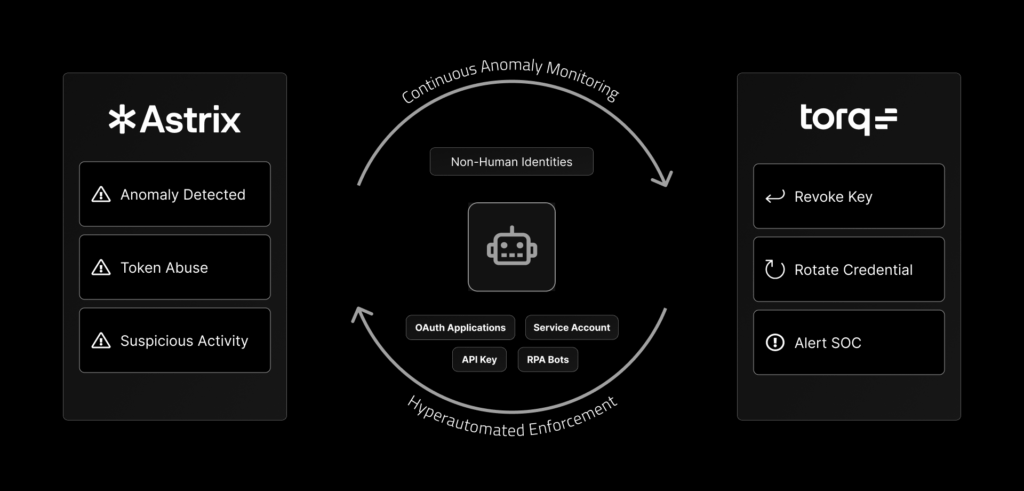
That’s why Torq and Astrix have partnered to deliver a fully automated, intelligent solution for securing NHIs. The solution combines Astrix’s real-time behavioral detection with Torq’s no-code remediation workflows to continuously protect against identity-based breaches.

Why Non-Human Identity Security Needs to Be a Priority

Cybersecurity teams invest heavily in protecting user identities, securing login credentials, and enforcing authentication. However, the rising number of non-human identities (NHIs) often escapes similar scrutiny, creating significant security vulnerabilities. NHIs have become a primary attack vector due to widespread lack of visibility, weak governance, and unmanaged permissions.

Common risks associated with NHIs include:

  • Over-permissioned or over-privileged access
  • Lack of credential rotation and MFA
  • Unused tokens and keys increasing vulnerability
  • Poor visibility across cloud and SaaS integrations
  • Increased susceptibility to credential-based cyberattacks

The Hidden Risk Behind Digital Identities

Non-human identities frequently possess highly privileged access with little oversight. Service accounts, API keys, OAuth applications, and other machine identities can remain active indefinitely without periodic checks, making them prime targets for exploitation. Credential misuse or breaches involving these identities often go unnoticed until damage is already done.

Why Traditional Identity Management Falls Short

Traditional identity solutions, such as Identity Access Management (IAM) and Privileged Access Management (PAM), primarily focus on human users. They enforce policies like MFA, regular password rotation, and robust activity monitoring. These tools, however, are not built for automated services or non-human identities, leaving a substantial gap in security posture.

How Torq and Astrix Automate Non-Human Identity Protection

Torq and Astrix seamlessly integrate to deliver a comprehensive solution that automates the detection and remediation of non-human identity risks. By combining Astrix’s advanced behavioral analytics with Torq’s intelligent automation, security teams gain unprecedented visibility and control.

Detecting Anomalous Behavior in Real Time

Astrix Security applies behavioral analysis typically reserved for human identities to NHIs. By monitoring activity patterns, Astrix detects unusual behaviors, unauthorized access, or suspicious usage in real-time, closing gaps often overlooked by conventional identity management solutions.

Triggering No-Code Remediation Playbooks Automatically

When Astrix identifies an anomaly, Torq instantly triggers no-code remediation workflows based on preset rules. These automated playbooks rapidly address issues such as revoking access, rotating credentials, disabling unused identities, or alerting security teams, streamlining threat mitigation, and significantly reducing response times.

Enforcing Least-Privilege Access with Continuous Policy Management

Astrix continuously assesses and identifies NHIs with excessive privileges and dormant or outdated credentials. Torq automates the enforcement of least-privilege access policies by proactively removing unnecessary permissions, revoking unused tokens, and continuously updating identity posture, ensuring minimal attack surface exposure.

Strengthening Authentication and Access Control with Automation

Static access controls and manual credential management are no longer sufficient. As organizations adopt cloud-native infrastructure, DevOps pipelines, and an ever-growing array of third-party services, the number of digital identities — especially non-human ones — has exploded. 

Without automation, ensuring secure authentication and effective access control becomes unmanageable at scale. Automating these processes enhances identity hygiene, reduces risk, and allows security teams to enforce policy consistently across complex, dynamic environments.

Simulating MFA and Rotating Credentials Automatically

While multi-factor authentication (MFA) remains a cornerstone of identity security for human users, non-human identities often can’t use MFA in traditional ways. Organizations are turning to automated mechanisms that simulate MFA behavior like enforcing time-limited credentials, rotating keys after specific usage thresholds, or applying context-aware access restrictions. Automatically rotating credentials or secrets based on predefined policies helps prevent unauthorized reuse, reduce the impact of credential leakage, and limit the exposure window for attackers.

Securing Third-Party Integrations and External Access Points

Third-party applications and services can significantly expand an organization’s attack surface if not properly secured. Many breaches originate from overly permissive or forgotten integrations. Automating these external connections’ discovery, evaluation, and control is essential for maintaining security. By continuously monitoring for risky behaviors, organizations can automatically revoke or reconfigure access, enforce least-privilege principles, and minimize external risk without relying on manual reviews. 

Common Identity Security Challenges and How Torq Solves Them

Closing Visibility Gaps Across Cloud and SaaS Environments

Torq consolidates identity and security signals from your entire security and tech stack, providing unified visibility into NHI risks. By centralizing this information, Torq enables precise identification and quick remediation of identity-related vulnerabilities across the entire digital ecosystem.

Stopping Credential Misuse and Phishing-Style Exploits

With automated playbooks, Torq instantly identifies and stops credential misuse, proactively revoking compromised tokens, and preventing phishing-like attacks on NHIs. This immediate response capability significantly reduces security risks and minimizes potential damage.

Eliminating Alert Fatigue and Manual Remediation Backlogs

Manual remediation processes can overwhelm security teams, resulting in alert fatigue and delayed responses. Torq autonomously resolves repetitive and high-volume NHI-related incidents, reducing operational overhead and allowing security analysts to focus on strategic security initiatives.

Securing the Future of Identity Security

As the volume and complexity of non-human identities grow, so does the urgency of securing them with the same rigor applied to human users. API keys, service accounts, and automation credentials often fly under the radar, creating a hidden and highly exploitable attack surface. Traditional tools were never designed to manage this scale or speed. 

By integrating behavioral detection and intelligent auto-remediation, Torq and Astrix empower security teams to proactively manage identity risk, streamline response, and enforce consistent access controls. The result is a scalable, flexible, and future-proof approach to identity security that addresses today’s threats and tomorrow’s challenges.

Ready to close the gap on non-human identity risk? Request a demo to see how automated identity security works in action.

SEE TORQ IN ACTION

Ready to automate everything?

“Torq takes the vision that’s in your head and actually puts it on paper and into practice.”

Corey Kaemming, Senior Director of InfoSec

“Torq HyperSOC offers unprecedented protection and drives extraordinary efficiency for RSM and our customers.”

Todd Willoughby, Director

Compuquip logo in white

“Torq saves hundreds of hours a month on analysis. Alert fatigue is a thing of the past.”

Phillip Tarrant, SOC Technical Manager

Fiverr logo in black

“The only limit Torq has is people’s imaginations.”

Gai Hanochi, VP Business Technologies

Carvana logo in black

“Torq Agentic AI now handles 100% of Carvana’s Tier-1 security alerts.”

Dina Mathers, CISO

Riskified logo in white

“Torq has transformed efficiency for all five of my security teams and enabled them to focus on much more high-value strategic work.”

Yossi Yeshua, CISO

Impossible Travel Detection with Torq: Stop Identity-Based Attacks in Real Time

Contents

Get a Personalized Demo

See how Torq harnesses AI in your SOC to detect, prioritize, and respond to threats faster.

Request a Demo

With remote work and global access, defending identity is now a 24/7 discipline. One high-fidelity risk signal is when a user appears to log in from two distant locations in an unrealistically short window — an anomaly that’s often a sign of stolen credentials, session hijacking, or policy misuse. Catching this impossible travel detection early lets you block access before attackers pivot, escalate, or exfiltrate data.

What Is Impossible Travel Detection?

How Impossible Travel Happens

Credential theft: Phishing, multi-factor authentication (MFA) “push fatigue,” and password reuse feed credential-stuffing and direct account takeover.

Token and session abuse: OAuth consent phishing, stolen refresh tokens, or session hijacking from compromised devices enable logins from anywhere without the password.

VPN/proxy/geolocation spoofing: Consumer VPNs, TOR, residential proxies, and cloud egress IPs make a user appear to “teleport” between countries.

Shared or service accounts: Multiple people (or scripts) using one identity from different regions trigger impossible travel detection.

Federated SSO drift: Misconfigured IdP/SAML/OIDC trusts or third-party SaaS logins from distant regions create mismatched signals.

Mobile or network artifacts: Carrier-grade NAT, roaming, airplane/ship Wi-Fi, and inaccurate IP geolocation can look like anomaly detection hits even when benign.

Why Impossible Travel Detection Matters

Early containment: Catching suspicious logins at the first hop prevents lateral movement, privilege escalation, BEC, and data exfiltration.

Lower dwell time and MTTR: Rapid triage and verification shrinks exposure windows, cuts investigation hours, and reduces downstream incident costs.

Protection of high-value access: Stops unauthorized entry to SaaS suites (email, finance, CRM), cloud consoles, and identity systems before damage occurs.

Fewer false positives with context: Pairing geo-velocity with device fingerprint, IP reputation, VPN awareness, and user history reduces noise while preserving real detections.

Compliance and audit readiness: Clear, automated decisions and records support regulations, incident reporting, and fraud investigations.

Proven pattern from fraud prevention: The same impossible travel logic used in travel and payment fraud highlights anomalous access patterns in enterprise identity, with measurable risk reduction.

Why Identity Threats Are the New Frontline in Cybersecurity

According to IBM, stolen or compromised credentials account for up to 40% of malicious incidents in Fortune 500 companies. These breaches also rank among the most expensive, adding over $1 million in costs per incident. Despite best practices like MFA and employee security training, the human element remains the weakest link — 68% of breaches stem from social engineering or user error.

Identity signals must be correlated in real time across IdPs (Okta, Microsoft Entra), EDR/XDR (e.g., Microsoft Defender), email, and cloud. That’s why modern security operations teams operationalize IdentityOps: for automated detection, contextual enrichment, and instant, policy-driven response.

How Torq Automates Impossible Travel Detection

To save security analysts from legacy systems and alert fatigue, Torq created an Impossible Travel Detection workflow that eliminates reliance on legacy, manual security processes. Torq automates Impossible Travel Detection with your existing best-of-breed toolstack. 

With 300+ integrations, this workflow can integrate with Okta, Microsoft Entra (Azure AD), and other leading identity providers, leveraging geolocation, user behavior analytics, and AI-driven security automation to identify and block suspicious logins instantly.

How To Detect Impossible Travel

Torq autonomously triggers its detection workflow based on successful login events from your identity access management (IAM) provider of choice and follows this streamlined identity-centric process:

  1. Login event capture: Activates the workflow when a user logs into Okta (or another IAM solution).
  2. Geolocation analysis: Determines the IP address’s physical location via integrated intelligence tools.
  3. Historical user behavior comparison: Compares the login’s geolocation with previous locations stored as identity baselines.
  4. Distance and speed calculation: Uses the Haversine formula to determine the travel distance and computes implied travel speed.
  5. Anomaly detection: Flags logins that exceed a predefined speed threshold (e.g., 1,000 km/h).
  6. Risk scoring and identity context awareness: Incorporates additional risk intelligence to minimize false positives.
  7. Automated response actions: Torq can automatically reset the user’s password, revoke active sessions, notify the SOC via Slack or Teams, and create an incident ticket — all in seconds.

By analyzing real-time user behavior and risk signals at machine speed, Torq instantly determines whether a login attempt is legitimate or an identity-based attack.

Going Beyond Geolocation: Smarter Identity Threat Detection

The power of IdentityOps lies in your ability to integrate across the security ecosystem — leveraging multiple threat intelligence and user behavior signals to detect, assess, and remediate compromised identities dynamically.

Advanced Risk Signals Integrated into Torq’s IdentityOps Workflow

Torq enriches Impossible Travel Detection with best-in-class security integrations, ensuring high-fidelity threat identification through:

  • IP reputation enrichment: Queries VirusTotal, Recorded Future, or CrowdStrike to determine if the login originates from a known malicious or suspicious source.
  • User behavior profiling: Establishes a historical baseline of each user’s login habits to detect anomalous patterns.
  • Context-aware decisioning: Analyzes additional identity context, VPN usage, corporate IP addresses, travel windows, verified itinerary data, and cloud service access patterns to reduce false positives.

These multi-layered identity security checks ensure precision threat detection while maintaining a seamless user experience.

Real-Time User Verification and Remediation Workflow

With this workflow, Torq detects potential takeovers. Then, Torq automatically engages users and security teams for real-time resolution.

Step 1: User Notification & Verification

The moment a suspicious login is detected, Torq automatically contacts the affected user with a context-rich, real-time security challenge delivered via their preferred channel (i.e., email, Slack, Teams, or SMS):

🚨 Suspicious Login Detected

We noticed a suspicious login to your account from [Geo IP City]; your last login was from [Cache Geo IP City].

📍 Distance between logins: [Calculated Distance]

❓ Do you recognize this login as yours? [Yes] / [No]

This proactive approach serves three key purposes:

  1. Alerts the user of potential credential compromise.
  2. Provides contextual insight into login activity.
  3. Engages users in real-time identity verification.

Step 2: Adaptive, Automated Remediation

If the login is verified as legitimate:

  • Torq updates the user’s known location history and device fingerprint.
  • A log entry is created in the audit trail for compliance tracking.
  • Operations continue without interruption.

If the login is denied (or is ignored or times out), Torq initiates auto-remediation.:

  1. Torq forces an immediate password reset and sends a secure reset link to the user.
  2. All active sessions are terminated across web, mobile, and connected apps.
  3. The SOC is alerted via Slack, Teams, SIEM, or ITSM for visibility.
  4. An incident ticket is automatically created and enriched with geolocation, IP reputation, and session history for investigation.

Optional: AI-Driven Investigation & Escalation

For high-risk scenarios — such as an admin account compromise or repeated suspicious logins — Torq automatically escalates the response by:

  • Disabling the account entirely until security clearance
  • Revoking OAuth and SSO sessions across all connected platforms
  • Enforcing step-up MFA for reauthentication
  • Running additional enrichment workflows such as IP threat lookups, device risk scoring, dark web credential checks

The result is a closed-loop, autonomous detection and remediation process that catches account takeover attempts early, engages the right people instantly, and resolves incidents before damage is done — without relying on slow, manual analyst intervention.

Save your SOC with Torq HyperSOC

Customizing IdentityOps: Flexible, No-Code Security Automation

Every organization’s identity posture is unique. Torq HyperSOC™ lets you tune thresholds, data sources, and actions without long dev cycles. Torq has: 

  • Customizable risk scoring and speed thresholds
  • Seamless integration with IAM, SIEM, and XDR platforms
  • Adaptable remediation actions based on risk severity
  • Agentic AI and AI Workflow Builder for instant, custom identity automation

Organizations can fine-tune Impossible Travel Detection to align with their unique security policies, compliance needs, and identity protection strategy, including:

  • Adjusting velocity rules, confidence cutoffs, and country allow-lists
  • Choosing your enrichment stack (IdP, Microsoft Defender, EDR, TI, SIEM) and the integrations that matter
  • Routing outcomes to ITSM, SIEM, data warehouse, or compliance dashboards
  • Localizing messaging and multi-language prompts to reduce end-user confusion

Transform Your Identity Security with Torq

By shifting to IdentityOps automation, security teams can radically transform how they detect, manage, and respond to identity threats. When you connect IdentityOps signals to automation workflows, you:

  • Lower dwell time and MTTR: Automated verification and remediation closes the loop in minutes.
  • Reduce false positives: Contextual scoring means fewer noisy cases and crisper “go/no-go” decisions.
  • Protect critical access: Prevent bad actors from reaching SaaS finance apps, admin portals, and cloud consoles.
  • Prove outcomes: Every alert, action, and result is captured for audit and continuous improvement.

Instead of relying on reactive security controls and manual investigations, Torq proactively enforces identity security at scale — ensuring only trusted users access your most sensitive resources. 

Stop credential-based attacks before they spread. See how Torq turns identity signals into decisive action in our Don’t Die, Get Torq manifesto.

SEE TORQ IN ACTION

Ready to automate everything?

“Torq takes the vision that’s in your head and actually puts it on paper and into practice.”

Corey Kaemming, Senior Director of InfoSec

“Torq HyperSOC offers unprecedented protection and drives extraordinary efficiency for RSM and our customers.”

Todd Willoughby, Director

Compuquip logo in white

“Torq saves hundreds of hours a month on analysis. Alert fatigue is a thing of the past.”

Phillip Tarrant, SOC Technical Manager

Fiverr logo in black

“The only limit Torq has is people’s imaginations.”

Gai Hanochi, VP Business Technologies

Carvana logo in black

“Torq Agentic AI now handles 100% of Carvana’s Tier-1 security alerts.”

Dina Mathers, CISO

Riskified logo in white

“Torq has transformed efficiency for all five of my security teams and enabled them to focus on much more high-value strategic work.”

Yossi Yeshua, CISO

Cut Through the Hype: Tips for Evaluating AI Solutions for an Autonomous SOC

Contents

Get a Personalized Demo

See how Torq harnesses AI in your SOC to detect, prioritize, and respond to threats faster.

Request a Demo

As C-suites and boards are bombarded with headlines about AI revolutionizing cybersecurity, it’s no wonder they’re putting pressure on SOC leaders to adopt AI. The promise of AI in the SOC is rightfully alluring. An AI-native autonomous SOC has the potential to create a world where AI Agents collaborate with each other to take care of repetitive tasks and handle the majority of low-level alerts, freeing your human team up for strategic, proactive work. 

The hurdle? The AI cybersecurity landscape is swarming with vendors — and new ones are seemingly popping up out of stealth mode every day with shiny marketing and grand claims. 

This leaves SOC leaders wading through the noise to figure out which tools are overexaggerated AI-washed vaporware and which ones are truly operational, integrated, and trustworthy. Below are some tips for cutting through the hype to find the right AI solutions to help build an autonomous SOC. 

Start with the End Goal in Mind — and Think Big Picture

How do useful AI cybersecurity tools impact operational outcomes, functional goals, and strategic objectives?

Step back and start with the big picture. To avoid “scattergun” AI adoption in the SOC that leads to a flood of AI-generated alerts with no context or prioritization, begin by defining clear AI objectives aligned with your overarching security strategy. Before you dive into the AI vendor pool, take a moment to reflect on your SOC’s practical needs. What are your biggest pain points? Where could AI make the biggest impact? Are your analysts drowning in a sea of alerts? Or are they having to spend too much time on tedious tasks? Prioritize AI solutions that directly address these day-to-day challenges.

“I believe the successful use of AI in SOC operations shows up in practical outcomes. With Torq Agentic AI, the answer is ‘yes’ to questions such as: Are analysts happier? Are they sticking around? Do they have time to focus on more interesting and complex investigations? Are MTTM and MTTR lower? Torq Agentic AI extends and enhances our team so it can make better decisions more quickly — resulting in stronger security all around.”

– Mick Leach, Field CISO, Abnormal Security

Leverage AI for tasks where human limitations — such as fatigue and information overload — lead to inefficiencies. Generative AI-powered AI Agents are adept at tasks involving natural language processing and the creation of logical workflows. This makes AI ideal for automating repetitive, monotonous tasks, intelligently triaging alerts and autonomously handling incidents, and providing real-time insights and recommended next steps to speed up human decision-making. In turn, human analysts are freed up to focus on strategic activities and make faster, more informed decisions, significantly improving overall efficiency and effectiveness.

Think holistically to maximize the value of your investment. One-off AI tools from different vendors can’t add up to an autonomous SOC because they can’t connect security signals across your stack and provide meaningful, context-rich insights. Prioritize investing in a centralized automation platform with enterprise-grade scalability and the ability to integrate with every solution in your security environment. Purpose-built AI Agents for the SOC built on this foundation can work as a unifying force at the heart of your security stack to correlate disparate event data, uncover deep, contextual insights, and accelerate efficiency gains across your security operations.

Stay ahead of threats by keeping up with autonomous SOC advancements. Hyperautomation is now table stakes for Security Operations, demanding platforms with native, fully embedded AI capabilities rather than bolted-on GPT wrappers. Agentic AI,  the new frontier for delivering on the promise of the autonomous SOC, is now a reality. Torq just announced a groundbreaking Multi-Agent System for security operations with specialized AI Agents that collaborate, plan, and reason to autonomously analyze and resolve security threats. 

“SecOps organizations that adopt GenAI-based Hyperautomation will benefit from the most advanced LLMs ever, enabling analysts to auto-analyze more events and identify novel threats at the beginning of their cascade of potential impact, rather than after they’ve had a chance to create serious damage. GenAI will also further democratize SecOps, so employees at all levels are able to deploy, manage, and monitor Hyperautomation systems.”

– Leonid Belkind, Torq CTO and Co-Founder | 2025 Predictions: How GenAI and Hyperautomation Will Reshape SecOps and Threat Landscapes

Tips for Evaluating AI Cybersecurity Tools for the SOC

Establish your evaluation criteria: Given the potential risks associated with AI solutions, careful third-party risk management is crucial.  Collaborate with IT teams, business leaders, and legal to ensure alignment with company-wide AI usage policies. Below are some key considerations when choosing a vendor for AI in the SOC:

  • Flexibility and integration: Make sure the AI solution you choose can easily integrate with your existing security stack and ingest and intelligently transform data in any format. A flexible platform that can adapt to your evolving needs is essential so you don’t get locked in. 
  • Security and privacy: Any solution deployed in your SOC should meet enterprise-grade security standards and have tiers of controls to protect data confidentiality. 
  • Transparency: One of the most crucial elements for building trust in AI is to ensure the model can explain why it made the decisions it made and how it came to the conclusions it did. 
  • Human-AI collaboration: Effective AI Agents in the SOC facilitate a collaborative, back-and-forth relationship with the human analysts they work with, clearly communicating its capabilities and limitations. When encountering roadblocks, the AI should seek human input or validation.

Ask the right questions: Overexaggerated,  misleading, and outright false claims about AI capabilities are all too common. We’ve got a list of 40 questions to help you understand a vendor’s AI capabilities, integrations, and more, such as:

  1. Is all customer data encrypted in transit? Is stored data encrypted on disk? Is data stored in vendor data centers or only in memory? 
  2. What countermeasures does the solution have in place to prevent AI hallucinations?
  3. Does the system keep immutable records of all inputs and outputs for AI-driven actions?
  4. Does the solution have robust and versatile role-based access controls? 

Refine your shortlist: Use your evaluation criteria to narrow down your list of potential vendors. Consider factors like cost, features, and vendor reputation. Conduct thorough research and request demos from your shortlisted vendors. 

Test before you invest: The proof of whether an AI solution is vaporware or truly operational is in the POC. Ask for demos and conduct a proof-of-concept for a key use case to see the AI solution in action in a controlled environment. Pay attention to the scalability, ease of use, and overall performance. 

Consider long-term partnerships: Build strong relationships with vendors who can provide ongoing support and innovation. Ask about their AI product roadmap.

40 Questions to Ask AI SOC Vendors

To help you sharpen your evaluation of AI solutions for the SOC, we’ve put together this list of 40 critical questions to ask vendors. Cut through the noise of “AI-washed” marketing and dig into the AI’s operational and integration capabilities to ensure you get real value.

SEE TORQ IN ACTION

Ready to automate everything?

“Torq takes the vision that’s in your head and actually puts it on paper and into practice.”

Corey Kaemming, Senior Director of InfoSec

“Torq HyperSOC offers unprecedented protection and drives extraordinary efficiency for RSM and our customers.”

Todd Willoughby, Director

Compuquip logo in white

“Torq saves hundreds of hours a month on analysis. Alert fatigue is a thing of the past.”

Phillip Tarrant, SOC Technical Manager

Fiverr logo in black

“The only limit Torq has is people’s imaginations.”

Gai Hanochi, VP Business Technologies

Carvana logo in black

“Torq Agentic AI now handles 100% of Carvana’s Tier-1 security alerts.”

Dina Mathers, CISO

Riskified logo in white

“Torq has transformed efficiency for all five of my security teams and enabled them to focus on much more high-value strategic work.”

Yossi Yeshua, CISO

Simplifying Non-Human Identity Security with Torq and Clutch Security

Contents

Get a Personalized Demo

See how Torq harnesses AI in your SOC to detect, prioritize, and respond to threats faster.

Request a Demo

The rise of Non-Human Identities (NHIs) — think APIs, bots, service accounts, and machine identities — has expanded the attack surface in ways we’re only beginning to understand. NHIs now outnumber human identities in enterprise environments, often by a staggering ratio. While they streamline processes, enable scalability, and facilitate automation, these identities also present significant security risks.

The Growing Importance of Non-Human Identity Management & Security

Traditional approaches struggle to address the dynamic nature of NHIs, especially when it comes to:

  • Lifecycle governance: Stale or orphaned accounts are often left unchecked, creating vulnerabilities and increasing the risk of unauthorized access.
  • Contextual visibility: A lack of insight into what non-human identities are doing and why they are being used leaves security teams in the dark.
  • Zero Trust alignment: Continuously validating the usage of non-human identities is critical to enforcing least-privilege policies and maintaining security.

Security teams are left grappling with blind spots, operational inefficiencies, and increasing exposure to breaches. This is not just a challenge — it’s a mandate for change.

Enter Torq and Clutch Security: a partnership reshaping how security teams tackle the complexity of non-human identity management and security. 

Empowering SOC Teams with Seamless Zero Trust and Incident Response 

Clutch delivers visibility into NHI activity, offering deep insights into how these identities are created, used, and misused. Torq enhances this visibility with AI-driven Hyperautomation that transforms insights into action. When used together, SOCs are given the power to:

  1. Simplify complexity: Automatically ingest and contextualize Clutch’s NHI inventory into Torq workflows, enabling real-time decision making.
  2. Enhance Zero Trust: Dynamically enforce least-privilege policies for NHIs with automated remediation.
  3. Accelerate incident response: Detect NHI misuse through Clutch, then trigger Torq workflows to contain and remediate threats instantly.
  4. Future-proof security: Transition to ephemeral identities without operational friction, ensuring NHIs always align with your Zero Trust goals.

Real-World Implementation, From Detection to Resolution

Consider a common scenario: a temporary service account is created for a one-off task but inadvertently granted excessive permissions. Without the right tools, detecting and remediating the issue might take hours or even days. With Torq and Clutch, this process becomes seamless:

  1. Detection: Clutch identifies the account’s risky behavior in real time, flagging it for immediate review.
  2. Automation: Torq triggers a workflow to revoke the account’s excessive permissions, notify the SOC, and autonomously document the event for compliance.
  3. Prevention: Clutch provides recommendations for transitioning the account to an ephemeral identity, which Torq enforces automatically.

In short, this partnership enables security teams to do what they do best: defend their organizations with precision and confidence.

Ready to Transform Your Non-Human Identity Management and Security?

If you’re ready to bring Zero Trust to your NHIs and revolutionize your SOC, explore the Clutch-Torq integration today. Together, we’re setting a new standard for how enterprises secure their most overlooked — but most critical — identities.

SEE TORQ IN ACTION

Ready to automate everything?

“Torq takes the vision that’s in your head and actually puts it on paper and into practice.”

Corey Kaemming, Senior Director of InfoSec

“Torq HyperSOC offers unprecedented protection and drives extraordinary efficiency for RSM and our customers.”

Todd Willoughby, Director

Compuquip logo in white

“Torq saves hundreds of hours a month on analysis. Alert fatigue is a thing of the past.”

Phillip Tarrant, SOC Technical Manager

Fiverr logo in black

“The only limit Torq has is people’s imaginations.”

Gai Hanochi, VP Business Technologies

Carvana logo in black

“Torq Agentic AI now handles 100% of Carvana’s Tier-1 security alerts.”

Dina Mathers, CISO

Riskified logo in white

“Torq has transformed efficiency for all five of my security teams and enabled them to focus on much more high-value strategic work.”

Yossi Yeshua, CISO

What Is Auto-Remediation in Security? (And Why Your SOC Can’t Survive Without It)

Attackers aren’t waiting around while your team manually investigates every alert, updates every firewall rule, or sends out those “please reset your password” emails. If you’re still relying on human intervention for every step in your incident response process, you’re already behind.

That’s where auto-remediation comes in — your SOC’s not-so-secret weapon for quickly remediating threats, reducing burnout, and eliminating manual busywork once and for all.

Compared to manual processes, auto-remediation delivers greater speed, consistency, and scalability — critical elements for modern SOC success.

How Does Auto-Remediation Work?

In a typical SOC, auto-remediation involves four key stages:

  1. Detection: A system flags a suspicious login or abnormal behavior.
  2. Triage: Your platform checks context. Is this a known issue? Is this user legit?
  3. Remediation: If the threat meets the right criteria, your auto-remediation playbook kicks off: isolate the asset, notify the user, reset the password, and update relevant tools.
  4. Documentation: Every step is logged, so your audit trail stays clean.

Five Key Benefits of Automated Remediation

  1. Rapid response: The longer a threat lingers, the greater the damage. Auto-remediation slashes your mean time to response (MTTR) and gets you back on offense.
  2. Reduced analyst burnout: Alert fatigue is a thing. Offloading repetitive tasks frees up your team to focus on real, strategic work.
  3. Consistent uutcomes: Security automation ensures precise, repeatable responses without human error or oversight, following defined protocols every time.
  4. Scalable operations: As alerts multiply, automation scales effortlessly, allowing your SOC to manage larger volumes without adding headcount.
  5. Improved compliance: Automated remediation enforces security standards (e.g., PCI-DSS, GDPR) by rapidly detecting and correcting policy violations, with thorough documentation for auditors.

Everyday Use Cases for Auto-Remediation

Phishing containment: Automatically isolate compromised inboxes, revoke access to malicious emails, block phishing URLs, and notify users.

Malware-infected host quarantine: Detect malware, isolate the endpoint from the network, trigger EDR scans, and escalate the issue if necessary.

IAM policy violations: Spot privilege escalations or inactive admin accounts and auto-revoke access, enforce MFA, or disable the account, keeping identity sprawl in check.

Cloud misconfigurations: When CSPM detects risky S3 buckets or open ports, auto-remediation can tag the asset, log the fix, and alert the team.

Failed login brute force attacks: Identify login abuse patterns, block IPs, lock targeted accounts, and update firewall rules automatically, before damage is done.

Autonomous Remediation with Torq HyperSOC™

Torq HyperSOC™ takes auto-remediation from automated to autonomous. With powerful agentic AI,  HyperSOC enables the automatic detection, triage, and resolution of security incidents, eliminating the need for human intervention. Powered by Socrates — the AI SOC Analyst — and a suite of specialized AI micro-agents, HyperSOC auto-remediates over 95% of Tier-1 security operations. Here’s how it works.

Always On Detection and Triage

Torq integrates with your entire security stack: EDR, SIEM, email, IAM, cloud, and more. When a threat is detected, Torq Socrates immediately pulls in relevant data to triage the alert, determine its legitimacy, and assess severity.

Auto-Remediation with Agentic AI

Each agent within Torq’s Multi-Agent System (MAS) specializes in a different SecOps task, like investigation, enrichment, or containment. Once an alert is confirmed, these agents autonomously execute a pre-validated remediation path, such as:

  • Blocking compromised accounts in Okta or Azure AD
  • Quarantining infected endpoints via EDR tools like CrowdStrike
  • Revoking malicious OAuth tokens
  • Killing malicious processes or containers in cloud environments
  • Auto-closing resolved tickets in platforms like Jira or ServiceNow

Zero-Code, Full Oversight

Even with fully autonomous operations, Torq gives analysts total visibility. They can supervise AI remediation workflows, approve actions, and modify runbooks in natural language — no coding needed.

Unmatched Speed and Scale

HyperSOC enables SOCs to process and remediate 3–5x more alerts without expanding the team, reduce investigation time by up to 90%, and eliminate 95% of Tier-1 tasks — entirely autonomously.

Torq + Abnormal: An IRL Example 

Torq HyperSOC brings autonomous remediation to life in the real world with Abnormal Security email security. When Abnormal Security flags suspicious behavior, whether it’s an account takeover attempt, credential phishing, or post-delivery malware, Torq instantly kicks off a no-code auto-remediation workflow. That means the second a threat is detected, action is already underway.

Torq pulls in context from identity systems like Okta, security tools like CrowdStrike or SentinelOne, and communication platforms like Slack or Teams to automatically lock accounts, revoke sessions, isolate endpoints, delete malicious emails, and notify impacted users. 

Torq’s workflows can dynamically engage users to confirm suspicious activity, add decision branches based on user role or device posture, and escalate to humans only when needed.

TL;DR: Your SOC Can’t Survive Without Auto-Remediation

Auto-remediation is the engine behind scalable, resilient, and efficient security operations. By integrating automated remediation into your security operations, you transition from reactive firefighting to a proactive, autonomous SOC. With threats growing increasingly sophisticated, your SOC can’t afford manual inefficiencies.

Make auto-remediation a central part of your security strategy. Let Torq’s agentic AI-driven automation handle threats at machine speed, empowering your analysts to focus on strategic security initiatives.

Thinking about adding AI to your SOC? Get the inside scoop on what CISOs are considering, top use cases, and the key questions to ask vendors for a successful deployment.

SEE TORQ IN ACTION

Ready to automate everything?

“Torq takes the vision that’s in your head and actually puts it on paper and into practice.”

Corey Kaemming, Senior Director of InfoSec

“Torq HyperSOC offers unprecedented protection and drives extraordinary efficiency for RSM and our customers.”

Todd Willoughby, Director

Compuquip logo in white

“Torq saves hundreds of hours a month on analysis. Alert fatigue is a thing of the past.”

Phillip Tarrant, SOC Technical Manager

Fiverr logo in black

“The only limit Torq has is people’s imaginations.”

Gai Hanochi, VP Business Technologies

Carvana logo in black

“Torq Agentic AI now handles 100% of Carvana’s Tier-1 security alerts.”

Dina Mathers, CISO

Riskified logo in white

“Torq has transformed efficiency for all five of my security teams and enabled them to focus on much more high-value strategic work.”

Yossi Yeshua, CISO

New to the Torq Library: Analyze Files, Manage Identity, and More

Contents

Get a Personalized Demo

See how Torq harnesses AI in your SOC to detect, prioritize, and respond to threats faster.

Request a Demo

This month, we’ve continued to expand Torq’s offerings. Discover the new workflow templates, intelligent integrations, and utility steps — all meticulously crafted to streamline security operations and amplify your team’s impact.

New Workflow Templates

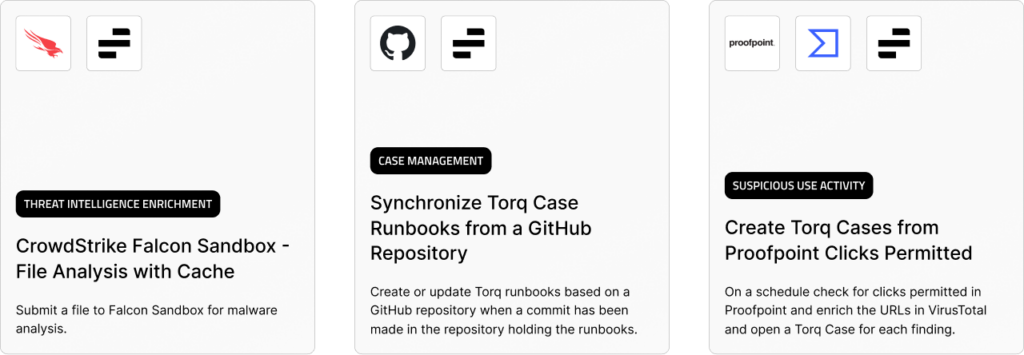
Analyze Files with CrowdStrike Falcon Sandbox or Retrieve Cached Results
Put a stop to redundant file analyses. This template checks cached results for files analyzed in the last 24 hours, delivering instant insights when available. Need fresh data? The workflow submits the file for analysis, returning a detailed report featuring MITRE TTPs, related hashes, and more.

Synchronize Torq Runbooks with GitHub Automatically
Keep your runbooks effortlessly in sync. This automation updates your Torq runbooks whenever changes are committed to your GitHub repository. As a result, you can maintain up-to-date runbooks without lifting a finger.

Create Torq Cases from Proofpoint Clicks Permitted
Phishing attacks keep on coming, but this workflow has your back. It scans Proofpoint for “clicks permitted” events, enriches URLs with VirusTotal data, and automatically opens Torq cases.


Intelligent Automation Integrations

Your favorite tools are amplified with new Torq steps.

Seven new steps for the Abnormal integration provide deeper visibility into activities like employee logins and vendor actions:

  • Get Vendor Activity
  • Get Employee Login Details
  • Get Vendor Case Details
  • List Vendor Cases
  • Get Employee Analysis
  • Get Employee Information
  • Get Vendor Details

Gain more control with several new steps in the Elastic integration:

  • Upgrade Elastic Agent version
  • Unenroll Elastic Agent from Fleet
  • Get Agent Details by ID
  • Get Agent Details by Query

The new “Get a Pull Request” step for the GitHub integration simplifies code review workflows.

Manage identity and access with enhanced options for the Okta integration:

  • Reset User Password
  • Create Policy Rule
  • Get Policy
  • List Policies
  • Set Policy Rule Status
  • Revoke API Token
  • List API Tokens
  • List Policy Rules

New Utility Steps for Seamless Operations

Smarter tools for transforming data and processes.

Output Utils: Effortlessly transform your data and turn complex logs into actionable information with the simplicity and elegance you expect.

  • CLF to JSON: Seamlessly convert Common Log Format (CLF) logs into JSON, ready for integration with SIEMs, EDRs, XDRs, and beyond.
  • CEF to JSON: Easily transform Common Event Format (CEF) data into JSON, unlocking enriched analysis and compatibility across your tools.

Utils: Discover new possibilities with tools that bring clarity to network data.

  • DNS Resolution: Instantly resolve IP addresses into domain names, transforming raw data into meaningful insights. Connect malicious IPs to their domains for faster detection and response, and enrich your threat intelligence with actionable details.
  • CIDR Validation: Validate IPv4 addresses effortlessly, ensuring they fall within authorized ranges. Automate access controls and dynamic firewall rules and flag unexpected traffic outside defined ranges to protect your most sensitive systems — even blocking entire regions or countries with precision and ease.

Stay Ahead with Torq

This month’s updates are just scratching the surface. With new workflow templates, smarter steps, and expanded integrations, Torq continuously improves to equip your security team to get more done, faster and strategically.

Now, you can do even more with the top-tier tools you trust, such as SecurityScorecard, Autotask, BitSight, CrowdStrike, Jamf Protect, Jira Cloud, Palo Alto Networks Cortex XDR, SentinelOne, Sumo Logic, ThreatConnect, urlscan.io, and Wazuh.

Want to see it all? Dive into the Full Content Digest for details.

SEE TORQ IN ACTION

Ready to automate everything?

“Torq takes the vision that’s in your head and actually puts it on paper and into practice.”

Corey Kaemming, Senior Director of InfoSec

“Torq HyperSOC offers unprecedented protection and drives extraordinary efficiency for RSM and our customers.”

Todd Willoughby, Director

Compuquip logo in white

“Torq saves hundreds of hours a month on analysis. Alert fatigue is a thing of the past.”

Phillip Tarrant, SOC Technical Manager

Fiverr logo in black

“The only limit Torq has is people’s imaginations.”

Gai Hanochi, VP Business Technologies

Carvana logo in black

“Torq Agentic AI now handles 100% of Carvana’s Tier-1 security alerts.”

Dina Mathers, CISO

Riskified logo in white

“Torq has transformed efficiency for all five of my security teams and enabled them to focus on much more high-value strategic work.”

Yossi Yeshua, CISO

5 Secrets of a SOC Leader Turned Field CISO

Contents

Get a Personalized Demo

See how Torq harnesses AI in your SOC to detect, prioritize, and respond to threats faster.

Request a Demo

Torq is thrilled to have Patrick Orzechowski (also known as “PO”) on board as our new Field CISO, bringing his expertise and years of experience as a SOC leader to our customers. PO is a seasoned security veteran with a deep understanding of the modern security landscape. By way of introduction, below he shares his five top pieces of advice for SOC leaders facing today’s security challenges.

When I say I’ve been in your shoes as a SOC leader, I mean it! I’ve spent around 25 years in the trenches of cybersecurity and security operations centers (SOCs). I’ve dealt with alert fatigue, managed incidents where our team didn’t sleep for days, and searched far and wide for an automation solution that can truly help SOC teams collaborate better and gain deeper insights into incident data.

I started my journey in a SOC at RipTech, which was acquired by Symantec. From there, I worked in the U.S. defense and intelligence communities as both a Blue Teamer and a Red Teamer, building SOCs and leading forensics and incident response as well as doing penetration testing for the U.S. government. My focus then shifted towards data analytics in security operations, and I held roles at telecom giants like TW Telecom and Level 3. 

Ten years ago, I co-founded a Managed Detection and Response (MDR) service called Deepwatch, where I built the SOC infrastructure to run and handle over 250 customers — and which is where I first came across Torq Hyperautomation as the answer to our SOC scaling challenges.

Today, as Field CISO at Torq, I’m applying my experiences as a security practitioner to help organizations navigate the complexities of modern cybersecurity. You’ll find me speaking at security conferences and events around the world, sharing my expertise in Torq content, and leading independent research projects to explore topics like SOC efficiency and case management effectiveness. 

I have seen firsthand that the old ways of doing things in cybersecurity are going away and need to be left in the dust. I truly believe Torq’s AI-driven Hyperautomation is an unprecedented solution for helping SOC leaders stay ahead of this evolution and the main reason why I am so excited to be here now. To pay it forward, below are my 5 top pieces of advice for SOC leaders facing today’s challenges.

5 Keys to Modern SOC Success

1. Evolve for the Expanding Attack Surface

The combination of cloud hyperscalers (such as AWS, Azure, GCP, etc.), legacy apps, on premise requirements, remote work, and SaaS solutions present a very complex problem set for SOC leaders. As the attack surface expands and gets more complex, attackers will have the competitive advantage of targeting disparate systems that do not talk to each other.

Therefore, as vulnerabilities and entry points multiply and digital transformation and AI adoption accelerate, security teams will need systems that become the “glue” that ties together the systems themselves (i.e., automation), the data they produce (i.e., SIEM and search), and event-driven case management

The sheer volume of data gives attackers an advantage as SOCs struggle to sift through the noise. Torq HyperSOC can process and triage high volumes of events to close out false positives more quickly and prioritize responses more efficiently, helping reduce alert fatigue and and intelligently escalating high-priority cases to security analysts so that nothing slips through the cracks.

2. Embrace the AI Revolution, Strategically

We are in a security AI arms race. While AI is undoubtedly a game-changer, it’s a double-edged sword because attackers are also leveraging AI — and they’ll always have the advantage over a defense team that has to worry about compliance, privacy, and red tape. 

It’s daunting to know that attackers can scale everything they do through AI and automation — and that it’s throwing traditional cyber defense rules out the window. For example, every phishing training for the last 15 years told users to “look for grammar errors or weird punctuation”, but a phishing email written with AI can look like a perfectly written email from a legitimate person. 

Deflating the AI fear factor requires strategically automated defenses that can match attackers’ AI-powered speed and scale. With Torq’s AI-powered Hyperautomation, SOC teams can automate repetitive tasks to free up analysts for complex incidents and proactive threat hunting, and can accelerate incident response through auto-remediation and AI-enhanced investigations. Torq’s platform is fully battle-tested to handle the immense data output of the modern SOC’s cloud-native security stack.

It’s crucial to remember that AI is a tool, not a magic bullet. We still need skilled analysts to make informed decisions based on AI insights. Additionally, any AI solution deployed in the SOC should be able to explain how it arrived at its conclusions and provide citations to original forensic evidence so that you can understand and verify its logic.

Get the AI or Die manifesto for advice for deploying AI the right way as a SOC leader.

3. Focus on Security Operations Transformation

Security Operations rationalization is a critical component of any long-term strategy for CISOs and security leadership. While cybersecurity is now recognized as a key business risk, the era of the “blank check” from the C-suite and board to buy whatever technology you want is over. SOC leaders now have to justify your budget and show value and ROI.

Throwing money at the problem by purchasing the newest, shiniest security tools or simply increasing headcount won’t solve your problems anyway. Instead, focus on fundamentally transforming your security operations by investing in automation for routine tasks, streamlining processes, and consolidating data insights from across your stack so you can eliminate analyst burnout and empower your existing team.

4. Overcome Security Data Assumptions

The classic notion of the SOC triad has proven to fail against threat actors who have time and resources. Legacy SIEM, SOAR, EDR, and network controls are not enough to operationalize and automate detection and prevention in an era where attackers are getting faster and faster thanks to AI.

The idea of a singular SIEM to gather, correlate, and alert on all data across the enterprise needs to go extinct. As we move to the new arena of SOC automation, we need scalable, flexible systems that can interconnect not just traditional security stacks but all data sources, including traditional IT systems, HR, Accounting, Sales, and Finance.

5. Don’t Forget the Fundamentals

There’s a lot out there to distract SOC leaders, but maintaining strong cyber hygiene remains crucial. Following basic security practices like zero trust or the NIST cybersecurity framework can never fall by the wayside. 

Additionally, your SOC team’s wellbeing remains central to your security wellbeing. Many SOC challenges are people challenges. Sleep deprivation during major incidents, challenges in effective collaboration, and an inability to access data insights from across different solutions, all add up to frustrated, tired, and checked out analysts — which means a weaker defense. 

When you automate menial, routine tasks and auto-remediate the majority of low-level alerts, you free up analysts to focus on more engaging and rewarding work while also cutting down on alert fatigue. I truly believe all SOCs should be measuring “analyst happiness” as a KPI that reflects the health of security operations.

A Real-World SOC Transformation: Torq + Deepwatch

I know first-hand what happens when a solution like Torq comes in and changes not just technology, but also SOC processes to bring about a more strategic approach.

At Deepwatch, our first foray into automation was with legacy SOAR — but hosting 250 SOAR instances became very expensive, very fast. The platform we were using proved to be costly to scale and extracting critical KPIs like mean time to response (MTTR) was difficult. This hindered our ability to demonstrate value to both internal stakeholders and external customers.

To address these limitations, Deepwatch embarked on a transformative journey with Torq Hyperautomation. The stress test we ran on the Torq platform during the POC was my “aha” moment — and it only impressed me more from there. The Torq platform’s ability to handle high-volume workloads, the simplicity of Torq’s integrations, and the speed and flexibility at which the team could build new workflows accelerated Deepwatch’s analysis, triage, validation, and response. 

Read the full Deepwatch case study here >

Moving Forward, Faster Than Ever

What worked in the SOC a few years ago is often obsolete today, making the ability to adapt rapidly key to survival in the modern security landscape. But this gets harder every day as attackers’ arsenal of technology and tactics gets more complex, sophisticated, and lethal. Somehow, SOC leaders have to keep evolving their tech, people, and processes to combat these evolving threats. It’s not easy, as I know first-hand.

At Torq, we’re revolutionizing the ability of the SOC to quickly move past the challenges that once left SOC leaders in a tar pit of despair. 

Want to chat about the practicalities of transforming your SOC? Let’s talk. 

SEE TORQ IN ACTION

Ready to automate everything?

“Torq takes the vision that’s in your head and actually puts it on paper and into practice.”

Corey Kaemming, Senior Director of InfoSec

“Torq HyperSOC offers unprecedented protection and drives extraordinary efficiency for RSM and our customers.”

Todd Willoughby, Director

Compuquip logo in white

“Torq saves hundreds of hours a month on analysis. Alert fatigue is a thing of the past.”

Phillip Tarrant, SOC Technical Manager

Fiverr logo in black

“The only limit Torq has is people’s imaginations.”

Gai Hanochi, VP Business Technologies

Carvana logo in black

“Torq Agentic AI now handles 100% of Carvana’s Tier-1 security alerts.”

Dina Mathers, CISO

Riskified logo in white

“Torq has transformed efficiency for all five of my security teams and enabled them to focus on much more high-value strategic work.”

Yossi Yeshua, CISO

Building Powerful CrowdStrike Automations: Insights from Fal.Con 2024

Contents

Get a Personalized Demo

See how Torq harnesses AI in your SOC to detect, prioritize, and respond to threats faster.

Request a Demo

“If I take Torq out, I lose three people.”

This sentiment expressed by Fiverr’s VP of Business Technologies perfectly reflected the energy at the Fal.Con 2024 Torq booth and struck a chord with security teams using CrowdStrike’s powerful tools. Detection isn’t the problem — CrowdStrike excels at that. The challenge lies in automating what happens next.

A Problem-First Approach to Security Automation

Security teams quickly discovered how to reimagine CrowdStrike operations from manual to automated, from reactive to proactive. The challenge was universal — while CrowdStrike excels at detection, teams struggle to scale their response processes. 

Torq’s problem-first approach resonated deeply with the crowd at Fal.Con. By focusing on solving real security challenges through intelligent automation and AI rather than adding more tools to the stack, Torq is trusted by organizations across the globe to complete 5.2 million Torq-CrowdStrike automation actions annually.

CrowdStrike Automation Templates to Tailored Solutions

The Torq platform’s featured EDR workflow (NIST-800-535-PM-16) demonstrates this philosophy. It starts with a foundational five-step process that automatically:

  1. Receives CrowdStrike detection events
  2. Decodes detection IDs and pulls detailed information
  3. Loops through resources and behaviors found in the detection
  4. Checks SHA256 signatures with VirusTotal
  5. Updates block lists across connected security tools

With Torq, security teams can use pre-built CrowdStrike automation templates as a launch pad and modify them as needed or use natural language prompts in AI Workflow Builder for limitless possibilities. Need to add custom enrichment sources? Want to implement team-specific notification procedures? Looking to integrate additional threat intelligence platforms? Simply describe what you need in natural language, and let Torq’s AI help turn your requirements into sophisticated automation in seconds.

Cross-Platform Intelligence

For organizations using Splunk alongside CrowdStrike, we showcased how teams implement seamless correlation and then leverage Socrates, the AI SOC Analyst. When CrowdStrike detections appear in Splunk, the powerful combination of Hyperautomation, Socrates, and AI can automatically help create and enrich cases, take action, and maintain detailed documentation throughout the investigation lifecycle.

Furthermore, two foundational examples handled IOC management — one for individual detections and another for incidents. Each validates files with threat intelligence and updates global block lists, ensuring consistent response across your security infrastructure.

Optimized Security Operations

CrowdStrike integration capabilities extended further with Hyperautomated use cases include:

Beyond Basic Automation

What sets these integrations apart is Torq Socrates’ ability to maintain context across the entire investigation lifecycle. Every action by the AI SOC Analyst, from initial detection to final resolution, is documented with clear reasoning and next steps. This transforms shift handovers from potential security gaps into seamless transitions.

When teams customize automation in Torq, they don’t need to start from scratch or learn complex coding. AI Workflow Builder understands the context of security operations and can transform natural language instructions into sophisticated workflows. Want to add conditional logic based on threat severity? Need to implement custom enrichment procedures? Simply describe what you need in natural language.

The Power of Official Partnership

Technical discussions at Fal.Con confirmed what security teams already know — CrowdStrike provides industry-leading detection capabilities, but the real power comes from intelligent automation. Starting with CrowdStrike automation templates and expanding through AI-powered customization, teams will:

  • Revamp CrowdStrike alerts into automated actions
  • Ensure consistent response procedures across global teams
  • Maintain comprehensive documentation without manual effort
  • Scale CrowdStrike operations without adding headcount

Looking Forward

With 325+ million workflows executed annually, Torq’s integrations demonstrate how teams can maximize their CrowdStrike investments through intelligent automation. The possibilities are limitless, whether starting with pre-built templates, creating new workflows through custom builds, or leveraging natural language instructions.

Discover how quickly you can accelerate from reactive to proactive, manual to automated, and overwhelmed to efficient. Schedule a demo or if you’re already a Torq user, explore the CrowdStrike template library.

SEE TORQ IN ACTION

Ready to automate everything?

“Torq takes the vision that’s in your head and actually puts it on paper and into practice.”

Corey Kaemming, Senior Director of InfoSec

“Torq HyperSOC offers unprecedented protection and drives extraordinary efficiency for RSM and our customers.”

Todd Willoughby, Director

Compuquip logo in white

“Torq saves hundreds of hours a month on analysis. Alert fatigue is a thing of the past.”

Phillip Tarrant, SOC Technical Manager

Fiverr logo in black

“The only limit Torq has is people’s imaginations.”

Gai Hanochi, VP Business Technologies

Carvana logo in black

“Torq Agentic AI now handles 100% of Carvana’s Tier-1 security alerts.”

Dina Mathers, CISO

Riskified logo in white

“Torq has transformed efficiency for all five of my security teams and enabled them to focus on much more high-value strategic work.”

Yossi Yeshua, CISO