Chris Coburn is the Senior Director of Technology Alliances at Torq, where he leads strategic partnerships that fuel innovation and growth. With experience scaling alliance programs at cybersecurity leaders like Recorded Future, he brings an execution-first mindset to ecosystem development. He’s the architect of Torq’s AMP program, redefining how partners integrate, collaborate, and win together.
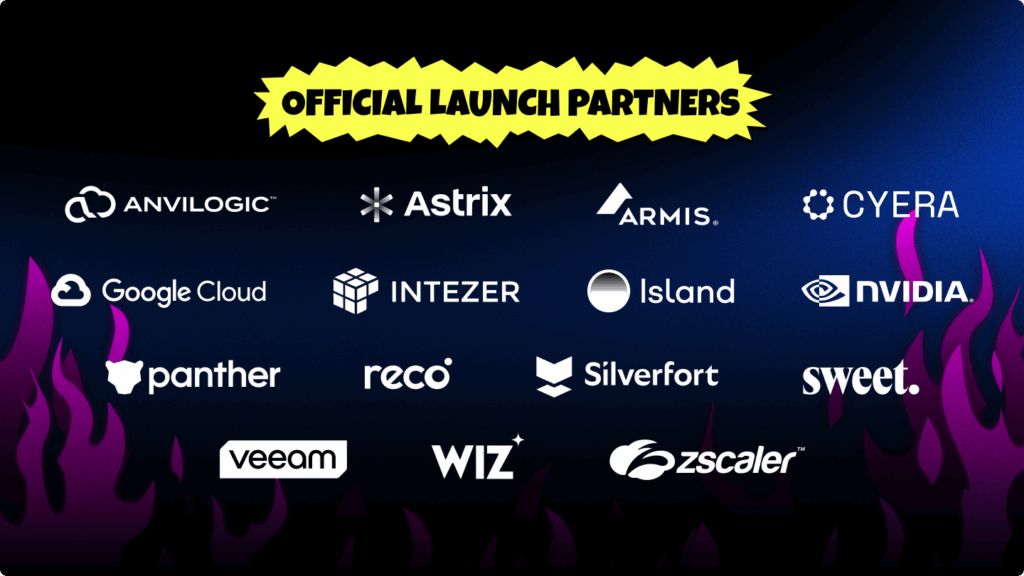
At Torq, we don’t believe in playing by the old rules. That’s why we’ve launched the Torq Alliance and Momentum Partners (AMP) program. It’s a bold new take on what a cybersecurity partnership can and should be. AMP is designed to accelerate SecOps innovation, eliminate red tape, and empower partners of all sizes to build, integrate, and grow.
Let’s be honest: most partner programs feel like gated clubs. Rigid tiers, “pay-to-play” models, and success metrics built for giants, not innovators.
With Torq AMP, there’s no tiering. No mandatory customer thresholds. No barriers to entry. What you build and how much effort you put into it matters. Whether you’re a two-person startup with a cool idea or an established leader reshaping a category, AMP gives you the tools and exposure to make it matter.
We’re looking for partners building the coolest, most impactful solutions and putting in the work to bring them to life.
Why Join AMP?
AMP is an ecosystem where innovation meets action. We’ve created a program that aligns technical creativity with meaningful business momentum, including:
Fast-track integration: You get your own Torq instance, hands-on support, and a clear path to go from concept to integration without unnecessary overhead.
Go-to-market that actually goes somewhere: From joint demos and field events to aligned sales plays and enablement, we work side-by-side to drive real pipeline.
Marketing with muscle: AMP partners tap into the full reach of the Torq brand, from strategic social promotion to presence in campaigns, solution briefs, the Torq platform, and yes, even custom swag.
And the best part? AMP is a living program. We don’t stop at launch. We keep building together — more use cases, content, and mutual value. The more you invest, the more you get back.
AMP in Action
Google Cloud + Torq: Powering Cloud-Scale Hyperautomation
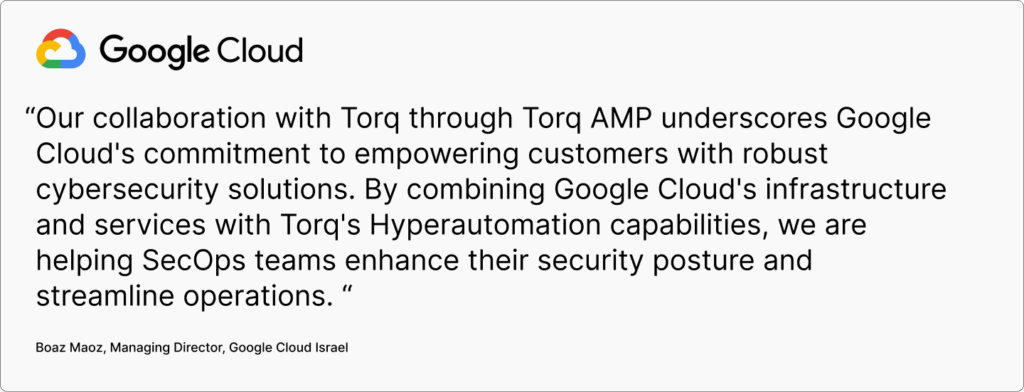
Torq’s integration with AMP Partner Google Cloud Platform (GCP) empowers customers to build workflows across Gmail, Drive, Workspace, and more. Google Cloud and Torq accelerate processes with seamless orchestration, rapid threat detection, and automated remediation at scale, making it easier than ever for SecOps teams to protect their cloud environments.
Wiz + Torq: Accelerating Cloud Risk Response
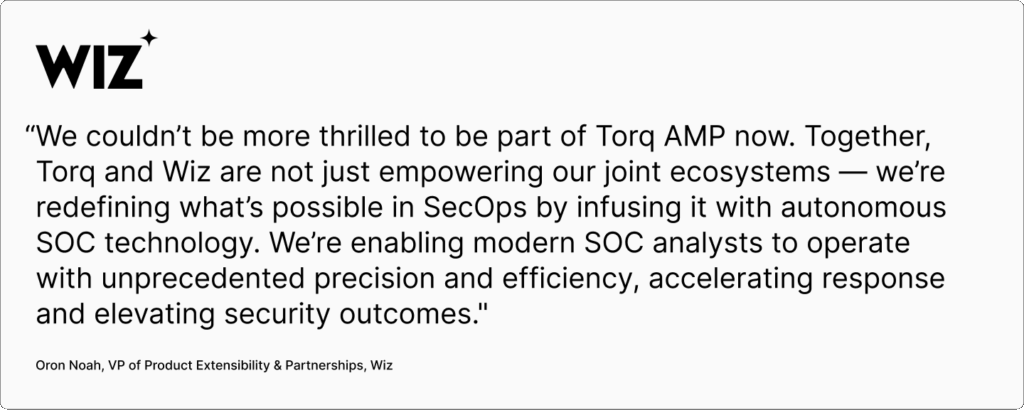
Torq’s integration with Wiz enables cloud-native security teams to automate proactive risk management with ease. Through Torq AMP, joint customers can trigger workflows directly from Wiz alerts and use no-code automation to remediate vulnerabilities, update issue statuses, and correlate cloud risk data with broader security operations. Together, Torq and Wiz accelerate threat detection and response across complex multi-cloud environments.
Get AMP’d
Cybersecurity innovation doesn’t need more red tape; it needs more momentum. That’s exactly what Torq AMP delivers.
If you’re building technology that could transform how SOC teams work, we want to hear from you. Let’s build it, ship it, and wow our mutual customers — together.
Explore the Torq AMP program and get ready to integrate with the most-talked-about company in cybersecurity.
Legacy SOAR solutions emerged in an era of traditional, static on-premises networks with fewer sophisticated threats. But today’s cybersecurity landscape is dramatically different — attack surfaces rapidly evolve, threats are multifaceted, and cybersecurity talent is increasingly scarce.
As organizations struggle with sprawling security stacks and burned-out SOC teams, legacy SOAR solutions reveal their significant limitations. One of the most critical weaknesses is their lack of support for the Secure Software Development Lifecycle (SSDLC).
The Evolution from SDLC to SSDLC
Every software application, from mobile apps to intricate enterprise solutions, follows a structured development process called the Software Development Lifecycle (SDLC). SDLC provides a systematic approach, covering requirement analysis, design, coding, testing, deployment, and maintenance. While it allows for systematic steps to ensure software quality and reliability, traditional SDLC often sidelines security until late stages in the software development process.
The growth of sophisticated cyber threats underscores the limitations of traditional SDLC. To address these gaps, the Secure Software Development Lifecycle emerged, embedding security practices at every stage of the development lifecycle. Unlike traditional SDLC, which prioritizes functionality and performance, SSDLC proactively addresses vulnerabilities and significantly reduces risk.
The Importance of Integrating SSDLC into Modern Development
Integrating SSDLC is essential for any organization serious about maintaining digital trust. Cyber threats continue to rise in complexity and frequency, making a security-first approach non-negotiable. The proactive, integrated model of SSDLC dramatically reduces vulnerability risks compared to traditional SDLC methods, which often rely on reactive, late-stage patching and inefficient security tests.
Transitioning to SSDLC signifies more than just a technical shift; it represents an organizational commitment to embedding security deeply into the culture and software development lifecycle, driving resilience, compliance, and long-term trust.
Where Legacy SOAR Fails: Lack of SSDLC Integration
SSDLC ensures that security considerations are seamlessly integrated throughout the entire software development lifecycle and automation workflows, reducing vulnerabilities before they become expensive, high-risk issues in production. However, legacy SOAR solutions typically:
Lack integrated tools and features specifically designed for SSDLC
Require substantial manual effort to verify that workflows meet security and compliance standards
Leave workflows vulnerable to potential security threats due to inadequate built-in security testing and checks
These gaps force organizations to invest considerable resources — both human and financial — to ensure automation workflows remain secure and compliant, resulting in higher operational costs and increased exposure to data breaches.
How Torq Hyperautomation Integrates SSDLC by Design
Unlike traditional SOAR solutions, Torq Hyperautomation™ inherently integrates SSDLC principles throughout its platform, ensuring security is embedded into every aspect of workflow development.
Built-in SSDLC Framework
Torq’s Hyperautomation platform offers a comprehensive framework that covers planning, software development, testing, deployment, and maintenance phases. Embedding secure software development into every step of automation ensures robust, compliant workflows.
Automated Testing and Continuous Validation
With Torq, rigorous automated testing is built into the workflow development process. These comprehensive tests check for:
Vulnerabilities: Continuous scanning and mitigation of security flaws.
Compliance adherence: Automatic checks aligned with industry standards and regulations.
Unlike legacy solutions, Torq’s automated tests are ongoing, not isolated to specific phases. This continuous validation ensures all workflow changes and updates remain secure and adhere strictly to best practices. Torq also integrates seamlessly with existing development tools, creating a unified and efficient workflow environment.
Environment Segmentation: Development, Staging, and Production
Torq allows security teams to separate workflow development into clearly defined staging and production environments. This enables controlled testing and refinement before workflows ever touch a live environment. By isolating workflows this way, Torq dramatically reduces the risk of security incidents and ensures smooth deployments.
Torq Hyperautomation also implements robust role-based access control (RBAC) by default. These stringent access controls ensure only authorized personnel can interact with specific functions, preserving workflow integrity and security.
Agile Workflow Development with Enhanced Security
Torq doesn’t just secure your automation workflows — it accelerates their development. Its intuitive, user-friendly interface empowers users of all technical skill levels to prototype, test, and refine workflows rapidly.
Torq’s iterative, agile-driven development process incorporates continuous feedback, ensuring automations remain effective and adaptive to evolving security requirements. This agile process far surpasses the capabilities of legacy SOAR platforms, enabling your organization to respond swiftly and confidently to new threats.
Hyperautomation is Essential for SSDLC
The future of software security demands an integrated, continuous SSDLC approach that seamlessly fits into an organization’s overall development strategy. Traditional SDLC approaches that defer security considerations are no longer viable in today’s rapidly evolving threat landscape.
Organizations adopting Torq’s Hyperautomation platform can confidently build security into the core of their development processes, ensuring their automation workflows remain robust and resilient against evolving threats. This continuous, integrated security approach positions organizations to maintain compliance, build digital trust, and sustainably mitigate risks.
Legacy SOAR solutions simply can’t keep up with modern cybersecurity demands. Their lack of built-in SSDLC support leaves critical gaps, resulting in higher costs, increased risks, and significant manual overhead. In contrast, Torq’s Hyperautomation platform is built from the ground up with security-first principles.
With automated SSDLC support, rigorous security checks, robust environment segmentation, and agile workflow development, Torq ensures automations are secure, compliant, and ready to handle today’s dynamic threat landscape.
Secure your organization’s future with Torq’s integrated SSDLC and Hyperautomation capabilities.
Managed security is a margin game. MSSPs live under strict SLAs and relentless alert volume — usually without proportional headcount growth. Traditional SOAR promised relief, but at multi-tenant scale it often becomes a cost center.
Industry reality backs this up: 80% of security pros say legacy SOAR is too complex, costly, and time-consuming, 92% say it demands scripting skills, and 90% say it needs heavy up-front investment to build playbooks. Meanwhile, the average enterprise runs 76 security tools — and MSSPs are expected to integrate with all of them for every customer.
What’s the fix? A scalable security automation platform that consolidates enrichment, correlation, case management, and automated remediation. Torq is not a SOAR. Torq is an AI SOC Platform that pairs the adaptability of agentic reasoning for complex, novel threats with the machine-speed execution of deterministic, rule-based Hyperautomation workflows for high-volume, repeatable tasks.
With Torq Hyperautomation, instead of pouring hours into brittle playbooks and manual triage, you can standardize cross-tenant workflows, automate Tier-1 at scale, and keep integrations healthy without constant rework. SLAs improve, analyst touches drop, and margins rise even as alert volume and tool sprawl grow.
Below, we expose five hidden SOAR costs that quietly erode MSSP margins and how Hyperautomation changes the economics from reactive and expensive to proactive and profitable.
Why Legacy SOAR Breaks MSSP Economics
Before we fix the margin math, we need to start by understanding why SOAR for MSSPs strains economics in the first place. Traditional SOAR platforms weren’t built for the scale and variability MSSPs face. Their monolithic architectures force every tenant to feel like a one-off deployment: custom environments, unique connectors, and per-client playbooks.
Growth means redeploying and maintaining entire stacks — not just scaling the parts that matter. This results in rising maintenance hours, higher change risk, surprise downtime, and shrinking gross margins per tenant.
If the operating model is the problem, the remedy is architectural. Enter Hyperautomation built for multi-tenant scale.
What Replaces SOAR: Hyperautomation for MSSPs
Torq Hyperautomation was built for MSSPs: multi-tenant by design, horizontally scalable, and event-driven. It delivers limitless integrations, intelligent case automation and prioritization, shared workflow libraries, and a team of AI Agents that can handle the grunt work. Tier-1 work is fully automated, Tier-2 becomes supervised (i.e. one-click approvals in chat), and high-risk actions stay human-in-the-loop — all with complete auditability.
The results are proven: 18× faster onboarding, 10× faster workflow creation, and up to 95% of Tier-1 alerts auto-investigated and enriched.
Most importantly, Hyperautomation shifts MSSP economics. With Torq, SOC leaders can directly track and improve MTTR/MTTA, alert suppression rates, analyst touches per case, onboarding hours per tenant, connector uptime, SLA credits, and gross margin per customer. The curves bend immediately: fewer manual touches, faster time-to-resolution, and consistently stronger SLA performance.
Let’s map how each hidden cost of SOAR shows up in the real world — and how Hyperautomation can fix it.
Hidden Cost #1: SLA Exposure and Penalties
SOAR was sold as “faster response,” yet MSSPs still juggle fragmented alerts, manual pivots, and rework. Every extra touch burns analyst time and risks SLA penalties. Missed MTTA/MTTR targets lead to SLA penalties and eroded customer trust, often caused by manual approvals and inconsistent response times.
How Torq helps: Resolution time is key to minimizing costly service penalties and increasing SOC efficiency. Torq automates Tier-1 triage, enrichment, and safe containment for everyday alerts — phishing, commodity malware, suspicious process trees, and impossible travel. Playbooks include timers, retries, and just-in-time approvals baked in, while every step and artifact is logged for defensible SLA reporting. MSSPs can quickly turn their top SLA pain points into automated flows that act instantly and escalate only when risk exceeds defined thresholds.
Hidden Cost #2: Legacy Security Environments
Every new tenant brings a unique blend of on-prem firewalls, legacy AV, multiple clouds, and niche SaaS. Onboarding devolves into endless script writing and one-off exceptions — “temporary” customizations become permanent snowflakes.
How Torq helps: Torq enables a template-first design approach, letting MSSPs build runbooks with tenant-specific variables and policy toggles. Hybrid connectivity options — from agentless APIs and secure tunnels to UI automation where APIs are missing — ensure MSSPs can onboard even the most complex tenant environments quickly and consistently.
Hidden Cost #3: Integration and Maintenance Tax
With SaaS security products multiplying, MSSPs struggle to keep integrations current, draining time and resources while limiting their ability to deliver baseline SOAR operations across global tenants.
How Torq helps: Torq’s native integrations, no-code customization, and containerized connectors eliminate integration bottlenecks. MSSPs can connect to virtually any system — internal or external — and scale orchestration across tenants without the ongoing integration tax of custom development and maintenance.
Hidden Cost #4: Alert Volume and Manual Triage
Scaling alert queues with more analysts is expensive and unsustainable. Relying on humans for every triage decision drags down ROI and creates inconsistent service delivery.
How Torq helps: Torq automates over 95% of Tier-1 alert handling, reducing manual workloads and slashing mean time to detect and respond. By eliminating repetitive triage tasks, MSSPs cut labor costs, improve gross margins, and give analysts space to focus on high-value investigations and customer needs.
Hidden Cost #5: Continuous Optimization and Reporting
Clients expect MSSPs not just to meet obligations, but to continually improve detection and response — while also delivering unified reporting across complex environments. This creates constant pressure to re-tune playbooks and validate workflows.
How Torq helps: Torq enables continuous optimization through Hyperautomation. MSSPs can orchestrate cross-tool workflows that evolve as client needs change, without requiring costly rebuilds or periodic manual evaluations. Reporting is built-in and mapped to compliance frameworks, giving clients the visibility they demand while reducing operational drag.
The Bottom Line for MSSPs
Legacy SOAR for MSSPs wasn’t built for today’s multi-tenant, API-driven, high-SLA reality. Its hidden costs show up as onboarding delays, brittle integrations, analyst burnout, and margin leakage you can’t explain away at QBRs.
Hyperautomation changes the SOC narrative: correlate once, enrich once, execute safely at scale, then repeat that win across every tenant without spawning “snowflake” workflows. The result is tighter MTTA/MTTR, fewer analyst touches per case, healthier SLA performance, and gross margins that improve as you grow, not the other way around.
Retail cybersecurity teams face a perfect storm: high-volume, low-signal alerts, a massive surface area across stores, POS systems, cloud apps, and third-party vendors, and an environment where any delay in response can lead to reputational and revenue damage.
Yet most retail SOCs are held back by aging infrastructure and brittle tools. Alert fatigue, false positives, and manual workflows turn shifts into chaos. Legacy SOARs aren’t helping; they’re often the problem.
To survive and scale, retail SOCs need automation that’s fast to deploy, easy to use, and flexible enough to handle diverse systems and real-world incident volume. That’s Torq Hyperautomation™. Valvoline faced these exact challenges — and overcame them — by replacing their brittle legacy SOAR with Torq, transforming their SOC in just one week.
Retail SOC Cybersecurity Challenges
Retailers handle massive volumes of customer data, making them prime targets for cybercriminals. At the same time, they face growing IT complexity across stores, e-commerce platforms, and third-party vendors. Legacy systems, minimal in-house resources, and constant alert fatigue make defending against modern threats increasingly difficult.
Top retail threats include:
Phishing and social engineering: Used to steal customer credentials or launch broader attacks.
Ransomware: Often triggered by phishing, disrupting business operations and demanding costly ransoms.
Third-party & IoT risks: Unsecured vendors and smart devices expand the attack surface dramatically.
Credential attacks: From fake accounts to credential stuffing, bots wreak havoc on authentication systems.
DDoS and web exploits: Automated attacks can bring down retail systems and erode customer trust.
To stay resilient, modern retail SOCs need security automation that neutralizes threats faster than attackers can exploit them, without increasing analyst burden.
Hyperautomation: A Better Way to Automate the Retail Industry
When Corey Kaemming became Senior Director of InfoSec at Valvoline, he inherited a challenge familiar to many security leaders: Legacy SOAR that broke more than it built. His SOC had been cut in half during a major divestiture, and their deeply customized, brittle SOAR couldn’t keep up. Only a few SMEs could operate it, and everyone else was blocked.
“We needed a platform that didn’t require hard-to-find coding skills. Our SOAR was slowing us down, not scaling us up,” Corey shared. What followed was a full transformation of Valvoline’s security operations — one powered by Torq Hyperautomation™ for automation in retail.
How Valvoline Hyperautomated Their SOC
Valvoline put Torq to the test in a head-to-head proof of value. Within 48 hours, they were live. Within a week, they were running real automation in production.
Their Rapid7 integration, which had stalled for hundreds of hours in their SOAR, was live in less than a week in Torq.
Phishing triage, once eating up to 12 hours per day, became a fully automated workflow, slashing workload by 6–7 analyst hours daily.
Containment actions — password resets, session terminations, and more — became automatic, logged, and auditable via Torq’s built-in case management.
Non-developers could use no-code/low-code drag-and-drop workflows, which made it easy for anyone on the team to contribute.
“Torq takes the vision that’s in your head and actually puts it on paper and into practice.”
Corey Kaemming, Senior Director of InfoSec at Valvoline
From Reactive to Proactive: The SOC of the Future
With Torq, retail companies like Valvoline can move from reactive response to a strategic focus.
Anyone can build: Drag-and-drop workflows let even non-developers create automation.
Analysts reclaim their time: Repetitive Tier-1 tasks became automated, eliminating alert fatigue.
Response becomes instant: Clicking a malicious link now triggers a fully automated incident response workflow — no manual intervention required.
Case management got smarter: Built-in automation tracks every action and provides rich incident metrics.
Why Retail SOCs Are Turning to Hyperautomation
Torq isn’t just a better product — it’s a better partner.
From onboarding to enablement, SOC teams are supported by a dedicated Customer Success Manager, Solutions Architect, and content resources at every step. And because Torq is built for scale, Valvoline is now expanding automation to adjacent teams like identity and fraud.
What once took weeks or months now takes days. The Valvoline team is delivering more value with fewer resources — and doing it without waiting on developers or vendors.
Torq Hyperautomation gave Valvoline the speed, flexibility, and confidence they needed to scale security without scaling burnout. Within 48 hours, they were live. Within a week, they were automated. And, they’re just getting started with all that they can do with Torq.
See how Valvoline replaced legacy SOAR, automated phishing triage, and transformed their retail SOC in just one week with Torq Hyperautomation.
Patrick Orzechowski (also known as “PO”) is Torq’s former Field CISO, bringing his years of experience and expertise as a SOC leader to our customers. PO is a seasoned security veteran with a deep understanding of the modern security landscape. You can find him talking to SOC leaders and CISOs from major brands at cybersecurity events around the world.
Running a SOC isn’t for the faint of heart. I should know. Late nights, understaffed teams, endless alerts, and jumping from tool to tool — all fueled by a probably unhealthy amount of energy drinks? Yeah, I’ve been right there in the trenches. And let’s face it: the old SecOps playbooks can’t scale in the face of modern SOC challenges.
The SOC best practices below are the hard-won lessons that separate the security operations centers that struggle to keep up from the ones that position themselves as strategic value centers.
Level Up Your SOC: Best Practices to Stay Sharp and Secure
A Security Operations Center (SOC) brings together people, processes, and technology to manage and improve an organization’s security posture. Put simply, it’s the command center for protecting a business from cyber risk and threats.
In a world where a single data breach can cost millions, an efficient SOC isn’t a luxury — it’s a core business function. An effective security operations center can significantly reduce an organization’s risk by identifying, analyzing, and responding to cybersecurity incidents in near real-time, or better yet, finding and mitigating vulnerabilities before they ever become an incident.
When I ask security operations center leaders the “why” behind the way they built their SOC, most mention that it’s to:
Proactively prevent cybersecurity incidents by detecting and fixing vulnerabilities, security monitoring, and gathering threat intelligence on known threats.
Minimize the impact of data breaches by rapidly containing incidents and minimizing their impact on the organization.
Ensure business continuity by protecting critical assets and data so business operations can continue without interruption.
At the end of the day, all of these drive up to the ultimate goal of a SOC: reducing risk to the business.
5 Most Common SOC Challenges
If you run an SOC, these challenges probably keep you up at night. They’re not just headaches — they’re fundamental risks to your security posture.
1. Alert Fatigue
Alert fatigue is more than just “too many alerts” — it’s a soul-crushing onslaught of low-fidelity noise and false positives that buries the critical alerts that matter. While the cybersecurity industry is a bit of a broken record around alert fatigue, it doesn’t change the fact that most teams are still struggling with it — more than half of security teams say false positives are a huge problem, and nearly two-thirds are overwhelmed by sheer data volume. Alert fatigue burns out already stretched-thin SOC teams, delays threat detection and incident response, and increases the risk of missed threats.
2. Tool Overload
Too many security operation centers I see have sprawling security stacks of disconnected tools that don’t play nice. Security analysts waste precious time swiveling between different UIs and even writing clunky PowerShell or Python scripts to gather information, trying to solve a puzzle with pieces from different boxes.
3. Manual Processes
In 2025, there’s simply no need for human SOC analysts to be manually copy-pasting information from one tool to another to build a case. These repetitive, mind-numbing tasks are slow, prone to human error, and a complete waste of your team’s valuable expertise.
4. Talent Shortage
Finding and retaining top-tier security talent is brutally competitive. The shortage is real, and it means you can’t just throw more people at the problem (especially when budgets are lean). You have to make the team you have exponentially more effective. A crucial part of that is keeping your SOC analysts engaged — automating mundane tasks takes tedious work off their plates, which directly increases morale, boosts productivity, and gives your best talent a reason to stay.
5. Scalability Issues
The volume of data from cloud environments, SaaS applications, and distributed endpoints is exploding, and the security perimeter is larger than ever. A SOC built on manual processes and disjointed tools simply cannot scale to meet this demand. As your business operations — and your attack surface — grows, your security coverage will fall further and further behind unless you start automating.
6. The Ransomware Time-Bomb
Today, every organization of any size is a target for ransomware, and ransomware operators are moving at unprecedented speed, with a median time from initial breach to business-ending payload of less than 24 hours. This breakneck pace demands an immediate and flawless response that is nearly impossible to deliver with manual processes.
7 Security Operation Center Best Practices
Since I started at Torq, I’ve heard the same story from CISOs over and over — they’ve finally reached a tipping point with tech sprawl. They’re looking at unwieldy, expensive security stacks and asking the hard questions: Are these dozens of tools actually making us more secure, or are they just burning out our security analysts and our budget?
This is leading to a massive push for real SOC transformation. The smartest leaders I talk to are no longer content with running a reactive cost center that just cleans up messes. They’re determined to build a proactive, data-driven value center that anticipates cyber threats and demonstrates clear ROI, often by replacing ten disjointed tools with three or four that work together. But getting there requires a fundamental shift in strategy.
The following security operations center best practices are the playbook for that transformation.
1. Build a Strong Foundation with the Right People and Processes
Stop hiring bodies and start building a team. Move from generalized security playbooks to methodical runbooks that combine your security analysts’ expertise with strategic automation and AI augmentation.
2. Prioritize Threat Detection and Response to Your Business Needs
It’s key to shift your team’s focus from managing alerts to actively hunting cyber threats. But with the sheer volume of today’s alerts pinging from sprawling stacks and an explosion of endpoints, the only way to free them up is by leveraging automation and AI to handle the majority of your Tier-1 alerts.
3. Automate the Mundane, Focus on the Critical
Automating repetitive and time-consuming tasks allows your limited resource of human expertise to be focused on more strategic activities, such as threat hunting and investigating complex and critical cases.
4. Embrace Continuous Improvement
The most overused wording in cybersecurity think pieces is probably “the constantly evolving threat landscape,” but the truth still stands. To keep up, SOCs must continuously improve their processes and technologies, which means regularly reviewing and updating security policies, tools, processes, and procedures, tracking and reporting KPIs, and being able to slice and dice case data to pinpoint problem areas.
5. Measure Everything
If you can’t measure it, you can’t fix it. Mean time to investigate, respond, and remediate aren’t vanity metrics — they are the vital signs of a SOC. When you can show your CISO that Hyperautomation slashed MTTI from hours to minutes (like this top 30 U.S. bank did), you’re no longer talking about a cost center; you’re talking about tangible, provable ROI.
6. Be Strategic About AI
AI is the biggest buzzword in security right now, with every vendor promising it can solve all of your problems. But it’s not a magic wand — and there’s a whole lot of AI-washed marketing out there right now. The real power of AI in the SOC is leveraging it to automate away the noise and grunt work and accelerate incident response, so your human SOC analysts can hunt cyber threats and handle complex incidents. And if an AI solution can’t prove its logic with evidence, it’s a black box that will kill trust and has no place in your SOC. See how to deploy AI in the SOC the right way.
7. Consolidate and Optimize
True optimization isn’t a “lift and shift” of your old, inefficient workflows to a new platform — it’s about fundamentally transforming your processes. Torq helps customers escape the tech debt of legacy SOAR by replacing dozens of brittle, code-heavy workflows with a handful of powerful and efficient automations built easily in Torq.
When migrating off a SOAR, Torq customers consistently consolidate their processes, achieving the same outcomes with significantly fewer and more efficient automations, often slashing their workflow count by 30% or more. Get the SOAR migration guide.
The Best SOC Tools
You can’t win today’s fight with yesterday’s technology. What’s the core solution you need to build a modern, autonomous SOC?
Torq HyperSOC
HyperSOC™ is the AI-driven platform I wish I had years ago. Designed specifically to crush the biggest challenges SOCs face, HyperSOC uses powerful, no-code automation to become the connective tissue for your entire security stack, so your cases are managed out of a single interface, and agentic AI autonomously handles 90% of Tier-1 case work.
Here’s how HyperSOC incorporates critical SOC best practices, built in:
Automates alert triage: HyperSOC ingests the flood of alerts across your stack, using automation and AI to add context, dismiss false positives, and group related alerts into a single, actionable case. It cuts through the noise so your team only sees what truly matters.
Connects your security tools: Torq has hundreds of pre-built integrations to instantly connect your SIEM, endpoint detection and response (EDR), threat intelligence, ticketing, and communication platforms into seamless, automated workflows.
Uses no-code, low-code, and AI-generated workflows: With Torq, you don’t need a team of developers to build complex automations. Torq’s drag-and-drop and AI-generated workflow-building capabilities mean anyone can create automations to handle everything from phishing investigation to endpoint containment.
Supports human-in-the-loop actions: Any AI deployed in the SOC needs to be transparent to be trustworthy. Torq makes it easy to inject human decision points into any AI workflow. Torq’s AI SOC Analyst Socrates can automatically investigate and enrich a case, then present it to a security analyst in Slack or Teams for a final decision on a critical action.
The Foundation for Transformation: Why SOC Best Practices Matter
The days of running a SOC on manual processes and sheer willpower are over. The only way to win against fast, AI-powered adversaries is to fight back with smarter, faster automation. By following security operations center best practices like prioritizing automation, empowering your team with the right tools, and quantifying outcomes through metrics, you can transform your SOC into a strategic value center.
Torq HyperSOC was designed specifically to automate and orchestrate modern SOC operations at scale. Want to learn more about how HyperSOC can help your security operations center get a whole lot more done, a whole lot faster?
Get the SOC Efficiency Guide packed with insights from my years in the trenches as a SOC leader.
The big ones haven’t changed much, but they’ve gotten worse: alert fatigue from overwhelming volumes of low-fidelity alerts, tool sprawl creating “swivel chair syndrome” where analysts waste time jumping between disconnected UIs, talent shortages making it impossible to hire your way out of the problem, and scalability issues as cloud adoption explodes the attack surface faster than teams can keep up. Add ransomware operators moving at unprecedented speed, and you’ve got a recipe for burnout and missed threats.
How does automation benefit SOC operations?
Automation isn’t about replacing analysts — it’s about stopping the waste of human expertise on tasks machines can do faster and more consistently. The real benefits: dramatically faster response times (seconds vs. hours), elimination of human error in repetitive tasks, consistent execution of runbooks regardless of who’s on shift, and freed-up analyst capacity for threat hunting and complex investigations. The SOCs we see thriving are the ones where automation handles 90% of Tier-1 work so humans can focus on the 10% that actually requires judgment.
What tools are essential for SOC efficiency?
At minimum: a SIEM for log aggregation and correlation, EDR for endpoint visibility and response, threat intelligence for context, and a case management/ticketing system for tracking investigations. But here’s the thing — having the tools isn’t enough. The magic happens when they’re connected. That’s where a Hyperautomation platform like Torq comes in: it becomes the connective tissue that lets your SIEM, EDR, IAM, threat intel, and ticketing systems actually work together without analysts manually bridging the gaps.
How does Torq integrate into a SOC?
Torq sits at the center of your security stack, connecting to your existing tools via hundreds of pre-built integrations — SIEM, EDR, IAM, email security, cloud platforms, ticketing, collaboration tools, and more. It doesn’t replace your tools; it makes them work together. Alerts flow in from any source, get enriched automatically, and either get handled autonomously by AI or get routed to analysts with full context already attached. The implementation is fast (days to weeks, not months) because Torq’s no-code and AI-generated workflows don’t require a dev team to build and maintain.
How do I measure SOC performance?
The metrics that matter: Mean Time to Detect (MTTD), Mean Time to Investigate (MTTI), Mean Time to Respond (MTTR), and Mean Time to Remediate. Track alert volume vs. cases created (your noise-to-signal ratio), false positive rates by source, cases handled per analyst, and SLA compliance. But don’t just measure — act on it. If a particular alert source generates 90% false positives, fix the detection logic or auto-dismiss it. If MTTR is climbing, figure out where the bottleneck is. Metrics should drive continuous improvement, not just populate dashboards.
When a cyberattack occurs, every second counts. Metrics like Mean Time to Detect (MTTD) and Mean Time to Respond (MTTR) are critical benchmarks in cybersecurity, helping organizations evaluate the effectiveness of their Security Operations Centers (SOCs). But what’s the difference between MTTD vs MTTR, and why do they matter?
Understanding and improving these metrics through strategic investments in security automation can significantly elevate your security posture, minimize damage, and keep your organization safe from threats.
MTTD vs. MTTR in Cybersecurity
Mean Time to Detect and Mean Time to Respond are both fundamental KPIs in cybersecurity, but each measures something distinct.
MTTD (Mean Time to Detect) measures the average time it takes your team to identify that a security incident has occurred. This metric primarily evaluates your monitoring and detection capabilities. A lower MTTD indicates your security stack can quickly recognize anomalies and suspicious activity.
MTTR (Mean Time to Respond) (sometimes called Mean Time to Resolve) tracks the average time required to respond to and resolve an incident fully. Speed matters; a recent SANS survey found that 33% of teams take hours to respond to threats. That’s too long. A shorter MTTR reflects strong incident response procedures and an agile, responsive security team.
MTTR often involves people and a series of steps that are needed to fix the issue. While MTTD may measure how well an automated alert system performs, MTTR often measures both your systems and the people you depend on to jump into action after an incident.
Together, these metrics illustrate your SOC’s maturity and operational effectiveness. Optimizing MTTD and MTTR directly reduces risk and overall damage from cybersecurity incidents.
How Automation Improves MTTD and MTTR
Security automation plays a pivotal role in dramatically enhancing both MTTD and MTTR, empowering security teams to scale detection and response effectively by:
Improving detection: Automated systems like SIEM, EDR, and XDR can swiftly correlate vast data sets, instantly surfacing anomalous activities. Automation reduces reliance on manual log analysis, ensuring immediate, accurate threat identification.
Accelerating response: Automation streamlines and accelerates incident response workflows. Tasks like enrichment, analysis, and containment that typically consume significant analyst time become nearly instantaneous. Automation eliminates the manual “grunt work,” allowing analysts to focus solely on complex or high-risk situations.
Reducing human error: With agentic AI handling the automation, repetitive tasks become consistently executed according to predefined procedures, drastically reducing the potential for mistakes and inconsistencies in handling security incidents.
Seamless integration: Hyperautomation platforms integrate seamlessly with SIEM, EDR, and XDR tools, delivering rapid data exchange, correlation, and enriched context. This tight integration creates an end-to-end, automated security ecosystem.
In short, automation significantly shrinks the time between detecting a threat and mitigating its impact, providing an immediate, measurable boost to your SOC performance.
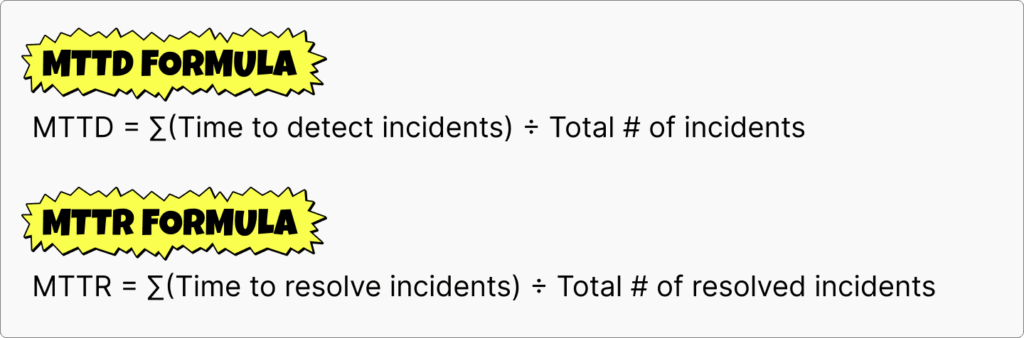
How to Measure MTTD & MTTR (with Formulas)
Quantifying your incident response effectiveness requires clear measurement methods. Here’s how you calculate each:
Below is some practical guidance for measuring MTTD and MTTR:
Consistent tracking: Record timestamps at every key incident stage (i.e., detection, acknowledgment, investigation, and resolution).
Aggregate metrics: Regularly aggregate these timings to spot trends or inefficiencies in your process.
Benchmarking: Establish baseline metrics to evaluate the impact of new tools, processes, or automation investments.
5 Related Incident Response Metrics You Should Know
MTTD and MTTR don’t exist in isolation. They are part of a broader landscape of incident response metrics that security teams should be tracking, including:
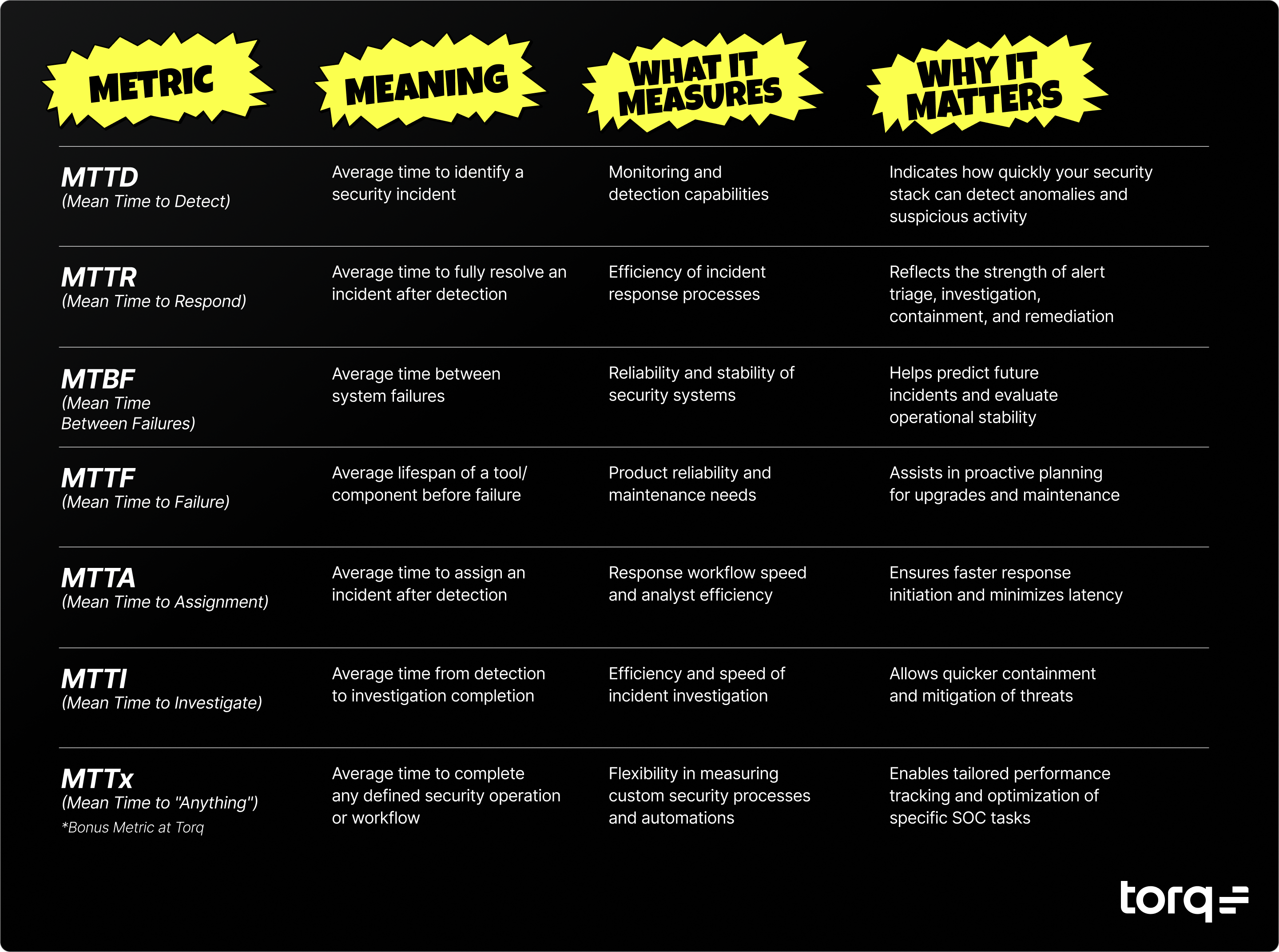
MTBF (Mean Time Between Failures): MTBF measures the average time between system failures. It’s useful for evaluating the reliability of security systems and predicting when future incidents might occur. A higher MTBF indicates stable security operations.
MTTF (Mean Time to Failure): MTTF tracks the average lifespan of a security tool or system component before a failure occurs. It’s commonly used to assess product reliability and helps organizations schedule proactive maintenance or upgrades.
MTTA (Mean Time to Assignment): MTTA is the average time it takes for an incident to be assigned to a specific analyst or team member after detection. Lower MTTA reduces response latency and enables teams to tackle threats more efficiently.
MTTI (Mean Time to Investigate): MTTI represents the average time taken from initial detection until the investigation is completed. Faster MTTI means threats can be understood and contained sooner, limiting potential damage.
MTTx (Mean Time to “Anything”): MTTx is a flexible metric used at Torq to track the average time to complete any defined security operation or workflow. It helps SOC teams measure efficiency across custom actions, automations, or specific tasks unique to their security processes.
Understanding these related metrics provides deeper insight into your security operations and helps identify specific bottlenecks or areas for improvement.
Key Incident Response Metrics Explained
The Hyperautomation Domino Effect in Incident Response
Improving MTTD and MTTR isn’t just about moving faster; it’s about removing the friction between each phase of the incident response lifecycle. Torq Hyperautomation connects the dots across the entire workflow — from detection to assignment, investigation to remediation — creating a seamless chain reaction of automation that compounds every efficiency. Here’s how that automation domino effect plays out in practice:
Faster detection (MTTD): Torq reduces noise by automatically filtering out low-priority alerts and surfacing real threats faster. This shrinks MTTD and ensures analysts aren’t wasting time chasing false positives.
Faster assignment (MTTA): Once a threat is detected, a case is immediately built and assigned to the right resource within Torq’s intelligent case management dashboard. Torq decides in real time whether Socrates — the AI SOC analyst that offloads 90%+ of Tier-1 cases — or a human should take the lead, dynamically reassigning ownership if the threat escalates. That means alerts don’t sit in limbo, waiting to be noticed.
Faster investigation (MTTI): By the time an analyst gets involved, much of the work is already done. Torq HyperSOC automatically enriches and correlates incident data, while AI agents generate case summaries and assign relevant case runbooks. This allows analysts to dive straight into meaningful analysis, not manual triage.
Faster response (MTTR): Response time is reduced by how quickly and efficiently action is taken. Analysts can trigger remediation with a single click or let Socrates respond autonomously in milliseconds. Whether isolating a device, disabling a user, or launching a complex remediation strategy, action happens at machine speed.
Each improvement compounds the next, like dominoes falling one after another. The faster a threat is detected and assigned to the appropriate resource, the faster those resources can be actioned. With Torq Hyperautomation, every second saved is multiplied across the incident lifecycle, delivering exponential gains in speed, accuracy, and scale.
Reduce Your MTTD and MTTR with Torq Hyperautomation
Effectively managing cybersecurity threats requires fast detection and even faster responses. Clearly differentiating MTTD vs. MTTR and understanding related metrics like MTBF, MTTF, MTTA, and MTTI enables SOC teams to target improvements strategically.
The Torq Hyperautomation™ platform offers a proven way to dramatically lower both MTTD and MTTR through real-time incident detection, streamlined automated workflows, and reduced analyst workload. Torq helps organizations minimize alert fatigue, decrease caseload per analyst, and improve overall compliance and efficiency.
Ready to drastically reduce your MTTx? Get practice advice from our Field CISO on how to make your SOC more efficient.
If you’ve been in cybersecurity longer than five minutes, you know one thing: legacy SOC architecture isn’t just showing its age — it’s creaking under the weight of today’s threats.
Cybersecurity analyst Francis Odum nailed it when presenting at Torq’s SKO 2025: “Legacy SOAR assumed everything starts in the SIEM. Now, teams connect automation directly to EDR, email, and identity systems.”.
This antiquated SOC architecture model, where every alert and log file is funneled into a Security Information and Event Management (SIEM) solution for analysis, is too slow, too rigid, and creates too many bottlenecks to support today’s exploding security event and data pipeline. Modern SOCs need speed, scalability, and a level of intelligence that legacy architecture simply cannot provide. They need a new approach that is purpose-built for the AI era.
What is AI SOC Architecture?
AI SOC Architecture
AI SOC architecture is a modern, AI-augmented design for SOCs that decentralizes data processing, automates low-level tasks, and enables agentic systems to proactively investigate, triage, and respond to threats.
AI SOC architecture is not just about adding AI to the stack — it’s about re-architecting the stack around AI. The traditional SOC model relies on aggregating data into a centralized point of analysis before taking action. In contrast, the AI SOC places agentic, AI-powered Hyperautomation at the center of operations — integrating directly with data lakes, security tools, and workflows to create a unified, AI-native control plane. This architecture ensures a single source of AI truth, distributed evenly across the entire security stack.
Shifting the SOC Foundation
“Architecture is changing. Automation tools like Torq are being plugged directly into FDR and identity systems — not after the SIEM, but before it.”
For years, the SOC has been centered around the SIEM. Disparate security vendor solutions would feed hundreds of thousands of logs, events, and alerts into the SIEM for security analysts to manually parse through, correlate, and eventually return to the respective point solution(s) to begin the remediation process. This model created a lot of friction, leading to several chronic problems, including:
Process debt: This process would cause what we in the biz call “swivel chair syndrome,” as it often isn’t as simple as a single straight line from detection to SIEM to remediation. Instead, the lengthy investigation had analysts swiveling back and forth between the SIEM and security tools several times before reaching a conclusion hours later.
Central bottlenecks: While a centralized approach to security event management once seemed favorable, SIEM solutions were not designed for the volume of data produced by the multi-cloud environments that organizations have built — let alone the deployment of AI to help alleviate the manual filtering of that data. This creates a massive data bottleneck and, worse, a single point of failure for the SOC to rely upon.
Reactive, delayed response: In addition to scalability concerns, this is also a largely reactive approach, requiring analysts to use the SIEM to begin the manual investigation process long after an incident occurs. This slows down critical SOC reporting metrics like Mean-Time-To-Detection (MTTD) and Mean-Time-To-Response (MTTR). Legacy SOAR solutions attempted to solve this problem but did not promise faster orchestration or response times due to limited and inflexible automation playbooks.
Between sifting through an overwhelming amount of logs in a centralized SIEM solution and battling the manual efforts of legacy SOAR automation, security analysts find themselves drowning in disconnected alerts and burning out at an alarming rate.
An AI SOC architecture flips this on its head, shifting the SIEM further left in the security event lifecycle, particularly as many organizations continue to adopt a multi-SIEM strategy to offset increasing storage costs from legacy SIEM vendors.
Gartner’s recent Reference Architecture Brief: SIEM-Centric Security Operations report points out that as the industry largely shifts away from legacy SOAR solutions, it is seeing more advanced capabilities come from platforms centered around AI SOC Analysts, which produce stronger outcomes for analyst augmentation and security automation.
What Does AI-Native SOC Architecture Look Like?
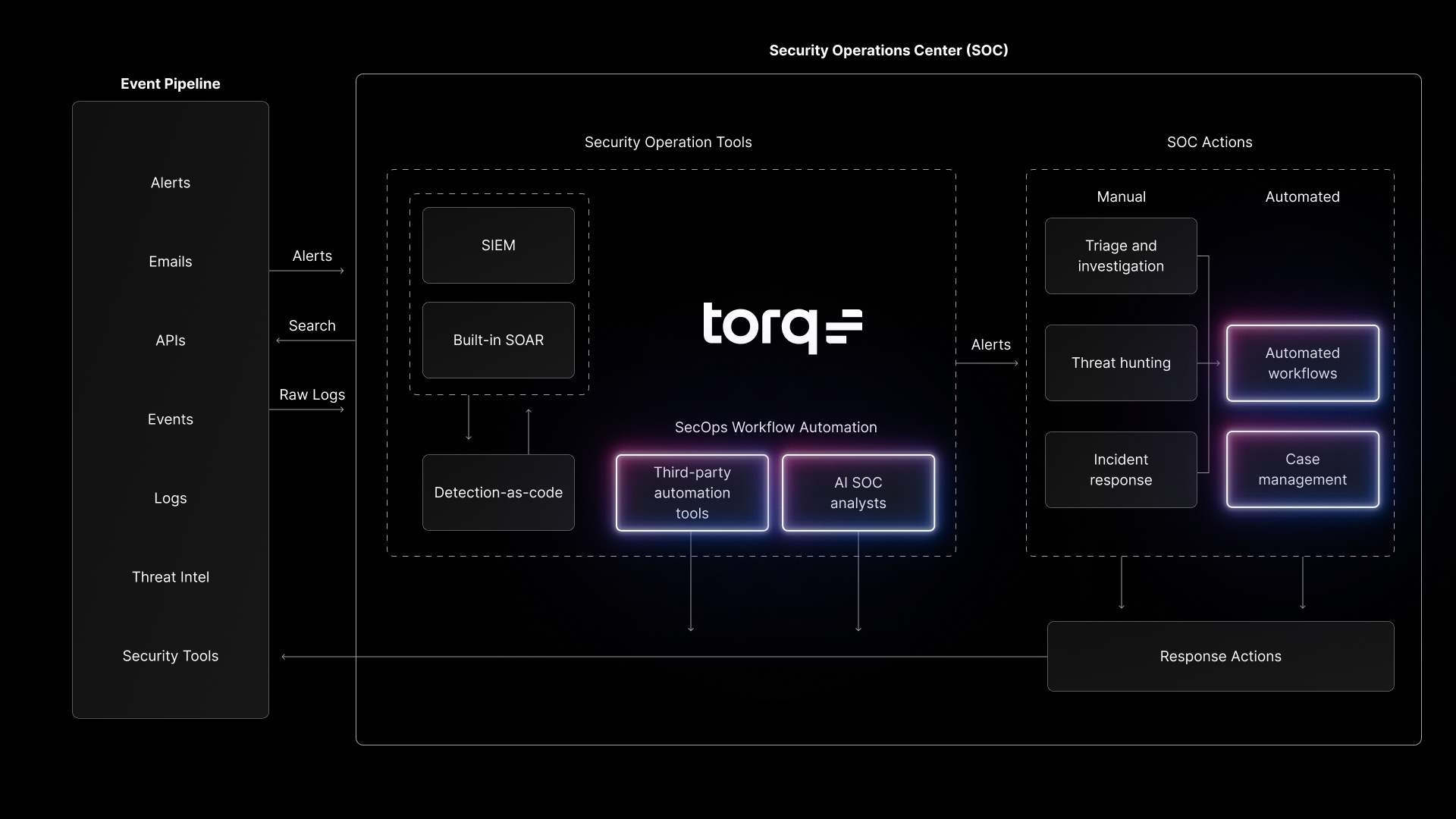
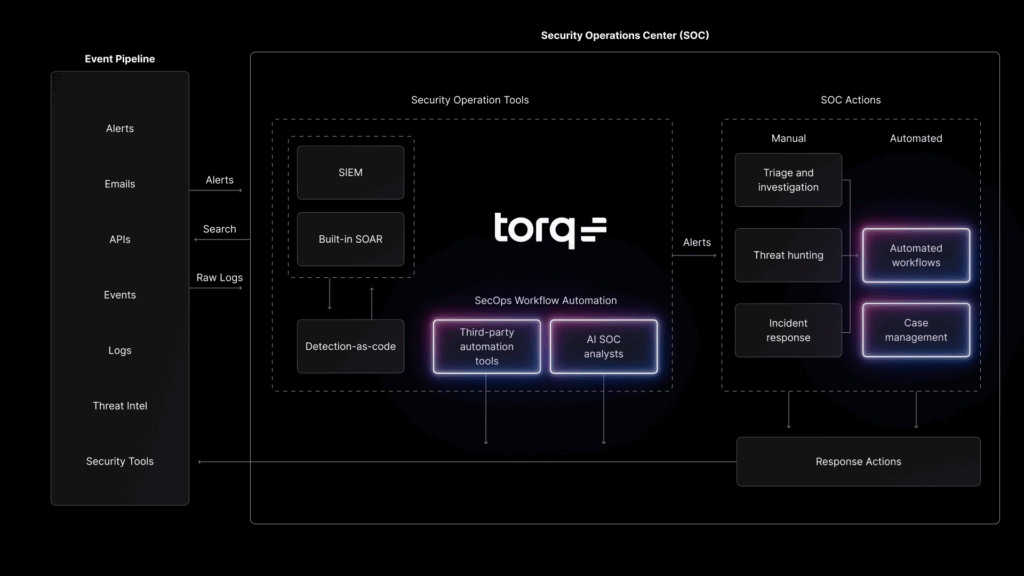
In the same report, Gartner breaks down the Security Operations Center architecture into two distinct components: Security Operations Tools (e.g., SIEM and Detection-as-Code solutions) and SOC Actions (e.g., manual triage, investigation, threat hunting, and response via the SOC Team). Gartner calls out SecOps Workflow Automation, which consists of third-party automation and AI SOC analysts, bridging the gap between these two pillars of the SOC.
This is the heart of the AI-native SOC Architecture — a foundation of agentic AI and Hyperautomation built for the modern cloud-first SOC environment and designed for simplicity, extensibility, and scale.
Torq unifies security tools with AI SOC analysts and Hyperautomated workflows — streamlining triage, case management, and incident response.
Agentic AI
Agentic AI sits at the core of the AI SOC architecture. Rather than burdening human analysts with manually piecing together thousands of logs and events, an AI-native SOC leverages a multi-agent system (MAS) to handle up to 90% of Tier-1 security analysts’ tasks. These specialized AI agents have a deep understanding of the SOC environment, allowing them to plan incident response, make complex decisions, and take remediation actions autonomously.
Hyperautomation
Hyperautomation is the engine that drives autonomous response and the glue that connects agentic AI with the rest of the SOC solutions to bridge the gap between Security Operations Tools and SOC actions. With limitless no-code or AI-generated integrations, the Hyperautomation engine is the delivery system allowing agentic AI to take action, automating anything from simple alert triage to complex, multi-step incident responses.
Enterprise-Grade Security Architecture
Unlike monolithic legacy SIEM and SOAR solutions, an AI-native SOC architecture is built for cloud-first scalability and flexibility. Underpinned by an extensible security architecture, horizontal and elastic scalability allows the SOC to dynamically process and prioritize hundreds of thousands of events from various data sources, ensuring the most critical information is surfaced without interruption.
Torq’s AI SOC Architecture
Torq is built for this moment. It’s not about retrofitting AI into a legacy architecture — Torq is an enterprise-ready, AI-native platform purpose-built from the ground up to solve existential SOC challenges like alert fatigue, tech sprawl, and analyst burnout.
Torq’s AI SOC architecture begins with the ability to integrate with any solution across the entire security stack and beyond — whether it’s EDR, IAM, email phishing, threat intelligence, collaboration and communication tools, and more.
This direct integration enables agentic AI to not only take autonomous remediation actions across Tier-1 and Tier-2 security use cases but also allows AI agents to retrieve and enrich data directly from the source, regardless of what data may be missing (or difficult to find manually) from SIEM logs. As the modern SOC scales to produce tens of thousands of alerts per day, Torq’s AI-SOC architecture can seamlessly handle massive alert volumes without creating single-point bottlenecks.
HyperSOC™
Torq HyperSOC, the AI-powered autonomous SOC solution, was also explicitly designed to support AI deployment across the modern SOC. While legacy SOAR solutions have bolted-on workarounds to handle case management once an analyst has manually pulled the relevant data from a SIEM tool, Torq HyperSOC is comprised of intelligent case management and Socrates, the agentic AI SOC Analyst, embedded directly in each security case. Socrates summarizes key findings, suggests next steps, and analyzes case runbooks for autonomous remediation.
The Multi-Agent System
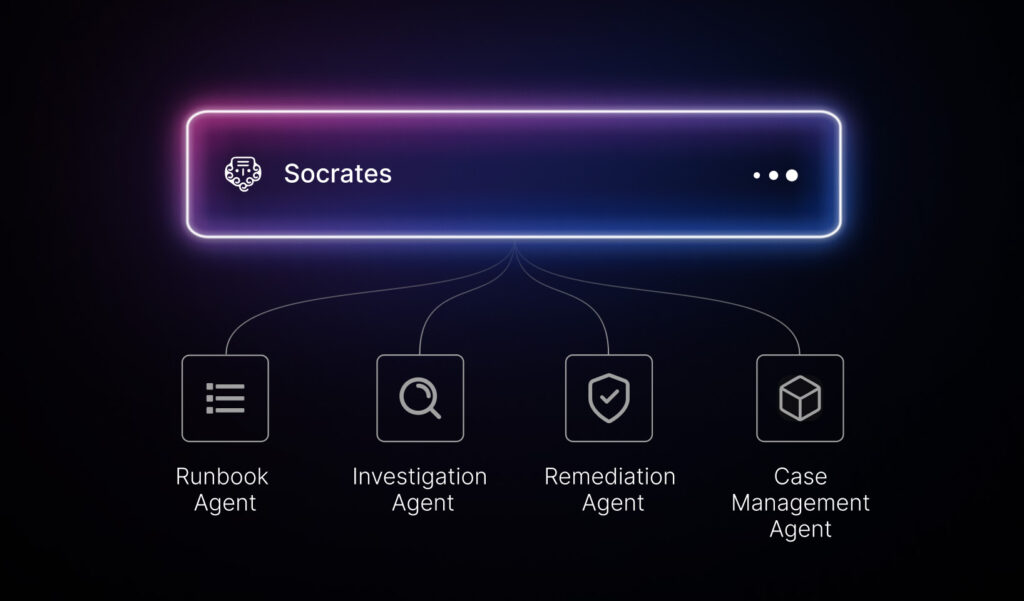
Socrates coordinates Torq’s multi-agent system, a team of AI Agents that can autonomously handle the vast majority of Tier-1 and Tier-2 use cases, reduce human analysts’ workload by over 95% from initial investigation to final remediation, and enable SOC teams to tackle up to 5x more security cases in a single day without adding headcount.
Socrates leads Torq’s multi-agent AI system, autonomously resolving cases, reducing analyst workload by 95%, and enabling SOC teams to handle 5x more incidents daily.
Model Context Protocol
To help Torq’s system of AI agents communicate reliably across a limitless amount of integrated security tools and other AI solutions deployed in the SOC, Torq’s AI SOC architecture also natively supports Model Context Protocol (MCP), an open protocol designed to standardize how applications provide context to AI Agents to retrieve contextual information from applications and systems.
Human-on-the-Loop AI Guardrails
Finally, this entire AI architecture is designed with the appropriate AI guardrails that provide the explainability, audibility, and control organizations require. These guardrails ensure there is always a human on the loop to avoid AI hallucinations and so SOC teams remain in control of critical decisions.
AI SOC Architecture in Action: Phishing Response
Here’s how AI SOC architecture changes the game for a common use case: phishing.
A phishing email lands in an employee’s inbox. In a legacy SOC, the detection fires into the SIEM, where it joins a queue of thousands of other alerts. An analyst eventually triages it, pivots to the email security tool to pull headers, checks threat intel for the sender domain, moves to EDR to scan the endpoint, switches to IAM to reset credentials, opens a ticket, documents everything, and notifies the user. Best case: 45 minutes. Realistic case: hours — if it doesn’t get lost in the noise entirely.
The SIEM bottleneck isn’t just slow; it’s a single point of failure that forces analysts into “swivel chair syndrome,” bouncing between tools while threats dwell.
With AI SOC architecture, automation connects directly to email security, EDR, and IAM — not after the SIEM, but alongside it. When the phishing email is detected, Torq’s agentic AI immediately:
Quarantines the email and extracts indicators of compromise
Enriches the alert with threat intelligence directly from the source
Scans the recipient’s endpoint for malicious payloads
Resets the user’s credentials and enforces step-up authentication
Creates a case with full context, AI-generated summary, and audit trail
Notifies the user with next steps
Organizations using Torq’s AI SOC architecture have reduced phishing response times from hours to under 60 seconds — a 95%+ improvement in MTTR. Analysts aren’t stuck on Tier-1 triage; they’re freed to focus on complex investigations that actually require human judgment.
From AI-Enabled to AI-Architected
Legacy SOC architecture isn’t just outdated — it’s actively holding organizations back. True AI-native SOC architecture, like Torq HyperSOC, breaks through these barriers. It offers immediate, measurable outcomes, dramatically improving analyst effectiveness, reducing costs, and transforming security postures from reactive to proactive.
In Francis Odum’s words: “The market is ready for next-gen, AI-powered solutions. These aren’t future-state ideas; they’re delivering real-world results right now.”
The future of cybersecurity isn’t just AI-enabled; it’s AI-architected.
Get the AI or Die Manifesto to learn strategic considerations and evaluation criteria for deploying AI in the SOC from the ground up.
AI SOC architecture is a modern design for security operations that places agentic AI and hyperautomation at the center of the SOC — not bolted on as an afterthought. Unlike traditional architectures that funnel everything through a centralized SIEM before taking action, AI SOC architecture integrates directly with security tools (EDR, IAM, email, cloud) to enable faster detection, autonomous triage, and real-time response.
How does AI SOC architecture enhance security operations?
AI SOC architecture eliminates the bottlenecks and manual handoffs that slow down traditional SOCs. By deploying agentic AI that can autonomously investigate, enrich, and remediate threats, organizations see dramatic improvements in key metrics: faster mean time to detect (MTTD), faster mean time to respond (MTTR), and up to 95% reduction in Tier-1 analyst workload. Security teams handle more cases without adding headcount, and analysts focus on high-value work instead of repetitive triage.
Why is Hyperautomation important in AI SOC architecture?
Hyperautomation is the engine that connects agentic AI to the rest of the security stack. Without it, AI is just another tool that generates recommendations that analysts still have to act on manually. Hyperautomation enables AI agents to actually take action — quarantining endpoints, revoking access, blocking IPs, creating cases — across hundreds of integrated tools.
What are the challenges of implementing AI SOC architecture?
The biggest challenges are organizational, not technical. Teams accustomed to legacy SIEM-centric workflows need to shift their mindset from reactive, centralized analysis to proactive, distributed automation. Integration sprawl can also be a concern — AI SOC architecture requires connecting to tools across the entire stack, which is why platforms like Torq offer limitless no-code integrations. Finally, governance matters: AI guardrails, explainability, and human-on-the-loop controls are essential to maintain trust and compliance.
How does AI SOC architecture integrate with existing systems?
Platforms like Torq integrate directly with SIEMs, EDRs, IAM solutions, email security, cloud platforms, ticketing systems, and collaboration tools via APIs, webhooks, and native connectors. The key difference is that automation no longer waits for data to flow through the SIEM first; it connects directly to sources for faster enrichment and response while still feeding relevant data back to the SIEM for logging and compliance.
In today’s enterprise environment, raw data flows in from countless sources — often messy, fragmented, and incompatible. Effective data transformation is essential for turning this fragmented data into actionable, compliant, and secure intelligence.
With Torq’s AI Data Transformation, organizations can achieve seamless, scalable data workflows without writing code, dramatically enhancing security operations and compliance.
The Role of Data Transformation in Cybersecurity
What is Data Transformation?
Data transformation is the process of converting, cleaning, and manipulating raw data into a structured format that is suitable for analysis or other data processing tasks.
Data transformation is critical for:
Data quality: Removing inconsistencies, duplicates, and errors.
Data compatibility: Ensuring different systems and workflows can use the same data formats.
Data reliability: Maintaining trust in analytics, compliance reporting, and operational decisions.
In a security context, data transformation keeps Hyperautomated workflows running smoothly by ensuring every downstream step receives data in the right format, at the right time. Without it, automation breaks, alerts go unprocessed, and compliance gaps widen.
How Data Transformation Works
Data discovery: Identify and profile raw data sources to understand structure, quality, and required transformations.
Data mapping: Define how fields will be transformed, matched, filtered, joined, and aggregated for the target system.
Data extraction: Move data from source systems (structured or unstructured) to a staging or target environment.
Code generation & execution: Use SQL, Python, or transformation tools to convert raw data into analytics-ready formats, running on a set schedule.
Review: Validate transformation accuracy, completeness, and alignment with business requirements.
Sending: Deliver transformed, structured data to its final destination, such as a data warehouse or analytics platform.
ETL and ELT in Data Transformation
In data engineering, ETL (Extract, Transform, Load) and ELT (Extract, Load, Transform) are proven methodologies for shaping and preparing information. ETL transforms data before loading it into a data warehouse, while ELT loads raw data first and performs transformation inside the warehouse. Both approaches are designed to ensure clean, structured, and trustworthy data for analytics, reporting, and compliance.
Types of Data Transformation
The main types of data transformation used in security automation include:
Aggregation: Summarizing multiple data points (e.g., calculating the average CVSS score).
Anonymization: Obfuscating personal information to protect sensitive data, essential for compliance with regulations like GDPR and HIPAA.
Filtering: Selecting only the most relevant records (e.g., isolating high-severity vulnerabilities).
Flattening: Converting nested or hierarchical data (such as JSON) into a flat, single-level table format so fields are directly accessible for querying, filtering, aggregation, and joining without complex parsing.
Conditional Logic: Applying predefined rules to determine which data proceeds through the workflow.
Data Cleansing: Removing invalid, duplicate, or incomplete data to improve accuracy.
Data Enrichment: Enhancing records with intelligence from external threat feeds or authoritative databases.
Whether you’re extracting key attributes from JSON logs or merging disparate datasets, these transformation types ensure raw data becomes structured and usable intelligence.
How AI Data Transformation Accelerates Security and Compliance
AI data transformation automates complex processes such as converting formats, improving data integrity, and enhancing data observability. AI significantly speeds up compliance reporting, streamlines incident response, and provides richer, actionable data for security analytics.
Torq’s AI Data Transformation translates natural language into precise data commands, making these sophisticated tasks accessible to all users. Torq’s AI Data Transformation brings automation and intelligence to the process along with:
Customizability: Edit or rewrite any command to suit your needs.
Testability and reproducibility: Test transformations and validate results for precise control.
Flexibility: Easily tweak transformations without disrupting your workflow.
Visibility: See prompts, code, and results at every step — zero guesswork.
While other solutions leave you in the dark, using monolithic parsing that makes it challenging to edit or troubleshoot, Torq keeps you in control through micro-transformations. Every transformation in Torq is testable, customizable, and modifiable with just a click, ensuring your automation runs precisely as intended.
For security teams, this means faster threat enrichment, streamlined compliance reporting, and better data lineage tracking — all with built-in data privacy compliance.
Getting Started with Torq’s AI Data Transformation Operator
The Torq AI Data Transformation Operator is a workflow step that lets you manipulate JSON data inside Torq without needing deep programming skills. It combines AI-powered natural language prompts with deterministic JSON processing using JQ, a high-performance JSON transformation language. AI helps you write transformations in plain language, then Torq converts them into JQ commands that execute consistently.
How It Works
Input your data: Pass JSON from a previous workflow step or paste it directly into the operator.
Describe your transformation in plain language. For example:
“Extract email, department, and action from each entry.”
“Remove results where department is equal to Engineering.”
“Group by department and count actions.”
AI converts your prompt to JQ: The operator generates JQ code from your instructions. The AI step ends here; the deterministic JQ engine handles the actual execution.
Chain multiple instructions: You can stack transformations — extraction, filtering, aggregation, string manipulation — all in one operator, with each step feeding into the next.
Preview and adjust: See the output for each step before finalizing, and tweak the natural language instructions or the generated JQ directly.
Save and reuse: If you create a transformation you’ll need often, you can save it as a custom step and reuse it across workflows or even share it across workspaces.
What You Can Do With It
The Data Transformation Operator supports a wide range of operations:
Mapping and extraction (pull only the fields you care about)
Renaming keys
Converting data types
Filtering and sorting
Conditional logic (if/else rules)
Math functions (averages, sums, etc.)
String manipulation (splitting, regex)
Restructuring JSON formats
Example Prompts
Need ideas? Here are a few natural language prompts and the associated JQ commands the Data Transformation operator could generate.
Natural Language Prompt
AI Translated JQ Command
Security Impact
“Extract all high severity vulnerabilities”
.vulnerabilities[] | select(.severity == “high”)
Quickly prioritize critical security threats
“Group alerts by source IP”
group_by(.source_ip)
Identify potential attack patterns or compromised assets
“Calculate the average CVSS score”
[.[].cvss_score] | add / length
Assess the overall vulnerability landscape
In security workflows, raw alerts and logs often come in messy, verbose JSON. The AI Data Transformation Operator lets you clean, normalize, and reformat that data on the fly, so the next steps in your workflow — whether enrichment, correlation, or reporting — get exactly the data they need in the right shape.
Torq Use Cases: Real-World AI Data Transformation in Security Operations
1. Normalizing SIEM Alerts Before AI Analysis
Challenge:SIEM alerts arrive in varied JSON formats depending on the source (cloud, endpoint, identity). Some include deeply nested keys or inconsistent field names.
Transformation:
Extract only relevant fields (timestamp, src_ip, dst_ip, event_type, username).
Rename fields for consistency (dst_ip → Destination IP).
Challenge: EDR telemetry is high-volume, and not every event is actionable (e.g., routine system updates).
Transformation:
Filter out entries where process_name equals known benign processes (e.g., svchost.exe in a non-suspicious path).
Keep only events matching defined high-risk criteria (e.g., unsigned binaries, rare parent processes).
Outcome: Reduces noise before enrichment, allowing workflows to trigger only on meaningful events.
3. Aggregating Failed Login Attempts for Brute Force Detection
Challenge:IAM tools generate individual failed login events, making it hard to see patterns.
Transformation:
Group events by username and source_ip.
Count the number of failed attempts per user per IP within a set timeframe.
Output only users exceeding a defined threshold.
Outcome: Aggregated insight triggers an automated account lockout or SOC escalation.
4. Enriching IOC Data Before Threat Hunting
Challenge: Incoming threat intelligence feeds may contain minimal metadata on indicators.
Transformation:
Attach GeoIP data for IP addresses.
Add WHOIS registration details for domains.
Convert lists into an array of {indicator_type, value, source, risk_score} objects.
Outcome: Analysts and automation workflows have full context without additional lookups.
6. Preparing Audit Logs for Compliance Reporting
Challenge: Audit logs contain extra data that auditors don’t need, making reports bulky.
Transformation:
Remove debug and low-value keys.
Sort events chronologically.
Output as a simplified JSON or CSV format matching compliance templates.
Outcome: Audit-ready reports generated instantly without manual editing.
These examples show how Torq’s AI Data Transformation Operator turns messy and inconsistent security data into clean, actionable intelligence that feeds directly into AI analysis, automation workflows, and case management.
Choosing the Right Data Transformation Tools and Software
Selecting the right data transformation software is critical for ensuring your workflows remain efficient, compliant, and adaptable as your organization’s needs evolve. When evaluating options, consider the following criteria:
Ease of use and no-code or AI-driven functionality: Look for platforms offering intuitive interfaces and visual or AI-generated workflow builders so technical and non-technical users can wrangle complex data without writing scripts. This reduces engineering bottlenecks and speeds up deployment.
Integration capabilities: Your data transformation tool should connect seamlessly with your existing security stack (SIEM, SOAR, EDR, threat intelligence feeds) and compliance systems (GRC, audit platforms). Native connectors and API support ensure smooth data integration across multiple environments.
Scalability: As data volumes grow, especially in large enterprise and SOC environments, the platform must handle high-throughput processing without latency issues. Real-time or near-real-time transformation capabilities are essential for automation-driven incident response.
Customizability and flexibility: Every organization has unique data mapping, aggregation, and enrichment needs. A robust platform allows you to tailor transformation logic, apply conditional rules, and reuse transformation templates without disrupting other workflows.
Data governance and compliance support: Choose a solution that offers data lineage tracking, audit logs, and privacy controls to meet data privacy compliance regulations like GDPR, CCPA, and industry-specific standards.
Why Torq Stands Out
Torq’s AI Data Transformation capabilities meet — and exceed — these criteria:
No-code AI workflows: Transform complex JSON or other structured data using plain-language prompts automatically converted into precise JQ commands.
Extensive integrations: 1,000+ prebuilt connectors for security, IT, and compliance tools.
Enterprise-scale performance: Designed to handle large-scale, real-time data transformations without performance degradation.
Full visibility and governance: Every transformation is testable, traceable, and compliant with your data governance policies.
Embrace AI-Driven Data Transformation
In a world where data flows faster and threats evolve by the minute, transforming raw, fragmented information into trusted, actionable intelligence is a competitive advantage. Torq’s AI Data Transformation delivers that capability, combining speed, compliance, and control in a no-code platform that works at enterprise scale. From unifying multi-source security alerts to streamlining compliance reporting, Torq ensures your workflows are reliable, transparent, and ready for whatever comes next.
See the difference for yourself. Request a personalized demo of Torq’s AI Data Transformation today and start turning your data into a decisive asset.
What is data transformation vs. AI data transformation?
Data transformation is the process of converting raw data from one format or structure into another to make it clean, consistent, and usable for analysis, storage, or automation. It typically involves tasks like data cleansing, mapping, aggregation, and enrichment.
AI data transformation uses artificial intelligence — often with natural language processing (NLP) — to automate these steps. Instead of manually writing scripts or queries, users can describe the desired transformation in plain language, and the AI generates the logic, executes it, and allows for easy customization. This speeds up the process, reduces technical barriers, and maintains accuracy and compliance.
What is a data warehouse vs. data lake?
A data warehouse stores structured, processed data in a consistent format, optimized for fast querying, analytics, and compliance reporting.
A data lake stores raw, unprocessed data — including structured, semi-structured, and unstructured formats — for flexible exploration, large-scale storage, and future processing.
Organizations often use both: the data lake for cost-effective retention of all data, and the data warehouse for ready-to-use insights that power day-to-day decision-making.
Why is data transformation important?
Data transformation is essential because it:
Improves data quality by removing errors, duplicates, and inconsistencies.
Ensures compatibility between different tools, systems, and formats.
Supports compliance by enabling privacy controls, audit trails, and data lineage tracking.
Enables better decisions by ensuring analytics, automation, and reporting run on reliable, well-structured data.
Speeds up workflows by making data ready for automation and integration without manual intervention.
In security operations, data transformation ensures that alerts, logs, and intelligence feeds can flow seamlessly into detection, investigation, and response workflows.
What is the difference between ELT and ETL?
ETL (Extract, Transform, Load): Data is extracted from sources, transformed into the desired format, and then loaded into a data warehouse or destination system. This is ideal when you need consistent, cleaned data before it’s stored.
ELT (Extract, Load, Transform): Data is extracted and loaded into the warehouse first, then transformed inside that environment. This approach is useful when storage is cheap and you want flexibility to transform data on demand.
Both approaches have their place, and modern AI data transformation tools like Torq can operate effectively in either ETL or ELT pipelines.
What are examples of data transformation?
Common examples include:
Format conversion: Converting XML to JSON.
Data mapping: Aligning “src_ip” and “source_address” fields into a unified “source_ip” field.
Filtering: Selecting only high-severity vulnerabilities from a dataset.
Aggregation: Grouping alerts by source IP or calculating average CVSS scores.
Enrichment: Adding threat intelligence data (e.g., IP reputation) to security alerts.
Data cleansing: Removing duplicate log entries or fixing malformed timestamps
Every day, analysts are buried under a mountain of low-value and often meaningless alerts. And they’re expected to triage, investigate, prioritize, and respond to all of them — faster, better, and with fewer people. With this comes cybersecurity alert fatigue, which can lead to missed threats, slower response times, and SOC analyst burnout.
The good news is that SOC analysts don’t have to live like this anymore. Not if you have the right kind of AI working for you. This blog explores what security alert fatigue is, the causes, and how agentic AI can kill your SOC alert fatigue.
What is Alert Fatigue?
Cybersecurity Alert Fatigue
Alert fatigue in cybersecurity refers to the desensitization and exhaustion experienced by security analysts when they are overwhelmed by a high volume of security alerts, many of which are false positives or low-priority events. This can lead to missed or ignored true threats, potentially causing significant security incidents and breaches.
More than half of security teams say false positives are a huge problem, and 62.5% are overwhelmed by sheer data volume. Without effective triage or prioritization, it becomes harder to distinguish real threats from background noise. This leads to slower detection and response, missed incidents, and higher stress on already-stretched SOC teams, which in turn increases risk to the business.
What Causes Cybersecurity Alert Fatigue?
Alert fatigue is the result of too many notifications with too little value. And it’s a problem that only gets worse as security environments become more complex. Here’s what’s driving it.
Excessive False Positives
False positives occur when security systems incorrectly flag benign events as threats. SOC teams inundated with false positives quickly become overwhelmed and stop trusting the alerts altogether. A recent study indicated that more than half of security alerts are false positives, making analysts skeptical about their legitimacy.
Poorly Tuned Detection Rules
Security monitoring tools like SIEM and SOAR platforms rely on detection rules to trigger alerts. When these rules are not properly tuned or regularly updated, they generate an overwhelming volume of irrelevant alerts, contributing significantly to SIEM alert fatigue and SOAR alert fatigue.
Lack of Context in Alerts
Without context, analysts spend valuable time manually investigating alerts to determine their relevance and severity. Contextual information, such as user details, historical activity, and threat intelligence, is essential for quick decision-making — yet many systems fail to provide it.
Manual Triage Processes
Manually sorting through thousands of daily alerts to decide which ones require attention is tedious and error-prone. Human analysts have limits on processing speed and focus, leading to mistakes, missed threats, and inevitable burnout.
Human Limits in Processing Volume and Urgency
Human cognition has inherent limitations. When faced with a high volume of urgent tasks, analysts inevitably experience exhaustion, become less effective, and experience reduced productivity, exacerbating overall security team burnout.
Legacy SOAR
Legacy SOAR is the #1 driver of SOC alert fatigue. It’s a rigid model that treats every alert like a five-alarm fire. It floods analysts with noise, drowns them in contextless data, and racks up costs with every added integration. And because most legacy SOAR platforms are stuck on-prem, they can’t scale or flex with today’s modern security environments.
Real-World Alert Fatigue Scenarios and Solutions
Alert fatigue plays out in specific, costly ways across every type of organization. Here’s what it looks like in practice, and what changes when the right automation is in place.
Keep reading for representative examples based on common patterns across enterprise SOC environments.
Enterprise SOC: Drowning in Volume
The Challenge A Fortune 500 financial services company’s SOC was receiving more than 15,000 alerts daily. Roughly 85% were false positives. Analysts were spending upward of six hours per shift on triage alone, missing approximately 12% of critical threats in the process. Average response time to a confirmed incident sat at 4.5 hours.
The Solution The team implemented AI-driven alert correlation and automated triage across their SIEM and EDR stack. Low-confidence, low-severity alerts were automatically filtered and closed. Medium-severity alerts were enriched with threat intelligence, user context, and asset criticality before reaching an analyst. Only high-confidence, high-severity cases required human review.
Measurable Outcomes Daily alert volume dropped from 15,000 to roughly 2,000. Threat detection accuracy reached 95%. Mean time to respond fell from 4.5 hours to 45 minutes. Analyst overtime decreased by 30%, and attrition on the SOC team dropped in the following two quarters.
Implementation Timeline Integration and initial tuning: four weeks. Full autonomous triage running on production alerts: eight weeks. Continuous model refinement via feedback loops: ongoing.
Mid-Size Organization: The Tuning Trap
The Challenge A 200-person technology company running a three-analyst SOC was generating 3,500 alerts per day from a combination of cloud security tools, endpoint protection, and a legacy SIEM. Detection rules hadn’t been updated in 14 months. The result: 70% of alerts were noise, analysts were triaging the same alert types repeatedly, and two of the three analysts had flagged burnout in their last performance reviews.
The Solution The team consolidated onto a security automation platform with built-in rule optimization and automated deduplication. Correlated alerts were grouped into unified incidents with full context — user history, asset owner, related events — before surfacing to analysts. Automated remediation handled password reset requests, low-risk cloud misconfigurations, and known benign processes without any human touchpoint.
Measurable Outcomes False positive rate dropped from 70% to under 20% within 60 days. Analyst triage time per incident fell from 35 minutes to 8 minutes. The team went from reactive to proactively hunting threats for the first time. Estimated annual cost savings from avoided headcount: $180,000.
Implementation Timeline Platform onboarding and integration: two weeks. Rule rationalization and deduplication tuning: three weeks. First autonomous remediation workflows live: week five.
Critical Infrastructure: When Alert Fatigue Becomes a Safety Issue
The Challenge A regional energy utility operating under NERC CIP compliance requirements was managing alerts across OT and IT environments simultaneously. The SOC team of five was responsible for both domains, fielding 8,000 alerts daily with no automated prioritization between IT noise and genuine OT anomalies. Compliance reporting was consuming 12 hours per week of senior analyst time. One missed OT alert had already triggered a regulatory inquiry.
The Solution The team implemented SOC alert management automation with separate triage tracks for OT and IT environments, mapped to their compliance framework. AI-driven threat detection flagged OT anomalies with elevated priority by default. Compliance-relevant events were automatically documented with full audit trails, removing manual reporting burden entirely.
Measurable Outcomes OT alert response time decreased from 3.2 hours to 22 minutes. Compliance reporting time dropped by 80%. Zero missed OT alerts in the six months following implementation. Regulatory audit preparation time cut from two weeks to three days.
Implementation Timeline OT/IT environment mapping and integration: three weeks. Compliance workflow automation live: week six. Full dual-environment autonomous triage: week ten.
Remote Work: The Distributed Workforce Alert Problem
The Challenge A global SaaS company with 1,800 employees across 14 countries saw its alert volume triple following a shift to fully remote operations. VPN anomalies, off-hours login attempts, and shadow IT usage generated thousands of daily alerts, most of them benign, but all of them require investigation. With analysts working across time zones with no unified handoff process, incidents were being duplicated or dropped entirely between shifts.
The Solution The team deployed automated incident correlation across identity, endpoint, and cloud sources, with shift-aware routing that assigned enriched cases to the on-call analyst based on time zone and severity. AI-generated case summaries gave incoming analysts instant context on open incidents without requiring manual handoff notes.
Measurable Outcomes Duplicate investigations dropped by 65%. Shift handoff time fell from 45 minutes to under five minutes. Incident response time reduction across all severity levels averaged 58%. Analyst-reported job satisfaction scores increased by 40% in the following engagement survey.
Implementation Timeline Identity and cloud integration: two weeks. Shift-routing logic and case summary automation: week four. Cross-timezone coverage fully operational: week six.
The Cost of Alert Fatigue in Cybersecurity
Missed vulnerabilities, delayed incident response: When analysts become numb to the constant flood of alerts, critical incidents can slip through unnoticed. Missed threats or delayed responses increase the likelihood of successful cyberattacks, leading to data breaches or significant operational disruptions.
Burned-out analysts and high turnover: Continuous exposure to high stress and repetitive tasks results in analyst burnout. Studies indicate that more than 70% of SOC analysts report burnout, driving skilled talent away and compounding the cybersecurity skills shortage.
Diminished trust in security systems: When false alarms dominate, analysts lose faith in their tools and processes. This lack of trust can lead to negligence or poor decision-making, ultimately undermining your entire cybersecurity posture.
Increased exposure to threats: Ignoring genuine alerts due to fatigue directly translates to higher vulnerability to cyber threats. Attackers exploit this weakness, capitalizing on diminished responsiveness to launch successful attacks.
Wasted resources: Teams overwhelmed by junk alerts often require more headcount. That’s expensive and inefficient.
Reputation damage: When a preventable breach hits the headlines, the fallout can be massive.
Legal and compliance issues: Missed threats can turn into breaches. Breaches mean SEC reporting, fines, investigations, and answering a whole lot of questions.
The average cost of a data breach was $4.9M in 2024, a 10% increase year over year. On the flip side, organizations that fully embraced security AI and automation saved an average of $2.2M compared to those that didn’t, according to IBM.
How Automation Helps You Beat Alert Fatigue
Security automation has become an essential solution for SOC teams to significantly reduce cybersecurity alert fatigue. Here’s how automation addresses the core issues.
Alert enrichment at scale: Automation enriches alerts with relevant context automatically, including threat intelligence data, historical user behavior, and asset criticality, enabling rapid and informed decisions.
Correlation and deduplication: Automation tools correlate related alerts and remove duplicates, drastically reducing noise. Analysts receive fewer but more comprehensive and meaningful incidents, improving efficiency and accuracy.
Routing to the right responder: Automated systems ensure alerts reach the appropriate analyst based on expertise, urgency, or resource availability. This eliminates delays in assignment, balances resource utilization, and improves team responsiveness.
Automated remediation of low-risk threats: Remediating low-risk incidents autonomously significantly reduces repetitive tasks. This allows analysts to prioritize their time and attention on high-severity threats.
Feedback loops for smarter alerting: AI-driven automated systems can learn from past incidents, continuously refining detection rules and processes to reduce false positives and enhance accuracy, minimizing future alert fatigue.
How To Combat Alert Fatigue
While automation is the key solution, here are other best practices your SOC team can implement to reduce alert fatigue further:
Prioritization strategies: Clearly define which alerts matter most based on business risk and prioritize accordingly.
Enhanced alert context: Invest in tools providing contextual intelligence so analysts quickly understand the nature of each alert.
Regular training and support: Ensure your team has access to continuous education and training, reinforcing resilience and reducing burnout.
Centralized management: Consolidate alerts into a single case management platform to streamline workflows and reduce duplication.
5 Benefits of Automating Cybersecurity Alert Triage
Automating alert triage doesn’t just address fatigue; it transforms your entire security operation.
80% fewer alerts reaching human analysts: Automation filters out irrelevant alerts, dramatically decreasing the number of notifications analysts need to review, significantly reducing cybersecurity fatigue.
Faster time to detect and respond (MTTD/MTTR): Automation reduces both mean time to detect (MTTD) and mean time to respond (MTTR), allowing analysts to act swiftly and decisively when genuine threats appear.
Reduced analyst burnout and turnover: By offloading repetitive tasks, automation allows analysts to focus on more engaging, complex issues that require critical thinking, significantly reducing burnout and improving job satisfaction.
Higher confidence in escalated alerts: With fewer false positives and enriched context, analysts have more trust in alerts escalated to them, ensuring quick and effective response.
Measurable reduction in false positives: Automated feedback loops continuously improve detection logic, resulting in fewer unnecessary alerts over time, further reducing security alert overload.
How Torq Can Prevent Cybersecurity Alert Fatigue with Automation
Security teams have always relied on automation to streamline repetitive tasks, but traditional automation still requires substantial human oversight and manual intervention. Hyperautomation, however, elevates security operations to an entirely new level by combining advanced deterministic automations with AI-driven non-deterministic automations for real-time adaptive decision-making capabilities.
Unlike basic automation, which crumbles under the pressure of too many complex alerts, Hyperautomation handles volumes that SOAR and other legacy platforms can’t even come close to. It dynamically filters, enriches, correlates, and aggregates alerts at machine speed, ensuring analysts see what actually matters.
Torq HyperSOC™ takes Hyperautomation a step further by integrating agentic AI — an intelligent system capable of autonomous reasoning, decision-making, and iterative planning — to manage security operations at unprecedented speed and scale. Torq HyperSOC dynamically adapts, picking the most appropriate Hyperautomation workflows based on live data and context, enabling autonomous resolution of complex security issues.
Unlike traditional automation, agentic AI iteratively plans and reasons, adjusting actions based on real-time context. It automatically filters noise, enriches data, correlates related alerts, and resolves low-risk incidents without human intervention.
With agentic AI, Torq has replaced repetition with relevance. Our multi-agent system takes on the tasks that drain analysts most — triage, enrichment, correlation, case summaries, even full remediation—and executes them autonomously. Analysts no longer have to sift through countless meaningless alerts because HyperSOC escalates only those that truly require human attention. That means fewer panicked 2 a.m. Slacks and “Why am I still doing this manually?” moments.
“Torq HyperSOC is the first solution we’ve seen that effectively enables SOC professionals to mitigate issues including alert fatigue, false positives, staff burnout, and attrition.”
Up to 95% reduction in alert volume: HyperSOC automatically filters, correlates, and prioritizes alerts, drastically reducing noise for analysts.
Real-time incident remediation: Automates end-to-end response, resolving low-risk threats autonomously without human intervention.
Accelerated mean time to detect and respond (MTTD/MTTR): Identifies and addresses critical security incidents in seconds, minimizing potential damage.
Reduced analyst burnout and improved rroductivity: Offloads repetitive tasks, freeing SOC analysts to focus on high-value activities that require human expertise.
With HyperSOC, SOC analysts can finally shift from constantly firefighting false positives to focusing their expertise on high-impact threats that demand human ingenuity.
Legacy SOAR vs. Torq AI SOC : Solving Alert Fatigue
Here’s how Torq HyperSOC™ stacks up compared to legacy SOAR systems when it comes to solving cybersecurity alert fatigue.
Legacy SOAR
Torq AI SOC
SOC alerts are treated like a five-alarm fire, with no intelligent prioritization
Agentic AI triages and prioritizes alerts with semantic, episodic, and procedural memory
Inflexible, SIEM-dependent pipelines for noise reduction and enrichment
Hyperautomation eliminates SIEM dependency and enriches data on the fly
Manual alert triage leads to SOC burnout and delays
AI-driven triage, investigation, and remediation reduce analyst burden
Rigid, on-prem architecture limits scalability and flexibility
Cloud-native architecture scales effortlessly with your environment
Siloed tools and alerts lack unified context
Multi-agent system correlates alerts into unified incidents with full context
Slower response times due to disconnected systems and workflows
End-to-end automation delivers sub-minute response times
High analyst turnover from alert overload and frustration
AI offloads repetitive work, reducing burnout and improving retention
By taking over the repetitive, time-consuming tasks that drive SOC burnout, agentic AI lets analysts do the work that actually matters. You know, the reason they got into security in the first place.
Alert Fatigue Solutions: Approaches and Comparisons
Not all alert fatigue solutions are equal. Understanding the differences between approaches and where each breaks down, is what separates teams that reduce noise from teams that eliminate it.
Traditional SIEM vs. Legacy SOAR vs. Hyperautomation
Capability
Traditional SIEM
Legacy SOAR
Hyperautomation
Alert processing speed
Batch/delayed
Near real-time
Real-time, machine speed
False positive handling
Manual tuning required
Rule-based filtering
AI-driven correlation and suppression
Context enrichment
Limited, manual
Partial, playbook-dependent
Automatic, multi-source
Integration depth
Broad but shallow
Moderate
Deep, bidirectional across full stack
Scalability
Limited by on-prem architecture
Moderate
Cloud-native, elastic
Analyst involvement in triage
High
Medium
Low (by design)
Typical false positive rate
60–80%
40–60%
Under 20% with tuning
Implementation complexity
High
High
Moderate with modern platforms
Estimated annual platform cost
$80K–$250K
$100K–$400K
Varies; consolidation typically reduces total spend
Rule-Based vs. AI-Driven Automation
Rule-based automation executes predefined logic: if this alert fires, run this playbook. It works well for known, stable threat patterns — phishing triage, password resets, known malware signatures. The problem is rigidity. When attacker techniques evolve or environments change, static rules generate more noise, not less. Maintaining them requires constant manual tuning, and they offer no adaptive learning between incidents.
AI-driven automation approaches alert correlation differently. Instead of matching events to fixed rules, it reasons across multiple signals; behavioral baselines, threat intelligence, asset context, historical patterns, to assess the likelihood that an alert represents a genuine threat. It improves over time through feedback loops, reducing false positives without manual rule updates. For SOC alert management at scale, AI-driven approaches consistently outperform rule-based systems on both accuracy and analyst workload reduction.
The practical difference: a rule-based system flags every off-hours login from a new IP. An AI-driven system flags the off-hours login from a new IP in an unusual country, following a credential stuffing attempt, on an account with privileged access and auto-closes the routine ones.
What Hyperautomation Actually Means
Hyperautomation in cybersecurity combines AI, machine learning, robotic process automation, and intelligent decision engines to autonomously handle end-to-end security workflows — from alert ingestion through threat response. Unlike basic automation, which executes linear playbooks, Hyperautomation reasons through context, adapts to novel scenarios, and chains investigative and remediation actions dynamically based on live data.
In a SOC context, this means an alert doesn’t just trigger a script. It triggers an AI-driven workflow that enriches the alert, correlates it with related events, assesses severity against business context, attempts automated remediation if confidence is high, and escalates to a human analyst only when the situation genuinely warrants it — with a full case summary already generated.
Implementation Approaches: What to Consider
Phased rollout vs. full deployment Phased rollout reduces risk by automating the highest-volume, lowest-complexity alert types first — freeing analyst time immediately while building team confidence in the system. Full deployment moves faster but requires thorough integration testing upfront. For most teams, a phased approach starting with triage automation delivers measurable incident response time reduction within 30 days.
Cloud vs. on-premise Cloud-native security automation platforms scale elastically with alert volume and support distributed SOC teams across time zones. On-premise deployments offer greater data residency control but constrain scalability and increase maintenance overhead. For organizations with strict data sovereignty requirements, hybrid architectures are increasingly viable.
Platform-agnostic vs. vendor-specific Platform-agnostic automation integrates across your existing stack without requiring tool replacement. Vendor-specific solutions may offer deeper native capabilities but create lock-in and can worsen fragmentation if they don’t connect cleanly to the rest of your environment.
ROI and Success Metrics: What to Measure
Effective alert fatigue reduction is measurable. These are the KPIs security teams should track before and after implementing automation:
Metric
What It Measures
Target Benchmark
Mean Time to Detect (MTTD)
Speed from threat activity to alert
Within minutes with automation
Mean Time to Respond (MTTR)
Speed from alert to containment
Under 30 minutes for high-severity
False positive rate
% of alerts that are benign
Under 20%
Alert-to-case ratio
How many alerts collapse into one case
10:1 or better
Analyst triage time per incident
Minutes spent per alert investigated
Under 10 minutes
Analyst utilization on high-value work
% of time on Tier 2+ investigations
60% or above
Attrition rate
Annual SOC analyst turnover
Industry average is 30%+ — automation consistently reduces this
Establishing baselines on these metrics before implementation is essential for demonstrating security automation ROI to leadership and justifying continued investment.
Hyperautomation is the Answer to Cybersecurity Alert Fatigue
The constant flood of alerts compromises response times, erodes analyst trust, causes burnout, and directly increases your organization’s cyber risk. Without addressing cybersecurity alert fatigue, your security strategy is fundamentally flawed.
Hyperautomation, driven by advanced AI, provides a decisive answer to alert fatigue. By automating routine, repetitive tasks and prioritizing real threats, it drastically enhances SOC efficiency and resilience. Torq’s HyperSOC, with its innovative agentic AI, stands at the forefront of this solution, empowering teams to work smarter, not harder.
Ready to take control of your alerts and eliminate SOC burnout once and for all? Learn how to kill your SOAR.
Security teams today juggle an overwhelming mix of alerts, tools, and manual processes. Legacy SOAR platforms only add to the complexity with rigid playbooks, siloed data, and slow integrations. Analysts waste hours on repetitive tasks, policy updates slip through the cracks, and team collaboration breaks down.
That’s why more enterprises are turning to integrated security workflows powered by automation. By combining Notion’s knowledge hub, Torq’s Hyperautomation platform, and Slack’s real-time communication, organizations can streamline security services — reducing noise, accelerating response times, improving trust, and building a more resilient SOC.
What Does It Mean to Streamline Security?
Streamlining security solutions refers to simplifying, unifying, and automating security system processes so that teams can respond faster, reduce risk, and improve SOC efficiency and resilience without adding personnel or complexity. In practice, this means reducing alert noise, eliminating swivel-chair tasks, and connecting tools into an integrated security workflow.
Benefits of Streamlining Security
Faster response times: Automation reduces manual triage and remediation, shrinking mean time to detect (MTTD) and mean time to respond (MTTR).
Reduced analyst burnout: Consolidated workflows and fewer repetitive tasks free analysts to focus on strategic investigations.
Lower costs: Automating tasks and consolidating tools decreases overhead and reduces reliance on one-off scripts or custom code.
Improved compliance: Consistent, auditable processes mean fewer gaps and easier reporting during audits.
Greater resilience: Streamlined workflows ensure security coverage scales as threats, data, and tools grow.
How Organizations Can Streamline Security
Centralize knowledge: Use platforms like Notion to keep threat intel, policies, and training content accessible and up to date.
Automate workflows: Deploy a security automation platform like Torq to orchestrate alerts, remediation, and case management across your stack.
Enable real-time collaboration: Tools like Slack bring context and decisions into one place so SOCs can respond to an alarm quickly and consistently.
Adopt Security Hyperautomation: Move beyond one-off automations to full lifecycle orchestration with policy-driven, AI-enhanced workflows that scale with your environment.
Threat Intelligence Sharing with Security Process Automation
SOC teams rely on up-to-date threat intelligence to stay ahead of adversaries. But managing indicators of compromise (IOCs), threat reports, and vulnerability details across scattered spreadsheets or portals drains time and increases risk.
With Notion, security teams can create a single source of truth for threat data. Torq automates the process by ingesting intel from multiple feeds, enriching it, and updating Notion databases in real time. This eliminates manual data entry and ensures intel is always fresh and actionable.
Slack completes the workflow by delivering alerts to dedicated channels, where analysts can immediately discuss findings, launch playbooks, or escalate suspicious activity. By using security process automation for threat intel, enterprises reduce swivel-chair work, shorten investigations, and ensure it turns intel into action.
Automating Security Awareness Training for Enterprises
Employee security awareness is often the weakest link in cybersecurity for enterprises. Traditional annual training is stale, compliance-focused, and rarely keeps pace with evolving phishing, social engineering, and identity-based threats.
With Notion, organizations can centralize training content — from interactive quizzes to bite-sized video modules — and make it accessible across the enterprise. Torq then automates reminders, tracking, and progress updates so managers and employees never fall behind on training requirements. Slack drives collaboration and engagement. Dedicated channels allow employees to ask questions, share phishing examples they’ve seen, and reinforce lessons in real time.
The result is cybersecurity awareness for enterprises that actually scales. Training isn’t a one-time compliance checkbox, but a dynamic, ongoing process that keeps employees engaged and SOCs safer.
Security Policy Management in Integrated Workflows
Security policies are only effective if employees can find, understand, and follow them. Yet in many organizations, policies are buried in static documents, updated inconsistently, and communicated poorly.
With Notion, all policies live in one centralized knowledge hub, ensuring they’re always accessible and up to date. Torq automates policy distribution — sending reminders when changes are published and nudging employees who haven’t acknowledged updates.
Slack ties everything together by enabling real-time conversations around new or revised policies. Employees can ask clarifying questions, SOC teams can provide guidance, and managers can track adoption.
This integrated security workflow removes gaps between drafting, distributing, and operationalizing policies, helping enterprises maintain compliance with less friction.
Using Cybersecurity Risk Assessment Tools to Streamline Security Services
Security teams can’t fix what they can’t see. Cybersecurity risk assessment tools identify vulnerabilities across data centers, cloud environments, and SaaS applications, but too often their findings sit in siloed dashboards.
Torq connects these assessments directly into workflows. For example:
A vulnerability scanner flags an exposed storage bucket.
Torq enriches the alert with asset ownership and severity context.
The finding is logged in Notion for tracking and visibility.
Slack alerts the SOC and IT teams instantly, while Torq can auto-remediate low-risk issues or escalate higher-priority ones for review.
This seamless workflow turns cybersecurity risk assessment tools into streamlined security services — faster response, less noise, and clear accountability.
Why Enterprises Choose Notion, Torq, and Slack to Streamline Security
Each of these tools adds value on its own, but together they create a force multiplier:
Notion provides clarity and structure for policies, intel, and training.
Slack keeps collaboration flowing in real time so security teams never operate in isolation.
The benefits compound: fewer missed updates, faster MTTR, improved compliance readiness, and reduced analyst fatigue.
Streamline Your Security Stack with Torq
Enterprises can’t afford to let challenges like tool sprawl, manual processes, and alert fatigue define their security operations. By integrating Notion, Torq, and Slack, security teams unlock streamlined, automated security workflows that cut through the noise and empower analysts to focus on what matters most.
Threat intelligence is always current.
Security training is automated and engaging.
Policies are accessible, actionable, and enforced.
Risk assessments turn into orchestrated responses.
This is what it means to streamline security in the enterprise: less manual effort, stronger resilience, and a proactive SOC instead of a reactive one.
Ready to see how Torq connects your stack and streamlines your workflows? Get our Don’t Die, Get Torq manifesto.
To streamline security means simplifying and automating security processes so teams can focus on high-value analysis instead of manual, repetitive tasks. It reduces complexity, accelerates response times, and improves resilience across the SOC.
How does automation help streamline security operations?
Automation eliminates repetitive steps like enrichment, ticketing, and reporting. By connecting tools and workflows end-to-end, platforms like Torq Hyperautomation cut alert fatigue, shrink MTTR, and make processes more consistent and auditable.
What tools help enterprises streamline security services?
Enterprises use a mix of cybersecurity risk assessment tools, data center security management, and integrated security workflows across platforms like Notion, Torq, and Slack to streamline threat intel, policies, training, and remediation.
Why should enterprises focus on streamlining security now?
The scale of modern threats and the shortage of analysts make manual processes unsustainable. Streamlining security reduces costs, boosts efficiency, and gives organizations a proactive rather than reactive defense posture.
How do insurance requirements affect streamlining security services?
Many insurers require risk management, access control, and alert/alarm monitoring documentation. Automated, streamlined security services make providing compliance reports and proving resilience easier, lowering premiums and reducing liability.
How does a security consultation help streamline security services?Add Row
A consultation helps identify redundancies, gaps, and integration opportunities across alarms, access control, and SOC workflows. Organizations can streamline security services by aligning strategy and automation for stronger, more efficient protection.
What role does access control play in streamlining security services?
Access control systems integrated with automated workflows simplify identity verification, reduce manual oversight, and improve compliance. Streamlined security services connect access control with alarms, policies, and monitoring tools for complete coverage.