The Evolution of Automation and AI for Security Operations

Contents

Get a Personalized Demo

See how Torq harnesses AI in your SOC to detect, prioritize, and respond to threats faster.

Request a Demo

In an era where cyber threats are constantly evolving, and security teams are overwhelmed by an ever-expanding flood of alerts, tech sprawl, and an ongoing talent shortage, modernizing the SOC is no longer optional — it’s imperative. AI for security operations offers the speed, intelligence, and resilience that today’s SOCs need to survive.

According to Gartner and IDC, automation and AI for security operations are the keys to unlocking new levels of efficiency, accuracy, and resilience in the fight against cyber threats. Learn how SecOps automation has evolved way (way) past SOAR and how SOC teams are putting agentic AI into action to elevate their teams and achieve machine-speed response times.

From Legacy SOAR to Hyperautomation + AI

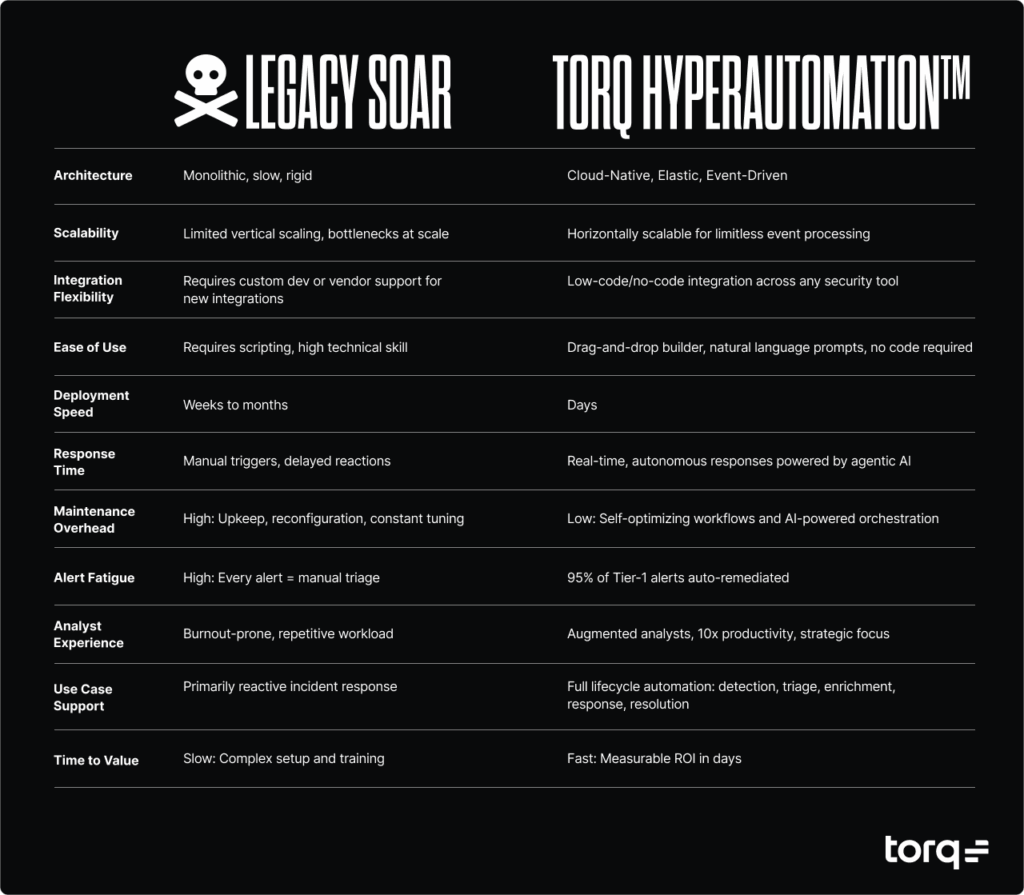
  1. Legacy SOAR came — and went. The security operations automation journey began with Security Orchestration, Automation, and Response (SOAR) as the primary automation and orchestration option for SecOps teams. However, as the cybersecurity landscape grew more complex and the volume of threats increased, SOAR’s limitations became glaringly evident. Gartner even went as far as to say “SOAR is Obsolete” in their latest ITSM Hype Cycle (2024), placing SOAR at the bottom of their “Trough of Disillusionment”. 
  1. Hyperautomation unleashed limitless potential. Unlike SOAR, Hyperautomation offered unlimited security integrations, simple-to-build automations, and cloud-native scalability. The incorporation of case management into a Hyperautomation engine helped mitigate alert fatigue by enabling automated remediation of false positives and other low-risk threats while more intelligently prioritizing comprehensive security cases in a meaningful way. 
  1. AI for security operations sped up the SOC. The next evolution of security automation involved leveraging generative AI to augment human expertise, enabling SOC teams to achieve machine-speed detection and response.
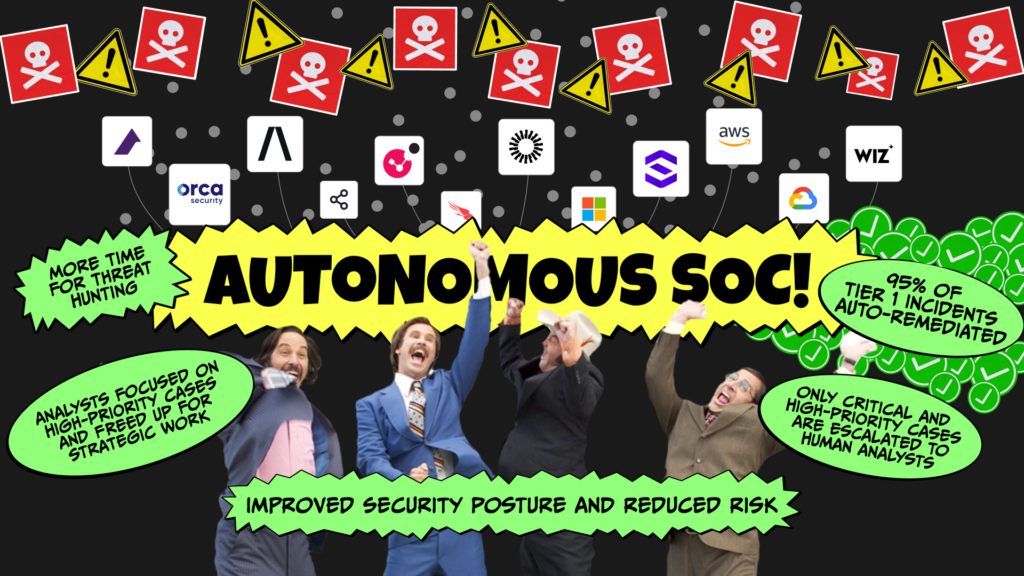
  1. Agentic AI takes the wheel: Agentic AI is the next logical evolution of AI for security operations, delivering autonomous decision-making capabilities that can reason, plan, and execute goals without constant human supervision. It’s the brain behind the autonomous SOC, freeing up analysts to do the strategic work. IDC’s report highlights that agentic AI can solve problems, adapt to its environment, and make complex decisions without human intervention. This shift moves SOCs from human-in-the-loop to human-on-the-loop supervision.

The modern SOC has arrived. As Gartner recently highlighted, to overcome the existential challenges that continue to plague SOC teams, security operations must continue to adapt. This brings us to the future of SecOps, where the gold standard for the modern SOC is a purpose-built combination of Hyperautomation and agentic AI to achieve the autonomous SOC.

Benefits of Adopting Automation and AI for Security Operations 

AI for security operations is critical not just for efficiency but for survival. It’s about alleviating the pressure on SOC teams, helping to avoid burnout and reducing the four million+ talent shortage gap that exists in the cybersecurity industry today. 

Gartner predicts that “by 2028, AI in threat detection and incident response will rise from 5% to 70%, primarily augmenting — not replacing — human analysts.”

As Gartner highlights, while the growth of AI continues to expand, its primary aim should be to augment the existing staff operating the SOC, not replace them entirely. This is good to keep in mind, as many organizations are hesitant to fully entrust AI with their security operations. However, with the rise of AI used in targeted attack campaigns, most organizations do recognize that it is near impossible for humans alone to keep pace with today’s quantity and complexity of threats.

When implementing AI for security operations, the most successful benchmarks to strive for are: 

  • Eliminating alert fatigue
  • Improving SOC analyst morale
  • Getting time back to focus on critical threats
  • Mitigating threats more quickly and efficiently
  • Increasing the accuracy of results

The benefits of automation and AI for security operations are not in removing human decision-making altogether but rather in upskilling the most junior SOC analysts while preventing the most experienced analysts from burning out in their role. 

To fully realize the potential of AI for security operations, organizations need a solution that combines context awareness and autonomous action. That solution is Socrates.

Introducing Socrates: Your AI SOC Analyst

Torq Socrates is our AI SOC Analyst capable of deep research, planning, and autonomous execution of end-to-end security case management. Socrates acts as an OmniAgent, coordinating multiple specialized AI Agents for contextual alert triage, incident investigation, and auto-remediation of Tier-1 tasks. 

For critical threats, Socrates augments your team’s expertise — enabling them to take action faster thanks to natural-language, human-AI collaboration.

There are two primary ways SOC teams are using Socrates to handle security cases today:

  1. Assigning cases to Socrates for end-to-end autonomous remediation
  2. Faster human-on-the-loop remediation with AI augmentation

1. Autonomous Remediation

First, SOC teams can assign specific cases to Socrates for auto-remediation without requiring any human intervention. 

In traditional analyst remediation, when a case is assigned, the analyst typically consults a runbook to guide them through the response required to contain the specific event (or events) that appear within the case. 

From start to finish, the triage, investigation, and remediation of a single case can take a human analyst 30 minutes or more, depending on the experience level of the analyst. In larger enterprises, there may even be multiple analysts with varying responsibilities involved in the lifecycle of a case — one for the initial triage, one for the Tier-2 investigation, and another for the incident response.

Socrates follows the same runbook planning and execution process but instead leverages a team of AI agents to craft, plan, and execute highly customized incident response strategies — at machine speed. Socrates’ leverages agentic AI to analyze SOC-defined runbooks written in natural language, learn from past outcomes, identify attack patterns, and continuously refine response plans to adapt to new threat vectors —  resulting in complete auto-remediation of 95% of cases in mere minutes.    

For cases that increase in severity based on Socrates’ agentic investigation or as new case data is added, raising the threat to a critical level, SOC teams can build off-ramps into each runbook that tell Socrates when to escalate cases to a human analyst for intervention.

2. Faster Human-on-the-Loop Remediation

Which brings us to the second use case: leveraging Socrates to help SOC teams investigate and take action on the cases that do require human decision making — faster. 

Analysts who are assigned critical cases for human-guided remediation can take advantage of Torq’s Multi-Agent System (MAS) by using natural language to chat with Socrates and ask for: 

  • AI-generated case summaries: Faster access to real-time and historical case observables, attachments, associated indicators of compromise (IOCs), or current case status enables streamlined decision-making by eliminating irrelevant noise.
  • Deep research investigations: Enrich cases by uncovering hidden attack patterns across diverse data sources and third-party threat intelligence to help precisely assess the threat impact and improve strategic threat prioritization.
  • Agentic AI-augmented remediation: Take action across the security stack using AI agents to trigger complex remediation workflows through Torq’s Hyperautomation platform, significantly reducing the amount of time from case assignment to case resolution.  

With Socrates, even a brand new analyst who hasn’t been trained on how to leverage the full functionality of every security solution in their stack can easily ask Socrates to deploy AI agents that can quickly quarantine devices, isolate hosts, or kick off a password reset — without the risk of human error. 

In its simplest form, Socrates was built to do what Torq has set out to do from the very beginning: Hyperautomate SecOps. By coordinating a team of AI agents, Socrates can automate the most repetitive tasks and reduce Tier-1 triage and investigation by 90% — helping humans respond to threats faster.

Embracing Hyperautomation and AI for Security Operations 

In an era where cyber threats are constantly evolving, the modernization of the SOC is no longer optional — it’s imperative. The inclusion of AI for security operations — like Torq Socrates — marks a pivotal shift in how SOC teams can combat alert fatigue, tech sprawl, and talent shortage. 

By integrating Hyperautomation and AI, Torq HyperSOC exemplifies how AI for security operations drives faster detection, smarter decisions, and machine-speed remediation, achieving:

  • Up to 90% reduction in investigation times
  • 3-5x increase in SOC alert capacity without additional headcount
  • Autonomous remediation of over 95% of security threats

AI for security operations lets teams regain significant amounts of time, allowing human analysts to focus on more strategic tasks while maintaining control over critical operations. The future of the SOC lies in this harmonious blend of human expertise and intelligent automation, setting a new standard for operational efficiency in security operations.

Want to learn more about the SOC’s evolution from automation to autonomy? IDC’s Spotlight Report explores why agentic AI for security operations is the next leap in the autonomous SOC. 

FAQs

What is AI's role in modern security operations?

AI in security operations enables SOC teams to detect, investigate, and respond to threats at machine speed — faster than any human analyst can work alone. Modern AI SOC platforms like Torq use agentic AI to autonomously triage alerts, enrich cases with threat intelligence, and execute remediation workflows end-to-end. The goal isn’t to replace analysts but to eliminate the repetitive Tier-1 work that causes burnout, freeing teams to focus on the threats that actually require human judgment.

How does Hyperautomation differ from traditional automation?

Traditional SOAR automation follows rigid, pre-scripted playbooks — if X happens, do Y. It breaks when conditions change and requires constant maintenance to keep integrations working. Torq Hyperautomation™ replaces that model with cloud-native, no-code workflows that integrate with unlimited security tools, scale automatically, and adapt without a dedicated engineering team to maintain them. Gartner placed SOAR at the bottom of its Trough of Disillusionment in 2024 for precisely these limitations.

What are the key benefits of using AI in a SOC?

The most measurable benefits are a 90% reduction in Tier-1 investigation time, autonomous remediation of over 95% of security threats, and a 3–5x increase in alert capacity without adding headcount. Beyond the metrics, the operational benefits matter just as much: reduced analyst burnout, less alert fatigue, and the ability for junior analysts to take meaningful action without deep tool expertise — using natural language to direct AI agents across the security stack.

Can AI help mitigate the talent shortage in security teams?

Yes — and it’s one of the most compelling reasons to deploy AI SOC automation now. The cybersecurity industry faces a shortage of over four million professionals globally. AI doesn’t solve the hiring problem, but it fundamentally changes the math. A four-person team running Torq can cover 24/7 operations without burning out, because AI handles the high-volume, repetitive work that would otherwise require a much larger staff. Gartner predicts AI in threat detection and incident response will rise from 5% to 70% by 2028, primarily by augmenting existing analysts rather than replacing them.

What are the most common challenges when integrating AI into security operations?

The three challenges that surface most consistently are tool fragmentation, trust in AI decisions, and governance readiness. Most SOCs run 7 or more AI-powered tools that don’t share context — meaning analysts still manually stitch together a complete picture of each incident. Trust is the next barrier: teams are confident AI can help but won’t let it act autonomously without transparency into how it reaches its conclusions. And governance — defining what AI can do, what requires human approval, and how decisions are audited — is the piece most organizations address too late. The platforms that resolve all three simultaneously are the ones delivering the outcomes security leaders are actually looking for.

SEE TORQ IN ACTION

Ready to automate everything?

“Torq takes the vision that’s in your head and actually puts it on paper and into practice.”

Corey Kaemming, Senior Director of InfoSec

“Torq HyperSOC offers unprecedented protection and drives extraordinary efficiency for RSM and our customers.”

Todd Willoughby, Director

Compuquip logo in white

“Torq saves hundreds of hours a month on analysis. Alert fatigue is a thing of the past.”

Phillip Tarrant, SOC Technical Manager

Fiverr logo in black

“The only limit Torq has is people’s imaginations.”

Gai Hanochi, VP Business Technologies

Carvana logo in black

“Torq Agentic AI now handles 100% of Carvana’s Tier-1 security alerts.”

Dina Mathers, CISO

Riskified logo in white

“Torq has transformed efficiency for all five of my security teams and enabled them to focus on much more high-value strategic work.”

Yossi Yeshua, CISO

The Future of Automated Threat Intelligence: 6 Enrichment Use Cases

Contents

Get a Personalized Demo

See how Torq harnesses AI in your SOC to detect, prioritize, and respond to threats faster.

Request a Demo

Cyber threats move fast — your threat intelligence should move faster. But most SOC teams spend more time drowning in false positives and manually correlating threat data than actually responding to real threats.

Automated threat intelligence changes this. With AI-driven automated intelligence, security teams can instantly collect, analyze, and act without sifting through endless alerts and indicators of compromise (IOCs). This shift from playing catch-up to a proactive, automated defense is critical to outpace attackers.

What is Automated Threat Intelligence?

Threat intelligence is the evidence-based collection of information and the observation of the capabilities, techniques, motives, goals, and targets of an existing threat. Simply put, it’s everything that you know about an attacker — actual or potential — based on their motives and how badly they can damage your business assets.

Threat intelligence is not a checklist. It’s a cycle of well-defined processes and operations that involves collecting raw data, cleaning and normalizing it into actionable observables, comparing it to current data to remove duplicates, and then storing it in a structured, human-readable format. That’s a lot of work.

And here’s the reality: SOCs are flooded with data — OSINT feeds, commercial intelligence, SIEM alerts, and internal security logs. Sorting through this manually is incredibly inefficient. Meanwhile, threat actors are evolving, moving faster, and becoming more evasive.

This is where security automation comes in. Instead of relying on analysts to manually collect, correlate, and respond to intelligence data, automated threat intelligence streamlines and enriches alerts, automatically prioritizes threats, and triggers incident response.

The Importance of Automated Threat Intelligence in the SOC

Threat intelligence is the backbone of a SOC, setting apart reactive teams from proactive ones. Here’s why it matters:

  • Automated threat intelligence adds important context to threats so teams know what they see.
  • It identifies attackers’ tactics, techniques, and procedures (TTPs), giving insight into how threat actors operate.
  • Intelligence can enable faster and smarter decision-making, reducing response time and preventing data loss.
  • By increasing efficiency, automated intelligence makes it easier to demonstrate ROI and value.

What is Threat Intelligence Enrichment?

Threat intelligence enrichment is the process of adding context to raw security threat data in order to better understand the threat. 

Imagine this scenario: You detect a wave of port scans against your servers. You know the IP addresses of the hosts from which the port scans originated, but you don’t know much more than this.

With threat intelligence enrichment, you could immediately gain insights like: 

  • Where the scanning servers are located
  • The operating systems and infrastructure they’re using
  • Whether the IPs are linked to known botnets, advanced attackers, or recent global threats
  • If these specific scans have been flagged in association with malware campaigns targeting similar organizations

With this enriched intelligence, your SOC can respond with precision and accuracy, blocking known malicious IPs, strengthening defenses against relevant attack vectors, and prioritizing investigations based on risk level. 

Of course, you can manage your threat intelligence data manually by correlating and comparing it. That approach, however, is not practical at scale. So, that begs the next question: How can we automate threat intelligence enrichment?

6 Ways to Automate Threat Intelligence Enrichment

1. Enrich Alerts Across Multiple Sources

Security teams need to correlate data from OSINT, intelligence feeds, internal logs, and SIEMs — but they’re stuck manually sifting through inconsistent, raw data. This delays investigations and allows threats to slip through.

Torq Hyperautomation™ automatically collects and correlates threat intelligence across all sources, filtering out false positives and providing actionable insights. Torq ingests, correlates, and enriches raw threat intel in real time, prioritizing alerts that actually matter.

Key Benefits For Alert Enrichment
Reduces the risk of false positives and false negatives in threat detectionAutomates the process of collecting and analyzing dataPrioritizes alerts, provides contextual information, and recommends response actionsQuickly and efficiently make informed decisions, reducing the response time to potential threats

2. Automate EDR, XDR, and SIEM Alerts

Manually managing alerts from EDRs, XDRs, and SIEMs can be challenging when dealing with large amounts of data. A Hyperautomation platform integrates across EDR, XDR, and SIEM platforms, automating alert handling and prioritization. It triages, enriches, and remediates alerts in real time, slashing MTTR and freeing up analysts to focus on real threats.

With Torq Hyperautomation, when an EDR alert flags a malicious file, Torq automatically quarantines, blocks the source, and launches an impact assessment. Torq is the connective tissue between these technologies, eliminating silos and enhancing data sharing.

Key Benefits For Alert Automation
Automates the process of collecting and correlating data from multiple technology sourcesRapidly identifies and responds to potential security threatsFrees up analysts to focus on critical tasks and work on strategic initiativesReduces response times, minimizing the impact of potential security incidents

3. Streamline Team-Based Threat Hunting

Threat hunting is the proactive search for threats that may have evaded detection by traditional security technologies. This process requires highly skilled analysts to investigate, but it is also a time-consuming and resource-intensive process. A Hyperautomation platform can centralize all the data, streamline the data correlation, and facilitate collaborative and automated threat hunts, reducing investigation times.

Torq’s AI-powered threat hunting assists SOC analysts by proactively analyzing high-velocity and high-volume data sets from multiple sources. It’s able to identify patterns, analogies, and IOCs that otherwise would have gone unnoticed.

Key Benefits For Threat Hunting
Automates the process of sharing information and delegating tasksProvides workflows to facilitate collaboration between multiple teams in threat huntingImproves the efficiency and effectiveness of threat hunting capabilitiesIdentifies and responds to potential threats more quickly and accurately

4. Align Processes

Disconnected security processes create inefficiencies, gaps, and compliance risks. Hyperautomation aligns security processes across teams and tools, ensuring every security event follows a standardized, automated workflow. 

For example, if a SIEM alert flags a compromised user account, Torq Hyperautomation automatically pulls identity and access logs, verifies behavioral anomalies, and notifies the security team with recommended actions.

Key Benefits For Process and Procedure Alignment
Standardizes security processes and proceduresEnsures all security workflows are repeatable and consistently applied across the organizationEnhances visibility into potential threats allowing organizations to proactively address concernIdentifies and responds to potential threats more quickly and effectively

5. Trigger Workflows Across Disparate Infrastructures

Security teams cannot manually manage the sheer volume and velocity of security data generated by different security technologies. They need a better way to identify and respond to threats. Hyperautomation can integrate EDR, SIEM, email security, cloud security, MDM, and endpoint security, plus more, allowing organizations to trigger cross-platform security actions.

When an incident is triggered in a workflow, Torq Hyperautomation can launch containment workflows and notify stakeholders.

Key Benefits For Workflow Triggering
Extracts maximum value from existing investments by integrating disparate security technologiesAutomates security workflows across the entire security tools stack


Collects and analyzes large volumes of data at scale to reduce noise


Responds to potential threats more quickly and accurately, reducing the MTTR


6. Minimize Manual Response Dependencies

Security incidents need instant response, but human remediation is too slow. The longer it takes to contain an attack, the more damage is done. Hyperautomation can speed up the entire response process, reducing manual effort and slashing MTTR. 

If an endpoint security tool flags a malicious file, Torq Hyperautomation instantly isolates the device, blocks the attack vector, and launches an automated investigation.

Key Benefits For Minimizing Manual Response Dependencies
Automates the coordination of incident response activities across different teams and technologiesResponds to threats with minimal manual human dependencies, helping improve and scale incident response capabilities
Assists with centralizing the coordination and multi-team collaboration to minimize the risk of errors and miscommunications
Provides workflows to help organizations respond to security incidents more efficiently, quickly, and accurately

The Role of AI in Threat Intelligence

AI plays a pivotal role in threat intelligence automation. It rapidly analyzes massive volumes of data to detect patterns, anomalies, and indicators of compromise that human analysts might miss. 

This dramatically improves detection accuracy, speeds up response, and helps organizations stay ahead of increasingly sophisticated attackers. In short, AI in threat intelligence turns reactive security into proactive, predictive defense.

Ready to automate your threat intelligence operations with AI-driven Hyperautomation? See how Torq can help.

SEE TORQ IN ACTION

Ready to automate everything?

“Torq takes the vision that’s in your head and actually puts it on paper and into practice.”

Corey Kaemming, Senior Director of InfoSec

“Torq HyperSOC offers unprecedented protection and drives extraordinary efficiency for RSM and our customers.”

Todd Willoughby, Director

Compuquip logo in white

“Torq saves hundreds of hours a month on analysis. Alert fatigue is a thing of the past.”

Phillip Tarrant, SOC Technical Manager

Fiverr logo in black

“The only limit Torq has is people’s imaginations.”

Gai Hanochi, VP Business Technologies

Carvana logo in black

“Torq Agentic AI now handles 100% of Carvana’s Tier-1 security alerts.”

Dina Mathers, CISO

Riskified logo in white

“Torq has transformed efficiency for all five of my security teams and enabled them to focus on much more high-value strategic work.”

Yossi Yeshua, CISO

What’s New With Torq: September 2024

Contents

Get a Personalized Demo

See how Torq harnesses AI in your SOC to detect, prioritize, and respond to threats faster.

Request a Demo

The Team at Torq is pushing the boundaries of what’s possible in security automation, and we’re excited to share several new capabilities designed to make security analysts’ lives easier and more efficient:

Introducing AI Case Summaries

Torq AI Case Summaries leverages the power of artificial intelligence to streamline and accelerate your security operations. Imagine this: instead of manually reviewing pages of logs and incident details, your team is presented with a concise, insightful summary of each case automatically generated by Torq.

Here’s how it works:

  • AI-Powered Summarization: Torq AI Case Summary analyzes all the relevant data points associated with a security alert, including logs, threat intelligence feeds, and historical incident data.
  • Instant Insights: Our advanced AI algorithms identify the most critical information and present it in a clear, easy-to-understand summary, highlighting the potential impact and recommended actions.
  • Faster Response Times: Armed with these AI-driven insights, your team can quickly understand the nature of the threat, prioritize incidents effectively, and take decisive action to mitigate risks.

Torq AI Case Summary enables your security team to operate at peak performance. By automating the tedious task of case summarization, AI Case Summary frees up analysts to focus on what matters most: investigating complex threats, hunting for vulnerabilities, and proactively strengthening your security posture.

Learn More

Simplify Form Building with Torq Interact

Need a department head to approve a suspicious travel request? Or perhaps you need a marketing manager to verify the legitimacy of a social media file? Torq Interact empowers security teams to automate approvals and data collection tasks with teams outside the security organization, ensuring a swift and coordinated response to security events.

As customers use Torq Interact to streamline both security team processes and end-user engagement, we continue to find new ways to improve the Interact experience. As of today, four new fields have been added to Torq Interact: 

  1. Date & Time Parameter: End users can easily select specific dates and times within interactions. For example, they can pinpoint the exact date of a thwarted phishing attempt.
  2. Enhanced File Parameter: Users can now upload multiple files simultaneously rather than one at a time. This simplifies the user experience, especially when dealing with unpredictable files. 
  3. Download File Parameter: Now, Torq users can leverage Interact to send files directly to end users for download, either directly or through workflow context. Analysts might be looking for a secure way to send a potentially malicious file to another team member so they can execute it in a sandbox for further investigation. 
  4. Secondary Button: This enables Interact users to add flexibility to their workflows with a secondary button that allows users to submit forms without filling in all required fields, perfect for adapting to various interaction scenarios.
  5. Conditional Elements: The conditional element introduces an advanced logic conditional element to enhance the end-user experience by dynamically presenting questions or information based on live responses, increasing the accuracy of every interaction.

Learn More

Enhanced Data Records with Torq Tables

Security teams are drowning in data. Every tool in your stack generates logs, alerts, and reports. But making sense of it all? That’s where things get messy. Spreadsheets buckle under the weight of hundreds, thousands, millions of rows. Custom dashboards require coding expertise and constant maintenance. You need a way to wrangle your data, not be ruled by it.

Torq Tables is a powerful, flexible way to interact with all your security data, directly within the Torq platform.

Torq Tables Enable You To:

  • Centralize your data: Pull in data from any source – NIST, SIEM, EDR, cloud platforms, and more – into a single, unified view—no jumping between tools and screens.
  • Investigate with speed and precision: Filter, sort, and analyze a significant amount of data in real-time. Uncover hidden threats and patterns that would otherwise remain buried.
  • Automate with ease: Trigger workflows directly from data in tables, responding to threats and anomalies at machine speed.

Torq Tables is now available for all Torq users. Log in to your Torq instance to get started, or schedule a demo.

Learn More

Monitor and Manage Workspaces with Organization Management

Organization Management introduces a new single pane of glass view, simplifying the process for Torq users to monitor usage across multiple workspaces and perform org-level administrative tasks. Additionally, we’ve introduced a new Organization Manager role to grant appropriate stakeholders org-level access while adhering to a least-privilege access approach. 

Learn More

We’re excited to see what security teams will accomplish with these new capabilities. Keep an eye out for future updates as we push the boundaries of security automation!

SEE TORQ IN ACTION

Ready to automate everything?

“Torq takes the vision that’s in your head and actually puts it on paper and into practice.”

Corey Kaemming, Senior Director of InfoSec

“Torq HyperSOC offers unprecedented protection and drives extraordinary efficiency for RSM and our customers.”

Todd Willoughby, Director

Compuquip logo in white

“Torq saves hundreds of hours a month on analysis. Alert fatigue is a thing of the past.”

Phillip Tarrant, SOC Technical Manager

Fiverr logo in black

“The only limit Torq has is people’s imaginations.”

Gai Hanochi, VP Business Technologies

Carvana logo in black

“Torq Agentic AI now handles 100% of Carvana’s Tier-1 security alerts.”

Dina Mathers, CISO

Riskified logo in white

“Torq has transformed efficiency for all five of my security teams and enabled them to focus on much more high-value strategic work.”

Yossi Yeshua, CISO

A Blueprint for Hyperautomating Your Next-Gen Secure Software Development Lifecycle (SDLC)

Contents

Get a Personalized Demo

See how Torq harnesses AI in your SOC to detect, prioritize, and respond to threats faster.

Request a Demo

Aner Izraeli is the Chief Information Security Officer (CISO) at Torq. He leads Torq’s cybersecurity strategy with a focus on innovation and resilience. Aner’s career spans over two decades in the cybersecurity field, where he has consistently demonstrated expertise in SIEM/SOC, incident response, and network security. 

At Torq, we’re all about pushing boundaries and driving innovation. But we can’t afford to treat security as an afterthought in our relentless pursuit of speed and creativity. As a lean and agile team, we’re constantly challenged to stay ahead of emerging threats without slowing down our momentum.

In this blog, I break down how we Hyperautomated our software development lifecycle (SDLC) to improve security coverage, reduce friction, and keep our R&D teams shipping fast.

The SDLC Challenge: Balancing Speed and Security

Our software engineering teams manage various components and microservices, each with unique functionalities requiring meticulous threat modeling and vulnerability assessments. Modern software engineering integrates open-source and proprietary libraries, introducing potential security vulnerabilities in individual and shared components across teams.

The primary challenge is ensuring these vulnerabilities are continuously identified and mitigated before they compromise the production environment. Simultaneously, it’s crucial to maintain an environment where teams can continue to innovate and deliver high-quality software without being hindered by security concerns. 

In short, how do we ensure that potential application security vulnerabilities are identified and resolved before they threaten our production environment while empowering our teams to innovate and deliver high-quality software? That’s where SDLC automation and security Hyperautomation come in.

Building Our SDLC Automation Architecture

Our solution started with integrating an Application Security Posture Management (ASPM) platform, which provided complete control over our supply chain and SDLC. This visibility extends across open-source packages, Dockerfile dependencies, and container images — everything from the far-right side of the SDLC. But visibility alone can be overwhelming. 

We needed to take it further by leveraging Torq’s Hyperautomation capabilities. Hyperautomation enabled us to combine no-code workflows, AI-driven orchestration, and system-wide integrations into a single, scalable SDLC framework.

Here’s how our SDLC automation stack works in the context of our Application Security events pipeline:

SDLC automation architecture and blueprint at Torq

Inside Our Hyperautomated SDLC Pipeline

My vision was simple but ambitious: create a seamless, automated SDLC pipeline that transforms how we manage vulnerabilities. Here’s how we did it:

I used Torq’s workflows to categorize and aggregate issues, while centralized case management simplifies investigations for R&D teams. Automation facilitates generating Jira tickets, pull requests, and Slack notifications, keeping teams aligned with daily SLA reminders. This ensures our teams can focus on what matters most — innovation without compromise. 

Below is an illustration of what that automated SDLC flow looks like:

Visual flowchart showing Torq’s SDLC automation process

The SDLC Automation Implementation In Action

When the ASPM flags a new issue, Torq automatically creates a centralized case grouped by severity and category for that specific repository — eliminating duplicate tickets and reducing noise.

Diagram showing Torq case aggregating security issues by severity and category within a repository to streamline R&D workflows.

The case includes a detailed table with affected packages, suggested upgrades, a risk verdict, and direct links to GitHub and ASPM findings.

If action is needed, R&D can trigger a predefined workflow with one click, auto-generating a Jira ticket, a pull request, and a Slack notification, all while staying aligned with SLA requirements.

Table view of ASPM issues in Torq with quick actions to create Jira tickets, PRs, and Slack alerts for SLA-compliant remediation.
Torq interface showing direct PR links and automated change management for SDLC updates by R&D teams.

With enriched data and automated context in hand, our dev teams can patch vulnerabilities quickly. Each remediation follows Torq’s change management and SDLC policies, flowing through peer review and automated deployment like any standard feature or update.

SDLC automation workflow showing peer review and automated deployment of security fixes through Torq’s change management process.

SLA Compliance Made Simple

Automated workflow in Torq tracking SLA deadlines

In line with Torq’s policy, every issue is assigned a severity-based SLA. To ensure timely resolution, a daily automated workflow reviews open cases and notifies each R&D team of their remaining time to address these issues. SDLC automation keeps teams on track, ensuring vulnerabilities are managed effectively without disrupting ongoing development.

That’s the power of SDLC Hyperautomation: fast and repeatable.

When To Implement SDLC Hyperautomation 

Achieving fully automated vulnerability management may sound like an ambitious goal, but it’s essential for the velocity of modern security operations. Within Torq, we strive for a seamless process from detection to merge. Successful SDLC Hyperautomation can become possible when:

  • The vulnerability management program is mature and well-established
  • There are consistent, repeatable actions required for product or software updates
  • The SDLC includes a robust testing process, acting as a safety net to catch any oversights during automation

The Business Impact of SDLC Automation

The result of our efforts was a fully automated vulnerability management process that has revolutionized our approach to AppSec. We’ve slashed remediation times, improved SLA adherence, and empowered our R&D teams to deliver secure, high-quality software faster than ever. Here was the quantitative impact:R&D teams to deliver secure, high-quality software faster than ever. Here was the quantitative impact:

Ready to Hyperautomate your AppSec approach? Torq can help you build SDLC automation workflows that scale, simplify security, and eliminate busy work.

SEE TORQ IN ACTION

Ready to automate everything?

“Torq takes the vision that’s in your head and actually puts it on paper and into practice.”

Corey Kaemming, Senior Director of InfoSec

“Torq HyperSOC offers unprecedented protection and drives extraordinary efficiency for RSM and our customers.”

Todd Willoughby, Director

Compuquip logo in white

“Torq saves hundreds of hours a month on analysis. Alert fatigue is a thing of the past.”

Phillip Tarrant, SOC Technical Manager

Fiverr logo in black

“The only limit Torq has is people’s imaginations.”

Gai Hanochi, VP Business Technologies

Carvana logo in black

“Torq Agentic AI now handles 100% of Carvana’s Tier-1 security alerts.”

Dina Mathers, CISO

Riskified logo in white

“Torq has transformed efficiency for all five of my security teams and enabled them to focus on much more high-value strategic work.”

Yossi Yeshua, CISO

Five Ways to Automate Threat Hunting in Your SOC

Contents

Get a Personalized Demo

See how Torq harnesses AI in your SOC to detect, prioritize, and respond to threats faster.

Request a Demo

Modern threats don’t come crashing through the front door — they slip quietly through gaps in the side of your house that your legacy tools don’t even know exist. Automated threat hunting is how you find threats before they find your sensitive data. 

Automated Threat Hunting Overview

Automated threat hunting uses rule-based logic, AI, automation, and real-time telemetry to identify suspicious behaviors across your environment. While manual threat hunting is resource-intensive and dependent on expertise, automation levels the playing field. 

With Hyperautomation tools, security teams can automate detection queries, enrich findings with threat intelligence, trigger searches across systems, and initiate immediate responses.

Automated threat hunting enables your SOC to:

  • Continuously monitor and detect threats at scale
  • Investigate faster and cut root cause analysis time in half
  • Shrink time from detection to response (MTTR)
  • Apply proven threat hunting strategies automatically
  • Handle multiple threat hunting sessions simultaneously
  • Give your analysts time back

Let’s break down five ways to automate threat hunting in your SOC.

1. Automate EDR, XDR, SIEM, and Anomaly Detection Queries

Your stack is loaded with tools. Torq seamlessly integrates your stack to make them work together. When EDR, XDR, SIEM, and anomaly detection platforms are paired with automation, these tools can detect threats and act on them.

With threat hunting automation, you can: 

  • Trigger a SIEM alert to automatically query EDR logs
  • Parse XDR telemetry to extract IOCs and enrich investigations
  • Respond to anomaly detection with distributed searches across email, cloud, identity, and endpoint logs

2. Share and Standardize Threat Hunting Templates 

Every SOC team uses custom automation templates, which are shared with team members to ensure the most efficient threat hunting workflows. These threat hunting templates serve as playbooks for automating investigations received from the SIEM/EDR/XDR queries.

Teams can:

  • Standardize how alerts are prioritized and triaged
  • Automatically detonate suspicious files in sandboxes
  • Use natural language prompts to build or modify workflows

This makes threat hunting more accessible, scalable, and consistent. Now, even junior analysts can execute expert-level investigations.

3. Trigger Search Processes With Workflows

Manual searching is slow. Automated workflows can activate search processes across various systems to identify further events and evidence. 

These workflows can:

  • Trigger endpoint and log searches across EDR, MDM, and SIEM platforms
  • Perform cross-system correlation to identify lateral movement
  • Enrich alert data using threat intelligence and vulnerability scanners

This reduces the time analysts spend manually digging through data, allowing them to focus on high-value tasks.

4. Use Playbooks for Automated Incident Response

Threat hunting without response is just research. Turn detection into action with instant, automated incident response.

Build workflows to:

  • Isolate compromised systems
  • Revoke access or reset credentials
  • Trigger notification workflows to stakeholders
  • Update case management systems

5. Automate Threat Remediation

Once a threat is confirmed, it’s go time. Depending on the threat, workflows may automate remediation by:

  • Quarantining compromised files using EDR
  • Removing malware from cloud storage or inboxes
  • Blocking malicious IPs and updating firewall rules
  • Rolling back affected systems from backups

Real-World Automated Threat Hunting Scenarios

The following scenarios illustrate how automated threat hunting plays out across different industries — from initial detection trigger through to containment. Each is paired with a real outcome from a Torq customer facing similar challenges.

Detecting Advanced Persistent Threats in Financial Services

Threat type: Advanced Persistent Threat (APT) — credential harvesting and lateral movement

Timeline: Alert to full containment in 18 minutes (vs. 4+ hours manually)

Imagine this scenario. A regional bank’s SOC spots anomalous after-hours logins from a privileged service account. The attacker stays just below SIEM detection thresholds — querying Active Directory in small batches to avoid triggering rules. No alert fires. Without automated threat hunting, this lateral movement goes unnoticed for days.

With an automated threat detection workflow in place, a scheduled query cross-correlates after-hours authentication with AD enumeration activity — two signals that look benign individually but together indicate compromise. Torq automatically pulls 72 hours of authentication history, enriches source IPs against VirusTotal and Recorded Future, and queries CrowdStrike for suspicious process execution on every host the account touched. When the confidence score crosses the threshold, Torq triggers containment automatically: suspending the account in Okta, isolating compromised endpoints via CrowdStrike, and opening a fully enriched P1 case in Torq Case Management — all within 18 minutes, without waiting for analyst review.

Quantified outcomes:

  • Investigation time drops from 4 hours to 18 minutes.
  • Mean time to contain decreases by 87%.
  • False positive rate falls 94% after tuning.
  • The team saves approximately 3 analyst hours per incident.

Real-World Torq Scenario

A top-30 U.S. bank faced exactly this pressure — too few analysts, too many alerts, and manual processes leaving them exposed to phishing and ransomware. After deploying Torq, they launched over 100 automated workflows in 3 months, connecting VirusTotal, SentinelOne, Proofpoint, and ServiceNow into a single response layer. Torq also automated end-to-end fraud detection and account lockdown, enabling the bank to reinstate a suspended payment service and satisfy SEC compliance requirements. Read the full case study

A global money transfer platform faced the same problem at scale — manually triaging alerts across AWS, Microsoft 365, Active Directory, and SentinelOne. After deploying Torq, the team achieved 30% overall time savings and cut one IAM task that previously consumed a full analyst day down to three minutes. Read the full case study

Automated Ransomware Detection in Healthcare Networks

Threat type: Ransomware pre-execution — living-off-the-land techniques and shadow copy deletion

Timeline: Pre-encryption detection and full isolation in under 9 minutes

Imagine this scenario. A clinical workstation on a hospital network starts exhibiting ransomware precursor behavior — shadow copy deletion attempts, high-volume file enumeration exceeding 500 reads per minute, and living-off-the-land binaries executing from non-standard paths. No single signal crosses a detection threshold. By the time an analyst reviews the alert queue, encryption has already spread across the EHR system.

With automated threat hunting, a query monitors all three signals simultaneously and scores them dynamically. When all three co-occur, Torq triggers an immediate automated response — no analyst review required. Torq isolates the workstation via MDE’s isolation API, disables the compromised Azure AD account, quarantines the malicious binary, and preserves a memory snapshot and process tree for HIPAA chain-of-custody reporting. The entire sequence completes in under 9 minutes. Zero files get encrypted. Zero breach notifications go out.

Quantified outcomes:

  • Zero files encrypted across three separate incidents.
  • The team achieves detection to isolation in under 9 minutes.
  • Torq fully eliminates Tier-1 triage time for this response type.
  • The team avoids HIPAA breach notification in all three cases.

Real-World Torq Scenario

Kenvue — the global consumer health company behind Johnson’s, BAND-AID, and Neutrogena — made exactly this shift: moving from reactive, outsourced security operations to proactive, in-house threat detection under significant compliance pressure. Kenvue selected Torq to enforce consistent response across every incident type and launched end-to-end case management in 6 weeks. Read the full case study

Valvoline faced the same containment challenge in a different industry. Before Torq, analysts spent up to 12 hours daily on phishing triage alone. Now when a user clicks a malicious link, Torq automatically initiates password resets, terminates sessions, and executes containment actions across integrated platforms — saving the team 7 analyst hours every day. Read the full case study

Supply Chain Attack Prevention for Manufacturing

Threat type: Supply chain compromise — trojanized software update with C2 beaconing via DNS over HTTPS

Timeline: C2 beacon identified and network-blocked in under 12 minute

Imagine this scenario. A vendor pushes a signed software update to an industrial monitoring tool running across 14 production facilities. The update contains a backdoor that communicates with a C2 server using DNS over HTTPS — blending into legitimate encrypted traffic. Because the software carries a valid vendor signature, traditional allow-listing provides no protection. The attack spreads silently across facilities.

With automated threat hunting, Torq continuously compares the application’s outbound network behavior against a 30-day rolling baseline. When the tool initiates HTTPS connections to a domain it has never contacted before — one registered just 11 days prior with a privacy-protected registrar — Torq flags the anomaly, automatically submits the domain to Recorded Future for threat intelligence scoring, and queries IBM QRadar to identify every host running the same software version that contacted that domain in the past 72 hours. Torq surfaces 23 additional affected hosts across 4 facilities automatically, adds the C2 domain to the enterprise firewall blocklist and DNS blackhole, and opens a vendor notification, a Jira remediation ticket, and a vulnerability tracking case with all affected assets pre-populated — before a single analyst reviews the original alert.

Quantified outcomes:

  • Torq blocks C2 traffic across all 14 facilities in under 12 minutes.
  • The workflow surfaces 23 additional compromised hosts with no manual hunting.
  • Production experiences zero downtime. Investigation time drops from 6 hours to 25 minutes.

Real-World Torq Scenario

Valvoline manages a large distributed network of service centers — similar in security complexity to a multi-facility manufacturer. When their legacy SOAR became too brittle to maintain, Torq replaced it and delivered operational value in 48 hours. A Rapid7 integration their previous SOAR had failed to complete after hundreds of hours of effort was running in under a week. Read the full case study

Kenvue built Torq-powered workflows to manage third-party risk and cross-stack threat correlation across their global supplier ecosystem. Automated intake forms now route third-party security issues directly into SOC workflows — directly applicable to any organization managing software vendor and supply chain risk at scale. Read the full case study

Automated Threat Hunting with Torq

With Torq, threat hunting can be fully automated with our AI SOC platform. Here’s how we do it: 

  • Automated Case Management: Torq automates case management by automatically creating, updating, and managing cases in response to incoming alerts. High-fidelity signals get prioritized instantly, and cases are enriched in real-time with contextual data from across your stack. 
  • Observables: Observables like IPs, hashes, URLs, and domains are more than just data points. They’re trackable objects tied directly to cases and alerts, fully compliant with OCSF standards. This lets security teams link activity across seemingly unrelated investigations and surface patterns faster than ever before.
  • Relationship Tracking: Torq’s platform allows security teams to implement correlation, enrichment, and contextualization logics in their workflows, leveraging the relationships between observables, cases, and alerts. This helps security analysts identify patterns and uncover hidden threats.

As cyberattacks grow more advanced, real-time visibility and rapid response aren’t optional — they’re essential. Automated threat hunting enables SecOps teams to stay proactive, reduce alert overload, and handle complex multi-vector attacks faster.

Torq gives security professionals the automation edge they need to hunt smarter, not harder. See how Torq can elevate your automated threat hunting strategy today.

FAQs

How long does it take to implement automated threat hunting?

Most organizations achieve an initial automated threat hunting deployment within 2–4 weeks, with a phased rollout reaching full maturity in 60–90 days. The timeline depends heavily on the complexity of your existing stack and how many integrations you need to connect. Platforms like the Torq AI SOC platform can accelerate this significantly, since pre-built integrations with tools like CrowdStrike, Splunk, and Microsoft Sentinel eliminate weeks of custom development. Starting with a single, high-priority use case — such as automating EDR-triggered SIEM queries — lets your team demonstrate value quickly before expanding scope.

What's the difference between automated threat hunting and traditional SIEM alerts?

Traditional SIEM alerts are reactive — they fire when a predefined rule threshold is crossed, then wait for an analyst to investigate. Automated threat hunting is proactive: it continuously executes queries across your environment looking for anomalies and TTPs (Tactics, Techniques, and Procedures) that haven’t yet triggered a rule. Where a SIEM alert surfaces a known signature, an automated hunt surfaces unknown or novel behavior by correlating telemetry across EDR, identity, cloud, and network sources simultaneously. The result is a shorter exposure window and far fewer threats that hide in the blind spots between your existing detection rules.

Which tools integrate best with automated threat hunting platforms?

The most impactful integrations for automated threat hunting are EDR platforms and threat intelligence feeds. Identity providers like Okta and Azure AD are also critical, enabling automated hunting across user behavior anomalies and privilege escalation patterns. A AI SOC platform like Torq connects all of these tools through a single orchestration layer, so hunts can query across your entire stack in parallel rather than tool by tool.

How much does automated threat hunting cost to implement?

Costs vary widely based on organization size, existing tooling, and chosen platform. For mid-size enterprises (500–5,000 employees), a SOC automation and threat hunting platform typically runs $50,000–$200,000 annually, which is often offset by a reduction of 2–4 FTE analyst hours per day and a measurable decrease in breach-related costs. Organizations that build automated hunting on top of existing SIEM/EDR investments generally see ROI within 6–12 months. The most cost-effective approach is to leverage a platform that integrates with your current stack rather than ripping and replacing tools.

What skills do analysts need for automated threat hunting?

Analysts working with automated threat hunting workflows need a solid grounding in threat intelligence frameworks like MITRE ATT&CK, familiarity with query languages like KQL (Kusto Query Language) or SPL (Splunk Processing Language), and an understanding of how attacker TTPs map to observable behaviors in logs. Automation platform literacy — knowing how to build, modify, and debug workflows — is increasingly essential. Modern AI SOC platforms lower this bar significantly: tools like Torq allow analysts to use natural language to build and refine hunts, meaning even junior analysts can execute sophisticated investigations without deep scripting knowledge.

What are the biggest challenges when implementing automated threat hunting workflows?

The most common challenges are data quality (incomplete or inconsistent telemetry across tools), alert fatigue from overly broad hunt queries, and organizational resistance to trusting automation for high-stakes decisions. Tuning is critical — automated hunts that generate too many false positives quickly lose analyst trust. The other common pitfall is scope creep: attempting to automate everything at once rather than iterating on a focused set of high-ROI use cases first. Starting with a well-defined hunt — such as detecting lateral movement after an initial EDR alert — and measuring its precision before expanding gives teams the confidence to automate more aggressively over time.

Can automated threat hunting detect ransomware before it executes?

Yes. This is one of the highest-value use cases for threat hunting automation. Ransomware actors typically spend days or weeks inside an environment performing reconnaissance, lateral movement, and privilege escalation before deploying the payload. Automated threat hunting can detect these precursor behaviors by continuously cross-correlating EDR telemetry, authentication logs, and network traffic for indicators such as mass file enumeration, shadow copy deletion, unusual admin tool usage (living-off-the-land), and anomalous SMB activity. By catching these behavioral signals early, automated workflows can trigger isolation, credential revocation, and stakeholder notification well before encryption begins — dramatically reducing both blast radius and recovery costs.

SEE TORQ IN ACTION

Ready to automate everything?

“Torq takes the vision that’s in your head and actually puts it on paper and into practice.”

Corey Kaemming, Senior Director of InfoSec

“Torq HyperSOC offers unprecedented protection and drives extraordinary efficiency for RSM and our customers.”

Todd Willoughby, Director

Compuquip logo in white

“Torq saves hundreds of hours a month on analysis. Alert fatigue is a thing of the past.”

Phillip Tarrant, SOC Technical Manager

Fiverr logo in black

“The only limit Torq has is people’s imaginations.”

Gai Hanochi, VP Business Technologies

Carvana logo in black

“Torq Agentic AI now handles 100% of Carvana’s Tier-1 security alerts.”

Dina Mathers, CISO

Riskified logo in white

“Torq has transformed efficiency for all five of my security teams and enabled them to focus on much more high-value strategic work.”

Yossi Yeshua, CISO

Black Hat 2024: Torq Takes Over Vegas

Our Arrival: Black Hat 2024

Subtlety has never been our specialty. Our arrival in Las Vegas for Black Hat 2024 had the city abuzz with excitement as our HyperTrucks blazed through the street, broadcasting that “SOAR is dead.” Our team traveled from across the globe, and converged to make this event unforgettable. We were not just attending; we were here to revolutionize how security operations are perceived and executed.

Torq HyperSOC™: The Demo that Broke Black Hat

Torq HyperSOC™ was undeniably the star of the show. Our demo booths were consistently surrounded by security teams waiting for their turn to witness the groundbreaking capabilities of our latest solution. The reactions were phenomenal—visitors were blown away by the efficiency and innovation that Torq HyperSOC™ brings to the table. The non-stop lines at our demo stations were a testament to the immense interest and excitement generated by our cutting-edge technology. 

“I’ve never seen anything like it in 20-something years of doing this.”

Mick Leach, Field CISO at Abnormal Security

Torq for Good

To raise awareness of the cyber skills gap and to encourage the next generation of young professionals to consider a career in cybersecurity, we committed to donate $10 for every person who visited our booth to Tech Queen Elite Training Institute. They caught our eye as a local Vegas non-profit organization that trains students in coding, business communication skills, and digital marketing technologies. We are also donating a pair of premium socks for every visitor to our booth via the Communities In Schools, Nevada organization. This donation is designed to inform kids about the value of a SOC career while also providing them with a useful back-to-school item. Communities In Schools is the nation’s leading dropout prevention organization. Its mission is to assess needs and deliver resources that remove barriers to success. It supports more than 100,000 students at 110 schools. 

Hyperautomation™ Reaches New Heights

Our booth at Black Hat 2024 was not just a display; it was an experience. The buzz and energy were palpable, with attendees continually stopping by to see what the excitement was all about. We made it loud and clear that “SOAR is Dead,” and the hundreds of security professionals we spoke to agreed.

Torq, Out. 

Black Hat 2024 was a monumental success for Torq, as we showcased our commitment to pushing the boundaries of cybersecurity and automation. Stay tuned for more exciting updates and innovations from our team – and be sure to catch us back in Vegas next month for Fal.Con.

SEE TORQ IN ACTION

Ready to automate everything?

“Torq takes the vision that’s in your head and actually puts it on paper and into practice.”

Corey Kaemming, Senior Director of InfoSec

“Torq HyperSOC offers unprecedented protection and drives extraordinary efficiency for RSM and our customers.”

Todd Willoughby, Director

Compuquip logo in white

“Torq saves hundreds of hours a month on analysis. Alert fatigue is a thing of the past.”

Phillip Tarrant, SOC Technical Manager

Fiverr logo in black

“The only limit Torq has is people’s imaginations.”

Gai Hanochi, VP Business Technologies

Carvana logo in black

“Torq Agentic AI now handles 100% of Carvana’s Tier-1 security alerts.”

Dina Mathers, CISO

Riskified logo in white

“Torq has transformed efficiency for all five of my security teams and enabled them to focus on much more high-value strategic work.”

Yossi Yeshua, CISO

SecOps, DevOps, ITOps, DevSecOps: What’s the Difference and How to Build a Strategy

Contents

Get a Personalized Demo

See how Torq harnesses AI in your SOC to detect, prioritize, and respond to threats faster.

Request a Demo

In cybersecurity, collaboration isn’t just helpful — it’s mission-critical. Evolving threats, hybrid infrastructure, and growing operational complexity have forced organizations to rethink how their teams work together. That’s where SecOps, ITOps, DevOps, and DevSecOps come into play.

These terms may sound similar. And they are — to a degree. But they have different areas of focus and philosophies. This guide will break them down, show how they overlap, and explain why automated SecOps is essential to a modern security strategy.

What is SecOps?

SecOps (Security Operations) is the fusion of IT operations (IT Ops) teams and security teams, processes, and technologies. It transforms security from a siloed afterthought into an integrated, continuous part of infrastructure management and incident response.

Unlike traditional models where IT and security operate independently, SecOps encourages real-time collaboration, shared visibility, and automation-powered workflows. The result is faster detection, smarter triage, and reduced risk.

At the heart of SecOps is the SOC (security operations center), which can be physical, virtual, or hybrid. The SOC centralizes collaboration among security analysts, IT operations engineers, system admins, and others, all aligned under the CISO.

Why SecOps Matters 

Security complexity is exploding. The average enterprise juggles hybrid infrastructure, sprawling cloud environments, and a distributed workforce. Meanwhile, attackers are faster — and smarter — than ever.

Siloed security and IT operations can’t keep up. Digital SecOps helps you scale. It reduces response times, minimizes risk, and improves visibility by aligning security into other parts of the business.

SecOps vs. ITOps

SecOps connects security and IT operations by aligning their workflows and priorities, not by merging teams. 

Traditionally, ITOps and security teams operated on parallel tracks. ITOps focused on maintaining infrastructure, keeping systems running, and resolving performance issues, while security focused on identifying and responding to threats. They might’ve shared a Slack channel, but rarely a strategy. That separation created gaps, and attackers took advantage.

SecOps closes those gaps. It ensures security is embedded into every layer of IT operations, from provisioning and deployment to monitoring and response. It’s not about turning IT teams into security experts or vice versa — it’s about building stronger collaboration.

SecOps vs. DevOps

DevOps is a collaboration between developers and IT operations teams that ensures developers understand the needs of ITOps when they write software and that ITOps teams understand what developers intend for software to do when they manage it. 

While SecOps and DevOps serve different functions, they share a common goal: breaking down silos between teams to improve agility, speed, and resilience across the organization. Here’s what they have in common:

  • Both break down silos between teams to improve efficiency and scalability
  • Both emphasize automation, real-time communication, and shared accountability
  • Both are cultural philosophies more than strict operational frameworks

But the difference lies in focus:

  • DevOps = Developers + ITOps
  • SecOps = Security + ITOps

In short: DevOps is about velocity. SecOps is about visibility. And both benefit from strong security automation.

Where DevSecOps Fits In

You can’t really talk about ITOps, SecOps, and DevOps without hitting on DevSecOps — the (relatively) new kid on the block that pulls development, security, and operations into a single, streamlined, collaborative model.

In DevSecOps, security “shifts left”, meaning it’s embedded earlier in the development lifecycle, not bolted on at the end. Security testing, threat modeling, and policy enforcement become part of the CI/CD pipeline.

With DevSecOps, developers, IT, and security collaborate from day one. Bugs are fixed before they become breaches, and vulnerabilities are squashed in staging rather than discovered in production.

Comparing ITOps, DevOps, SecOps, and DevSecOps

ITOpsSecOpsDevOpsDevSecOps
Primary FocusManaging IT infrastructure and servicesSecurity + IT operationsDevelopment + IT operationsEmbedding security into DevOps pipelines
GoalEnsure performance, uptime, and support of systemsStreamline threat detection and incident responseAccelerate software delivery and qualityShift security left in development workflows
Key StakeholdersIT admins, system engineersSecurity teams + ITOpsDev teams + ITOpsDev, Sec, and Ops teams working as one
Collaboration ModelOperates in silos or supports other teamsSecurity works closely with IT operationsDevelopers and OTOps work in tandemFully integrated cross-functional security practices
Examples of ToolsServiceNow, Nagios, PuppetTorq Hyperautomation platform, EDR/XDR, SIEMJenkins, Kubernetes, TerraformSAST, DAST, IaC security tools
PhilosophyKeep the lights on, ensure uptimeProactive threat mitigationMove fast, reduce friction between Dev and OpsSecure every commit, shift security left

Collaboration Isn’t Optional

At the end of the day, whether you’re operating under the banner of ITOps, SecOps, DevOps, or DevSecOps, one principle remains constant: collaboration is everything.

Security doesn’t happen in isolation. It happens when developers, IT, and security engineers have shared visibility, shared tools, and shared responsibility. When everyone’s aligned, security becomes part of the everyday workflow — not an afterthought or a bottleneck.

Scaling Through Collaboration with Torq

Torq’s no-code SOC automation platform is purpose-built to connect the dots across ITOps, security, and development. It breaks down barriers between teams with collaborative, transparent workflows that streamline communication, reduce handoff friction, and automate everything. Here’s how Torq emphasizes collaboration: 

  • Unified workflows: Bring security, IT, and engineering together in a single automation layer with shared playbooks.
  • No-code + Deep customization: Anyone can build and execute powerful workflows using natural language, prebuilt templates, or drag-and-drop tools.
  • Real-time collaboration: Triage, investigate, and remediate cases through chat tools like Slack and Teams.
  • Extensible by design: Torq integrates with your entire security stack and scales with your business. 

By embedding security into day-to-day operations and giving every stakeholder access to automation, Torq turns collaboration into a force multiplier. 

See how data security leader BigID increased SecOps efficiency by 10x with Torq Hyperautomation.

SEE TORQ IN ACTION

Ready to automate everything?

“Torq takes the vision that’s in your head and actually puts it on paper and into practice.”

Corey Kaemming, Senior Director of InfoSec

“Torq HyperSOC offers unprecedented protection and drives extraordinary efficiency for RSM and our customers.”

Todd Willoughby, Director

Compuquip logo in white

“Torq saves hundreds of hours a month on analysis. Alert fatigue is a thing of the past.”

Phillip Tarrant, SOC Technical Manager

Fiverr logo in black

“The only limit Torq has is people’s imaginations.”

Gai Hanochi, VP Business Technologies

Carvana logo in black

“Torq Agentic AI now handles 100% of Carvana’s Tier-1 security alerts.”

Dina Mathers, CISO

Riskified logo in white

“Torq has transformed efficiency for all five of my security teams and enabled them to focus on much more high-value strategic work.”

Yossi Yeshua, CISO

Torq Delivers SOC(ks) for the Community

Torq Gives Back and Supports the Next Generation of Cyber Talent

For the second year in a row, Torq is pleased to make donations to charities that invest in supporting the next generation of young professionals and encourage them to consider STEM-related career paths. 

Torq will be at Black Hat, one of the cybersecurity industry’s leading trade shows, August 6-8 at Mandalay Bay, Las Vegas. We’ll be exhibiting Torq Hyperautomation at our booth, including the AI-driven Torq HyperSOC, a purpose-built solution that automates, manages, and monitors critical SOC (Security Operations Center) responses at machine speed. This innovation has been game-changing for tech workers in the SOC and is helping alleviate the cybersecurity skills gap that’s leading to global labor shortages and burnout.

To raise awareness of the cyber skills gap and to encourage the next generation of young professionals to consider a career in cybersecurity, Torq will donate $10 for every person that visits its booth (#960) to Tech Queen Elite Training Institute. It’s a non-profit organization dedicated to training students in coding, business communication skills, and digital marketing technologies. Tech Queen Elite Training Institute helps eliminate barriers so students can earn globally-recognized credentials and become gainfully employed, in fields that include cybersecurity and AI.

“We’re grateful to Torq for making such a generous investment in the career paths of Tech Queen Elite Training Institute students,” said Dr. Duana Malone, Founder of Tech Queen Elite Training Institute. “Our goal is to ensure every student we work with has an opportunity to devote themselves to meaningful skills development that enables them to elevate their future potential, as well as their community at large. Torq’s donation will make a real difference for many students in Nevada.”

In addition, for every visitor to our Black Hat booth, Torq will donate a pair of premium socks to local kids in need via the Communities In Schools, Nevada organization. This donation is designed to inform kids about the value of a SOC career, while also providing them with a useful back-to-school item. Communities In Schools is the nation’s leading dropout prevention organization. Its mission is to assess needs and deliver resources that remove barriers to success. It supports more than 100,000 students at 110 schools. 

“Communities In Schools, Nevada, is very happy to have Torq contribute to the back-to-school packages we’re providing our students this year,” said Hayden Havon, Events Coordinator, Communities In Schools, Nevada. “Together with our other partners, Torq is helping ensure kids have the essentials they need to get up and running for their 2024-2025 academic sessions.”

“Every employee at Torq worldwide is proud to help make a positive impact in the communities in which we do business,” said Ofer Smadari, CEO, Torq. “We’re very happy to contribute to the wellbeing of students and for them to be exposed to the possibilities of cybersecurity as a fulfilling and valuable career option for the future. All of us are incredibly impressed by Tech Queen Elite Training Institute and Communities In Schools, Nevada, and we encourage others to also step forward and support their amazing work.”

SEE TORQ IN ACTION

Ready to automate everything?

“Torq takes the vision that’s in your head and actually puts it on paper and into practice.”

Corey Kaemming, Senior Director of InfoSec

“Torq HyperSOC offers unprecedented protection and drives extraordinary efficiency for RSM and our customers.”

Todd Willoughby, Director

Compuquip logo in white

“Torq saves hundreds of hours a month on analysis. Alert fatigue is a thing of the past.”

Phillip Tarrant, SOC Technical Manager

Fiverr logo in black

“The only limit Torq has is people’s imaginations.”

Gai Hanochi, VP Business Technologies

Carvana logo in black

“Torq Agentic AI now handles 100% of Carvana’s Tier-1 security alerts.”

Dina Mathers, CISO

Riskified logo in white

“Torq has transformed efficiency for all five of my security teams and enabled them to focus on much more high-value strategic work.”

Yossi Yeshua, CISO

Three-Time Torq Hyperautomation™ Customer Achieves Unparalleled Productivity and Efficiency

The following is from a conversation between Torq and Kevin Rickard, VP of IT and Security at Jobcase, Inc. Jobcase is an online community dedicated to guiding and advocating for the world’s workers. Read on to learn how Kevin and his team have used Torq Hyperautomation to automate many security workflows.

From Torq Customer to Hyperautomation Enthusiast

Kevin Rickard is not just a repeat customer of Torq; he’s a three-time advocate for the transformative power of Torq Hyperautomation. What keeps him coming back? The exceptional quality of Torq’s pre-and post-sales support.

“The folks at Torq have been top-tier, and their expertise and support have made a world of difference,” Kevin shared. Compared to other SOAR products, Torq Hyperautomation stands out, offering unmatched agility and productivity. Kevin and his team at Jobcase have been able to deploy use cases within hours—something they hadn’t achieved with other solutions.

“Nothing compares to the agility and productivity I’ve achieved with Torq Hyperautomation.”

Kevin Rickard, VP of IT and Security at Jobcase, Inc.

Seamless Collaboration with the Torq Team

Jobcase’s collaboration with the Torq team has been both productive and ROI-driven. From the outset, Torq has been deeply engaged with the team, providing initial drafts for Jobcase’s workflows and demonstrating a deep understanding of their needs and processes. This personalized support has been instrumental in optimizing their security operations.

Top Hyperautomation Use Cases at Jobcase

Kevin’s team has found Torq particularly useful for a variety of IT and security processes, both large and small. One standout area is phishing analysis. With Torq Hyperautomation, they can quickly identify phishing threats and significantly reduce the alert fatigue caused by false positives. Additionally, automating employee onboarding and offboarding has improved operational efficiency and satisfaction among internal customers by eliminating many manual tasks.

With Torq Hyperautomation, Jobcase has streamlined workflows through Slack messages, automating everything from user welcome emails to complete enrollment processes. This automation has saved valuable time, eliminated repetitive tasks, and streamlined processes, allowing the team to allocate their efforts to more impactful and strategic initiatives.

How Torq Hyperautomation is Different from SOAR Offerings

Kevin’s experience with multiple SOAR platforms underscores the unique advantages of Torq Hyperautomation. Unlike traditional SOAR platforms, which often require extensive experience and substantial time investments, Torq’s ease of use and rapid deployment capabilities are game-changers. Teams can go from development to full production in just days.

Moreover, previous SOAR solutions often fell short in their tiered support structures, sometimes necessitating additional financial investments for adequate assistance. Torq, on the other hand, provides a seamless and supportive user experience, ensuring rapid and efficient operationalization of security workflows without extra costs.

In summary, Torq Hyperautomation has revolutionized how Jobcase manages its security workflows, driving unprecedented productivity and efficiency. Kevin Rickard’s continued reliance on Torq is a testament to its superior capabilities and exceptional support.Want to learn more about Torq Hyperautomation? Get a demo.

Watch the Full Interview

SEE TORQ IN ACTION

Ready to automate everything?

“Torq takes the vision that’s in your head and actually puts it on paper and into practice.”

Corey Kaemming, Senior Director of InfoSec

“Torq HyperSOC offers unprecedented protection and drives extraordinary efficiency for RSM and our customers.”

Todd Willoughby, Director

Compuquip logo in white

“Torq saves hundreds of hours a month on analysis. Alert fatigue is a thing of the past.”

Phillip Tarrant, SOC Technical Manager

Fiverr logo in black

“The only limit Torq has is people’s imaginations.”

Gai Hanochi, VP Business Technologies

Carvana logo in black

“Torq Agentic AI now handles 100% of Carvana’s Tier-1 security alerts.”

Dina Mathers, CISO

Riskified logo in white

“Torq has transformed efficiency for all five of my security teams and enabled them to focus on much more high-value strategic work.”

Yossi Yeshua, CISO

Leading MSSP Increases Service Delivery with Hyperautomation

The following is from a conversation between Torq and Brian Brown, CISO at Solis. Solis delivers best-in-class managed cybersecurity services and incident response to small businesses around the world. Read on to learn how Brian and his team have used Torq Hyperautomation to exponentially increase the number of workflows running to prevent and respond to cyber threats.

Introduction to Solis

Solis is a full-spectrum MSSP and DFIR company. It has been in business for over 20 years and serves a range of customers from SMBs to enterprises, with a core focus on small- to medium-sized businesses. 

“I consider Torq’s automation format to be best in class from everything we’ve evaluated in the market.” – Brian Brown, CISO at Solis

The Benefits of Hyperautomation for MSSPs

Solis has experienced multiple benefits since adopting Torq Hyperautomation. Efficiency and agility (without sacrificing security) are crucial to delivering the service they promise to their customers, as managing the security practices of multiple clients simultaneously comes with a great deal of responsibility. 

The team has evaluated many automation options in the market, and they’ve come to consider Torq’s automation format to be the best in class. Solis cited the integration support and the speed at which development happens within Torq as “amazing.” 

“Having an assigned Sales Engineer, having an assigned team, and having ready access to them, all while having them understand the product from top to bottom, has been absolutely critical to the speed we’re trying to deploy this,” Brown added. “Additionally, having the Torq team available to answer our questions at any time has been extremely valuable. Outside of the technology being best in class, the service and support has been what has really pushed Solis forward.”

Experience Using Torq Hyperautomation

Solis has been pleasantly surprised at how quickly they have developed and deployed over 273 workspaces and over 5,823 workflows. Using Torq gave Solis the efficiency to build out automations that are consistent between workspaces as needed and the flexibility to fully customize those same workflows for each client’s environments and requirements. “The speed in which our automations run and the security around isolating those workspaces has been advantageous for us as well,” Brown commented. 

Want to learn more about Torq Hyperautomation? Get a demo.

Watch the Full Interview

SEE TORQ IN ACTION

Ready to automate everything?

“Torq takes the vision that’s in your head and actually puts it on paper and into practice.”

Corey Kaemming, Senior Director of InfoSec

“Torq HyperSOC offers unprecedented protection and drives extraordinary efficiency for RSM and our customers.”

Todd Willoughby, Director

Compuquip logo in white

“Torq saves hundreds of hours a month on analysis. Alert fatigue is a thing of the past.”

Phillip Tarrant, SOC Technical Manager

Fiverr logo in black

“The only limit Torq has is people’s imaginations.”

Gai Hanochi, VP Business Technologies

Carvana logo in black

“Torq Agentic AI now handles 100% of Carvana’s Tier-1 security alerts.”

Dina Mathers, CISO

Riskified logo in white

“Torq has transformed efficiency for all five of my security teams and enabled them to focus on much more high-value strategic work.”

Yossi Yeshua, CISO